
Bryston Mini T10 Loudspeaker Review
A Thoroughly Enjoyable Loudspeaker that Deserves Your Consideration
Actor and comedian Rodney Dangerfield, when asked “How’s your wife?,” would riposte, in full deadpan:
“Compared to what?”
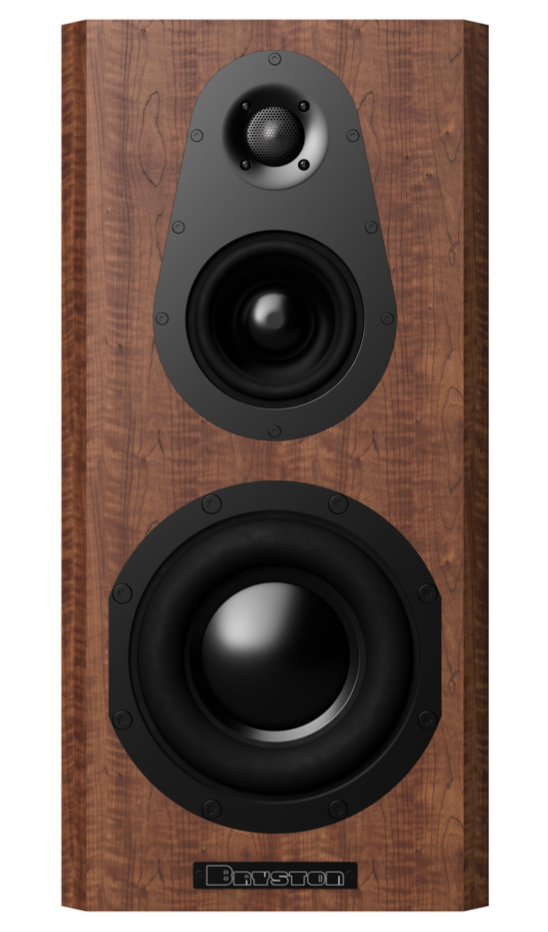
The loudspeaker under review weighs 42 pounds (each), and is basically 22.5 x 10.5 x 10 inches in dimensions. I say “basically” because the rearmost thirds of the cabinets’ side panels are slightly beveled. Therefore, in vertical cross-section or as a “footprint,” the loudspeaker is mildly Trapezoidal. (Also, the vertical front edges of the side panels have 45-degree bevels.)
A cabinet of 22.5 x 10.5 x 10 inches displaces almost the same volume as a “BBC Classic Two-Cubic-Foot Monitor.” But despite its rather imposing bulk, this loudspeaker is called the “Mini” T10.
My Rodney-Dangerfield-esque thought is… “A Mini, compared to exactly what?”
BTW, here’s Bryston’s own “Origin Story,” from its website
Bryston was originally a manufacturer of high-tech blood analyzers that began business in 1962. In 1976 James Tanner purchased a pair of Dayton-Wright electrostatic loudspeakers that his current amplifiers were having a heck of a time driving. So, using high-tech and sophisticated parts, we modified the amplifier and boy it sounded terrific! We then decided to build an amplifier with no holds barred, from scratch, using medical-grade parts. Bryston was born!
Well, Bryston is now a full-line loudspeaker manufacturer, and their top-of-the-line model bears an eerie resemblance to the Duntech Sovereign 2001, which was a very famous Super Speaker in the late 20th-c.
The Sovereign 2001 had two 12-inch woofers, two seven-inch midrange drivers, two two-inch tweeters, and one ¾-inch super-tweeter. Back in the day, they were Bob Ludwig’s choice for monitoring loudspeakers.
The line-topping Bryston loudspeaker of today seems to have more than a bit of Duntech 2001 in its DNA.
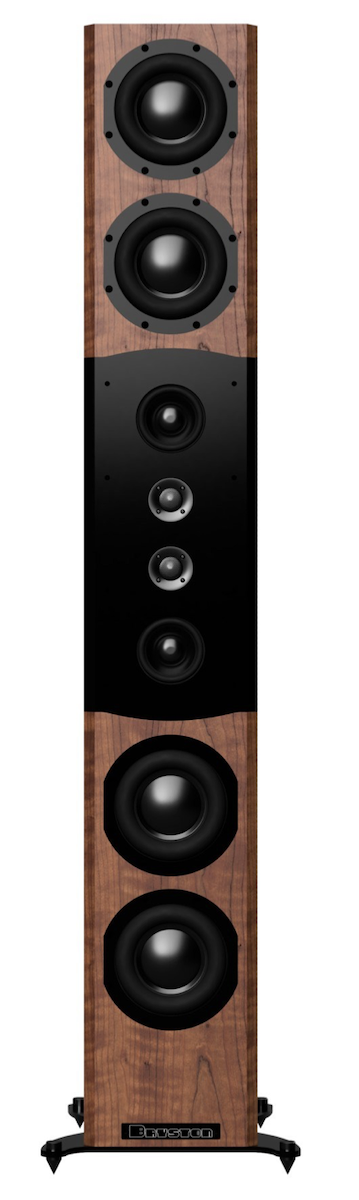
That’s Bryston’s Model T10 “Line Array,” and it stands six feet tall. Quad woofers, dual midranges, and dual tweeters in a quasi-D’Appolito array. Sure looks impressive. So, at least in comparison, I guess that the loudspeaker under review perhaps is a “Mini.”
Circa 2013, Bryston’s James Tanner wanted a fully active loudspeaker that he could use to evaluate Bryston equipment in his home. But it was only a personal pet project. He was not intending to get into the loudspeaker business. However (and I think that this is an oft-told tale), when friends and dealers heard the pet-project active loudspeaker, they urged him to commercialize the design. Bowing to economic realities, Bryston decided also to offer a passive version.
I respect Tanner for not trying to carve his entire world out with the pocket knife he inherited from his Grandfather, so to speak. By which I mean, he decided to partner with loudspeaker design and manufacturing experts (Andrew Welker and Ian Colquhoun, at Axiom Audio). Rather than attempting to Reinvent the Wheel.
Axiom Audio’s Research Laboratory, located in Dwight, Muskoka, Canada, in many respects replicates the famous acoustical laboratory and anechoic chamber at the Canadian NRC (National Research Council) in Ottawa, where Axiom’s founder Ian Colquhoun spent many years. So, therefore, one should expect to hear a loudspeaker the design process for which was rigorous measurement, rather than impressionistic listening. Build quality and wood finish are excellent.
Bryston’s passive-loudspeaker design approach is unique in my experience. The rear panel has space for a module that determines whether the triple pairs of binding posts are connected for one channel of amplification (per speaker), or bi-amping, or tri-amping (or fully Active). Each Bryston passive loudspeaker ships with four such modules.
Please note, between one thing and another, one thing being that the loudspeakers are shipped down from Canada, it is possible that one or more of the six binding posts on the rear panel might work loose. Therefore, all the posts need to be checked for tightness. Otherwise, the collars (or whatever you call the screw-down parts) on the unused binding posts might start to rattle.
Obviously, this design has been refined to a fare-thee-well. Furthermore, should the urge or itch to Upgrade beckon, instead of selling or trading-in the loudspeakers at a loss, you can move up to bi-amping or tri-amping. Clever!
A lame attempt at a witticism I from time to time indulge in is that, in the fullness of time, I expect the Catholic church to recognize me as the Patron Saint of “Confirmation Bias.” Ha ha. If that phrase is new to you, Confirmation Bias boils down to, “You expected to hear a difference, therefore you did; regardless whether there really was a difference.”
Mini T10
Thinking that it made the most sense for break-in to connect the speaker cables to the Woofer terminals on the Mini T10’s rear panel, that’s how my listening started. After a while, I moved the speaker cables to the Tweeter terminals, and I believed I heard a minutely small difference.
Then, after more break-in, perhaps the tweeters were ever-so-slightly more efficient and therefore slightly louder. Hmmm. So, I moved the speaker cables back to the Woofer terminals, and the timbral balance seemed ever-so-slightly more delicate or refined.
Or perhaps it was simply because, for the woofer, being definitionally less efficient than the tweeter, the shorter signal path was better. BTW, my test track for this was Cat Stevens’ “Where Do the Children Play?” (from Tea for the Tillerman (1970)). The over-dubbed self-harmonies were rendered slightly more clearly. (QOBUZ 24-bit/192kHz hi-res streaming. That amazing hi-res track is a great example of why QOBUZ is such a bargain!)
Thinking about Bryston’s corporate history and brand identity reminds me of the one class I took in Marketing. “The Marketing Mix,” taught by Steve Triedman, was one of the best-taught—and most impactful—courses I ever took. Steve started the first meeting of the class by telling us that if we only remembered one thing from his course, it should be this:
In the entire history of the human race, most of the people who bought
quarter-inch drill bits did not actually want quarter-inch drill bits…
they merely wanted to make a quarter-inch hole in something.
SHAZAM! Meine Weltanschauung was thoroughly shaken. I might as well have been a Martini being made-to-order for James Bond.
The Take-Aways:
· Don’t focus on your product! That’s “Me Marketing!”
· Focus on how your product meets your customer’s needs. That’s “You Marketing.”
Because if you think that you are in the Drill-Bit Business, instead of being in the Hole-Enabling Business, you might be asleep at the wheel. I imagine that, as Henry Ford was getting his assembly line ironed out and ready to go, there were some Buggy-Whip makers who really believed that they were permanently in the Catbird Seat.
Over the course of the class, Steve introduced us to an awful lot of advertising and marketing initialisms and jargon, such as “FFB,” “AIDA,” “CTA,” and “USP.” USP became a favorite of mine. It means “Unique Selling Proposition.” The USP is what makes your product stand out from the General Onslaught, as American Poet William Carlos Williams once put it.
I think that I am on very solid ground when I state that, as far as I can tell, Canadian audio company Bryston Ltd.’s Unique Selling Proposition is that, since Day One, the 20-year duration of the warranty on Bryston audio gear has been far longer than the average duration of each of Elizabeth Taylor’s eight marriages (4 years), or the average duration of each of Judy Garland’s five marriages (5 years), or the average duration of each of Zsa Zsa Gabor’s nine marriages (6 years). Way longer!
In researching background for this review, I stumbled upon what must be one of the most backhanded “compliments” in the history of Consumer Electronics. Most audiophiles are aware of the scandal some years back when it turned out that the Lexicon company, best known for its professional reverb units, decided to put an Oppo Universal Disc Player (that retailed for $500) into a new enclosure or cabinet with Lexicon’s logo on it, and raise the price to $3500. Yikes. (There was reportedly also some Monkey Business about the THX Certification.)
The $3500 Oppo is widely known. What is less well-known is that when Lexicon decided it needed to add amplifiers to its offerings, they bought and re-branded… Bryston amplifiers.
So, now we all know that “Imitation” is not “the most sincere form of flattery.”
“Rebranding” is!
(Also known as "Badge Engineering." As in, the only engineering the lazy company did was on the new badge.)
Trivia Bit: When Harman International decided to shut down all operations in the Northeastern United States, three outplaced Lexicon employees banded together to build a business… and to do it right. That business is Bricasti Design.
However, while I love a “cute/hooky” introduction as much as anyone else does, I must admit I might be underselling Bryston. The fact that their 20-year warranty never drove them into bankruptcy (or whatever they call it in Canada—”Administration”?) is remarkable. But there is more to Bryston than their warrantees. (Note, Bryston’s digital gear has a 5-year warranty. I think that that’s understandable. And it’s way better than 90 days or 12 months, however you slice it.)
EVERYTHING BUT THE PROVERBIAL KITCHEN SINK
Today, Bryston stands nearly “all by its own self” in offering all of: phono stages, a CD player, digital streamers, analog and digital amplifiers, and active and passive loudspeakers. No cowards, they. (Yes, I am aware that McIntosh does most of that, too.)
Bryston organizes its loudspeaker offerings into three menus (or tiers):
• the Model T loudspeakers, which are characterized by a high-tech approach;
• the Model T10 loudspeakers, which are characterized by a “higher-tech” approach; and
• the Model A loudspeakers, which offer a “Classic” approach.
Prices run from $2590/pr. for the Tiny T10 bookshelf loudspeakers, to $19,990/pr. for the Model T10 Tower (which is a “Quasi Line Array”) speaker. (These are U.S. prices.) In addition, Bryston offers four Center Channel speakers and three Subwoofers. All of which can be ordered as Passive or Active, in five colors of wood stain, or in your choice of custom finishes.
For my review, I requested the Mini T10 “Bookshelf” 3-way loudspeaker, with an 8-inch woofer ($5,990/pr.). Even though, at 42 pounds each, I have trouble imagining a bookshelf that would happily bear the burden of two of them.
My choice was driven by the similarity of the Mini T10 to the so-called “BBC Classic Two-Cubic-Foot Monitors.” Speakers such as the Spendor SP1, with a form factor of, height of two feet, and width and depth of one foot. According to ancient folklore, BBC engineers needed a medium-format monitor, because the bass energy in the music of Bob Marley and the Wailers was just too much for the BBC’s smaller LS3/5A “Shoebox” remote-van recording monitors.
And that’s the basis of my longstanding contention that a “Two-Cubic-Foot Monitor” is likely to be a Pareto-Optimal/Sweet Spot product, with a winning combination of capabilities, size, and price. The Mini T10’s claimed -3dB point is 33Hz; efficiency is stated as 86dB. Maximum SPL is 112dB. Crossover frequencies are stated as 250Hz (woofer-to-midrange) and 2000Hz (midrange-to-tweeter). Those strike me as sensible, even conservative, points.
Focusing for a moment on the Mini T10’s claim of, “-3dB down at 33Hz,” Bricasti’s new S7 floorstanding, 3-way-with-double woofers loudspeaker (which is, at present, still in prototype form) claims -2dB down at 32Hz… and has a US MSRP of $36,000.
Ahem. Pareto Optimality compared to the Bricasti offering would make the price of the Bryston loudspeakers US$7200, not almost $6000. Therefore, as long as the differences of one Decibel and one Hertz are essentially meaningless to you, the Bryston actually is a “Better-than-Pareto-Optimal” choice. (In terms of economics, and all other things being more equal than not.)
Of course, the two loudspeakers are very different in design, and will sound very differently in a room. The Bricasti’s higher price is completely justified by the size of its cabinet, the use of two, 7.5-inch Thin Ply Carbon Diaphragm (TPCD) “TeXtreme” woofers; the use of the first-ever TPCD 3-inch dome midrange; and the use of a Beryllium tweeter with a Moving Mass of one-tenth of a Gram. Obviously, computing and comparing Pareto data is no substitute for an audition!
HOW LOW DOES IT GO?
The Mini T10’s woofer is in a ported enclosure. The port is at the rear, and is fluted, in the sense that the inner surface of the port tube has small convolutions (or, if you prefer, it is a bit lumpy). I gather that the intent is to make what would otherwise be pistonic motion of the air column more complex, in the interest of less “port noise.”
BTW, the Mini T10’s woofer has the most robust surround I have ever seen (in proportion to driver size; and, on a woofer rather than a subwoofer). The Mini T10’s woofers look for all the world like they could serve as tires on a riding lawn mower. The midrange is a cone, not a dome. The tweeter is a Titanium dome, with a mesh screen to assist dispersion. The tweeters did not exhibit any of the excess sibilance that is sometimes associated with metal tweeters.
There is no provision for grilles, as far as I know. There is a logo plate at the bottom of the front panel. If the logo’s style is too “1960s Peter Max” for you, you can remove the logo plate and fill in the screw holes using “Wood Filler Crayon Sticks” such as you can find on Amazon.
As I just said, I think that a “Two-Cubic-Foot Monitor” is likely to be a Pareto-Optimal/Sweet Spot product. Here’s why. I think that most of us are tempted to over-rely upon raw specification numbers, forgetting about the musical context.
I think that it is fair to say that most of the music that most people listen to today is Popular or Rock music with the usual, “Beatles-Based” instrumentation of guitars, bass, and drums, and sometimes keyboards. Obviously, there are exceptions. Madonna’s Ray of Light “Electronica” album has some very deep synth bass. Pipe-organ fans love very deep bass.
(I have to interrupt here, JM: much of today's popular music is synth based and much of it goes way down electronica deep. Guitar, bass and drums is mostly a spent force_ed.)
That said, the lowest pitch usually heard from “Beatles-Based” instrumentation is Low E = 41.2Hz (Equal Temperament tuning). That is the lowest string on a conventional, 4-string electric bass guitar.
In contrast, the center of the energy output of a bass kick drum is circa 80Hz to 120Hz, which just happens to be the resonant-frequency band of a mature adult male human’s chest cavity. That is why a loud kick-drum thwack feels so impactful.
Furthermore, that 41.2Hz pitch from the electric bass is technically a “Weak Fundamental.” That’s because the Wavelength of 41.2Hz is 27.4 feet. That’s nearly twice the distance from a basketball-court Free-Throw Line, to the Backboard. Think about that!
Even a quarter of 27.4 feet (6.8 feet) is far longer than the speaking length of an electric bass-guitar string. The result is that the first-octave harmonic of electric bass guitar 41.2Hz, which is E = 82.4Hz, is at least +6dB louder than the Fundamental. Because the Low E string is too short to be able to fully support the fundamental pitch. +6dB is perceived as being twice as loud. Or, in cases, louder.
Here’s a grab of an Amadeus Pro II Digital Audio Workstation software-generated Spectrum of the final electric bass note that John Atkinson plays on the Stereophile Channel ID and Phasing test tracks. Of course it is Low E = 41.2Hz. The point being that the octave harmonic is much stronger than the Weak Fundamental. The Bryston speaker handled 41.2Hz very convincingly.
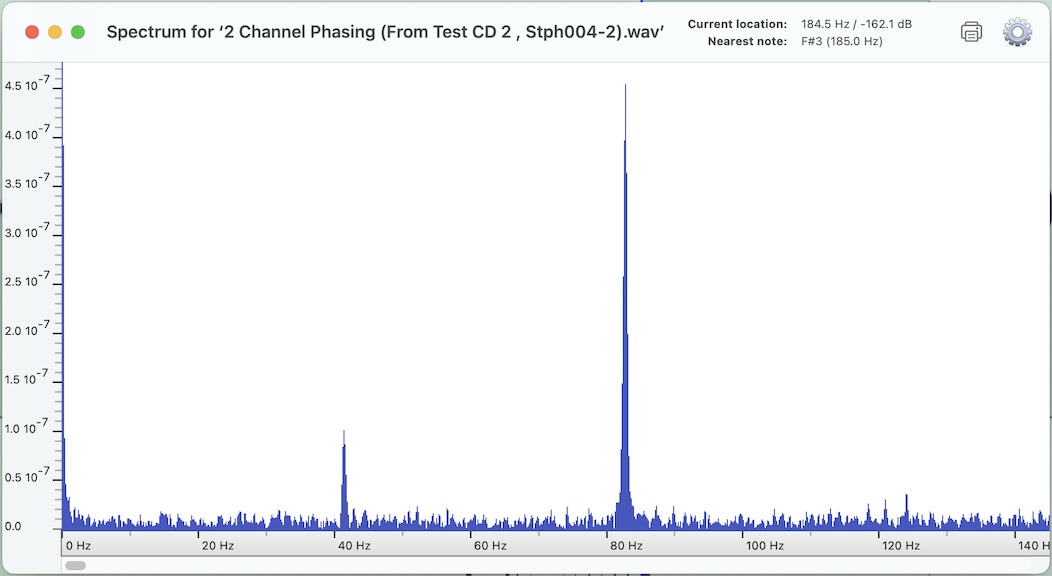
Pondering all that for a while, I think it is rational to conclude that if a loudspeaker is basically Flat at 41.2Hz (keeping in mind that a loudspeaker in a room usually benefits from some bass gain anyway), it should handle the bass requirements of most of the music we encounter. But of equal importance is the ability of the woofer to clearly and cleanly sound 41.2 and 82.4Hz (and so on, up the harmonic profile) at the same time.
With a claimed -3dB point of 33Hz, my educated guess is that, at 41.2Hz, the Mini T10 is only 1.0 or 1.5dB down from Flat response. Either datum is at the threshold of perception. And, there is usually Room Gain.
LISTENING
Here’s a YouTube of a Mini T10 playing one of my favorite bass test tracks, Jane Monheit’s “Honeysuckle Rose.” Bassist Christian McBride almost steals the show:
I think that Bryston’s Mini T10 admirably fills that bill. The sound is very coherent from bottom to top, with admirable integration of the midrange and the tweeter. Dynamics were excellent. Imaging was excellent.
For circa 40 years, I have followed a strict routine, whenever I change a sound setup. I play the first two tracks of Stereophile’s Editor’s Choice test-track CD. Those tracks being, Channel ID and Phasing.
The reason I always rely upon those tracks is that, ages ago, my then girlfriend and I were at Ocean State Audio in Providence, basically hanging out. The owner demonstrated a new pair of loudspeakers. I recall that they were “Hybrid” speakers from Apogee Acoustics: Ribbon drivers for tweeter and midrange; but a conventional woofer, in a conventional box enclosure, to handle the bass. I was unimpressed; but I simply concluded that they were just not my cup of tea.
But my girlfriend said to the store’s owner, “There must be something wrong with your setup. It is really wrong.” He did an eye-roll. But then he did check the setup. Oops. One speaker was connected out of phase. Ouchsies.
So, first I make sure that I have not made any amateur set-up goofs.
Then, almost as importantly, I carefully listen to the overall imaging differences between the “In-Phase” and “Out-of-Phase” electric-bass Phasing riffs. I have found that however wider or larger that difference is strongly correlates with a loudspeaker’s phase correctness.
On the Mini T10, the difference was dramatic. Not the greatest ever… but impressive, at only six thousand clams.
My go-to listening for this review was a QOBUZ playlist I put together of male vocals, mostly Pop and Rock. But also some Country and Folk, and some Classical. The playlist’s title is “And Now, for the Gentlemen.”
A few outstanding impressions:
• On “Now and Then” (from the album Cold on the Shoulder (1975)), the timbre of Gordon Lightfoot’s voice was rendered as truly as I have ever heard from a conventional cone-and-dome loudspeaker. I think that this is one of Lightfoot’s most poignant songs, in that he at least tries to reach out, rather than just calling it quits like he usually did.
By the way, the final two pitches that Lightfoot sings, on the word “then” (E to F#?) strike me—at least emotionally—as some kind of a Church-y “Roman Cadence.”
Not an “Amen” cadence; some other kind. Perhaps a “Perfect Authentic Cadence.” Or perhaps it’s a sophisticated Deceptive Cadence. Or just a “7 - 8 Ending.” Music-Theory Experts, please Chime In!
Perhaps, as he wrote that song, Lightfoot was beset by painful recollections… of a church wedding. (As a Boy Soprano, Lightfoot was a prize-winning church chorister.)
• Al Jarreau’s scat-singing on “Letter Perfect” (the opening track from the album Look to the Rainbow—Live in Europe (1977)) was very convincingly articulated. First class. What a wonderful album!
• Marvin Gaye’s title track from the album What’s Going On (1971) is a very complex mix. The music is overlaid on top of the cinéma-vérité sounds of a robustly enthusiastic social gathering. The Mini T10 handled those “Inner Voices” very well.
Here’s a Trivia Bit for you: Marvin Gaye was the first male vocalist to have three Billboard No. 1 singles from one album (albeit, on different charts). Those being the title track to What’s Going On; “Mercy Mercy Me (The Ecology);” and “Inner City Blues (Make Me Wanna Holler).”
Auditioning other familiar tracks seemingly at random, I eventually figured out that I was choosing mostly sad or at least pensive or thoughtful songs, in the vein of Lightfoot’s “Now and Then.”
Songs such as Mickey Newbury’s “Three Bells for Stephen,” and Phil Ochs’ “Pleasures of the Harbor” and “Cross My Heart.”
Also, HIGHEST RECOMMENDATION, Emilia Jones’ heart-stopping cover of Joni Mitchell’s “Both Sides, Now,” as made famous by Judy Collins (from the soundtrack to CODA—The Children of Deaf Adults (2021)). (The easiest way to find this track on QOBUZ is to search for “Emilia Jones” and select the CODA soundtrack album.)
Wikipedia tells me that Joni Mitchell gave Emilia Jones’ movie cover her approval. Wow. Just watch and listen to the YouTube!
I challenge you not to “tear up.” I can’t watch it without crying. If I were being exiled to that Desert Island, with only one YouTube to watch… this one might be it.
Emilia deserves her more than 9 Million (total, across multiple uploadings) YouTube views. She also obviously deserved an Oscar. (I am aware that the 2021 film itself was awarded the 2022 Oscar for “Best Picture,” as well as awards in two other categories.)
Astute viewers might catch that, of the 500-plus comments upon that YouTube, the one from “Yr Hmbl Srvt” is pinned at the top. Perhaps because I am a shameless name-dropper.
Pondering all that, I think it might be the case that the Bryston speaker did an unusually persuasive job of presenting the music as a whole, and not just as “the sum of its parts.” The Mini T10 excelled at delivering the “Paradoxical Pleasure” that sad music is.
I used my Cheap-n-Cheerful Parasound integrated amp for break-in and preliminary listening, with fairly generic interconnects and speaker cables. For critical listening, courtesy of Ernie Meunier’s Argent Pur Audio, I used pure-silver loudspeaker cables (US MSRP $3875/2.5m) and Argent Pur’s IBIS GaN-FET integrated amplifier ($2975/150Wpc). It’s almost unnecessary to tell you that everything the Mini T10 had done well, it then did better.
That said, as nice as the IBIS was, for me at least, it did not have the “WOW”-Factor reaction its larger stablemate the Argent Pur DUO dual-mono stereo version provoked ($5300/250Wpc).
But isn’t that the way things should be? “You Spent More, So You Got More”?
IN CONCLUSION…
I found the Bryston Mini T10 to be a thoroughly enjoyable loudspeaker, with an impressive pedigree, and very fairly priced.
Just think of it as another BBC LS3/5A clone—but with a Titanium tweeter and a lot more bass.
(I know, the LS3/5A’s woofer is 4.5 in.; but the Bryston midrange is 5.25 in. Not a big deal.)
However, at the same time, I will not go as far as to say that I expect that everyone will be as enthusiastic as I am. Why? Because I think some people will want a loudspeaker with, for lack of a better phrase, a more outgoing “Personality.”
More slam in the bass, more zing in the treble. That sort of thing.
So, as always, you should arrange an audition.
# # #
Specifications
Min. Amp Power 20 Watts
Max. Amp RMS Wattage 600 Watts
Freq. Resp. +/-3dB 35 Hz-20 kHz
Impedance (Ohms) 4
SPL in-Room 1w/1m 90 dB
SPL Anechoic 1w/1m 86 dB
Crossover: 250 Hz & 2 kHz
Tweeter: Single 1" Titanium
Midrange: Single 5.25"
Woofer: Single 8"
Dimensions H W D (inches):
22.5 x 10.5 x 10
Dimensions H W D (mm):
71 x 267 x 250
Weight (lbs) each: 42
Weight (kg) each: 19
Manufacturer Information
Bryston LTD.
2885 ON-60
Dwight, Ontario
Canada P0A 1H0
(The web site has a form to send a message.)
1-800-632-8217