
Can GaN Cell Technology Plus Class D Finally Climb to the Head of the ‘Class’?
AGD Duet Monoblock amps
Over the last 5 years, advanced technology has found its way into the high end audio world through two specific breakthroughs, which has not only advanced the goals of better audio but has challenged designers to adjust their thinking about introducing new products that contain this advanced technology.
Specifically, I'm referring to the optical phono cartridge and all its associated specialty preamps and GaN cell based class D amplifiers and preamps. Many readers know that optical phono cartridges are not new, per se, that Toshiba among others produced them in the 1970s, but that advancements in LED technology has again made them both popular and reliable.
In both cases the results of these advanced technologies have shaken the industry but, as vinyl is a niche product affecting a certain class of audiophile, the Gallium Nitride {GaN) based electronics can hit the entire spectrum of the high end audio world.
This hobby of ours will always have its naysayers and luddites who will tell you that the best gear they owned was the “wattchamacallit amplifier built in 1910!”
That will never change as it is part of human nature and we, as audiophiles, can thank these naysayers for keeping analog alive during the dark early days of digital audio. In fact, it is crazy to think that the continued love of vinyl sustained enough commercial interest that it kept the market not only alive but allowed innovators to refine all the parts of this unique part of the audio world (ie: turntables, tonearms, cartridges and phono stages) that, 45 years after the introduction of the CD, which was supposed to wipe out this form of music reproduction, analog has never sounded better.
In this regard, optical phono cartridges are a great alternative that will appeal to many but will not replace MM, MC and Moving Iron options.
Well. I'm here to tell you that GanN based class D electronics are the next step to better audio reproduction with the added benefit of creating a class of electronics that are compact in size, weight & energy consumption.
The mono block amplifiers I am reviewing here, The AGD Duet monoblocks are 9” long, 4 1/2” wide, 3 ½” high and weigh 8 lbs. each and draw 2 watts from the wall!
First, however, let's go back over 50 years to the early days of the high end. The year was 1972 and the hot amplifier was the Phase Linear 700.
This was, at least in my world, the first super amp. Yes, Crown amps were available but were primarily used in PA systems. In fact, Crown got a bad rap for the newly minted audiophiles who grimaced at the harsh, bright and two dimensional sound of the Crown amps when used in home stereo applications.
In 1972, the hot combo was a Phase Linear amp and Phase Linear 4000m preamp coupled with a pair of Ohm F speakers These downward firing full range speaker cones were power hungry but sounded incredible, especially at parties!
In those days, your dad may have had a McIntosh and a pair of AR3a speakers but that was for classical and jazz. Us ‘youngin’s’ rocked out to Phase Linear and Ohm Fs, Bose 901’s or JBL L100 loudspeakers.
Thus began the equation of amp size and power.
Soon to follow were SAE, Ampzilla, then later Levison, Krell…well you get the picture.
As far as solid state amps were concerned, bigger and heavier meant better!
There is some truth to this especially in regard to power supplies and in the case of class A amplifiers, larger and larger heat sinks.
In 1972 no one I knew talked about class A, class AB etc.
The original Phase Linear ran in class B only, Its smaller sibling, (the 400) ran in class A/B.
I didn't know then about any class distinctions or that there was a class C and a class D.
I really didn't know anything except the amps looked really cool, weighed in at 45 lbs. …and (at least in those days) it was big!
As time marched on solid state power amps got bigger and heavier,
While working at Lyric Hifi In 1994 Levinson introduced the No. 33 mono block amplifiers. . It was the size of a small radiator, came in at approximately 400lbs, had a power rating of 300 WPC into 8 ohms and continued to double as the ohms dropped.
Tube designers joined in the size and weight wars as well and by 2005 Audio Research unleashed the model 610T mono blocks using 26 tubes that weighed in at a bit under 170 lbs each!
So Today Where Are We in the Amplifier Sweepstakes?
At last Spring's AXPONA show in Chicago two trends stuck out:
The super sized (and priced) mono and stereo amplifiers— i.e. The Gryphon Apex (405 lbs in stereo, or used as mono blocks 810 lbs) $100,000 each. Boulder 3050 355lbs. ($306,000). D’Agostino Relentless Epic 1600 Mono block, 570lbs. ($385,000). Pass Labs XA 300.8 mono blocks double chassis 300 lbs total weight per channel pr ($95,000 pr.)
And super sized (and priced) integrateds, many offered by the same companies who make the behemoths for those who expect quality as close to separates as possible but need to downsize for various reasons.
Luxman, Accuphase, Pass Labs, CH Precision, Constellation, Boulder, Gryphon, T+A, D’Agostino, McIntosh, Audio Research, Levinson, Esoteric, among others all offer one box solutions, some with phono stages and streamer/ DAC options because this is what the market demands
But what if you really want all the advantages of separates but in small, light and attractive packaging that also won't break the bank?
Welcome AGD Productions, which manufacture Gallium Nitride (GaN) FET’s, with class D technology, bringing extraordinary high end amps and preamps into the 21st century!
Is this the sonic equivalent of the meteor wiping out the dinosaur?
It is way too early to tell but I will tell you this:
Go to any audio show where this technology is on display, or go online to the numerous testimonials from influencers/reviewers and in some cases, listen to the comparisons or order a pair of these amazing amps and replace whatever you have, be it solid state or tubes and sit back and be amazed.
My reference amp is a Luxman M-10x, a 105 pound class AB amp which I really like. This has been my new reference for the last 6 months.
I was so impressed when I saw the AGD amps, I contacted the company and received for review a pair of AGD Duet monoblocks.
These small amps (8 lbs. each) are rated at 150 wpc into 8 ohms/ 300 wpc into 4 ohms.
The pair comes beautifully packaged in a flight case complete with a pair of 2 meter custom made high quality power cords.
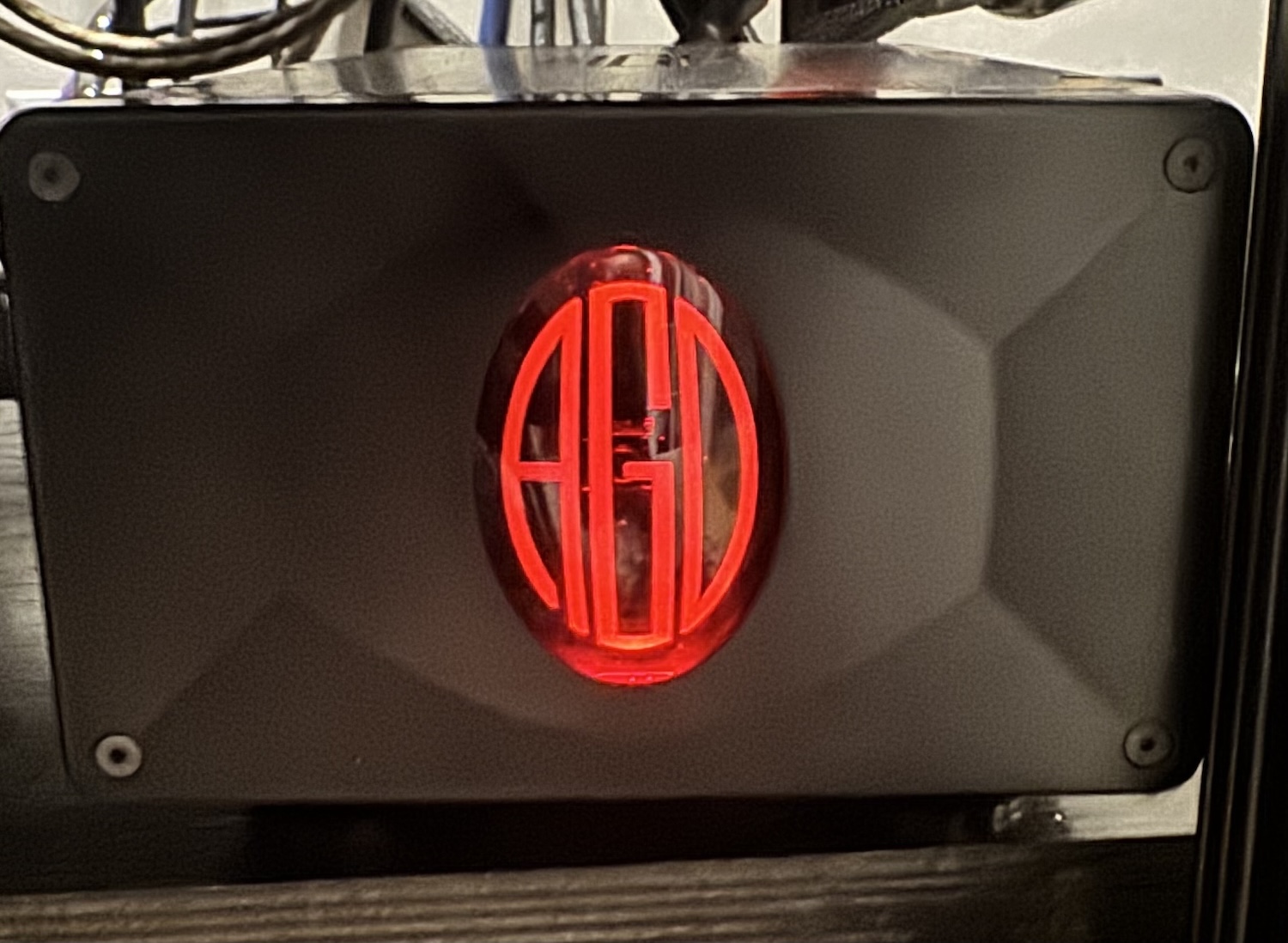
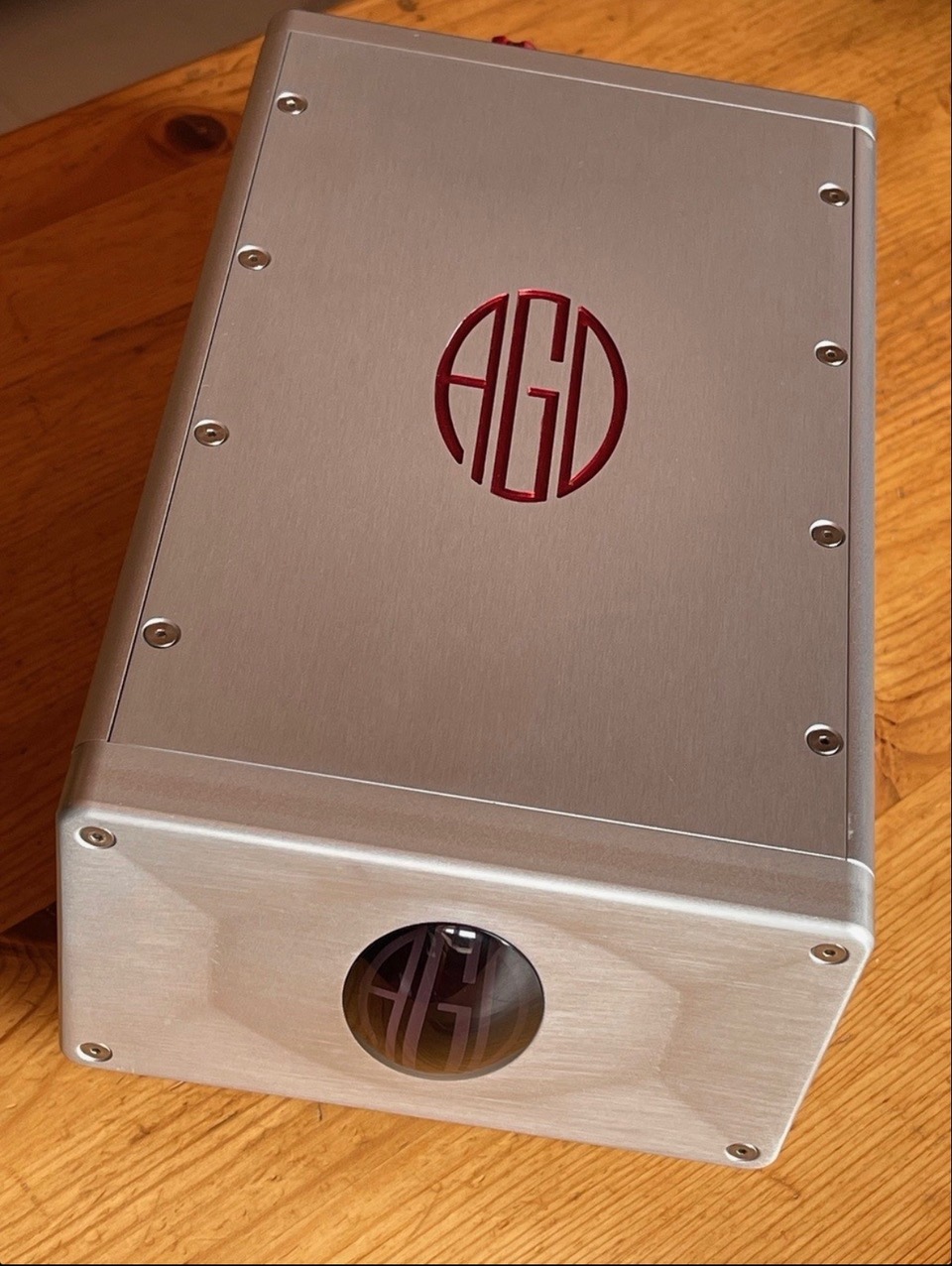
The front of the units contain a huge oval pushbutton that lights up in red with the AGD logo when the amps are turned on. The amps, being only 10 inches long and 4 inches wide have a very small footprint and I placed them on shelves 1 meter away from my speakers.
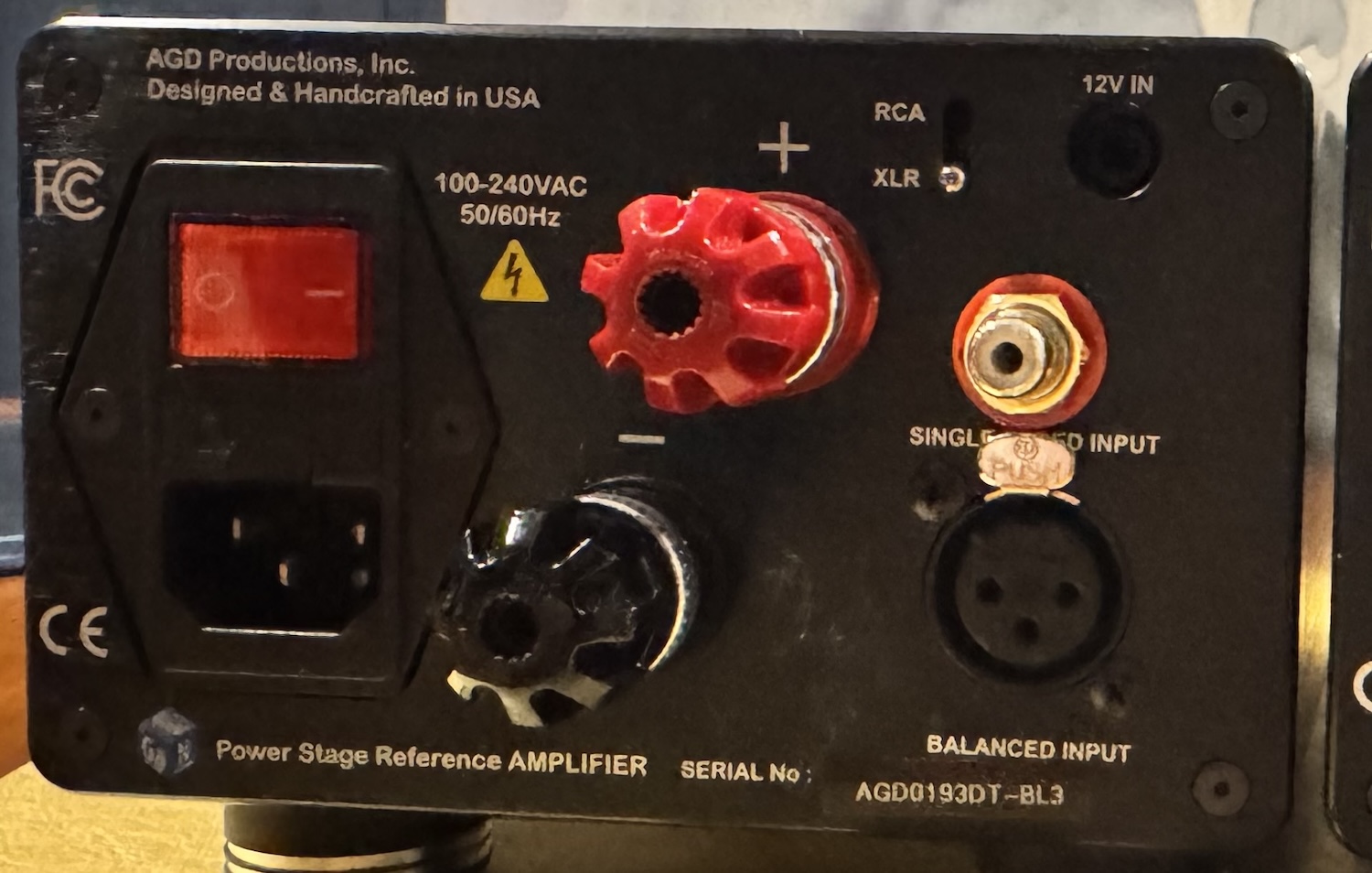
The rear of the mono blocks have an on /off rocker switch, one RCA and 1 XLR input (swithable), a 12v trigger input and 1 pair of large high quality WBT speaker cable posts that take either spades or banana plugs. The top plate of each amp has the AGD logo etched in red.
Each unit has 8 X 4-40 hex drive 1/16” screws on the top plate that can be removed by the owner when updated circuit boards become available thus allowing the value and the lifespan of ownership to be greatly enhanced.
I placed them 1 meter away from my stand mounted Franco Serblin Accordo Goldberg speakers. connected the speaker cable, turned the amps on and streamed music overnight to get things warmed up although Gan FET amps are really ‘instant on’ but AGD tells me to let the unit run for 30 minutes to reach full temperature stability and uniformity. As a creature of habit I played CD’s for 24 hours anyway prior to listening critically.
When I was ready to really listen, I took out my new 45 RPM copy of Janis Ian’s Breaking Silence (AAPP 027-45). This recording has some of the best bass on vinyl and I wanted to start with that. If there were any doubts about what these amps could do, they were ameliorated almost immediately.
I then played an SACD of The Very Best of Acoustic Alchemy. This music has a sonic spectrum that really pushes speakers with a very broad dynamic range and again the entire system i.e. the Duets, Luxman C-10X , preamp, Luxman D-07X SACD player and speakers performed as a well tuned unit.
IF you didn't notice these diminutive AGD Duets amps on the shelves and just saw the huge Luxman sitting between the speakers you wouldn't be faulted if you thought that the music was coming from the Luxman.
Speaking of the Luxman M-10X , I bought it because it sounded great and it ran much cooler than my Pass Labs 30.8’s which were impossible to use during the summer months in NYC. My thinking was “well if these AGD’s are simply OK, I'll buy them because I can use them in the summer time”
They were/are better than just OK. They are, in my system, a revelation.
They are however, as different from the Luxman amp as a direct drive turntable is from a belt drive. Luxman gave a more laid back presentation where the Duets sounded more immediate and dare I say, cleaner. There was less sonic character from the Duets which brought back that cliche that the best amps should just be a ‘straight wire with gain’.
I decided when I started reviewing, that I would never say that this or that was the best. I’ve been around long enough to know that this year's “Gobsmaked” is next year's “ho-hum” so I will just say that they both do a great job but in direct comparison, the M-10X which is a pretty neutral amplifier (compared to say a PassLabs Class A amp) now sounds softer and warmer and so, to my ears, the AGD Duets are the most uncolored amps I have ever owned (oops, just gave away the conclusion).
The bass coming out of my Franco Serblin Accordo Goldbergs while listening to Christian McBride’s “Afrika” (on his album Conversations With Christian) was full and tight, The mid band retained all the tonal color and transparency I was used to hearing and the highs were not brittle but smooth and non fatiguing.
The speed of the drum fills on Sonny Rollins' Saxophone Colossus album was sharp, fast and thrilling.
The Duets cost $11,500 pr. This is not inexpensive but given all of the benefits, sonic and physical that's a bargain in the real high end amp world.
Never has the difference been as stark as it is now.
This is where products like the AGD GaN FET amps are perfectly suited.
To those who are unaware of Gan FETS, you are probably aware that most solid state amps use MOSFETS which have been used since the advent of solid state electronics going back to the mid 1950’s.
It took the advancement of this circuit topology to finally realize what a class D product could deliver.
The promise of Class D was about its super efficiency but it had its sonic drawbacks when used in the world of high end audio and that gave it a pretty bad rap over the last several years. Most everyone reading this knows or has heard what the sonic problems were.
It took the development and proper application of GaN (Gallium Nitride) cell technology, which uses a wide bandgap semiconductor material to power electronics, enabling faster switching, higher efficiency, and smaller, lighter devices compared to traditional silicon to, in my opinion, fully deal with those problems and solve them.
Bottom line, if audio quality is your main concern, these AGD amplifiers deliver beyond your wildest imagination. At least they did that beyond my wildest imagination.
As I was coming to terms with this new innovative technology, listening and comparing the quality of audio reproduction in my studio, I started to wonder about the future of 200 lb. amplifiers costing hundreds of thousands of dollars.
If one can attain the same (or better) results from devices that weigh no more than 10 lbs and can be manufactured for much, much less, maybe this is what can save our industry or at least propel it forward into the 21st century.
I fully get the fact that there will always be a customer who will only listen to tube gear and there will always be a customer who wants the biggest, most expensive audio products. That won't change.
I can still walk around the audio shows and admire the insanely sized and priced hardware but I challenge everyone to audition the AGD amplifiers and not be blown away as to where this alternative technology is going, which will be into the homes of many very serious audiophiles who never thought it possible.
Conclusion
If downsizing your system is on the horizon for you, but you also want the benefits of separates in boxes that are lightweight, easily transportable, cool running and super energy efficient—yet you still wish to maintain the highest high-end audio sound quality, you owe it to yourself to give these remarkable amps an audition.
I reached out to Alberto Guerra (The AG) of AGD to get a fuller picture and better understanding of how GaN cell technology may cause a revolution in the audio world—if it hasn't already done that.
Jay Jay French: We’ve all heard this cliche in the audio business that the perfect amplifier should be nothing more than a straight wire with gain.
Do you believe that gallium nitride technology gets us closer to that goal than we ever have been before? And how much farther do we have to go before we reach that perfect description?
Alberto Guerra: The combination of two technological trends (Gan FET, class D) that brings what was once the ideal goal of a perfect amplifier closer to reality.
CLASS-D and GaN are these two technological trends.
The latter is in the semiconductor space, and over time, we will see more advanced GaN MOSFETs capable of switching at higher frequencies while also reducing size and losses, hence even more efficient amplifiers.
Then there is the CLASS-D topology, which is also evolving toward a configuration in which the audio signal remains in the digital domain, with direct conversion from PCM to PWM, thereby removing the need for DAC stages and additional analog PWM converters, possibly with open-loop or minimal negative feedback. These are the incremental evolutionary steps I believe will deliver the ideal amplifier.
JJF: Before GaN cell Technology, what was your favorite form of amplification? Tubes? Solid state?
AG: My initiation into music and the “mystery of electronics” began with my father's acquisition of a fantastic 1967 Grundig Stereo Console, (by the way, I recently fully restored that amazing wood-made console with its excellent FM STEREO radio and Garrard mechanical automatic turntable).
My first audio system was a graduation gift from my father and included a Thorens TD166 turntable, an AKAI 400DS open reel tape recorder, and a Hirtel 2020 amplifier, an Italian brand from the 1970s. To complete the system, I built a pair of three-way speakers myself. That setup, along with the very same components (repaired and restored in time), still operates flawlessly today—both at my home and at some friends’ places. Back in those days, the ultimate dream was to own a Marantz amplifier, AR speakers, a Revox or Technics open reel, or a Denon turntable. However, these products were beyond reach for a high school student with limited finances, making the journey toward the ideal system a long and a memorable one.
JJF: When did you realize that Class D years ago had this ability, and you just needed to perfect it?
AG: I developed a serious interest in this area when I had an epiphany during the development of GaN technology while working at International Rectifier (now Infineon, following the acquisition that occurred in 20215).
Initially, my interest in amplification was shaped by the available technologies—tubes and solid-state systems. The landscape changed dramatically when I had a pivotal experience during the development of GaN technology at International Rectifier.
The performance we observed in early GaN MOSFET prototypes during the few years of the development stage of the new technology, far surpassed that of the best silicon-based MOSFETs. This inspired me to pursue a somewhat Quixotic goal of removing the stigma linked to Class-D amplification, a topology often considered an unforgivable sin when used in high-end audio products.
With the advent of GaN technology, I realized that achieving the perfect amplifier was within reach. I was motivated to eliminate the need for bulky heatsinks, the short lifespan of vacuum tubes, and other outdated technologies still prevalent in the audio world. Moreover, I wanted to challenge the long-held beliefs among audiophiles regarding the unique sound signature of tube amplifiers. I have always been driven by a passion to blend perfection and beauty in the art of audio reproduction. In the high-end audio market, many top designers created stunning products designed to deliver the best possible music experience, and I also believed I could contribute a bit, just like these renowned engineers and entrepreneurs have done with their exceptional products, building lasting brand reputations. I too have dreamed of offering innovative solutions and exceptional audio experiences.
JJF: While this may sound like a crazy exaggeration, do you believe that the development of GAN cell technology will be the sonic equivalent of the meteor that wiped out the dinosaurs? Will this change the entire solid-state amplification business fundamentally?
AG: Well, no, that is certainly not going to happen. The power range of amplifiers in both the consumer and pro-audio markets is so broad that there will always be application-specific solutions with products of varying characteristics, tailored for each segment. For example, while GaN technology brings remarkable advantages in efficiency, speed, and sonic performance, there are scenarios—such as very high-power industrial amplifiers or cost-sensitive entry- level consumer products—where traditional silicon-based designs may remain preferable due to their established supply chains, lower costs, or compatibility with legacy systems. GaN will continue to expand in the higher-end and professional audio markets, where its ability to deliver greater clarity, efficiency, and compactness is most valued. Furthermore, GaN’s superior switching speeds and thermal performance make it an increasingly attractive choice for modern power supply designs across virtually all power levels, from compact desktop units to large-scale professional equipment. However, it’s important to recognize that audio and power electronics are fields defined by diverse needs and priorities; as such, both GaN and silicon-based solutions will coexist, each serving the requirements of their respective niches. Over time, as manufacturing processes mature and costs decrease, GaN may see even broader adoption, but it is unlikely to entirely supplant other technologies across every application area.
JJF: Is this particular technology available only to you through patents, and not available to other companies? Or, will other companies be able to adopt this kind of circuitry in their amplifiers and preamps?
AG: Yes, of course. After we introduced the first GaN-based Class-D amplifier in 2018, several other brands quickly followed suit in the early 2020s, and today, the marketplace includes a growing number of GaN-powered amplifiers. For instance, other companies have all developed their own GaN Class-D amplifiers that cater to different segments of the audiophile and professional audio markets.
However, creating a truly exceptional-sounding product involves much more than simply installing a GaN MOSFET in the output stage and calling it a day. If it were just about the semiconductor choice, we would expect all amplifiers using the same GaN MOSFETs—or even the same tubes, transistors, or silicon MOSFETs—to sound identical. That’s obviously not the case.
The reason lies in the intricate design decisions beyond the core component. For example, the overall circuit topology, the quality and layout of the power supply, the choice and matching of passive components (such as capacitors and resistors), the implementation of feedback networks, and the skillful tuning of the amplifier’s sonic signature all play critical roles. Consider tube amplifiers: two models using identical tubes can sound dramatically different due to variations in circuit design, transformer quality, and even the physical layout of the components. Similarly, in the solid-state realm, amps using the same MOSFETs may differ in sound because of how the designer manages heat dissipation, controls distortion, and handles the signal path.
In the world of GaN-based amplifiers, brands like Orchard Audio or Peachtree Audio each employ unique engineering philosophies, resulting in distinct sonic characteristics even though they use similar GaN MOSFETs.
In short, while GaN technology is an exciting advancement that opens new possibilities for amplifier performance, it is the combination of thoughtful engineering, component selection, and design innovation that determines whether an amplifier stands out in terms of sound quality and user experience.
JJF: You have two kinds of amplifier designs. One with the external tube-like extensions, which consists of technology within a tube structure that is not actually a tube. just a housing that contains upgradable technology that can be easily removed, replaced, and upgraded.
The Duet model mono blocks I am reviewing, however, do not have an external tube. Is there a sonic difference between the two designs, or is it simply that one looks cooler because it features a tube-like version that can be easily swapped out? In other words, is there any trade-off between choosing the externally removable tube upgrade versus the internal structure (also upgradable), like in the Duet models?
AG: Back in 2018, when we kicked off this adventure, I had a big fear: if I just rolled out a plain “shoe box” labeled GaN and Class-D, it would have generated no interest whatsoever in any audiophile convention. Let us be honest—the market’s reaction would have been more “meh” than “wow,” especially since nobody knew who we were and Class-D still carried a terrible stigma. So, I knew I needed an idea, something clever to catch people’s attention and prevent the lack of interest or worse the plain rejection. That is when it came to the serendipity moment of the tube-like design. Is there a better example for audiophiles than a tube delivering quality sound? The eye-catching and reassuring tube visuals initially captivated audiophiles. They were then amazed by the impressive holographic soundstage and the remarkable power that came from such a “single ended triode?” design. And the best part? When they realized it was a Class-D amp,they did not run for the hills—they grinned from ear to ear, pleasantly surprised and eager to brag to their friends. It was genuinely amusing at the beginning, and it still is sometimes. After all, we are not exactly a brand renowned everywhere. But in the end, although this required additional effort and expense, our work received considerable recognition and is and will remain a distinctive unique feature of AGD (with more new products coming)
On the other hand, the Duet (and TEMPO and SOLO) monoblocks feature an internal, upgradable daughter board. The upgradability is still present, but the process may be less immediate or visually attractive compared to the external tube version. However, we had to offer our technology also to those audiophiles that had constraints in placing the industrial design of the Audion and Gran Vivace, in regular component racks. Regarding sonic performance, there is no fundamental reason the presence or absence of the external tube-like extension would directly affect sound quality, assuming identical internal circuitry and components are used. The key elements of sonic characters such as circuit topology, component choices, layout, and engineering design remain identical whether the upgrade mechanism is external or internal. The external tube design enhances convenience and look, while the Duet, SOLO and TEMPO simply offer a more traditional form factor.
Therefore, choosing between these two designs is more a matter of aesthetics and upgrade convenience but I would not discount the psychological inviting look of a Tubelike design, it may sound better just because the mind is calmer and more relaxed. Ultimately, the choice as always will be just very personal and subjective.
JJF. Do you believe that the gallium nitride technology vs. silicon technology in MOSFETs is ultimately a superior version of circuitry transmission, and that there is really no contest between the two and the future will be dictated by essentially GaN cell technology, at least in the audio realm.?
AG: Absolutely. Gallium nitride (GaN) MOSFETs outperform traditional silicon MOSFETs in several key ways. They offer higher efficiency by switching faster and handling higher voltages with less energy loss, resulting in less heat and more power output, which is crucial for high-performance audio amplification.
These benefits enable designers to create amplifiers that are smaller, more energy-efficient, and capable of delivering greater sonic detail and clarity than silicon-based models. In essence, GaN technology represents a significant advancement in amplifier design, enhancing efficiency, sound quality, and size.
While silicon MOSFETs have traditionally performed well, I truly believe the unique features of GaN are fueling the next wave of audio equipment innovation.
JJF: Lastly, GaN cell technology is now in amplifiers and in your preamp. Do you also see this in phono stages, streamers, and DACs? Is that where GaN is headed?
AG: GaN MOSFETs are only suitable for switching topologies because their key advantages—such as extremely fast switching speeds and high efficiency—are realized in circuits where the transistors operate as on/off switches rather than as linear amplifiers. In linear designs, such as those found in phono stages, or the output stages of DACs, or in line preamplifiers, the transistors need to operate in linear mode to process analog waveforms. GaN devices are not optimized for this mode of operation; they tend to have characteristics that make precise linear amplification challenging, including higher gate capacitance and nonlinearities that can introduce distortion when used outside of switching applications.
For this reason, GaN MOSFETs are not used in phono stages or other linear analog circuits. Instead, these components are increasingly found in switching power supplies, where their superior efficiency and thermal performance can be leveraged at all power levels. In summary, while GaN technology is revolutionizing power delivery and switching amplifier designs, it does not currently offer (by design) any advantages for phono stages, DACs, or streamers, which rely on traditional silicon or other semiconductor technologies for their analog and mixed-signal processing tasks.
Specifications
Nominal Output Power at 0.1% THD+N, 20Hz÷20KHz, 4Ω 300W, THD+N 10W/1KHz <0.005%: 300 Watts
Maximum Output Power at 0.1%, THD+N, 20Hz÷20KHz, 8Ω: 150W
Bandwidth ±3dB: 5Hz÷80KHz
Input Impedance: 40kohm
Efficiency%: >94%
Gain: 23db
Dynamic Range: >120dB
Dimension: 10"x5.6"x4.0" (254x142x100mm)
Weight: 8.25lbs (3.75kg)
Input Voltage: 110-240V, 50-60Hz
Weight | 26 lbs |
|---|---|
Dimensions | 20 × 18 × 9 in |
Finishing Options Price | Special, Satin Black, Satin Clear, Full polished SE, No logo $11,500+ tax |
Manufacturer Information
2644 Via Valdes
Palos Verdes Estates
90274 CA (USA)