
Constant Impedance 600Ω LCR RIAA Equalization Is But One Outstanding Performance Feature of This $9975 U.K. Import
MM/MC + up to 80dBs of gain, multiple front panel adjustable resistive and capacitive loading options
Cut Music First’s head honcho Jonathan Billington in half and you will find tightly wound copper wire, this man lives, breathes and hand turns transformers more as a way of life than in an effort to make a living. He never stood a chance to be honest, his parents’ company Stevens & Billington made transformers and when Jonathan took over he carried on the family tradition. It wasn’t until some crazy young East German hi-fi nut asked him to make some transformers for a passive preamplifier that he discovered that his creations had a new market. That young man was none other than self-professed analogue addict Thorsten Loesch, the man who would go on to be the lead designer at AMR and iFi before moving to Thailand as a freelance gun for hire electronics guru.
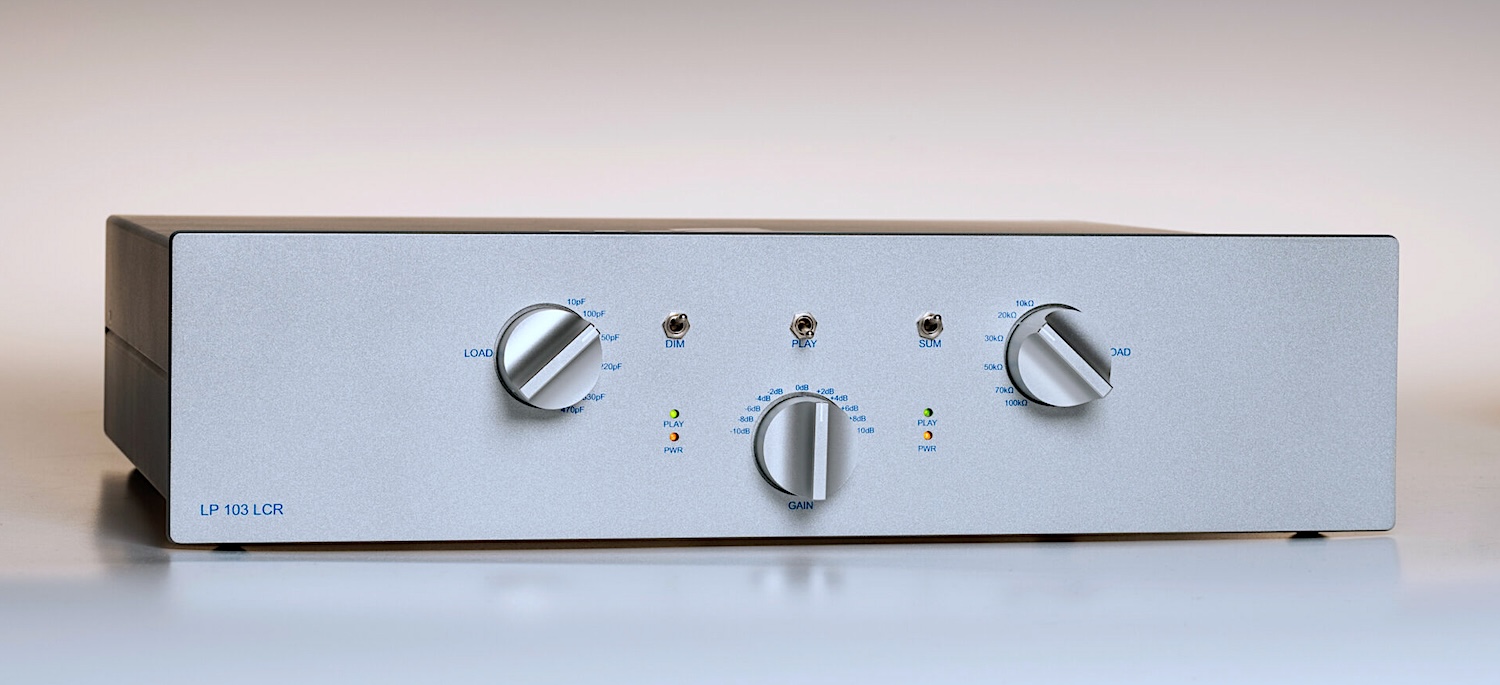
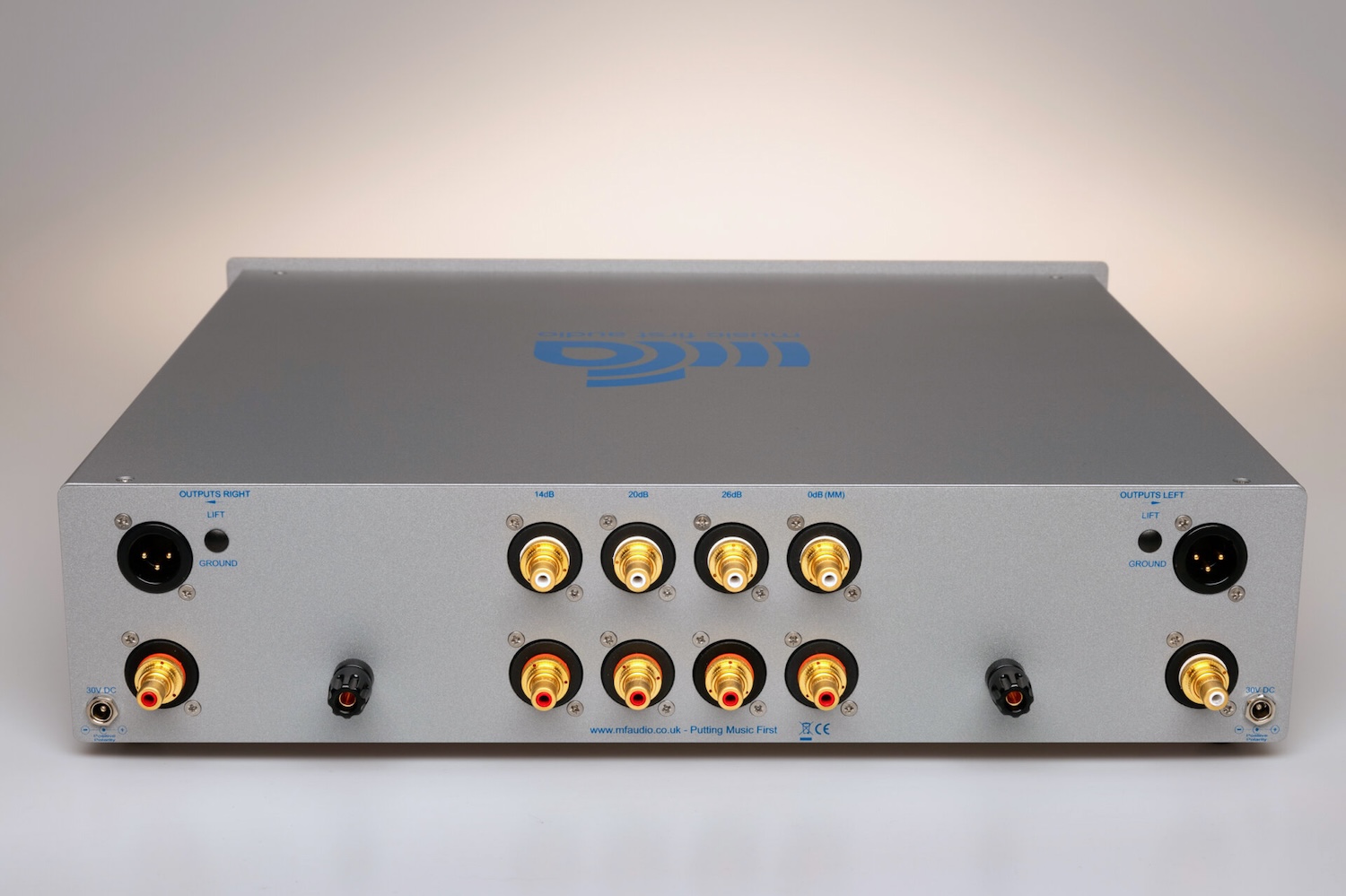
The Music First LP-103 LCR is a phono preamplifier that will equalise and amplify the signal from both MM and MC cartridges. Where it differs from the norm is that the active electronics consist of a moving magnet stage and the low output of MCs is stepped-up to MM level with onboard transformers. The latter have three primary connections that provide three levels of gain, but rather than having a switch to choose how much gain to apply there are three sets of MC inputs on the back of the box. This is an expensive way of doing the job but does avoid a switch that could easily degrade the tiny signal from a low output MC. This preamp offers up to 80dB of gain with multiple steps available through a front panel selector.
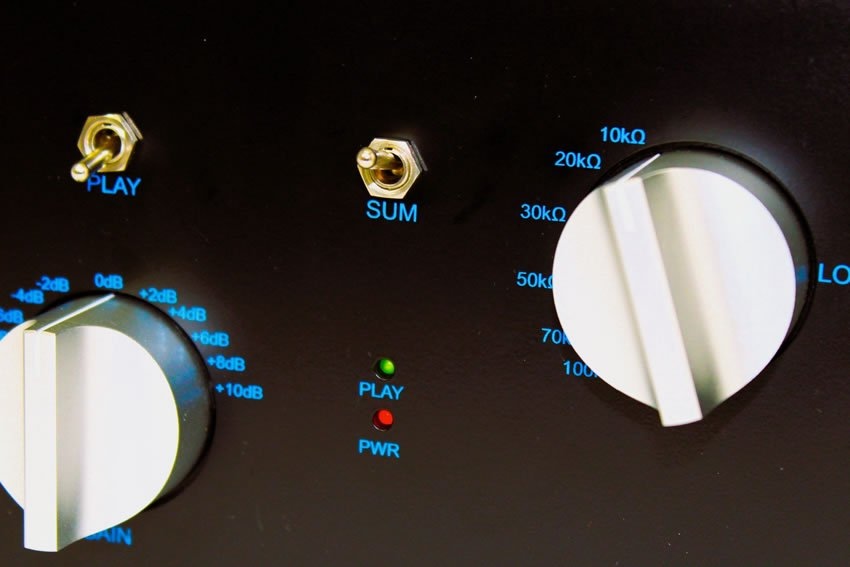
It also offers a wide range of load impedances and capacitance options but setting it up is not merely a case of picking the desired impedance, capacitance and gain to suit the cartridge. This is because the impedance is intrinsically linked to the step-up input used, and setting the desired loading requires careful consultation with the manual – not always a reviewer’s first port of call! However, when I realised that all the impedance settings on the front were for the MM stage (in kOhms) and thus too high for my MC I did investigate and discovered that the Rega Aphelion 2 would only see 100 Ohms if I connected the arm cables to the +20dB input and selected 10kohms on the front. Once this is set, gain can be adjusted using the central rotary by +/- 10dB, which is a useful range when combined with the base gain of 40dB plus 20dB on the step-up. It does of course mean that for this loading the max gain is 70dB, but that is higher than I am used to with totally active phono preamps.
While previous Music First electronics have involved Nick Gorham of Longdog Audio, Jonathan chose to go with Thorsten for his first phono stage because of the man’s deep love of vinyl (look him up, like us he has been obsessed for decades) combined with the ability to design a circuit that fits the bill. Thorsten says that the LP-103 is “based on classic pro audio circuits, all discrete, pure single ended Class A, single supply. Think Rupert Neve, EMI's Record Engineering Development Department, Universal Audio's Bill Putnam. Early Naim Preamplifiers also used a similar basic philosophy”. Which sounds like a very good place to start to me, Rupert Neve after all was the guy who built the mixing desk at Sound City that was used to make so many classic albums and was purchased by Dave Grohl a few years back.
Thorsten makes a number of technical points in his description of the circuit for this preamp, not least that if you want to build an LCR circuit that has the minimum of character you need very good inductors. He had to get these custom made in order to keep parasitic capacitance low enough not to influence the equalisation curve. Ditto capacitors used for blocking DC on the input, these are film and foil types, the output caps are Nichicon Muse bipolar devices which are placed within the feedback loop. Loesch also makes the point that DC coupled circuits that remove capacitors from the signal path end up being more complex than those containing coupling capacitors, which is the approach he has taken with high quality caps selected using his “extensive experience of capacitor sound”.
Perhaps the most controversial things about this phono preamplifier is indicated by the absence of an IEC power inlet on the back of the box. With a purist product like this one expects a linear power supply based around a toroidal transformer. What Jonathan Billington has done is to take a contemporary approach and used two switched mode power supplies rather than one linear example. These are separate plug top supplies that output 30V via fairly basic cables terminated in barrel plugs that connect with the LP-103. Jonathan states that these are high quality supplies and Thorsten has been known to take this approach with very successful iFi products in the past. There is always the option of upgrading the preamp with suitable linear supplies but one reason why Music First hasn’t done this is cost, such a thing would likely increase the price by 50%, and critically would require different versions for different local voltages.
In the system with the LP-103 LCR hooked up to the output of a Rega Aphelion 2 MC on my Naia turntable, it proved tricky to get a handle on largely because it is so neutral in character. Neutral can often be a bit of a back handed compliment, it can suggest dull or boring, but that isn’t the case here. Here the neutrality lets you hear what the vinyl, cartridge and turntable sound like with uncanny transparency. It puts the onus on the soft- and hardware to deliver the sonic goods by adding and subtracting so little in the amplification and equalisation process. This can mean that more glitzy productions don’t seem quite as sparkly as usual because the phono preamp is not emphasising certain aspects of the recording to create a polished or pacey sound. The proof of this comes when you play good, eg relatively clean, uncompressed recordings, which sound very real and vital, putting the musicians in the room and engaging the head and heart in equal measure.
It doesn’t stop more ‘produced’ music sounding good either, Frank Zappa’s fairly grungy One Size Fits All being a good example. You can hear the compression but you can also hear the brilliance of the songs and musicianship, in fact you pretty well have to sing along with “That’s the kind of sound she makes when her crap cakes” on "Florentine Pogen", I guess it helps that I love this album but that doesn’t usually happen. Likewise, the guitars on "Andy" sound filthy but the Music First manages to cut through the thick production and open up the song to great effect. I experimented with impedance settings and discovered that 200 Ohms sounded better than the 100 Ohms recommended by Rega, I also tried changing the gain using the front panel control and preferred an extra 2dB on top of the 60dB provided by hooking the arm cable up to the +20dB inputs. This gave the sound a little more of the zip that I am used to with a more conventional phono preamp.
This Music First really comes into its own with decent recordings of acoustic or largely acoustic music, one example that I only discovered when ECM put out a reissue is Gary Burton’s The New Quartet. The track "Olhos de Gato" is a busy piece with all four musicians working hard, it can often sound confused and forward/bright, here it sounded like the inspiration for prog bands like Brand X – intense but totally coherent and utterly thrilling, so much so that it has inspired me to investigate songwriter Carla Bley’s oeuvre more deeply than has thus far been achieved. A more recent pressing from the Liv Andrea Hauge Trio revealed a characteristic of the LP-103 LCR that was to pop up a number of times in my notes, that is its ability to track dynamic range to the extent that the remote needs to be at hand for those occasions when a piece starts quietly and builds into a tsunami. Which is not something that all phono preamps are so good at, this one really opens up dynamics in both the broad and micro sense, it’s partly why it feels like you can hear into every recording in a way that is rare.
This is one of those products that makes me wonder whether what I have been listening to for the last few decades is accurate after all, and that the Music First’s version of events is closer to reality because it reveals such huge differences between recordings. That is the only gauge that the end user has to assess how truthful a piece of equipment is, we can’t know what the engineer heard in the studio and in many cases what he/she heard has no basis in reality, it is a construct based on sounds that are usually manipulated for a certain end. We can get a better idea with acoustic material but even that is rarely recorded with maximum fidelity in mind, the goal is generally to sell the finished result and if that doesn’t sound as good as possible on the average system then it is massaged to do so. What we need to find is gear that shows the huge variations between recordings, especially those of the same genre, where even if it’s only a piano trio the potential for differences in instrument sound, studio acoustic etc etc are exponential.
This was brought home to me when I tried a Music First Baby Reference passive transformer preamp with the LP-103 LCR, suddenly those differences were amplified. On the one hand it meant that lesser recordings sounded even more so but on the other that the good ones became dramatically better. One example being Led Zeppelin II which has far more presence and power than I had realised, my ancient first pressing is not exactly pristine yet the energy in those grooves is as impactful today as it ever was. The difference is that late sixties sound systems were nowhere near as good as today’s finest examples, but they might have had the opportunity to see the real thing, and their pressings weren’t knackered.
Out of interest I tried using a moving magnet with this preamp, the best I have is a Rega Nd9 for which I used 100pF of capacitance and 50 kOhm impedance, there is no 47 kOhm option. This resulted in an appealingly powerful sound, the extra voltage provided by the cartridge resulting in a bodacious meaty presentation of Keith Jarrett, Gary Peacock and Jack DeJohnette’s Meaning of the Blues (Standards Vol.1). It also resolved the key moment in this tune when Jarrett enters a flow state about two minutes before the end, the moment when the player appears to be channelling the music from another sphere, a kind of meditative state that can is rarely captured and requires focus to appreciate. The MM is not as refined and doesn’t have the low level resolution that its MC opposite does but it does deliver the musical goods to powerful effect through the Music First.
In an attempt to make this less of a Rega fest I also installed a Van den Hul Colibri MC into the RB3000 arm and sent its output through the LP-103 LCR. This proved to be a very good idea, the sound being slightly more fruity than the Aphelion but full of detail, especially when it came to three dimensionality. The depth of bass being particularly good and the shine on brass rich and vibrant but not hard edged, Gary Burton’s vibes were a clear beneficiary, delivered as they were with an open glow and an awful lot of the instrument’s rich character intact. Joni Mitchell’s "Don’t Interrupt the Sorrow" always sounds pretty good but here the tone of the lap steel shone through and the genius of the composition was matched only by the second to none quality of musicianship.
Conclusion
I hope that I have been able to give you a flavour of the Music First LP-103 LCR and what it did for my record collection. It proved to be a slow burn process but right now I am wondering if I can afford to buy one, it’s that good. I have never got on with step-up transformers in the past because it can be very difficult to eliminate hum in a solid state system, so the fact that there are several in this fully dual mono phono preamp (right back to the wall socket) and it is extraordinarily quiet is a testament to the build and design.
If you want to know what is actually cut into the grooves in your record collection this preamplifier is highly recommended, you will find more exciting and obvious examples of the art but it will be hard to track down a more honest and revealing one.
Specifications
Performance Features
Constant Impedance 600Ω LCR RIAA Equalisation
Class A, fully discrete J-Fet & Bipolar Transistor amplification based on classic studio equipment
Input transformer noiseless and distortion free gain matching of Moving Coil Pickup Units
Highest grade passive signal circuit components
Active components selected based on a listening test for outstanding performance
3 pairs of MC inputs at 1:5, 1:10 and 1:20 ratios. 1pair of MM inputs
Dual left and right circuit boards. Dual left and right power supplies
Both RCA and XLR outputs.
Adjustable MM gain stage. 40dB +/- 10dB in 2dB Steps
Additional 14dB, 20dB and 26dB Step-up Transformer gain
Sum ( mono ) switch
Dim switch to lower gain by 12dB when lowering tone arm
6-position Resistor loading switch
6-position Capacitor loading switch
Mute switch
Available in silver or black casework
















.png)