
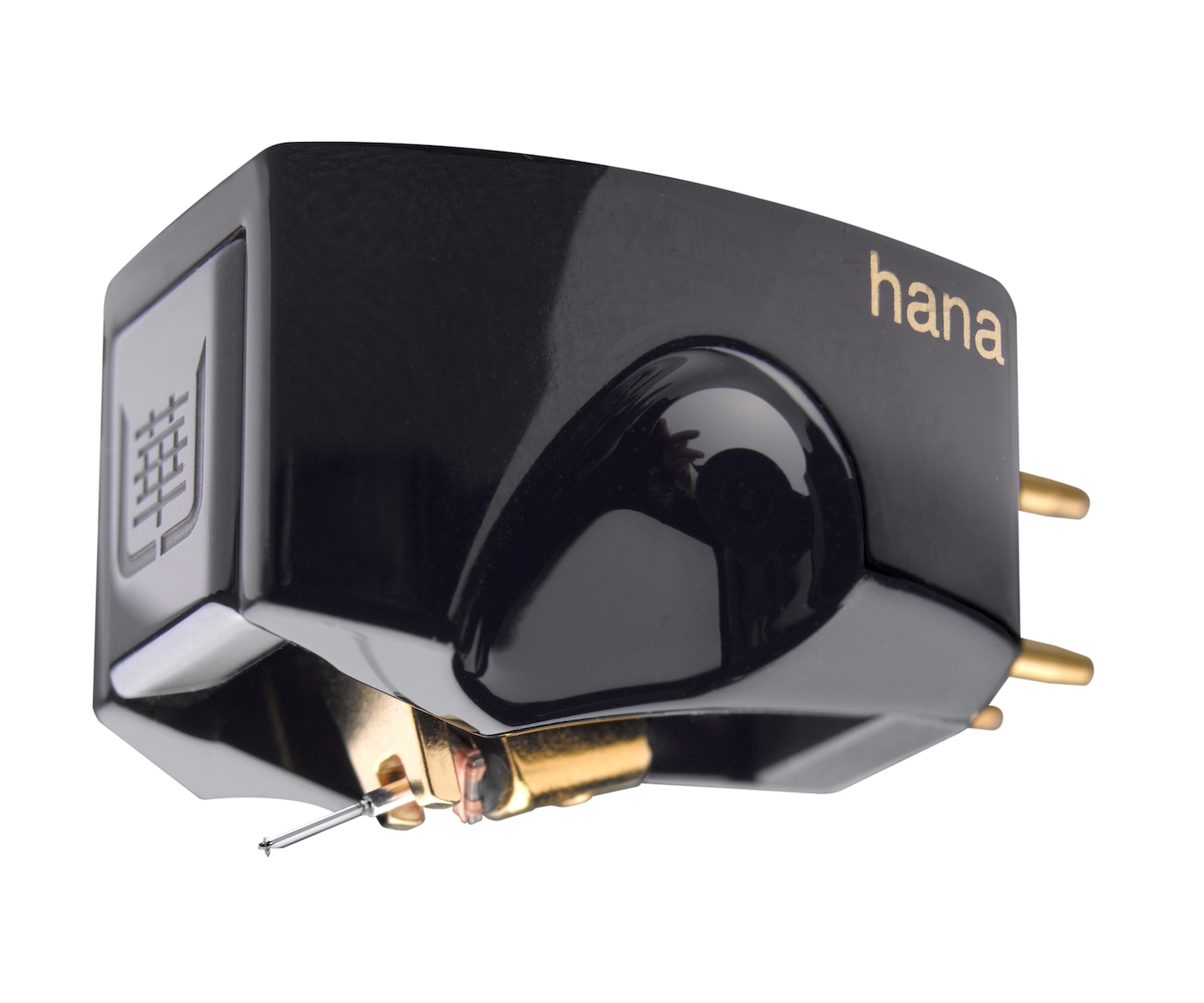
Hana Umami Black Moving Coil Cartridge—"Seamless Elegance"
diamonds are a cart's best friend
You don’t have to be told that uphill is more difficult than down. It’s true marathoning and it’s true developing lines of hi-fi products. That’s why, often, start-ups begin with the statement and work down to the affordable.
It’s no secret that Hana’s parent company, 55 year old Excel Corporation, has been the OEM builder for many costly cartridge brands, Benz-Micro and Etsuro among them as well as Argent, a defunct brand with which some older readers might be familiar, and for most of those years Excel was content to remain in the background.
That changed in 2016 with the highly successful Hana (“brilliant and gorgeous”) cartridge launch, inspired by the resurgence of interest in vinyl record playback.
Excel Corporation founder Masao Okada-san developed the line in cooperation with Youtek Corporation’s charismatic industry veteran Hiroshi Ishihara. The two had known each other for 40 years when together they established the moderately priced “for export only” brand and brought onboard Garth Leerer’s Musical Surroundings to import and distribute in North America.
It’s doubtful either one was prepared for Hana’s almost immediate success in the cartridge market—the result of both high performance and build quality as well as the line’s reasonable pricing. The early E and S series (elliptical) and SH (Shibata) available in both low and high output versions set a high bar for sonic performance and value. The EL (for low output) then sold for $475.
I was privileged in the summer of 2017 to meet both Ishihara and Okada at the factory. It was a quick visit just before heading to the airport to return home after a tour of a few other Japanese manufacturing facilities, and a combination of translation frustration and being “punch drunk” tired, resulted in a factory tour visit that some viewers found highly offensive. I was just having some fun.
These YouTubers thought I was being disrespectful and even abusive, but fortunately neither Okada nor Ishihara thought so—or at least they didn’t let on that they had been in any way offended.
 Ishiwara-san and Masahiro-san (Okada-san's son) on our way to Hana G-6 Summit and Hana Umami California Festival
The Hana line grew as the company made the more difficult upward trek to more costly Hanas. In 2020 the company named its newest and most expensive cartridge the Umami Red, name provided by Musical Surroundings’ Garth Leerer, which both Okada and Ishihara liked and adopted for the new line in lieu of the usual often dizzying non-descriptive numbers Japanese companies tend to prefer.
Though Umami refers to a specific basic taste identified in 1908 as the fifth in addition to sweet, sour, bitter, and salty, making the association to sound proved relatively easy. Umami taste is also described as ‘meaty’ and ‘delicious’. The Umami Red cartridge sound is definitely well-textured and on the pleasingly ‘rich’ and ‘meaty’ side but not thick and stew-like. The cross taste/sound reference was well-accepted among both audio journalists and consumers.
Though priced at $3950, well above the previous Hana high, the Umami Red was an immediate success. Three years later came the less costly and equally successful Umami Blue. Both cartridges did everything right and nothing wrong, though everyone including everyone involved knew more could be retrieved from a record groove.
Most recently the company "zigged" in the other direction by launching the Umami Black, which at $11,500 takes cartridge pricing to near stratospheric levels, though many others are similarly priced, including some Excel builds for others and compared to say, Kuzma’s new $42,000 KAR70, the Umami Black is “affordable” lol.
The Umami Black is Not a Umami Red Painted Black
To celebrate the launch and put in perspective the entire Umami cartridge line, Garth Leerer, Excel Sound and Youtek assembled a group of its distributors plus invited guests from around the world to the “Hana G-6 Summit/Hana Umami California Fest” for three days of meetings, greetings, eatings, drinking, and celebratory doings in Sonoma County wine country centered in the town of Healdsburg.
I hope you’ll watch the video, which includes a detailed illustrated description of the new cartridge’s design elements as well as a useful historical perspective. It's a "sneak peek" you don't often get to see, into design, marketing, and presentation in the high performance audio marketplace.
The new flagship Umami Black features the line’s first diamond cantilever/Microline stylus assembly, part of the new high efficiency “OKD” moving coil generator system featuring an all-new integrated pole piece, rear yoke assembly and inverted “U”-shaped front yoke.
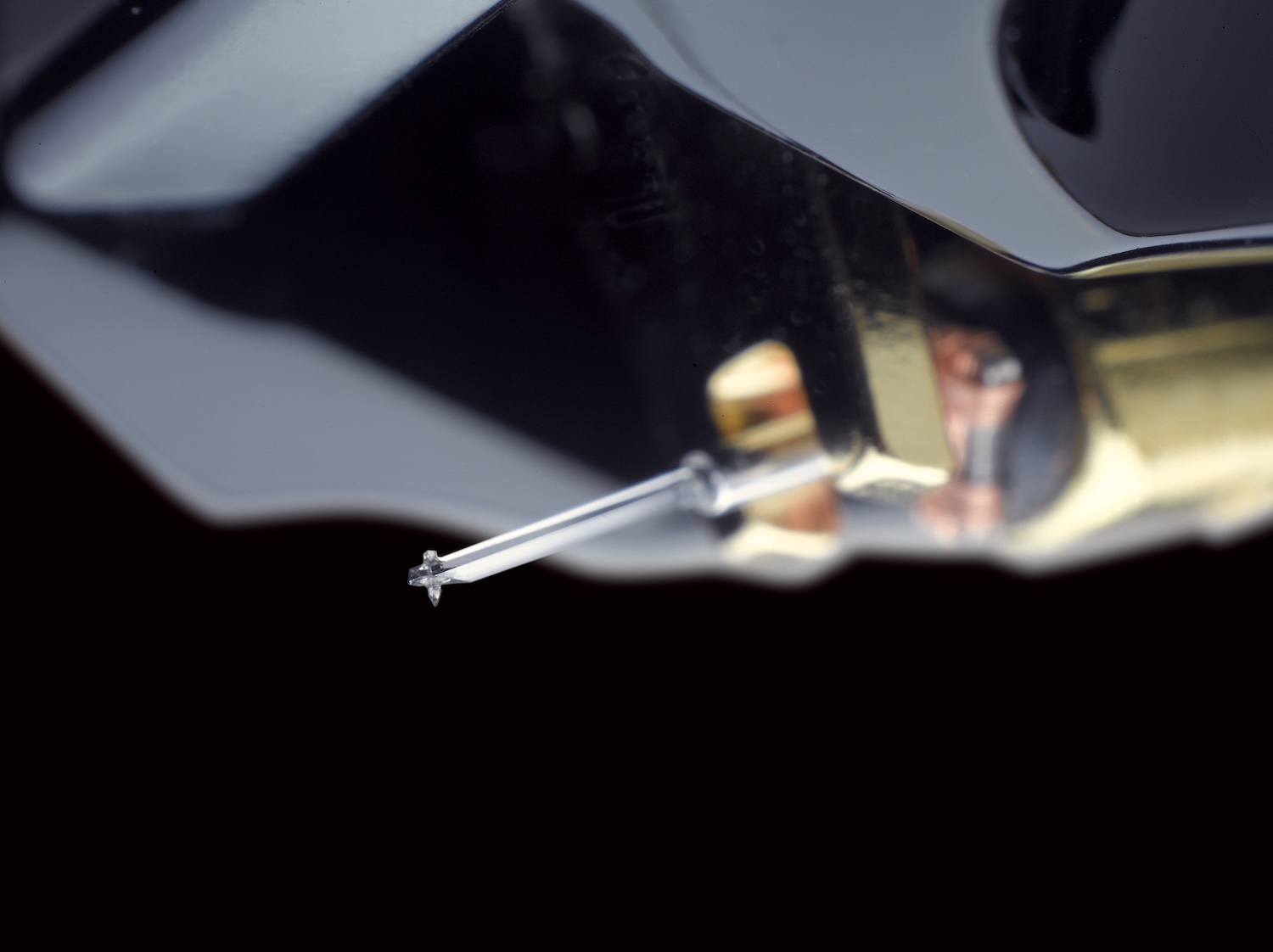 Up close cantilever/stylus "U" shaped front yoke assembly
A new 2 millimeter square hybrid 78% carbon fiber/nickel armature, hand-wound with 30 micron, 4Ns high purity copper wire combines low moving mass with efficient generating capabilities.
Hana claims the OKD generating system, which outputs 0.3mV at a useful low 5Ω optimizes energy transfer, minimizes magnetic power loss, and suppresses unwanted magnetic vibrations to “vanishingly low levels”. Also unique to the Umami Black is a rare earth neodymium-iron-boron (NdFeB) magnet. All magnetic and signal path components—U front yoke, integrated pole piece/rear yoke and 24k gold-plated brass output pins are deep cryogenically treated.
The Auricle™ machined open air aluminum body is Urushi lacquer finished, applied at 120 degrees C and bonded via vapor deposition. It’s a multi-stage high gloss finish that both looks great and helps control body resonances. The black zirconia inlaid facia also damps and adds a pleasing visual accent. If you’re going to spend this kind of money you should at least have something good to look at. And it is, though in a pleasingly understated way.
In other words, the Umami Black shares a body shape with its Red and Blue relatives, but little else. It's most certainly not a Umami Red painted black! What's more, it takes advantage of previously unavailable, or recently developed generator components.
Set-up
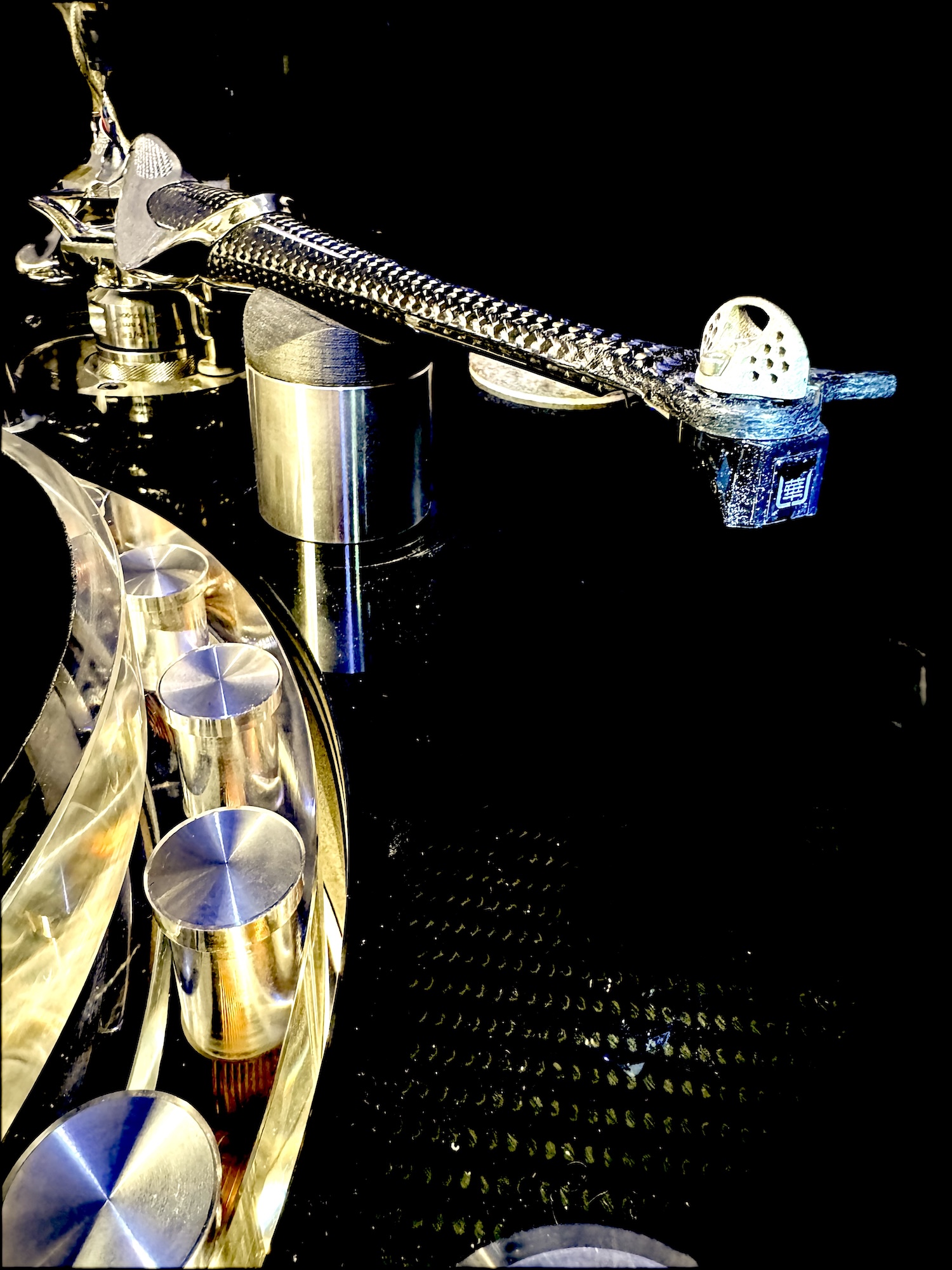
I gave the Umami Black a ride in the Wilson-Benesch Graviton arm. Weeks of use left dust on the Urushi as you can see. Out of the box it's a gleaming satiny black presence.
;
It's a relatively "high rider", which makes setting overhang and zenith angle easy. Tracking at 2 gram, the cartridge met its 70µm spec using the Ortofon test record. Channel balance within .5dB and 29dB/ 29.5dB L-R/R-L separation was achieved a tiny nudge from cantilever/record surface perpendicularity and SRA was "close enough" to 93 degrees with the arm parallel to the record, which is fortunate because right now I can't adjust VTA/SRA because the software that adjusts arm height remotely "by phone" has decided to no longer work! W-B is working on it.
Note that Soundsmith's Peter Ledermann claims that the oscilloscope azimuth setting methodology, which samples cross channel values 16 times a second, considerably underestimates actual separation so while my measurement meets Excel's published specs, it's likely that using a voltmeter would indicate even higher channel separation specs, though 30 is pretty much at the limits of most commercially pressed records according to my reliable sources.
Oh Mommy! Sound
Some cartridges require a serious break-in to sound coherent, and sometimes regardless of how great it might immediately sound, the ear has to acclimate to a new sound compared to what's been removed, in this case the $11,500 Wilson-Benesch Tessellate Ti-S, which without comparison to anything is highly resolving and decidedly "analytical" but in the best sense of that word. Its sapphire cantilever, while not as light and stiff as diamond is still fast, aided by a uni-directional carbon fiber sleeve W-B puts mid-position on the cantilever to dampen and further stiffen it.
The Tessellate digs out the detail and has no easily discerned additive sonic properties, particularly in the mid-bass and bottom octaves. If there's bass on the record you get it and how. If there's none it doesn't add any.
It's fun playing a series of bass shy records for visitors using the Tessallate, followed by one with depth charge bass. Just as they're ready to declare the Tessellate stingy on bottom the room gets quake-energized by a bass giant that sets the record straight. But the Tessellate also has an upper octave balance that can sometimes sound desolate and "analytical" like the original Lyra Atlas for example. Still, it works really well with great recordings.
Replacing one $11,500 high-tech performer designed to not have a resonating character (there are plenty of available colorful carts), with another with the same design goals can never produce the memorable wow factor you get the first time you hear such a cartridge, which for me was the Transfiguration Orpheus D almost a decade ago. It was an unforgettable serious step up from anything I'd previously heard in terms of detail retrieval. "speed" and macrodynamic slam. Orbray's single piece diamond cantilever/styli takes things up a few more steps in terms of dynamics and "speed" as heard in the Audio Technica MC-2022 and in DS Audio's Grand Master EX cartridge. That assembly was considered but for now shelved for the Umami Black probably because of cost.
Moving from the W-B cartridge to the Umami Black was not a step up but rather a step onto the same plateau to a different sonic vantage point—one that immediately sounded more tactile and well-textured, with an inviting, yet subtle "velvety" finish. You could even say it glows.
The Umami, not yet broken in was immediately lovable, mesmerizing, disarming, seamless in its "wholeness". It immediately produced for me the sonic equivalent of "falling into" a loved one's photo. Top to bottom sound that was smooth but not soft, airy and complete on top, but not spotlit, generously weighty on bottom but well defined, nimble and not at all thick and bloated.
This wasn't a timbral shift from the W-B. Both are among the more neutral transducers I've experienced. Rather it was a full range, seamless subtle textural reboot and don't ask me how a cartridge designer produces that. Diamonds are supposed to be harder, Sapphire warmer, but here, the diamond had more and it wasn't exactly "warmth". It was more of a surrounding supple envelope that produced both sharply focused clarity and listening comfort and ease.
Usually a new high performance cartridge produces an immediate "yes, but" response: what's great is immediately noticeable (sometimes I think this is partly due to a brand new un-worn stylus) but so are areas of sonic discomfort—perhaps excess warmth, some edginess, whatever, that you hope break-in or just acclimation to the sound will cure.
The first evening with the Umami Black produced no sonic hesitation, no sense of giving up something to get something else. I just needed to stay up stupidly late playing familiar favorites, partly because of its effortlessness and background serenity. Gliding on freshly Zambonied ice, schussing on fresh powder both immediately came to mind and they are somewhat useful, but nothing about the sound is icy.
Tracking back to the first record played and this may sound self-serving but first up was Chapter One the Caelan Cardello album I had just released on Liam Records. I obviously knew it well and had played it at least two dozen times using the Tessallate cartridge. I went directly to "Steppin' Up" and then the solo Monk track "Ask Me Now" that's exclusive to the vinyl edition.
On the highly percussive "Steppin' Up" drummer Domo Branch goes absolutely wild—Art Blakey wild—and the cymbal sizzle was suitably hard, metallic, realistically splashy and spectacularly well-defined in the small studio space. Small shifts in stick hit intensity were effectively communicated. The presentation was appropriately crystalline but never strident and that encouraged cranking up the volume. The louder I pushed it, the better it sounded. The sonic lens remained focused. Caelan's Steinway also maintained its sonic composure at higher SPLs-the piano's percussive and resonant qualities remaining well-balanced and nimbly presented.
The Umami Black allowed me to play the record louder than I'd become accustomed to, without the upper keys biting back. Jonathon Muir-Cotton's aggressively plucked bass notes remained fully contained and controlled. On the album's opening track he's both mic'd and directly fed to the board, which produces a big bass picture that gave some rooms and systems problems when I played the record in Warsaw and at the Cap Audio Fest. At home the doubled source produced a larger bass "footprint" but it was fully controlled. I've not heard Caelan's album sound better. Guest performer Chris Lewis's saxophone sounded rich and full, yet convincingly "reedy" and brassy.
The other evening I compared the original 1978 DGG pressing of the Mozart Violin Concertos 3 & 5 with the then 14 year old violin prodigy Anne-Sophie Mutter and Von Karajan conducting the BPO (DGG 2531 049) with an upcoming Original Sound Series edition mixed live from the original 1" 8 track tape. The original pressing sounded murky and indistinct, shrouded in fog, yet overall not unpleasant. There just wasn't much to "see". The OSS was startlingly better: veils lifted revealing previously hidden instruments on the stage presented in three dimensions and the violinist, properly sized and in clear relief; her touch on the strings delicate and nimbly drawn, the bow smoothly gliding across the strings. All the natural detail you could want with no edgy mechanical additives. Detail and delicacy or as my friend and TAS reviewer Jacob Heilbrunn immediately heard from this cartridge "Seamless elegance".
After sitting pleasantly transfixed through both concertos I decided to remove the shrink-wrap from the Super Deluxe Edition of The Rolling Stones' not particularly well-received 1976 release Black and Blue. Mick Taylor had left and, well I'll cover it in a record review, but first I played the original U.S. pressing mastered by Lee Hulko at Sterling Sound. Kind of a shoddy presentation gatefold jacket, no annotation, no explanation, nothing. Just an inner sleeve with the tape box images on either side. So, in that Mick and Keith were decades ahead of their time.
A super star engineering team recorded it: Keith Harwood, Glyn Johns, Phil McDonald and Lew Hahn, the latter best known as an Atlantic Records jazz engineer. This record was more interesting as an audition for a new guitarist than anything else, and opens up with the repetitive and monotonous disco/funk "Hot Stuff". This was guitarist Harvey Mandel's tryout track (he's known to some for his album Cristo Rodentor on Philips Records, or for his work with Canned Heat).
Anyone paying attention to the 16track recorder's track assignments (confusing because the template was for 8 but divided in half) would be able to see what was happening here with Wayne Perkins and Ronnie Wood also auditioning, the latter obviously winning the spot. The the album overall is a mish-mash of styles, and seemingly lacking in musical purpose, (though in retrospect the variety show produces a lot more fun). Maybe that's why it sat on the shelf rarely played over the past 50 years! Plus the sound as I recalled it, was stiff, dynamically compressed and it lacked stylistic "production flair".
So i was surprise by how much the hard-edged sound appealed and more surprised that the Umami Black could turn the corner from gossamer, feathery delicacy on the orchestral recording to searing, hard-edged grit on the Stones album. Glyn Johns was always known for his drum mic set ups and here the snare sizzles and the kick drum has weight, definition and a tight profile. Parts hidden for decades in mediocre playback muck burst forth now, including Billy Preston's piano and organ parts. On "Hey Negrita" he sounds positively Mike Garsonized. On "Melody" Preston pounds heavily and the Umami Black effectively delivers the hard news. Vocal clarity was another highlight with images spread in space hanging three-dimensionally. Wyman's bass line was taut and tuneful. Again, the louder the better! The Steven Wilson re-mix will be covered in the box review but here's a hint: it's limp, "audiophile" blown apart so you hear every element separated out and it misses the entire gestalt of the record! Otherwise it's great. i'd love Glyn Johns opinion on it, if he even cares.
The next four Strata-East releases arrived and first up was Music Inc (SES-1971-25LP) a raucous brassy big band 1971 release that was Charles Tolliver's and Stanley Cowell's first on their new label. Big bands in 1971 weren't a big thing, but Tolliver and Cowell took their quartet with Cecil McBee and drummer Jimmy Hopps and blew it wide open with brass—4 trumpets, 4 trombones, tuba, plus reeds, flutes and baritone sax. Among the players were Clifford Jordan, Jimmy Heath, Howard Johnson and Curtis Fuller. They blasted a mighty wind on the opener "Ruthie's Heart," which bristles with relentless hard-edged energy and sounds like a Blaxploitation film cue, though the label's intentions were quite the opposite.
Recorded at Mediasound—like Columbia's 30th street studio, an unsanctioned church—the sound is anything but cathedral like. Everything's closely miked for impact and immediacy. As with The Stones album, this could be blasted at high volume and the sound remained big, brassy and well-controlled—as bright and hard edged as you'd want but never artificially edgy or searing.
Stanley Cowell's "Abscretions" is groove dig-able, and danceable too with a snake-y rhythmic thrust over which the trumpets blare and flutes soar to cool the heat for a few bars. Meanwhile Hopps' kit pounds in the background, cymbals ringing cleanly in a different timbral and spatial zone from the brass, while the assemblage rides on Cowell's insistent piano. The Umami Black is well up to the task of delivering all of it with rhythmic and timbral flare.
I tried Pentangle's Sweet Child (Transatlantic TRA 178)—not played in a long time. The live Royal Festival Hall record recollection is of the delicate acoustic group bathed in murky, enveloping hall reverb. This play the quartet was more immediate and placed further forward on the stage, murk clarified with the hall space more discernible and clarified. What sounded like a cavernous space when I first got this record in 1968 now sounds like one with a far drier one with a shorter reverb time and in fact, the hall back then was known for being dry. On the Bert Jansch solo number "A Woman Like You", his voice is effectively framed in the mild reverb, which spreads behind across the stage and rapidly evaporates. The cartridge (and turntable) capture delicate foot taps on the stage that I'd never before heard.
This record re-emphasized the Umami Black's smooth, gliding on ice character, and the speed, clarity and nimbleness with which it delivers acoustic bass. A masterful presentation.
Conclusive Conclusion
Simply put, the Excel Sound team has delivered a masterpiece. Listening to the Umami Black many weeks after it was installed is as exciting and mesmerizing as it was on day one. Whatever the break-in was I can't recall the usual "aha! Now it's broken in". It sounds as fast and clean, yet full bodied and timbally linear as it did on day one. The Umami Black proved to be an ideal fit for every kind of music I threw at it. Jazz, Rock, Folk, orchestral, chamber music, big band, electronic, whatever! It has no shortcomings, unless you crave cozy warmth, which it will not deliver. It won't sound cold either. Its micro and macro dynamic authority will not disappoint.
I keep returning to the Pentangle album. I've always admired the recording quality and the playing but it always (and this goes back to 1968) left me kind of bored. I rarely played both records through. I've played it through more than a few times over the past few weeks, taken by every aspect of the presentation: effortless vocal clarity, sibilant perfection, and transient accuracy. Terry Cox's shimmering glockenspiel floated almost daring me to reach out and touch it; the attack immediacy, sustain delicacy and decay generosity convincing in ways I hate to flog a dead horse but no digits do this! And if a cartridge can better what the Umami Black did with this recording, I'd like to hear it! More are on the way, so maybe I will. If you can afford this luxury, I'm pretty sure you'll not regret the purchase.
Specifications
Body material: Duralumin (A7075)
Body shape: Auricle™ open air
Finish: Urushi lacquer
Cantilever: Diamond
Stylus: Microline Nude Diamond
Armature material: Permaloy, 78% carbon-infused nickel-iron
Armature Shape: 2mm Square Plate
Vertical Tracking Force: 2.0g
Coil Impedance: 5Ω
Output: 0.3mV
Load impedance: ≥50Ω
Output balance: 0.5dB/1kHz
Channel separation: 30dB/1kHz
Trackability: 70µm/2g
Dynamic compliance: 10 x 10(-6) cm/dyne (100Hz) Estimated at 17 x 10(-6)cm/dyne at 10Hz
Cartridge weight: 11.3g
Warranty:
The manufacturer's warranty will apply to normal usage and operation for 2 years after purchase date or shipping date from the manufacturer at Excel's discretion . The warranty does not apply to any damage from abuse. This will be determined by manufacturer for warranty eligibility. The warranty covers defects in materials and craftsmanship, but not abuse or wear of stylus tip due to use.
Manufacturer Information
Manufacturer: Excel Sound Corporation
American Importer: Musical Surroundings