
I Had My Purist Thermionic Cake and Ate It Too
and it sounded delicious
To understand what Dejan Nikic has accomplished with the NAT Audio Transmitter EVO monoblocks, it’s worth pulling back the lens a bit, far enough to take in a century of amplifier design, complete with its obsessions, breakthroughs, and the occasional bout of engineering tunnel vision.
For decades, the mainstream chased vanishingly low distortion figures, typically achieved through generous applications of global feedback. On a test bench, the results looked immaculate, numbers so clean they practically sparkled. In listening rooms, however, the experience could drift toward the clinical: precise, controlled, and about as emotionally engaging as a well-organized spreadsheet.
Predictably, a rebellion formed. In Japan, designers such as Nobu Shishido and Hiroyasu Kondo revisited vintage Western Electric theater amplifiers and rediscovered the peculiar charm of the Direct-Heated Triode (DHT). Operated in single-ended, zero-feedback Class A, these designs offered a kind of immediacy and tonal intimacy that felt less like reproduction and more like direct contact with the performance.
In the U.S., Harvey “Gizmo” Rosenberg took up the banner with characteristic flair, extolling tubes like the 300B for their almost eerie harmonic coherence, the sense that music wasn’t being pieced back together, but simply allowed to flow.
At the core of this philosophy is a distaste for crossover distortion, that subtle but consequential discontinuity introduced in push-pull designs when the signal is divided and handed off between devices. A single-ended triode sidesteps the issue entirely. One device carries the signal from start to finish, uninterrupted, no relay race, no baton drops.
Of course, nothing comes for free. The classic 300B amplifier produces only a few watts, which historically meant pairing it with highly efficient loudspeakers, often horns, if you wanted anything approaching realistic dynamics.
That constraint led to a kind of thermionic arms race. Designers turned to larger transmitting tubes like the 211 and 845, sometimes paralleling them to boost output, though not without compromising the single-device ideal. At the extreme end, there are amplifiers like the WAVAC HE-833, wielding enormous transmitting triodes to deliver genuinely substantial power.
NAT Audio takes a slightly different path. Dejan Nikic’s work feels less like brute-force escalation and more like careful evolution. His aim isn’t merely to build a powerful SET amplifier, but to create one that behaves like a thoroughly modern design, linear, wide bandwidth (8Hz to 110kHz), and competitive on the measurement front with contemporary heavyweights.
In essence, he preserves the defining virtue of the SET, its total absence of crossover distortion, while extending its capabilities into territory where it no longer just seduces, but seriously competes.
When a 5,000-Volt Tube Gets Told to Behave Itself
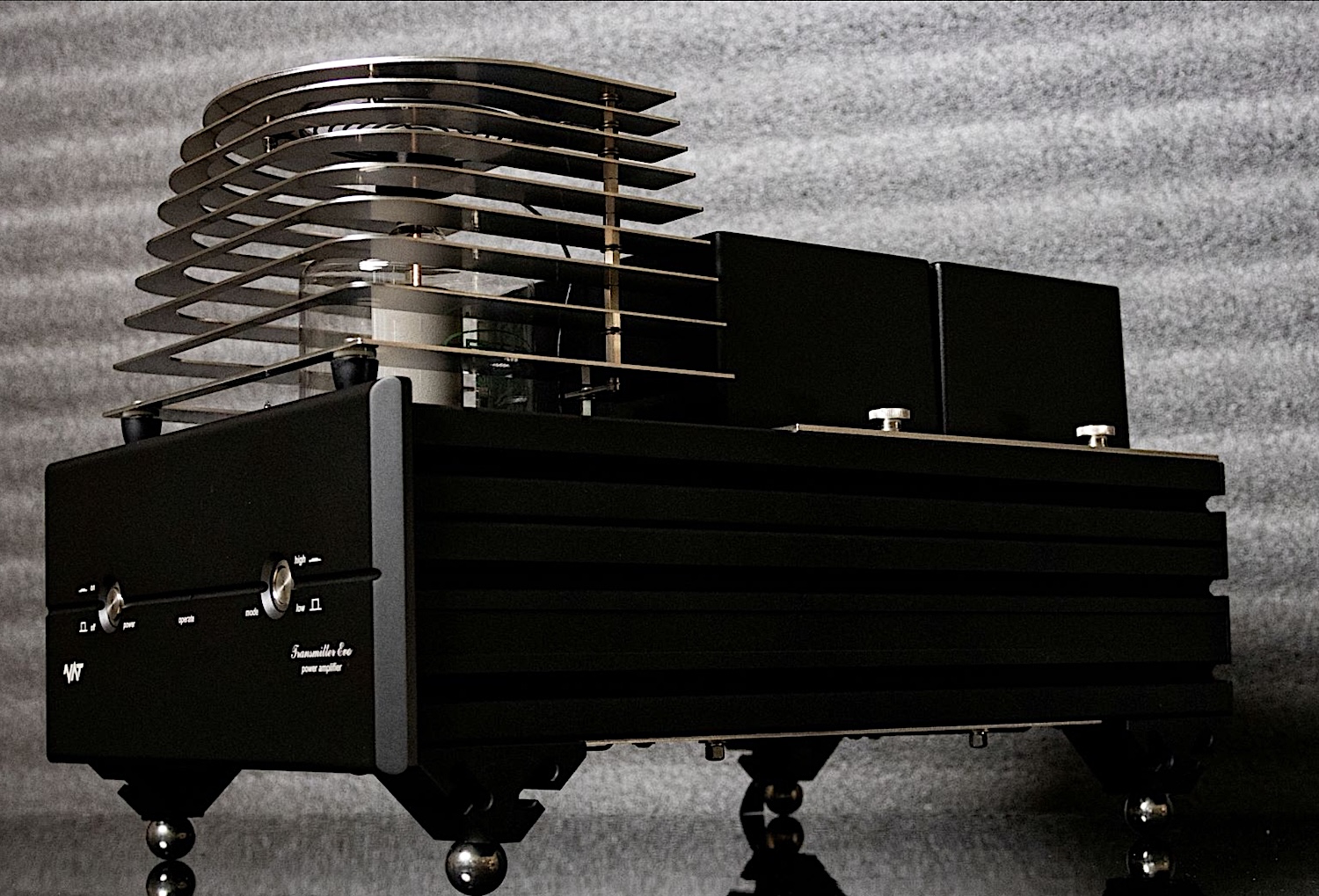
As a physical object, the Transmitter EVO doesn’t so much sit in your listening room as assert itself into it. Each monoblock tips the scale at around forty kilograms, less “component,” more “small industrial appliance.” The chassis is fully CNC-machined, finished in black or silver, and leans toward a purposeful, almost utilitarian aesthetic. No jewelry-box frivolity here, this is equipment that looks like it expects to be taken seriously. A stainless-steel cage surrounds the output tube, which is not optional theater; the thing runs hot enough to make poor decisions feel immediate and memorable. Think of the entire structure as a mechanical anchor for the electrical acrobatics happening inside.
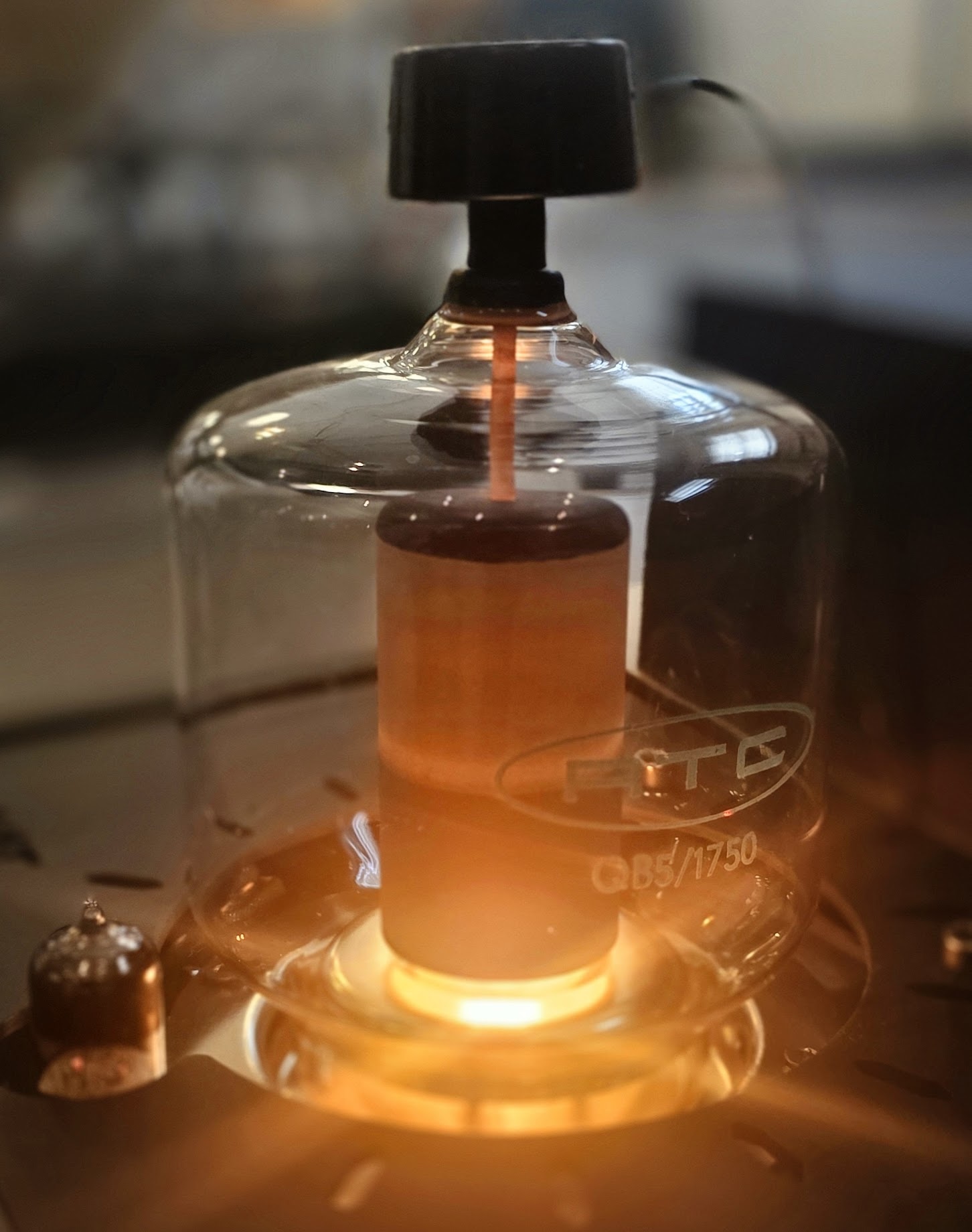
At the center of it all is the Philips/Siemens QB5/1750, also known in certain circles as the NOS 6079 or RS687. This is not your garden-variety audio tube glowing politely in the corner. It’s a hulking RF beam power tetrode, born in the mid-1950s for shortwave broadcasting, radar, and military comms. Its original job description involved hurling signals into the upper atmosphere with unwavering reliability. To that end, it boasts a frankly intimidating 565 watts of peak thermal dissipation and plate voltages that climb to around 5,000 volts. Subtle it is not.
Dejan Nikic looks at this industrial brute and decides to civilize it, on his terms. The first move is to triode-strap the tube, tying the screen grid directly to the plate and forcing the tetrode to behave like a triode. It’s a bit like taking a freight train and insisting it learn chamber music. The second move is arguably more important: he runs the tube at roughly 35% of its rated dissipation. In other words, this monster is loafing, barely breaking a sweat. The benefits are not trivial: lower operating stress, tube life exceeding 10,000 hours, and operation squarely in its most linear, lowest-distortion region. The payoff is a claimed 80 watts of pure Class A, zero-feedback single-ended power, numbers that would have seemed fanciful in traditional SET circles.
Of course, even the most heroic output tube can be undone by a compromised circuit. Here, the Transmitter EVO takes an approach that borders on purist extremism: it is fully direct-coupled. In most tube amplifiers, a coupling capacitor sits between stages, blocking dangerous high-voltage DC while passing the signal along. Necessary, yes, but not without cost. Capacitors bring dielectric absorption, phase shift, and a subtle temporal blurring that can soften leading edges and smear harmonic structure.
NAT’s solution is simple in concept and daunting in execution: remove the capacitor entirely. No coupling caps, no interstage transformers, nothing between the driver and output tube except wire and intent. The plate of the NOS 6N6P driver feeds directly into the grid of the QB5/1750. It’s a straight shot, electrically speaking, and about as forgiving as a tightrope in a crosswind.
Making this stable requires serious engineering muscle. NAT backs it up with a heavily overbuilt, laboratory-grade regulated power supply feeding all stages, alongside a computerized automatic bias system that maintains precise, drift-free DC conditions. The result is a circuit that behaves less like a nostalgic tube design and more like a disciplined, high-voltage instrument, one that just happens to glow.
The Setup: Nowhere to Hide
The system feeding the Transmitter EVO deserves a careful look, because in a chain this stripped-down, there’s no place for ambiguity to hide. If something sounds extraordinary, or questionable, you’re hearing it more or less in the raw.
Up front sits the MSB Reference DAC, fitted with the company’s preamp module and run in full direct mode. This isn’t your typical DAC followed by a polite analog stage that “finishes the job.” It’s closer to a straight voltage-domain converter. No op-amp buffer, no transistor gain stage, no traditional reconstruction filter smoothing things over on the way out. The discrete resistor ladder doesn’t hand off to an output stage, it is the output stage.
That signal feeds directly into the NAT Transmitter EVO monoblocks, which, true to form, continue the no-safety-net philosophy. The amplifier itself is direct-coupled from input to output, so the electrical path from the MSB’s ladder network to the grid of the 6N6P driver tube is essentially continuous. No coupling capacitors stepping in to “help,” no gentle buffering, just a straight, high-voltage handshake between source and amplifier. It’s about as unmediated as it gets without inviting OSHA into the listening room.
From there, the EVOs drive the Alsyvox Caravaggio loudspeakers, full-range ribbon panels with a rated sensitivity of 94 dB and a nominal 4-ohm load. These aren’t speakers that respond to brute-force wattage with gratitude. They care about current delivery, linearity, and, perhaps most ruthlessly, the integrity of everything upstream. Feed them a compromised signal, and they won’t politely obscure it; they’ll underline it in red ink.

What emerges is a system that is deliberately minimal in topology but maximal in exposure. There’s no editorial layer, no soft-focus lens. Whatever character the amplifier imparts arrives intact, unfiltered, and very much on display, for better or worse.
Listening Impressions
(hyperlinks below to Qobuz)
"But Not for Me" — Chet Baker (from Chet Baker Sings)

This is one of those recordings where the myth can easily overwhelm the music unless the system refuses to editorialize. Chet’s vocal mic placement is extremely close. You hear breath, lip noise, and that slightly fragile West Coast studio bloom around the trumpet that too often turns into haze on lesser chains.
Here, there is no haze.
What stands out immediately is how the MSB to NAT chain preserves microdynamic shading without smoothing edges into sentiment. Chet’s phrasing, those slightly behind-the-beat moments where he sounds like he is thinking in real time rather than reciting, comes through intact. The Transmitter EVO does something that is not typical SET behavior in a good way. It keeps harmonic density stable without blurring the transient shape of the trumpet. The result is not romantic fog but a strange kind of clarity, where you can hear both the tone and the structure of the performance at once.
Uri (The Wind) — Flora Purim (From the album Encounter)

This is a track that depends on transient speed and rhythmic elasticity. Flora Purim’s vocal line is constantly in motion, leaping and suspending in ways that punish systems that soften leading edges.
The MSB ladder feeding the NAT amps preserves attack with real precision. The Alsyvox panels then let the decay and spatial bloom open up without collapsing the center image.
What is notable here is speed. Despite being a single-ended, high-voltage tube design, the Transmitter EVO does not feel slow or overly lush. It tracks rhythmic changes cleanly, almost percussively. Flora does not float above the mix. She cuts through it and stays locked in place while doing it.
"Last Leaf on the Tree" — Willie Nelson (From Last Leaf on The Tree)

Late Willie recordings are about restraint. Voice, guitar, space. That is the entire composition.
What this system exposes very clearly is vocal grain. You hear the slight looseness in pitch, the behind-the-beat phrasing, and the sense that timing has become expressive rather than technical.
The MSB to NAT chain does not try to “improve” any of that. The Transmitter EVO gives the voice body without turning it into something overly warm or sentimental. It sounds aged but present. The guitar has a soft but defined attack, enough to keep structure without drawing attention to itself. The effect is not nostalgic. It is direct and slightly uncomfortably real in a good way.
"Cocaine" — Jackson Browne (From Running on Empty)
Live recording, mobile energy, and just enough chaos to make timing the real test.
This is where systems either smear rhythm or lock it in.
Here, the MSB direct output into the NAT amplifiers stays surprisingly coherent. Bass has real grip, which is not always expected from a single-ended topology at this scale. The Transmitter EVO does not smooth out the recording’s rough edges or try to romanticize the tape. Instead, it preserves the slight instability of the performance, the subtle density shifts as the band leans in and out of the groove.
It feels like you are inside the recording space rather than observing it from a distance. That can be slightly chaotic, but it is musically convincing.
La Ciudad de los Aires Buenos — Dino Saluzzi (From the album El Viejo Caminante)

ECM recordings are built around space and decay. On many systems they become beautiful but slightly detached, like sound suspended in glass.
Here, the NAT chain avoids that kind of soft-focus presentation. The reverb field is fully present but not exaggerated. You can clearly distinguish direct sound from reflected energy, which keeps the spatial structure intact.
Instead of turning ECM ambience into a wash, the system treats it as geometry. The result is more analytical in structure but not cold. It simply avoids adding atmosphere that is not already on the recording.
If I Needed You — Townes Van Zandt (From The Late Great Townes Van Zandt)

This is all about fragility. Voice, guitar, and not much else.
Townes’ vocal comes through slightly unstable, which is exactly the point. The NAT amplifiers preserve that instability without smoothing it into artificial warmth. There is no attempt to “fix” anything, which matters here because fixing Townes Van Zandt usually means losing the performance.
The guitar has texture and small variations in attack that remain easy to follow. Nothing feels polished or softened for comfort. It stays emotionally exposed without being exaggerated.
Wayfaring Stranger — Emmylou Harris (From the album Roses in the Snow)

Bluegrass gospel depends on blend and spacing. If a system collapses that, everything becomes a flat vocal mass.
Here, vocal layers remain distinct without losing cohesion. The Alsyvox panels open the space quickly, while the NAT amps provide a stable foundation underneath. The bass is controlled but not emphasized, which keeps the focus on harmonic interaction rather than low-end weight.
The result is a performance that stays human scale rather than becoming a hi-fi effect.
Wild Fire — Laura Marling (From the album Semper Femina)

A more modern production, and less forgiving in terms of revealing system behavior.
The MSB to NAT chain is very transparent here. You hear layering choices, vocal doubling, and compression artifacts clearly. There is no attempt to smooth any of it over.
The strength is consistency. The Transmitter EVO maintains tonal balance as intensity rises and falls, so nothing shifts character as the arrangement builds. That consistency is not always flattering, but it is honest about what is on the recording.
Haseen The — Arooj Aftab (Love in Exile)

This is probably the most revealing track in the set.
Everything here is about microtexture and space. The MSB preserves harmonic structure without blurring fine detail, while the NAT amps maintain spatial integrity without pushing the sound toward glare or artificial separation.
What you get is a layered acoustic environment that feels continuously alive rather than assembled. It is less like playback and more like the system reconstructing an event in real time.
At that point, you stop thinking about the equipment and start just following the sound. That is usually where the interesting part begins.
Comparisons
Context is everything in high-end audio, and an amplifier of this ambition only makes sense when placed against meaningful reference points, not brochure fantasies.
For quite some time, my reference has been the Aurorasound PADA EL34. It is a genuinely well-judged 43-watt push-pull design using EL34 tubes and Lundahl output transformers, and it did something rare in this hobby: it displaced a far more expensive pair of Pilium solid-state monoblocks from my system.
Those Pilium amps had no shortage of control. They delivered that seemingly endless, low-effort grip that keeps difficult loudspeakers, think Magico or MBL, locked in line. On paper, they were authoritative. In practice, they left me emotionally unengaged. Impressive, yes. Involving, not really. The kind of sound that makes you admire the system more than the music.
The Aurorasound was a different proposition. With the Alsyvox Caravaggio panels, it produced a lit, coherent presentation with a sense of flow that made long listening sessions easy. It had enough tonal richness and harmonic ease to feel, at the time, like a genuine endpoint. It was my “this is it” moment.
Then the NAT Transmitter EVO arrived, and it did not politely improve things. It reframed them.
What it revealed in the Aurorasound was not flaws so much as limits. A slight softening of dynamic edges, a gentle rounding of structure, and a kind of civility that, while pleasant, was not the same as full-scale realism. What had previously read as “musical balance” now sounded more like controlled restraint. Nothing was broken, but more was being held back than I had realized.
The comparison with the Enleum AMP-54R is equally instructive, but in a different direction. The Enleum is an impressive piece of modern solid-state design. It is extremely low-noise, highly resolved, and produces a strikingly holographic image with microscopic retrieval of detail. In many respects, it behaves like a high-powered acoustic microscope.
But in direct comparison with the Transmitter EVO, it begins to sound more like a projection of the event than the event itself. The tonal density is lighter. Images are precise but less physically anchored. There is an undeniable sense of resolution, but less sense of flesh and mass behind it. The music is sharply outlined, but not quite embodied.
The most obvious dividing line appears in the low frequencies. The Enleum is fast, controlled, and extremely articulate, but it approaches bass in a strictly managed way. The NAT Audio, by contrast, moves air with more physical authority. It is not loose, and it is not romantic in the usual sense, but it has a kind of high-current, mechanical inevitability to its delivery. The Caravaggios respond with scale and pressure that feel more like acoustic force than electrical interpretation.
The Point of No Return
In ultra high-end audio, everything is a tradeoff. Intimacy or scale, delicacy or impact—pick your poison. The fantasy that engineering eventually eliminates these tensions mostly survives on wishful thinking and marketing brochures.
The NAT Transmitter EVO doesn’t break that rule so much as stretch it in both directions at once. A massive broadcast tetrode run gently in triode, zero global feedback, no coupling capacitors in the signal path, and a very serious power supply behind it all results in an 80-watt single-ended amplifier with an unusual sense of control and ease.
What stands out is the combination: single-ended-style harmonic coherence and low-level nuance, but with real-world drive that doesn’t collapse when the music gets demanding. It’s not sweetened, not polite, and not interested in smoothing over reality.
In the end, the verdict wasn’t philosophical. It was simple system reality: once heard, going back meant accepting compromises that had already stopped sounding acceptable. And in this hobby, that’s usually all the conclusion you really need.
Specifications
Price: $32,000/pr
Single Ended Class "A" Triode
Power Output: max. 80 Watts @ 1 kHz @ 4 ohms or 8 ohms
Frequency Response: 8 Hz to 60 kHz @ 4 ohms or 8 ohms
Input impedance: 100 k ohms
Input Sensitivity: 1.0 V RMS for 80 Watts
Gain: 28 dB (x25)
Noise: 110 dB below rated output "A" weighted
Output Tube Complement: QB5/1750 (6079)
Power Requirement: 100 to 250 VAC @ 50 to 60 Hz, 370 VA
Dimensions: 14.2" (360 mm) wide ´ 25.2" (640 mm) deep ´ 12.2" (310 mm) high
NET Weight: approx. 89 lbs (40 kg) unpacked / per block
TOTAL Weight: approx. 220 lbs (100 kg) packed in flight case / per pair
Manufacturer Information
Krajiskih brigada 31
Kragujevac, Serbia
office@nataudio.com
Imported to The United States by:
Mike Powell Audio
Atlanta, GA
USA
404 764-6233