
Luxman MM/MC Phono Amplifier Combines Versatility, Design Excellence and Elegant, Transparent Sound
delivers sonics well above its price point!
Now in its 101st year, Luxman is one audio company you needn't worry about not being around when you need service or parts—not that you're likely to need either. Luxman has always had a solid reputation for excellent build quality and high reliability. With its understated size (17.3" wide × 3.6" high × 16" deep) and business-like front panel, the recently introduced E-07 may appear to be a lightweight but it weighs in at a hefty 29 pounds that's not dead weight. A stacked pair of thin copper plates forms the chassis base—a rigid, resonance reducing construction to securely house the electronic circuitry that attaches to it from above. The importance of structural rigidity in an audio product that amplifies ultra-low voltage signals cannot be overstated, nor can rejection of vibrational energy, which is why Luxman sits the chassis on cast iron feet.
The E-07 is a versatile phono preamplifier featuring a trio of inputs—two single-ended RCA and one fully balanced XLR. There are four "independent" Super Permalloy core MC step-up transformers, two per channel (MC "High" and MC "Low"). The single-ended input pair can be configured for either MM or MC cartridges, the balanced for MC cartridges only, which allows the balanced differential output to connect directly to the balanced output stage. There are also a pair of single-ended outputs.
The efficiently laid out, spacious rear panel includes the inputs and outputs plus a pair of pleasingly useful and convenient gold plate over brass post ground terminations, one each for the single-ended inputs and one for the balanced input if necessary. There is also a chassis ground lug of the same hefty construction.
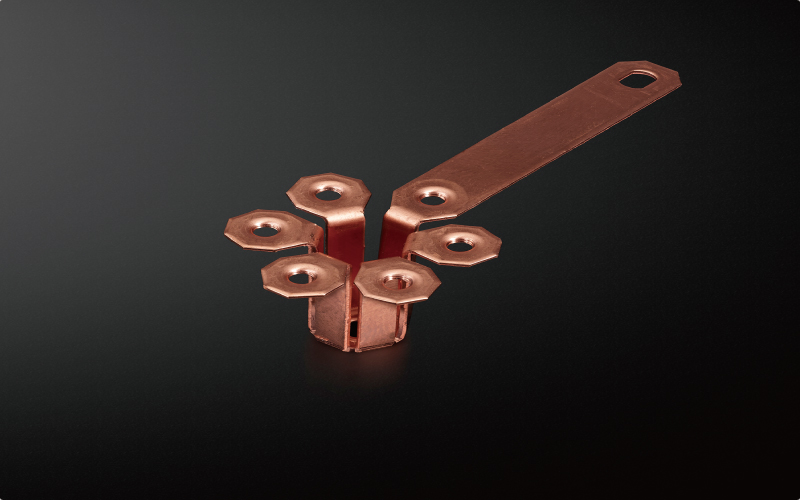
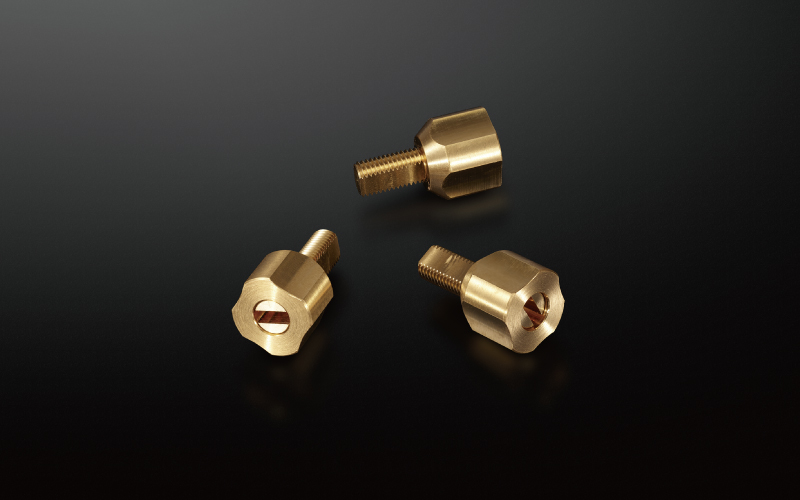 The three phono ground points connect to a Star ground circuit reference point. The chassis ("Frame") ground point connects directly to the chassis. Interestingly, the "star" in star grounding is not an acronym for anything but Luxman refers to it as "Signal Transit for Accurate Response" and further gives it the acronym "PGS" for "Petal-Shaped Ground Supply").
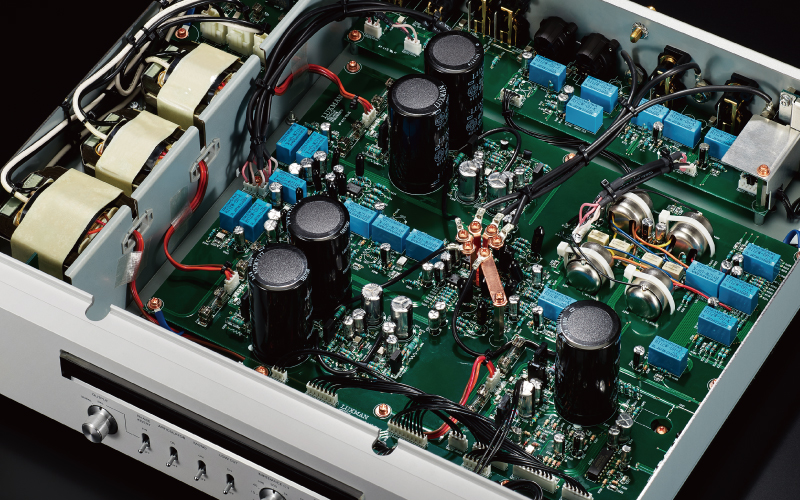
You can see the PGS as well as the four SUTs to its right. Also note the trio of independent power transformers walled off to the left (the trio of associated speedy, low noise Schottky rectifiers are not visible) and the adjacent dual mono circuit boards.
 It had better be quiet after all of this!
Other circuit and construction features include quad parallel FETs in the first amplification stage (direct input in MM and through the transformers in MC), zero feedback RIAA equalization, Luxman designed oxygen free spiral wrap shielded unplated copper wire, Luxman designed and sound tested circuit board components, Neutrik XLR terminals and HQ "18 mm pitch" RCA input/output jacks capable of supporting cables with large plugs.
Moving magnet impedance and capacitance loading options, also located on the rear panel, are unusually versatile. Instead of the usual 47kOhm only setting, DIP switches offer 34K, 47K, 56K and 100kOhm options. The 47kOhm "standard" is really a convenience setting and the correct setting for a given MM cartridge's electrical characteristics are often different. You may find this Hagerman Audio Labs page either useful or confusing! A second set of adjacent DIPS allows MM capacitance settings of 0, 100, 220 and 320pFs. MM gain is 38dB.
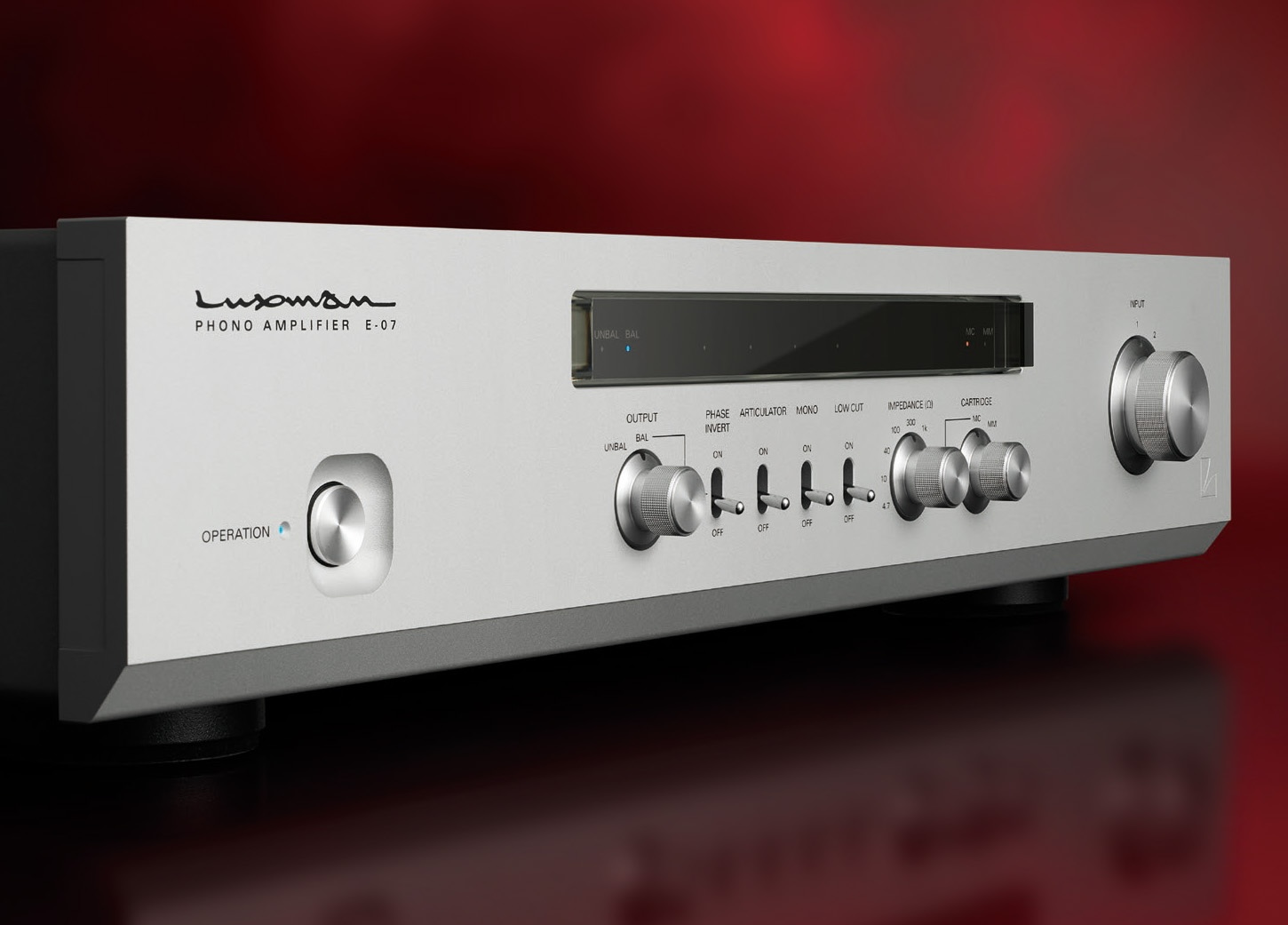
Front panel facilities are equally well organized and complete. Adjacent to the power "on/off" button is a knob to set output to balanced or unbalanced. Next are four vertically oriented"on/off" switches to select "phase invert", "Articulator", "mono/stereo" and "low/cut" ('6dB/octave below 30Hz). All but "Articulator" should be self-explanatory to anyone reading this. "Articulator" is a cartridge and step-up transformer demagnetization feature.
The first of the two knobs to the right of the four switches is a rotary MC-only impedance selector. The choices are 4.7Ω, 10Ω, 40Ω, 100Ω, 300Ω and 1kΩ. The instructions state "It is recommended to select an impedance equal to or slightly greater than the impedance of MC cartridge to use" (obviously bad translation). "Refer to the instruction manual of your cartridge to use" (ditto). The usual "rule of thumb" is 10X the cart's internal impedance.
The second of the smaller knobs selects MC or MM for each of the two single-ended inputs. The large knob on the right side of the front facia selects which of the 3 inputs you wish to listen to. A thick plexiglass strip running across the top includes small LEDs that monitor your choices for all the switches and knobs other than the MC impedance knob. The front panel gives you the look and feel of full control—other than the MM switches on the rear panel.
Some Confusion Then an Explanation
Gain in the specifications are 57dB (MC-HIGH) and 66dB (MC-LOW) and the instructions refer to "Independent MC-HIGH, MC-LOW transformers" but there are no front panel selector switches so how do you select between them? A look at the block circuit diagram explains it. The impedance selector switch also functions as a transformer selector switch. 100Ω, 300Ω and 1kΩ settings shunt the signal to the MC-High transformer while 4.7Ω, 10Ω and 40Ω settings deliver the signal to the MC-low transformer. Confusion explained but the instructions should be further clarified in the next printing.
Set-up, And Use
I ran the E-07 balanced out and used both balanced in and single ended in connections. I did not try a MM cartridge, figuring most users will run this $7995 phono preamplifier using low output moving coil cartridges but given that the circuit is identical with both MM and MC, with the SUTs in MC input the only difference, I figured what I heard through the MC inputs could only be as good if perhaps not better. But I did try the MM section with an external SUT. More about that later.
Using the E-07 was both easy and pleasurable. The switches and knobs had a pleasingly solid feel and the no-nonsense ergonomically designed "control panel" layout put all (but the MM loading facilities) within easy reach. A fast acting relay efficiently mutes the signal when switching, for instance, stereo to mono, or using the low cut filter.
I ran the just reviewed Hana Umami Black on the SAT CF1-12 arm and the Wilson-Benesch Tessellate Sapphire Ti on the W-B Graviton arm. Both cartridges cost considerably more than the E-07. And both for the most part sounded best set to 40 ohms, or about 10X the internal impedance of both cartridges (5Ω for the Umami, 6Ω for the Tessellate), which is the loading "rule of thumb" though both also sounded great loaded further down, program material dependent.
Cue La folia!
 Nothing's more fun when reviewing a piece of equipment then playing a record you've never before played. In this case I was exploring a deep, dark corner of my utility room where I know there are many unplayed great records and i came up with this oddity. Now I knew this as a Harmonia Mundi, France record (HM 1050) with a different gatefold jacket cover. My copy of that one was given to me years ago by Keith Herron, who some of you know as a designer/manufacturer of phono preamps and amps. But what was this (other than an Atr Master cut Recording (ATR 013 LP)?
I guessed it was a special audiophile issue of an already audiophile quality record that combines exceptional musicianship of the Atrium Musicae de Madrid and its director/conductor Gregorio Paniagua performing his original, and sometimes zany compositions that are musings on an ancient Spanish dance melody, recorded with spectacular audiophile quality sound.
This same group and conductor performed the renowned BIS release la Spagna that was also reissued by AudioNautes records, mastered by Stan Ricker, but is now out of print. Coincidentally I used that record in a review for The Absolute Sound of the sonically spectacular and spectacularly costly (at the time pre tariffs $89,000) HSE Swiss Masterline 7 that Jacob Heilbrunn reviewed here almost a year ago.
But back to the music for a sec. Yes, it's based on an ancient dance music form but the composer goes all Spike Jones adding sound effects of gun shots, birds and noisy automobiles plus musical references to Henry Mancini's "The Pink Panther", "Turkey in the Straw" and some Indian rhythmic countdowns. On the final track the composer/conductor is credited for playing "Land Rover". Get the picture? But it's all neatly tucked into serious playing and composing. So why not start with this Atr record? It was a version of a familiar record but an unfamiliar version on an equally unfamiliar phono preamplifier.
Wow!!!!!!!!!!!!!
Within about a minute listening to this record through the $7995 Luxman, the HSE's spectacular sonic performance surprisingly sprang to mind: an enormous, airy soundstage deep and wide, instrumental dulcimer "pluck delicacy", generous sustain and decay, macro dynamic slam, dramatic bass authority and flute and percussive hits that floated eerily seemingly inches from my face. Soon there was a tabla of exquisite delicacy yet strong physical presence to the right of the left speaker. When there was musical silence, the background was dead quiet but you could still feel the air in the room. This was expected performance from a far more costly phono preamp.
A bit later the "Pink Panther" theme emerged, followed by a giant tabla, and soon an enormous, startling crash. Somewhere in there a bottle of cognac explodes (that it was Cognac was identified in the Harmonia Mundi edition, I'm not saying the E-07 is so good it told me that!).
Instrumental attack throughout was precise and delicate, sustain and decay generous thanks to the background quiet, and transparent. Both image size and the deft touch with which they were drawn produced uncanny realism, actually both because they sounded that way and because this was not at all what I was expecting, though I was anticipating something competent.
I expected good but not this good and I'll tell you why. Two things: first transformers in the signal path can be great but they can also be an impediment to transparency. The HSE doesn't use transformers and it's measured quiet is almost twice that of the E-07 (and most phono preamps). Some of the best transformers cost more than the E-07 and they are generally large. That's the first thing. The second is that the E-07 uses blocking capacitors not a servo-system to block D.C. While Luxman doesn't specify what components were custom or what role they served in the circuit I'd guess perhaps in the RIAA filter and especially in the blocking caps. This level of transparency and delicacy isn't accidental. But maybe I'm wrong about that.
I had to play the La folia version I was familiar with and of course it wasn't nearly as dynamic, transparent and three-dimensional as the Atr edition (I assume tape playback on an Ampex ATR?) but still the lesser still outstanding sounding French original produced identical, absolutely impressive "audiophile checks": dynamics, transparency, imaging, staging, you name it. An excellent start to a review experience and I wasn't yearning to return immediately to the far more costly CH Precision P10. I wanted to hang around this kind of sound.
Next I sampled the Music Matters Blue Note edition of Unity (MM BST84221) a very familiar record and one referenced in the Bob Blumenthal's annotation in the outstanding reissue of Woody Shaw's Love Dance (TT-M004) on Zev Feldman's Time Traveler label that originally appeared on Muse. I'll get to that review ASAP but for now, what I learned from Unity, (Shaw's amazing recorded debut!) was that the best loading for the Tessellate cartridge wasn't static. Here, 10Ω or just slightly above the cart's internal impedance (as suggested in the instructions) produced the most satisfying and recognizable result: Shaw's trumpet had the correct timbral balance, not too bright and Elvin's incredible cymbal work rang true. When Henderson entered it had that immediately identifiable "honk". Young's organ center channel brought the juice and overall the album was rendered nicely through both cartridges, but the bass notes played by Young were not quite as forceful and well-defined as expected compared to far more costly phono pres. Same with Elvin's kick drum. Good but not as deeply felt as possible. Still an enjoyable sonic ride especially in the upper frequencies. You'd enjoy the tightly compacted crack of the snare sound for sure.
Moving on to Nat King Cole's Love Is the Thing (Analogue Productions APP 824-45)—a record not played in along time—I wanted to hear if there was sufficient weight to Nat's voice. It was nicely rendered as were the strings. Nat's sibilants had a bit more "SSS" to them than expected through both cartridges, and his rich "chesty" timbre was slightly attenuated as expected from how Young's organ sounded like on the previous record, but overall the presentation was well detailed and enjoyable. The mic "pops" were cleanly reproduced and were short defined events not "blobs" that lingered. That this is a quiet phono preamp was clear by the black backgrounds against which the strings and Nat's voice appeared. No, this isn't an $89,000 phono preamp, but a highly accomplished and nuanced one, though if you're a "tube person", while you would probably appreciate the clarity and quiet, it wouldn't be for you.
Paul Seydor's masterful review of the new Decca Pure Analogue reissue of Sibelius's Symphonies #5 and #7 (Phillips 487 14959) mixed live from the 4 track tape by Rainer Maillard and cut by Sidney Meyer is everything Paul wrote it was (it quickly sold out at Acoustic Sounds, Elusive Disc and Music Direct!) and definitely 11/11. I'd not played it before so had no reference, which is probably a good thing. Compared to nothing, the E-07's rendering brought a Cinemascopic "you are there" orchestral picture within the shoebox confines of Boston Symphony Hall that maybe I "see" because I'd been there many times?. Bottom end weight was more than sufficient to deliver the power of the double basses and the full power of the orchestra. Strings and brass were richly convincing—especially the almost glowing burnished brass—and the total absence of instrumental congestion impressed. The transparency noted in the La folia made its presence known as eyes closed the E-07 produced a thrilling "you are there" three dimensional experience enhanced by superbly quiet vinyl surfaces. The power of the presentation, the effortless dynamic contrasts reminded me of the D2D Bruckner 7th and that's saying something about both the recording and the E-07. Maybe it is better to review less costly equipment than you're accustomed to using unfamiliar recordings? The E-07 had me fully sonically satiated here.
Finally for a rock sample I went with a U.K. Pye pressing of The Kinks' Lola versus Powerman Part One and The Moneygoround (Pye NSPL 18359). Side two's melancholic opener "This Time Tomorrow". The album is bass shy, though the bass that's there is cleanly recorded. There's a strummed guitar and a National Steel Resonator plus piano and drums. A lot going on in a narrow frequency band. I noted the same bit of sibilant over accentuation I heard on the King Cole record, but Ray's voice otherwise sounded cleanly "Ray" and as with all of the records I auditioned, imaging was three-dimensional with Ray upfront center stage occupying a specific space, drums behind. The piano easily lost on lesser analog front ends, was easy to follow as was the vocal doubling. The same character that produced the consistent slight sibilant excess also produced a most pleasing snare sound from Mick Avory's drum kit. Overall, the E-07's crisp rhythmic presentation delivered rock records with authoritative snap.
Transformer Substitute
How would substituting a pair of costly SUTs into the MM input affect the sound? On the Nat King Cole record the strings became richer, sweeter and grander, though they were very fine directly into the E-07. Nat's voice also benefitted. No point delving further here. You can buy the E-07 and enjoy as is and later, if desired try more costly transformer tweaks and you'll hear the upgrade. From this I can say without question that running an MM into the E-07 would yield a positive sonic outcome.
Conclusion
All expectations of a competently designed, enjoyable sounding phono preamp from this veteran company that "grew up" in the analog age, were more than met. First play produced somewhat of a sonic shock, so nuanced and pleasing was the sonic performance.
Lush it's not but properly neutral and uncolored it is. Luxman's E-07 made for a fun, fast paced long term listen. It's also got that rhythm'n'pacing thing in spades. It's quiet too, allowing it to reveal all that lurks in the background of familiar recordings. Solo voices or instruments center stage appear in vivid contrast to black backgrounds behind. If fed a warm recording it delivers it. If it's a cool one you get that. The only consistent timbral tick was where vocal sibilants reside. This seemed to be a consistent character on all vocals, male and female but it's a minor "thing" because otherwise warm recordings sounded that way as did cool ones. The Sibelius referenced in the review was majestic and vivid. The Larry Young record, correctly bright with cleanly rendered transients. The E-07 could sound liquid and it could sound hard depending on the recording. The overall sonic character was timbrally neutral with low distortion, fast pacing and an overall no-nonsense, lively sound. Above all else the E-07 was quiet. I tried the Articulator and thought I heard a bit of an improvement in what already was excellent transparency but it's neither a deal maker or a deal breaker.
Overall the E-07 delivered musical excitement from the first record I played and it kept me happily listening for more weeks than the distributor probably wanted me to hold onto it. If you're looking for a versatile phono preamp in the under $10K price point, don't buy until you get a chance to hear the Luxman E-07. I'm glad I did.
Specifications
Circuit configuration: Non-feedback type phono equalizer (RIAA, first stage four parallel FET, unbalanced configuration)
MC step-up transformer: Super permalloy core x 4 (L/R channel, L/H impedance independent) : 0.3mV / 100Ω
Input sensitivity: MM 3.2mV, MC-H 0.37mV, MC-L 0.12mV
Rated output/output impedance: 250mV / Unbalanced 300Ω, Balanced 600Ω
Load capacity: MM 0 / 100 / 200 / 320pF
Gain: M 38dB, MC-H 57dB, MC-L 66dB
Maximum input: MM 120mV, MC-H 15mV, MC-L 5mV
RIAA response: MM 20Hz to 20kHz (±0.1dB), MC 20Hz to 20kHz(±0.3dB)
Total harmonic distortion: 0.003%
S/N ratio (IHF-A): MM 88dB, MC-H 81dB, MC-L 78dB
Channel separation: 80dB or more
Power transformer: OI type x 3 (L/R independent + Peripheral circuit)
Insulator feet: Density gradient
Power supply: 230V~(50Hz) / 115V~(60Hz)
Power consumption: 13W
External dimensions: 440(W) x 92(H) x 407(D) mm; front side knob of 14mm and rear side terminal of 37mm included in depth
Net weight: 13.2kg (main unit)
Accessories: Power cable
Price: $7995
Manufacturer Information
Luxman Corp.
1-3-1 Shinyokohama
Kouhoku-ku Yokohama-shi
Kanagawa 222-0033, Japan
(81) (0)45-470-6980
Imported to North America by Rhythm Distribution
1330 Monte Vista Ave Suite 6
Upland, CA 91786 USA