
PrimaLuna EVO100 V2 Phono Preamplifier
Enthusiastic, Excellent, Engaging, and Fun
Rather than try to build some suspense and to keep you from just scrolling to the bottom of this review, I’ll just start by saying I love this PrimaLuna Evo100 V2 Phonostage and I’ll be sorry to pack it up and send it back.
I was looking forward to trying this new version, as it included the ability to switch between 12AX7 and 6922 tubes in the MC gain section. Herman van den Dungen, PrimaLuna’s founder, told me that PrimaLuna’s designer, Jan de Groot, wanted to make the original Evo100 Phonostage more felixible, and fun to use. So he figured out a way to allow swapping the types of tubes used in the MC gain stage and allow more opportunities to tube roll and enjoy their different sonic characters. Specifically, in the V2 it’s now possible to swap out the original 6922 tubes and use 12AX7s instead. Or even 12AT7s and 5751s. This new version has a current retail price of $4,495USD.
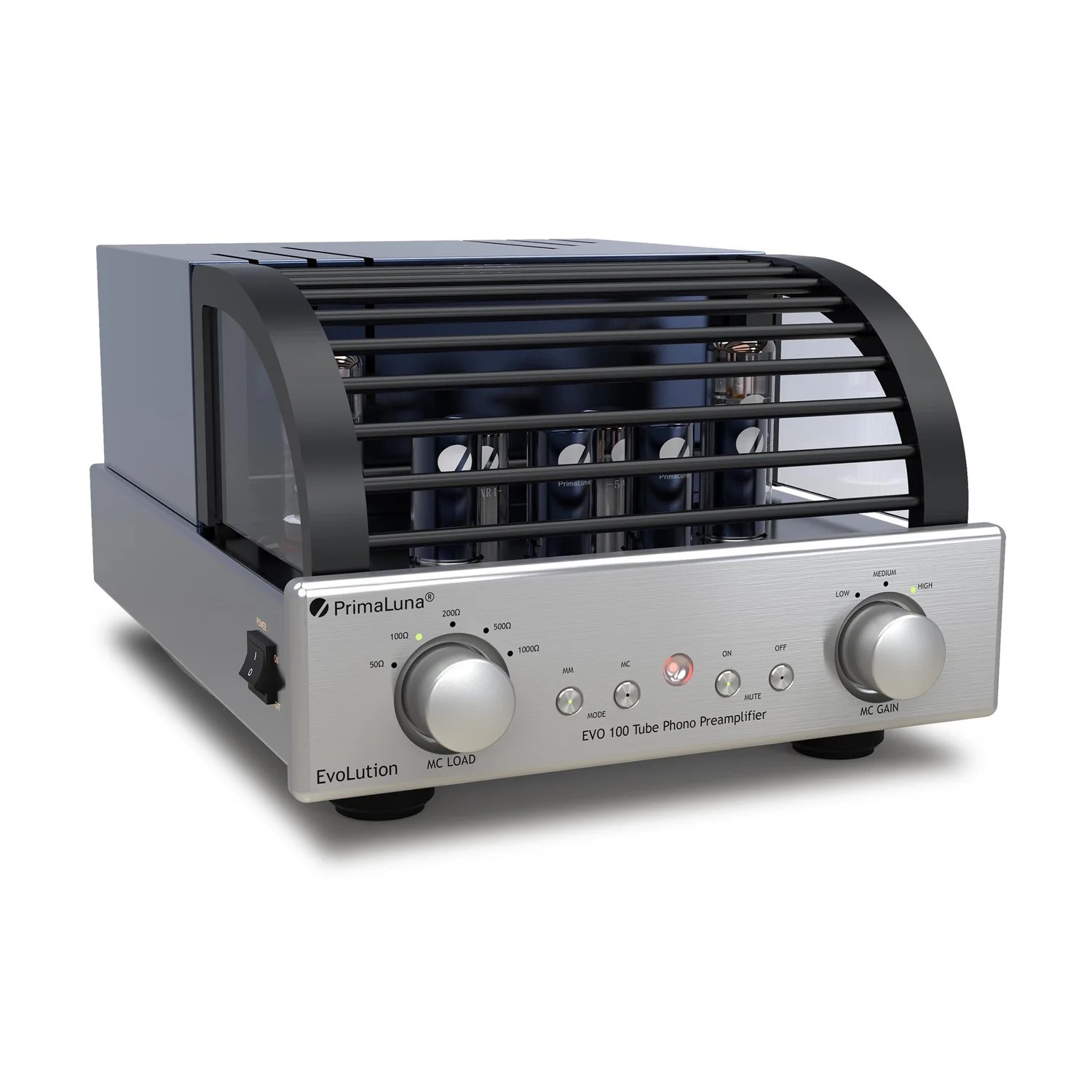
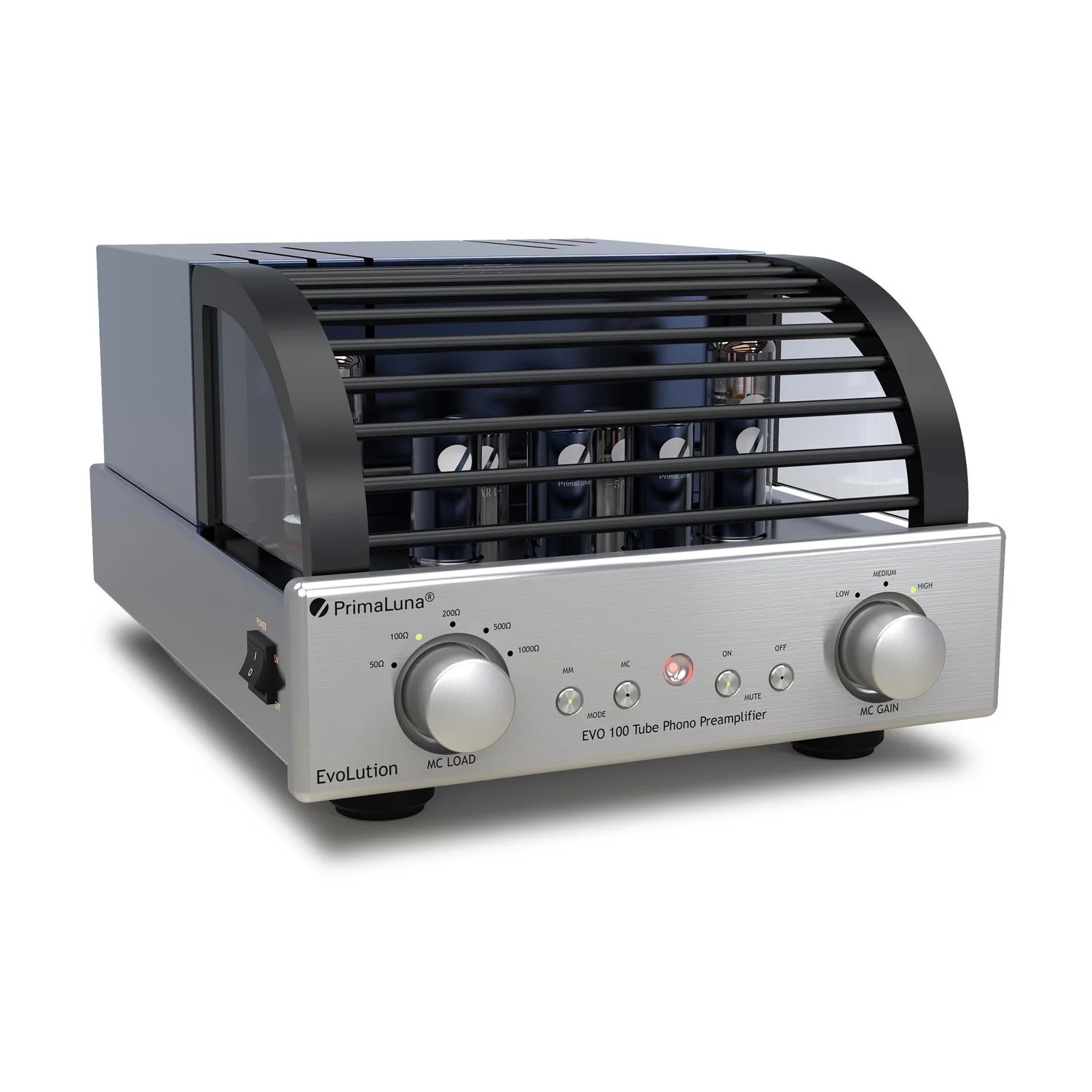
Right from the initial unboxing I found the somewhat unusual form factor of the Evo100 V2 Phonostage intriguing – very much the usual steampunk rolltop desk aesthetic PrimaLuna is known for, but much thinner than most components – at 11”W x 7.5”H x 15.9”D and weighing 28.7 pounds it’s a good 6 inches thinner than what I tend to think of as a standard 17”wide component, while still exhibiting some serious heft and having the feel of a serious piece of equipment. It comes with either black or silver face-pieces – my review unit is silver.
Herman explained that the slim footprint is in part a design reference back to PrimaLuna’s initial ProLogue series, which had a similar footprint and were quite well received, and in part because there just wasn’t a need for a bigger box. As he said, they try to avoid big empty boxes, and while other recent PrimaLuna products required larger boxes to accommodate larger power supplies and other parts, this Phonostage didn’t require anything more.
The front panel is uncluttered, functional, and clear - with buttons to choose between MM and MC operation, On and Off buttons for the Mute, a status light, and two dials for MC operation – one for Load and one for Gain.
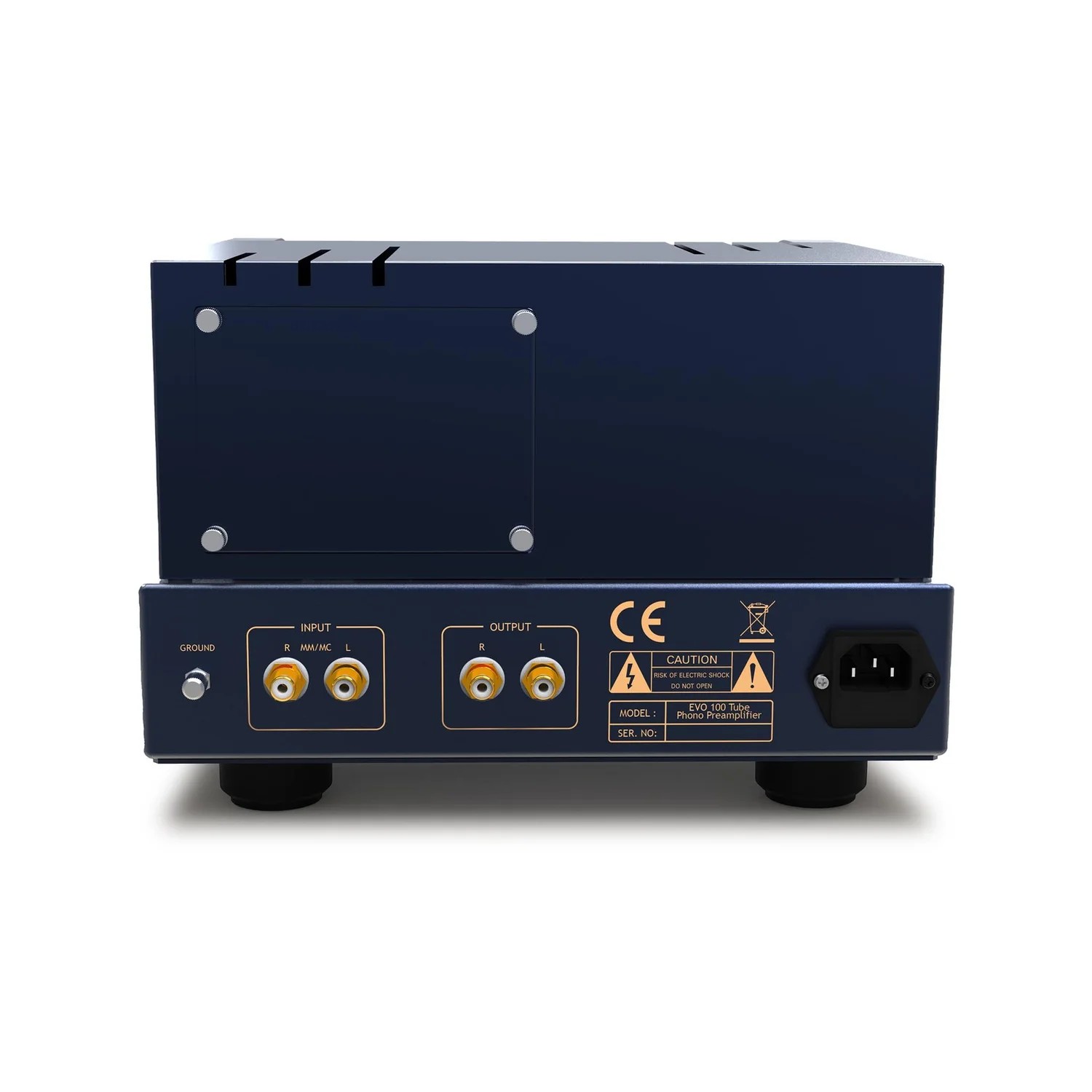
Around back, it’s even less cluttered – simply an IEC power receptacle, a pair of RCA inputs, a pair of RCA outputs, and a ground lug. Only one set of inputs, no XLR connectors, and to my great relief no dip switches or other controls in head-scratchingly inaccessible places. Although as I soon discovered this wasn’t exactly true…
The Evo100 Phonostage comes with its full tube complement installed – according to the website and the manual that consists of ten total - a pair of very welcome 5AR4 rectifier tubes (love me some good tube rectification), a pair of EL34 tubes to stabilize the power supply, 4 12AX7 tubes form the MM gain stage, and a final pair of 6922 tubes for the MC gain stage.
So I was confused – looking at the tubes through the rollcage and applying both fingers and toes to the task I counted the two AR4s, the two EL34s, and all 4 12AX7s. I had two toes left over. Not seeing any 6922s.
As you can see in the above photo, the back of the unit has 4 thumbscrews which allowed me to open up a rectangular panel - however on the actual review model that rectangular panel also has a sticker applied to it.

Opening that panel reveals the two MC gain tubes, which are labeled as 6922s. Ok, I can put my socks back on.
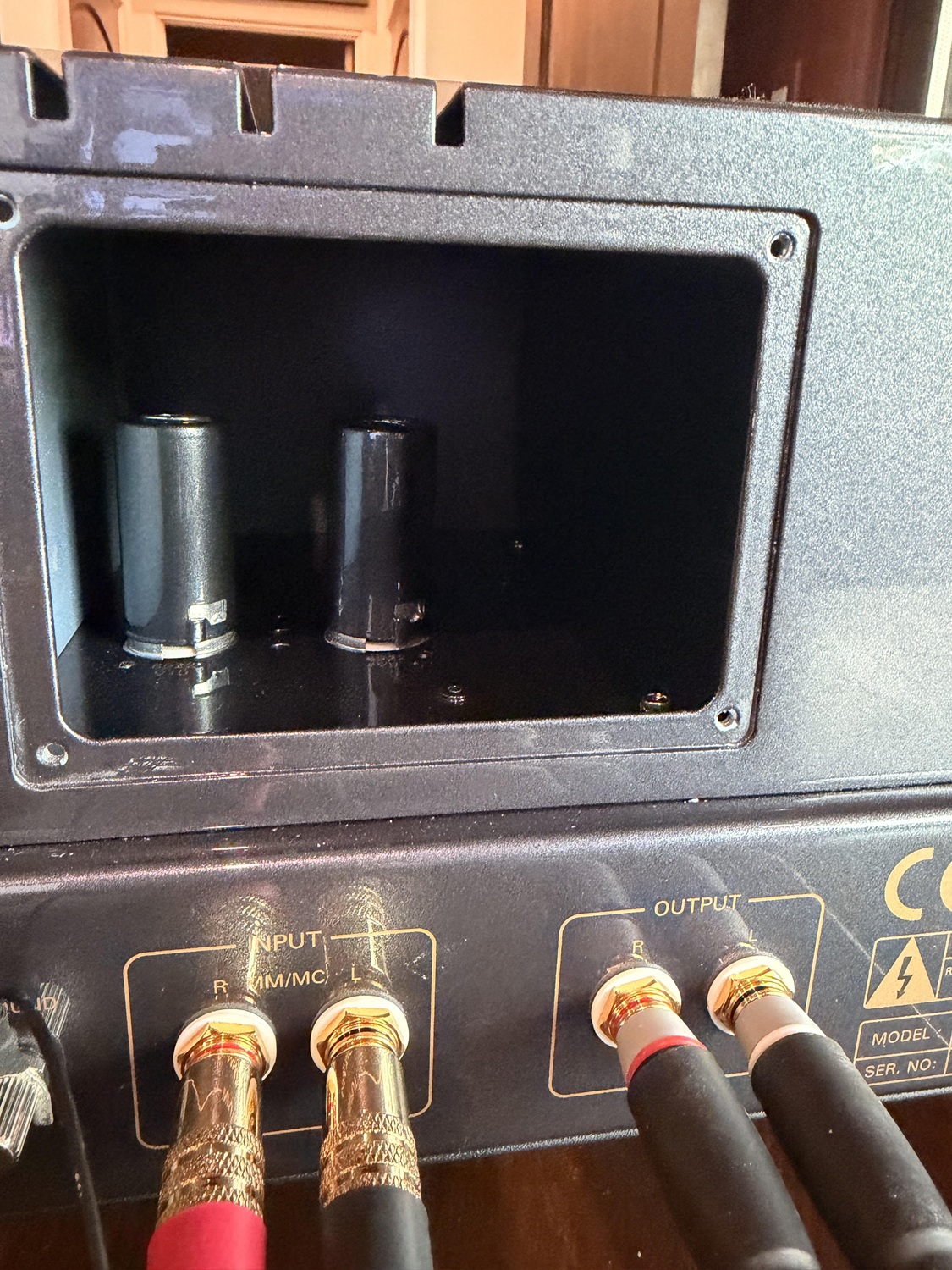
But I was still confused – the warning sticker on the back panel refers to a switch, and I didn’t see one on the back panel, inside the secret MC gain stage compartment, or anywhere else. And this is when I actually read the entire manual rather than just skimming it.
It turns out that if I wanted to switch between 6922s and 12AX7s in the MC stage I’d have to flip the whole unit over and remove the bottom panel to find the switch. So much for my relief about not having any inaccessible phonostage controls.
Opening up the bottom panel did allow me to see the signature PrimaLuna point to point wiring, as well as a switch, which seemed to match up with the photo of the switch in the manual. Although neither the switch itself nor its two positions appear to be labeled.
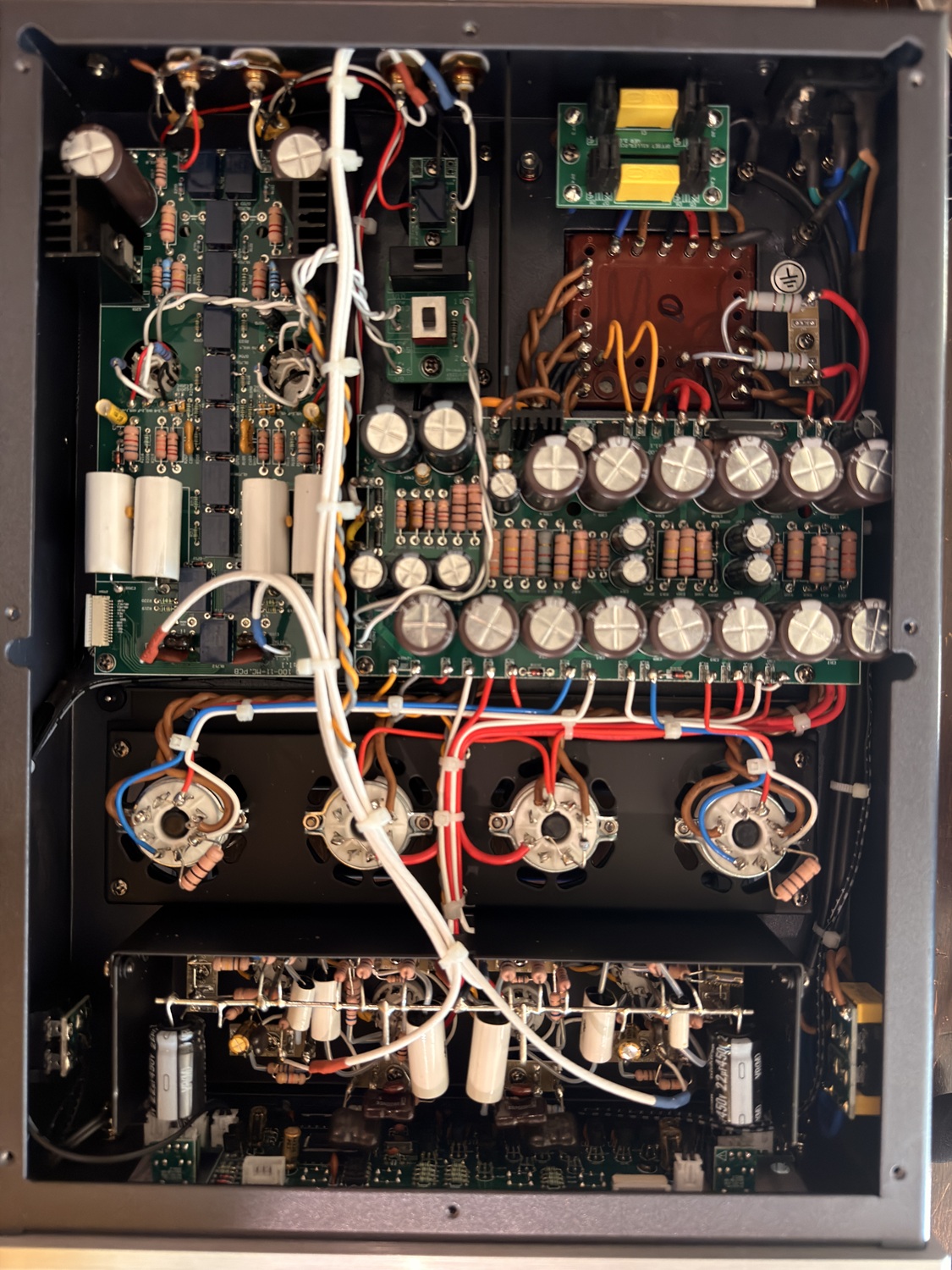
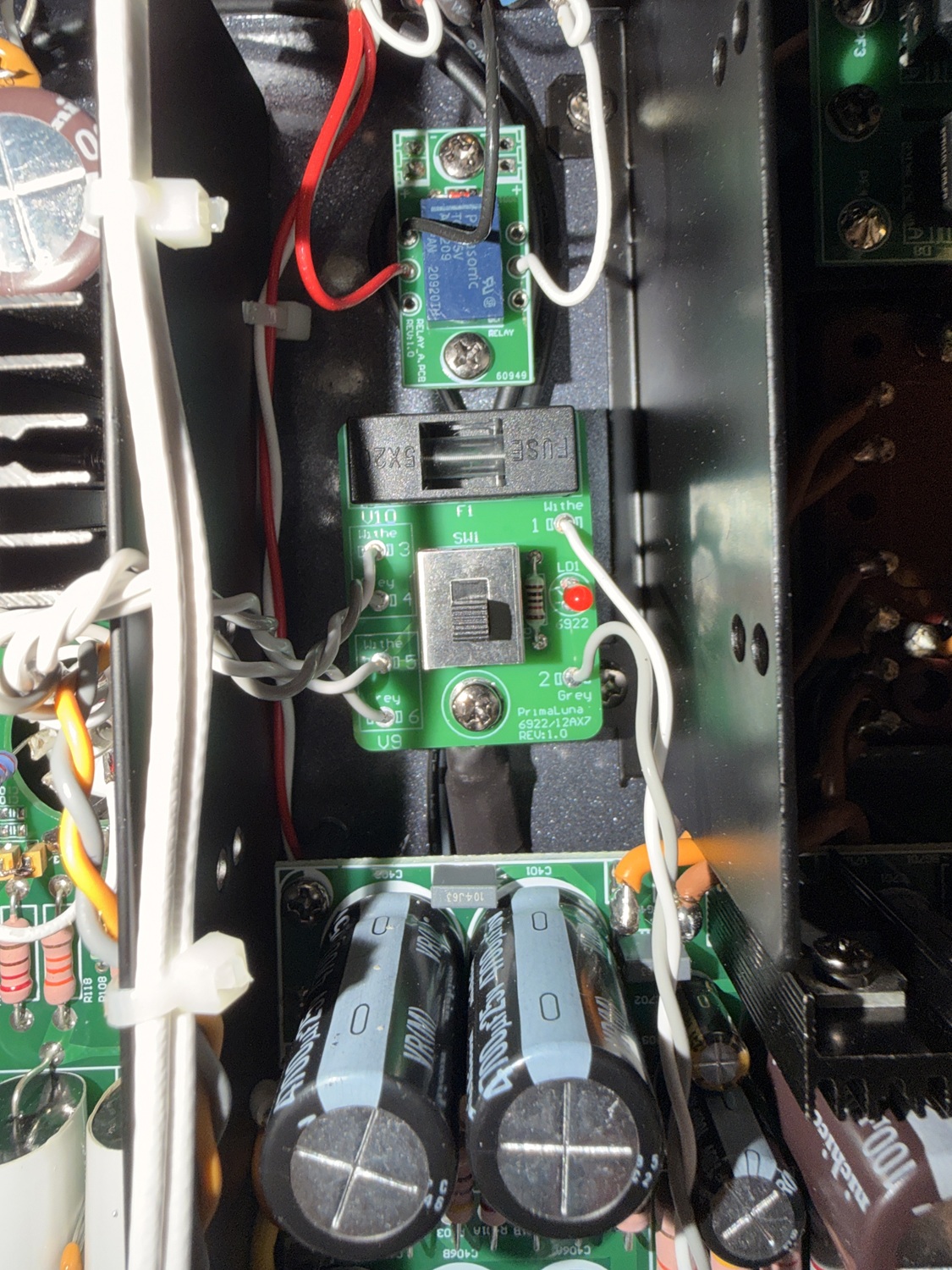
As a friend regularly points out to me: If at first you don’t succeed, read the directions. If that doesn’t work, follow them. So when referring to the manual, I found two photos of switches with a direction to note the position of the switch in the photos. If that matches the position of the switch in the actual unit, the 6922 MC gain stage tubes are actually 12AX7s and the unit is set to use them. That manual photo matched the switch inside my unit, so I finally concluded that the MC gain stage tubes in my review unit were actually 12AX7s rather than 6922s. And that if (or more accurately when, knowing me) I wanted to try some 6922s instead, I’d have to open up the secret compartment in back, remove the tubes, flip the unit over, remove the bottom panel, flip the switch, replace the bottom panel, insert the new tubes, make very sure they’re the right ones, even though the switch isn’t labeled and can’t be seen at this point in the process anyway, and replace the back panel.
To be fair, the switch does have little red LED which lights up if the switch is in 6922 position, meaning I also need to plug the unit in and turn it on with the bottom panel off and all the wiring exposed before replacing the bottom panel to make sure the LED is illuminated. And I always thought tube rolling was fun.
As you can tell, I found this whole unlabeled switch situation less than ideal, but when armed with the manual, a screwdriver, and some patience, it worked just fine. I’ve gone into this detail because of the existential danger that can result from using mismatched tubes and switch settings. You’ve been warned. And I haven’t caused the review unit any irreparable damage, and if I can manage that it can’t be too difficult.
Once I got the tube identification and switch sorted out, my attitude changed immediately and I started getting it into a system. I hooked the Evo100 V2 up to a Pure Fidelity Harmony turntable with a Supatrac Blackbird tonearm, and then ran the output into a PrimaLuna EVO400 Preamp and a Pass Labs XA25 Amp, which powered a pair of Klipsch LaScala AL5s. Speaker wire was Cardas Clear Reflection, interconnects and phono cables were Analysis Plus Silver Apex. Power cables from Triode Wire Labs, Power Conditioning and Grounding from Puritan Audio Laboratories.
Prima Luna suggested that I use the Evo100 V2 with MC cartridges having output levels over .4mv. Herman’s rationale for that was that some people, especially those new to tube phonostages, might not realize that the 60dB of gain generated in a phonostage is a lot, and that there will be “noise” from the tube phonostage until the needle is dropped – the lower the cartridge output, the higher that potential pre-needle-drop noise could be. Herman went on to point out that in the EVO100 V2 there are no chips or FETs in the signal path, which means no “chip tricks” to hide what appears to be noise while adding a solid stage edge to the sound.
I started out with a MM cartridge, an Ortofon MM Black LVB 250, which of course had NOTHING whatsoever to do with not wanting to deal with the tube/switch MC gain stage thing. Of course not. With the Ortofon’s 5mV output I felt in virtuous compliance with PrimaLuna’s output suggestion. I pressed the MM button, engaging the MM 47kOhm loading and the switch on the right side of the unit, which toggles MM capacitance loading between 47pF and 100pF, at 47pF. I do most of my listening with MC cartridges, and find I most enjoy MM with material which I categorize as More Rock Than Not. So I grabbed Bob Marley and The Wailers’ Babylon By Bus, a 2015 Reissue by Tuff Gong (Tuff Gong – 602547276230, Island Records – 602547276230, Universal Music Group International – 602547276230).
Finally – music. And an immediate big smile. This sounds great – an immediate, energetic, propulsive feel. Voices are out front, with the rest of the band clearly separated from each other across a soundstage between the speakers. Without the detail I expect from an MC cartridge, I was still hearing clear differences between drums, among the cymbals, and the tones of the instruments were clear and dense. I can’t say that the MM cartridge revealed much of the finely grained textures of voices and instruments, but I was hearing a band, not a single source of sound. And this band was rocking – the sound was enthusiastic, clear, energized, that feeling of music being alive and lit from within that I love about vinyl played well.
That impression held very true as I grabbed some more records. The Pentangle, the 2021 Renaissance Records release on marbled vinyl (RDEG-LP-889), one of my favorites from the English Folk Rock era, although it always feels much more jazz to me than rock. And The Mysterious Film World of Bernard Hermann, 1975 from London Phase 4 Stereo (SPC21137).
As with Babylon By Bus, I wasn’t hearing a depth of micro-detail, not much texture on the individual voices or instruments, but they were clearly voiced, both in tone and in the soundstage, which was widely spread between the speakers. And the sound was rich and full – not at all to say indistinct or smeared, but with weight and substance, expressive and very organic. In the Bernard Hermann disc the instruments weren’t individually identifiable, but the sections were certainly apparent, and the bombastic dynamic swings were immediate, powerful, and without distortion.
I was certainly enjoying what I was hearing and wanted to get a MC cartridge on the tonearm. Keeping in mind the output recommendation, I went with a Hana MH, which seemed a likely combination with this phonostage in the wild, and which has an output level of 2mV which fits PrimaLuna’s suggested output. Without messing with tubes or switches I started with a mandatory HO MC 47kOhm load setting and the medium gain setting.
And my smile just got bigger. This thing sounds great in this system. On the three discs mentioned above the MC cartridge started revealing much more detail and dynamic nuance. Voices projected forward from the soundstage which, while it never extended past the speakers, felt deeper and more three-dimensional. Instruments were clear, realistic, their sound solid and alive, well separated and distinguished, and the whole having a feeling of enthusiastic music making – immediate and engaging.
I put on one of my sister’s favorites – Lukas Nelson & Promise of the Real, from 2017 on Fantasy records (FAN00175). I was struck by how much Lukas’ voice resembles his father’s – that reedy quality, the wistful phrasing, an underlying humor even in despair. On the track "Forget About Georgia" I could hear all of that clearly, out in front and easily distinguished from the band, who sounded immediate and alive and entirely solid. Good stuff indeed.
Listening to Santana’s Abraxas, a 2020 Columbia/Legacy reissue (88875194291), I was smiling, nodding my head, tapping my foot, completely enjoying what I was hearing. Again, voices and Carlos’ guitar were front and center, the tones and voices clear and distinct – the whole band presented across that wide soundstage between the speakers, and each band member distinct in space. The word that kept coming to mind was enthusiastic. It felt like whatever I played, the EVO100 Vs was enthusiastic about – ready, willing and able to make some thoroughly enjoyable music.
That enthusiasm continued as I shifted into some more acoustic material – the new RSDBF disc Jazz Sabbath Live (2025 Blacklake BL411401) was just more great sounding fun. Piano, bass, and drums, playing music which was very familiar and at the same time very out of place. I was hearing a lot of the beginning complexity of the piano’s notes, which I rarely hear, and as a part of a coherent whole. The bass was solid, tuneful, tight, not a bit flabby, and the drums felt immediate and explosive. I don’t mean to suggest that I was hearing the same level of detail as, say a CH Precision P1 presents, of course not. But I am trying to say that the detail was entirely sufficient, combined with the energetic feel, the solidity of tone, the clarity of time and space, to pump out some fiercely enjoyable music.
I had that same experience with Mahler’s Symphony Number 5, with Claudio Abbado leading the Berlin Philharmonic (DG 486 4061). I wasn’t hearing enough detail to separate individual instruments, but the sections were distinct and solidly presented across that same wide soundstage. A very wide dynamic range without a sense of strain or breaking up at any point, the tones and resonant identities of the instruments were clear and faithfully presented throughout, although without the fine grain of those tones.
You get the idea – I’m enjoying everything I’ve been playing through the EVO100 V2, and my overriding feeling as I do are enthusiasm, fun, and engagement. And damn it sounds great. With the EVO100 V2 in place, it’s almost like this system is a young golden retriever – energetic and always enthusiastic to play, to run, to cuddle, and just be a thorough delight. Yeah, I really like this thing.
Because I have a somewhat complicated relationship with rules and “suggestions” I couldn’t just stop there. I shifted to a Hana ML (L for Low output) cartridge which has a .4mV output, right on the edge of that suggested by PrimaLuna. And I liked it even more than the Hana MH (H for High output). The amount of detail, especially in voices and acoustic instruments was more obvious, the small dynamic shifts more subtle and realistic, and the overall tones sounded more organic. That shift did also involve changing the MC gain tubes and balancing their different qualities with the much lower output of the Hana ML.
Which takes me to another note about tubes. The unit comes from the factory with PrimaLuna branded tubes which come from Sovtek, ElectroHarmonix, and PSVane. According to Herman, in the course of a multi-step quality control process, a batch of 100 tubes is evaluated, and the 60 best in that batch are printed with PrimaLuna labels. Those are tubes shipped in the Evo100 V2 Phonostage.
I couldn’t possibly have a unit sporting 10 tubes in my clutches without trying some others. And while I love tube rolling and listening to the musical results from the changes, my overall impression is that it’s very difficult and probably overly expensive to do better than the tubes which were shipped with my review unit. The phonostage was voiced for these tubes, and PrimaLuna has absolutely created something that works beautifully. I tried some very old Mullard rectifier tubes, which were, as expected, marvelous but probably too expensive for a phonostage in this price range, some old Telefunken 12AX7s, some new production 12AX7s and 6922s from other makers, and overall kept coming back to the stock set as the best balance of value and sound from any that I tried.
One tube change that might be significant when using a lower output cartridge is that the 12AX7 tubes, in the MC gain stage, will produce about 2dB of gain more than the 6922s. So when dialing in the load and gain on the phonostage it can be useful to use those different types of tubes to give more gain choices than just the three on the dial. In my case, when I installed the Hana ML cartridge, I found that the medium gain setting sounded the best, and the 12AX7 tubes added just enough more gain to that setting. And again, that’s what was shipped with my review unit.
And finally, while I generally feel that comparisons are at best unpleasant, I did compare the EVO100 V2 with another phonostage of approximately the same price range which I have here. It’s the Lab12 Melto2, to which I’ve added NOS Telefunken tubes. I believe its current retail price is around $4,500USD. I’m not going to pretend I conducted a rigorously designed experiment, all I did was unhooked the EVO100 V2 and hooked up the Melto2 in its place and adjusted the gain by ear. What I heard was an immediate and obvious decrease in the energy and drive of the music with the Melto2, although the detail had finer grain and microdynamics flowed with more subtlety. My internal shorthand was the Melto2 sounded more like brain music, while the EVO100 Vs was more about heart, soul, and balls. The Melto2 is significantly more flexible, with multiple inputs, more loading choices, a mono option, the ability to change everything via remote from across the room, but I hurried to replace the EVO100 V2 because damn, it’s fun and I wanted to hear more music through it.
PrimaLuna has a winner here. They’ve added some tube rolling flexibility to an already successful phonostage, and as far as I’m concerned, this thing sounds great, is FUN, and at around $4500 isn’t exactly inexpensive but certainly isn’t in the high end tube phonostage territory. It’s not going to deliver analytical detail and composure, but in my system it delivered smiles and fun by the handful. The unlabeled interior switch for the MC tubes is something I found inconvenient and unnecessarily risky, but not at all a deal-breaker. If you’re in the market for a phonostage in this price range I truly believe you’ll have a hard time finding one that outdoes the EVO100 V2 for sheer fun and enjoyment. Which, when it’s all said and done, are some of the most important reasons I have a system.
Specifications
Output Impedance: 100 Ohm
Input: 1 x Stereo RCA
Output: 1 x stereo RCA
Moving Magnet Stage
Gain: 40 dB
Input Impedance: 47 kOhm
Input Capacitance (Selectable): 47 pF, 100 pF
Moving Coil Stage
Gain (Selectable): 60, 56, 52 dB w/6922 62, 58, 54 dB w/ 12AX7
Input Impedance (Selectable): 50, 100, 200, 500, 1000 Ohm
Tube Complement: 2 x 5AR4, 2 x EL34, 4 x 12AX7 MM, 2 x 12AX7 MC (switchable)
Dimensions (LWH): 15.9" x 11" x 7.5" (405 x 280 x 190 mm)
Weight: 27.9 lb (12.7 kg)
Manufacturer Information
PrimaLuna
DUROB BV
P.O. Box 109
5250 AC Vlijmen
The Netherlands
General Enquiries
Phone: +31 73 5112555
Distributed in the USA by:
Harmonia Distribution
1712 Corrigan Ct
La Verne, CA 91750
(909) 931-0219