
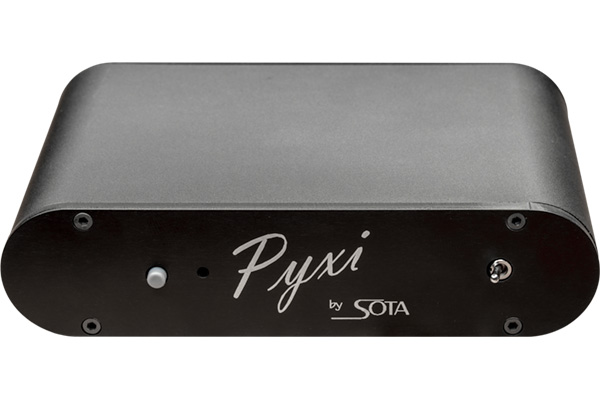
SOTA Pyxi MM/MC Phonostage Punches Way Above Its Weight Class
you could fool your friends....
The full SOTA story deserves telling but this isn't the place or time but a Reader's Digest condensed version begins with the late Dave Fletcher, an experimental physicist who left the U.C. Berkeley Particle Lab to be his own boss and in 1972 co-founded Sumiko.
During vinyl’s heyday, Sumiko was a leading North American importer of phono cartridges and tonearms, introducing brands to America that included Grace, Supex, Fidelity Research, Koetsu, Kiseki, Lustre, Audio Note and Breuer. Today, among other things, Sumiko manufactures a line of well regarded phono cartridges, manufactured for it by Excel Sound, including the new Oriole.
Fletcher and Robert Becker founded SOTA in 1980. First up was funding a Rod Herman effort to better the Linn Sondek LP12, which itself knocked off an Ariston design that was based on the classic Thorens suspended design, all of which evolved from Edgar Villchur’s original AR turntable.
SOTA's Star Sapphire offered vacuum hold down, variants of which found their way into other brands including Micro Seiki. Allan Perkins joined in 1985 and his ideas were incorporated into SOTA designs. Later he founded Immedia and introduced turntables under that name and later Spiral Groove. Still later he designed the outstanding MoFi electronics MasterDeck turntable.
Fletcher and Becker sold SOTA to Jack Shafton in 1991 but he wisely got out not that long afterwards just before vinyl died, selling it Kirk and Donna Bodinet. They moved the company to Illinois and revived the brand as vinyl mysteriously revived itself. Then in 2015 Kirk passed away suddenly at age 52.
Donna soldiers on and more likely than not you'll see her in AXPONA's marketplace along with SOTA's turntable line some of which keys directly off of those original now classic designs.
Pyxi
For this moderately priced turntable Sota joined forced with Wyn Palmer, a former senior fellow at chip maker Analog Devices (conflict of interest warning: I am an Analog Devices shareholder), who has a strong Internet presence as a designer of low cost high tech amps, preamp, headphone amps and such, and Phoenix Engineering's Bill Carlin, whose products I've reviewed over the years including the RoadRunner digital tachometer and the Eagle PSU. Bill supposedly retired a while back but here he is again and with Wyn Palmer they're designing a series of phono preamps for Sota, the first of which is the Pyxi.
The website announcement is funny: it says "Wyn Palmer and Bill of Phoenix Engineering..." as if everyone reading it is supposed to know who they are! But never mind. Now you know. The home page for this project says base price is $450, next page says MSRP $350. Such is the Internets. But also on the Internets is the current price where it's for sale and the price is $450.00
Pyxi is a compact, basic MM/MC phono stage encased in an attractive curvaceous sided housing. On the front is an on/off button, a green LED that lights when the unit is powered on and an unmarked toggle switch for selecting MM or MC.
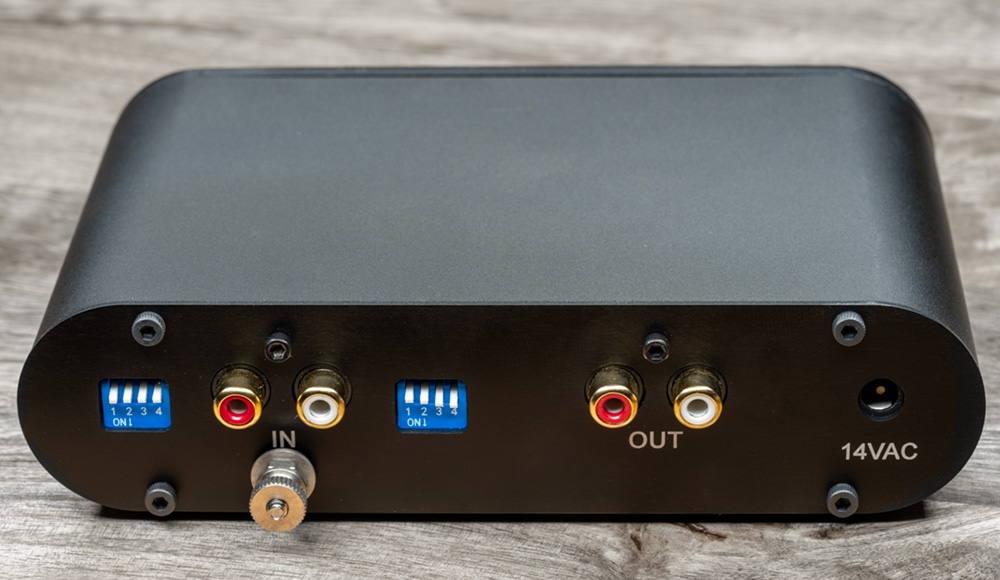
On back there's a pair of DIP Switches, each with 4 "on/off" choices, one for each input channel and two pairs of RCA jacks: one for input and one for output. There's also a nice and "beefy" metal ground lug. And that's it! If you've looked at the specs below you'll note they are unusually complete for a low cost phono preamp and the specs are outstanding. MM gain is 45 dB@ 1kHz MM is 65dB, which is sufficient for all but the lowest output MC cartridges.
You'll note in the specs the use of C0G Ceramic capacitors in the signal path and the note that they have measured distortion and dielectric absorption equivalent to Polypropylene caps, which are touted as best and more costly. Anyone who's played with caps knows how important they are to final sound.
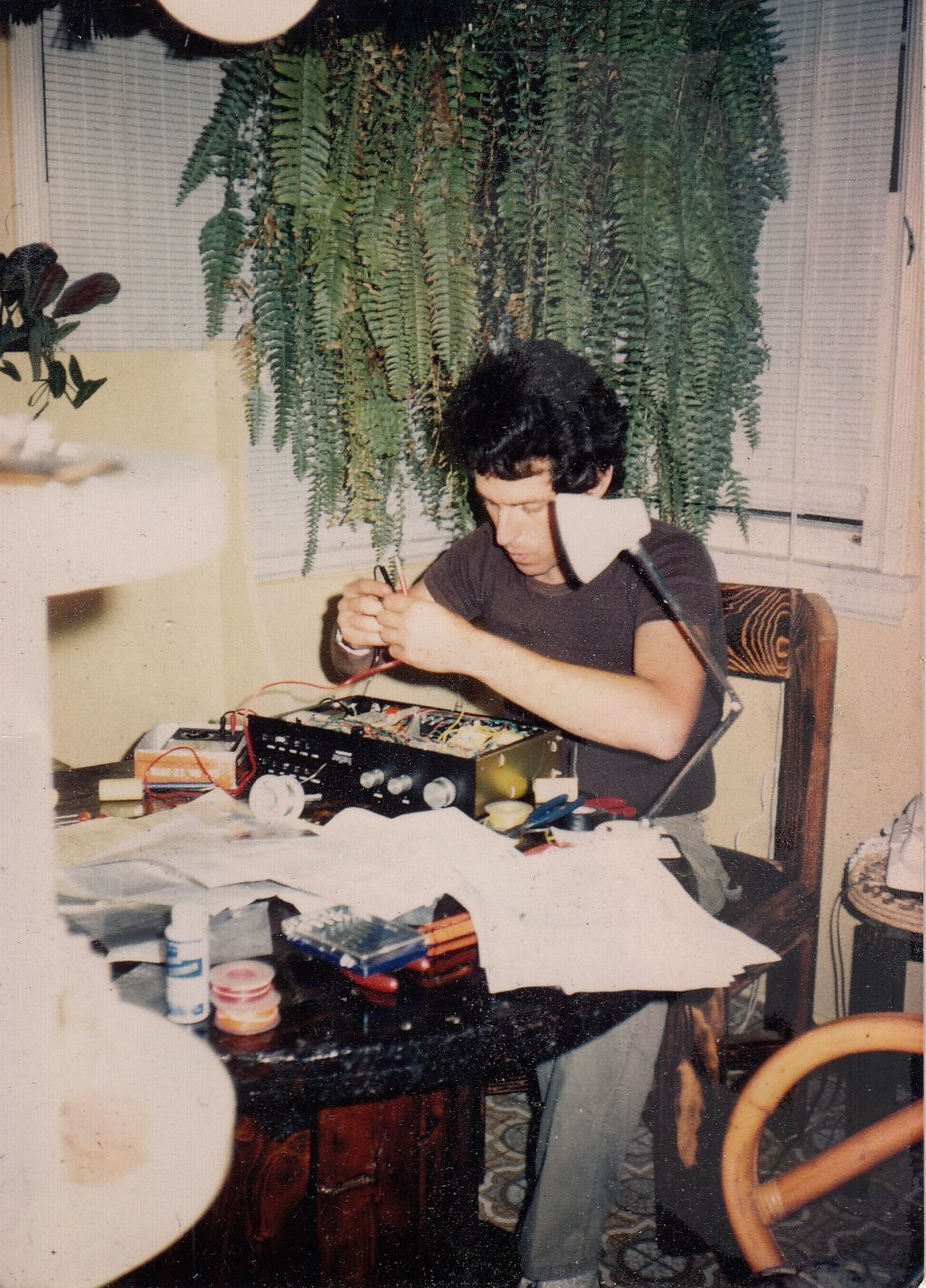 Here I am replacing or bypassing all the caps in my Hafler DH-101 preamp. The improvement was mind-boggling.
Perhaps more critical to the final sound of this low priced phono preamp is the absence of D.C. blocking coupling caps in the output, which is the typical route for low cost products. Instead it uses a "low offset, phase corrected DC feedback loop". And just to reassure easily panicked analog fans, it says "No digital. All analog implementation, including linear supply regulators." All good!
Set Up and Use
Resistive loading is set with DIP Switches 1 and 2 on each channel. They offer 150Ω, 220Ω,470Ω and 47kΩ. A sensible quartet. Switches 3 and 4 are for MM capacitive loading choices of 47pF, 147pF, 267pF and 367pF. An output relay control circuit prevents turn off or on "thumps". There's a warning to not operate unit in MM mode without a cartridge attached and input set to 47kΩ, not because the unit will be damaged but because that condition could send "potentially speaker damaging voltages to appear at the outputs". Not a problem if you follow the instructions.
I ran the Hana Umami Black ($11,500) cartridge (at 150Ω and then at 220Ω) mounted on the SAT CF1-12 tonearm (around $70,000), on the Wilson-Benesch Prime Meridian Turntable (around $250,000). Crazy, right? Unfair, right? Only as good as the weakest link in the chain, right?
Well this little box is ridiculously good. If I had any friends I think I could fool them into thinking the CH P10 was connected. Not that the Pyxi sounds remotely as good but without comparison to anything else it sounds really good! It has a somewhat sweet disposition, but minus the expected soft transients and sluggish rhythm'n'pacing that usually accompanies "sweet". For one thing, it's only slightly on the sweet side. It's also remarkably quiet, so music does emerge from pleasingly black backgrounds.
First up was (of course) Caelan Cardello Chapter One (Liam Records ARF-2) a record I know so well. The expected transient cymbal sizzle from Domo Branch's intense smacks, recorded so well by engineer Chris Sulit was somewhat surprisingly intact, neither softened nor made edgy. It was a pleasing balance of detail and texture. Caelan's Steinway was rich in the mids with slightly softened attack that emphasized the wood over the sounding board. Very likable. And Jonathon Muir-Cotton's bass had pleasing weight and texture.
Next up for no particular reason was an original promo pressing of John Fahey's Railroad 1 (Takoma TAK 7102). Not the best recorded Fahey album or most musically transcendent but still very well done and train songs are always appealing and Fahey's annotation sings. You want the edges on the opening track's processed guitar to shimmer and they did nicely. Side II's speedy "Medley: Imitation Train Whistle/Po' Boy" is a purer recording and a challenge to keep rhythmically together and not get lost in high frequency glaze. The Pyxi kept its rhythmic and transient composure throughout. The finale, "Delta Dog Through the Book of Revelation" is a reverb soaked tune that the Pyxi delivered with impeccable clarity putting Fahey's guitar impressively well focused to the right of the left speaker, surrounded by a huge reverb bubble that produced a generous sense of artificial space. No time smear whatsoever and impressive transparency.
I always use the title track of Davy Spillane's Atlantic Bridge (Tara 3019) to check out bass, both extension and control. The Pyxi didn't deliver the full weight of Eoghan O'Neill's bass but the control and articulation was excellent and as they say in tech talk circles "tuneful". Plus Spillane's Ulleann Pipes had midrange juice that made them sound airy and real.
Finally as a purity check I played Holly Cole Trio's girl talk (Alert Z1 81016) a live to two track recording using a single Calrec Ambisonic microphone as was used on Cowboy Junkies' Trinity Session. It's Cole backed by Aaron Davis on piano and David Pitch on double bass. It's a test of timbral purity and microdynamics. Plus it lets you know if a system or component can put together a believable three-dimensional soundstage.
This record's a tough test and here I could hear the Pyxi adding a consistent high frequency "ledge" of "electronica" to her voice and to Pitch's slap bass effect it flattened somewhat the images across the stage. But it costs $450 not $76,000 like the CH Precision P10 so all is forgiven!
Conclusion
Pretty simple: The Sota Pyxi resulted from a collaboration between two guys who know what they are doing, and who made the right choices to get the job done at a remarkably low price given what it achieves sonically—and I think it's made in America. Pyxi is quiet, capable and inexpensive too. I wasn't able to check out its MM capabilities but I will do that very soon using a new Audio Technica MM cartridge. Meanwhile if you're looking for a sonically pleasing MC cartridge phono preamplifier under $500, the Pyxi is a very safe bet to satisfy your low output needs.
Specifications
SPECIFICATIONS
MC
Input sensitivity: 250 µV rms @ 1 kHz, 5 cm/sec.
Rated output specified at 12 dB above sensitivity (1 mV rms, 1 kHz) to capture
signal dynamics.
Gain: 65 dB @ 1 kHz.
Rated output: 1.8 V rms. Rated peak 3dB higher.
THD: < 0.0002% @ 1 kHz, 1 mV rms input, <0.0003% @ 10 kHz, 10 mV rms
input.
IMD: < 0.002% CCIF 20 kHz/19 kHz 1:1 measured at rated output.
S/N ratio: 82 dBA, relative to 1 mV rms @ 1 kHz. Shorted input.
Hum levels: > 96 dB below rated output, shorted inputs.
RIAA compliance: 20 Hz - 20 kHz: within 0.15 dB p-p.
Input overload levels, nominal gain @ 1 kHz: 5.5 mV rms (27 dB relative to input
sensitivity)
MM
Input sensitivity: 2.5 mV rms @ 1 kHz, 5 cm/sec.
Rated output specified at 12 dB above sensitivity (10 mV rms, 1 kHz) to capture
signal dynamics.
Gain: 45 dB @ 1 kHz.
Rated output: 1.8 V rms. Rated peak 3dB higher.
THD: < 0.0002% @ 1 kHz, 10 mV rms input, < 0.001% @ 10 kHz, 100 mV
rms input
IMD: < 0.003% CCIF 20 kHz/19 kHz 1:1 measured at rated output.
S/N ratio: 98 dBA, relative to 10 mV rms @ 1 kHz input. Shorted input.
78 dBA, relative to 10 mV rms @ 1 kHz, 1.3 kΩ in series with 500 mH across
input. Load representative of typical (e.g Shure V15 III) MM cartridges.
Hum levels: > 96 dB below rated output, shorted input.
RIAA compliance: 20 Hz - 20 kHz: within 0.15 dB p-p.Input overload level, nominal gain @ 1 kHz: 55 mV rms (27 dB relative to
input sensitivity)
Other Features
Output impedance: 50 Ω single ended.
Channel matching: better than 0.1 dB @ 1 kHz.
Channel separation: better than 80 dB @ 1 kHz.
DC offset: < 10 mV .
Bandwidth: 0 to -3 dB: < 1 Hz - 150 kHz.
1% metal film resistors used throughout, with 0.1% in the critical gain and RIAA stages,
together with 1% capacitors.
C0G capacitors used in the signal path- with measured distortion and dielectric
absorption equivalent to Polypropylene capacitors.
Low offset, phase corrected DC feedback loop eliminates the need for coupling
capacitors while reducing DC peaking in the RIAA characteristic.
No digital. All analog implementation, including linear supply regulators.
Power consumption: < 5 W active, 0.1 W in standby.
You'll find unusually complete measurements on the final few pages here
Manufacturer Information
SOTA Sound Inventions LLC
1436 Mound Road
Delavan, WI 53115
(608) 538-3500
sales@sotalturntables.com