
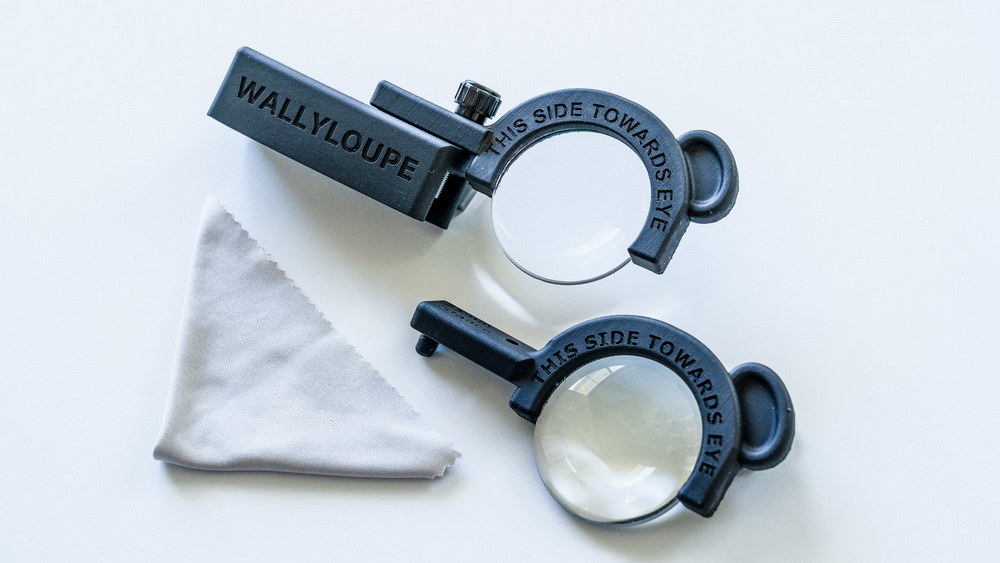
The WallyTools WallyLoupe
Seeing the Groove .... Hearing the Difference
Back in the ’70s, ’80s, and ’90s, when I was a dealer, I set up hundreds of turntables. I had my process down. A little patience, a familiar record, our Shure C/PEK3 tester tied to an oscilloscope, a CBS test album, and a few careful nudges, and listen to the results.
Fast forward to this decade, and I have taken a greater interest in devices that aid my vision as I age, especially those that help me see up close. I still do a lot of upgrade work, modifications, and repairs in my home shop, and my 20+-year-old OptiVISOR is indispensable. I have used it in the past for cartridge setup, but getting the right viewing angle has always been a challenge.
Enter the WallyLoupe.
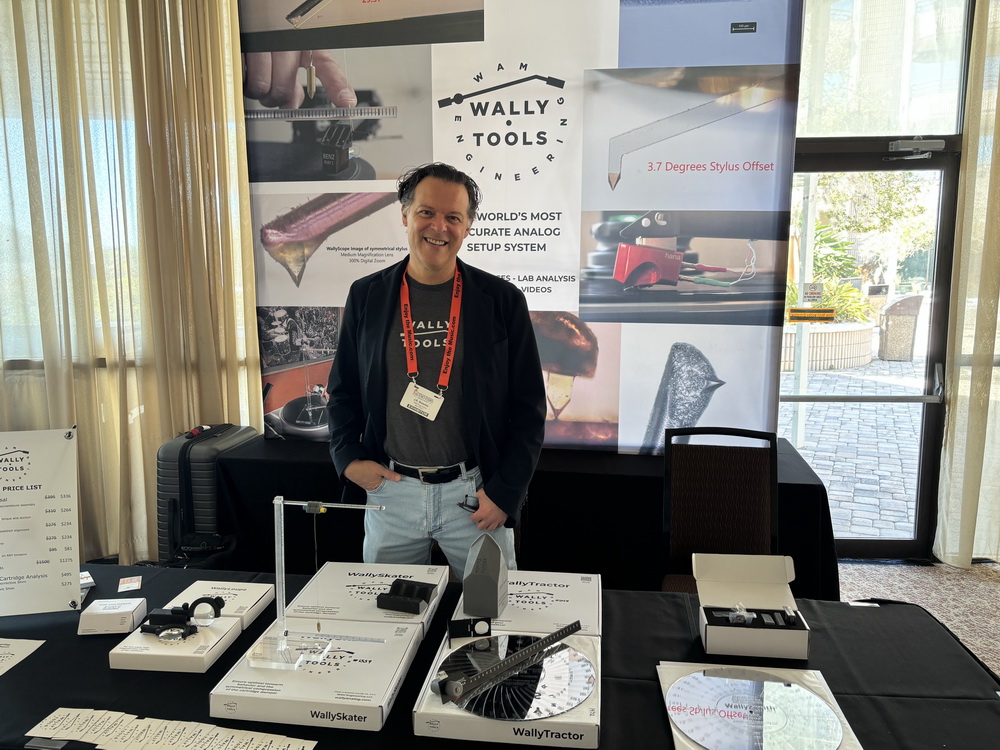
This year, Michael and I were walking the floor at the Florida Audio Expo, and as we passed by the WallyTools display, I noticed a magnifying device on the table. J.R. Boisclair, WallyTools designer and owner, told me it was his WallyLoupe, designed to aid cartridge setup by using two high-quality glass lenses oriented at the correct angle to view a cantilever/stylus.
Hey… Glass lenses…better viewing angle!? That sounded like the ticket for me. So I asked J.R. to send me a WallyLoupe to try out.
I’ll admit, I didn’t expect it to change much. I have tried a plethora of magnifiers before: jeweler’s loupes, mineral magnifiers, even a USB microscope that looked impressive until I tried to position it under a tonearm. They all technically worked, but they always felt like compromises. Awkward angles, limited visibility, and just enough frustration with their operation to make me succumb to a bit more guesswork than I probably should have. The WallyLoupe felt different almost immediately, not because it magnified more, but because it let me see from the right perspective.
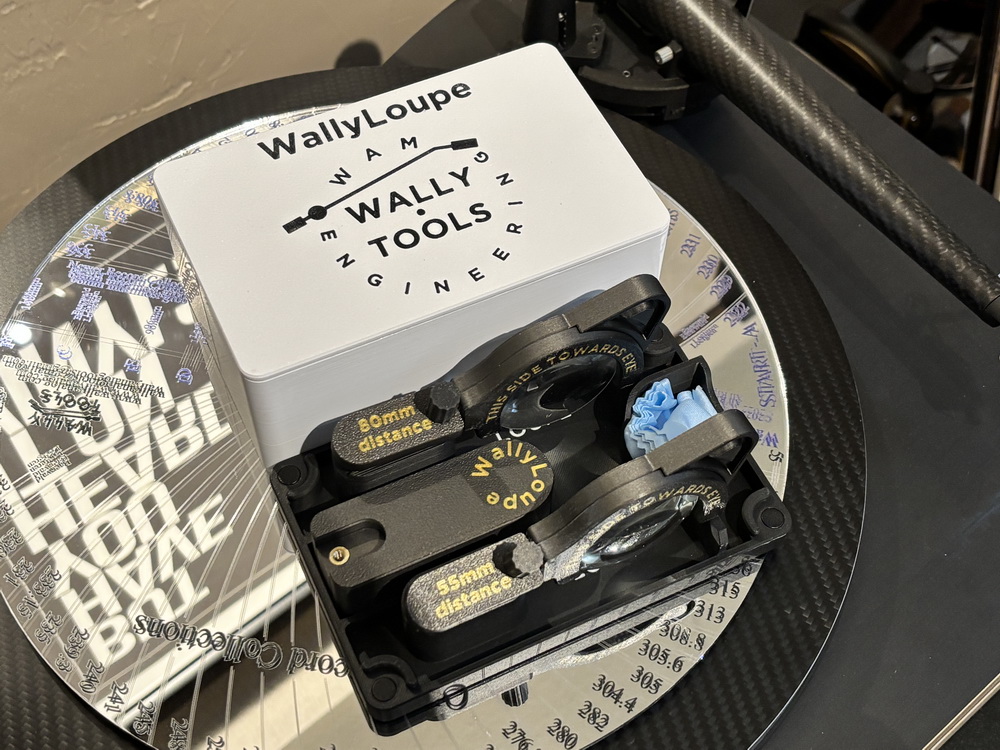
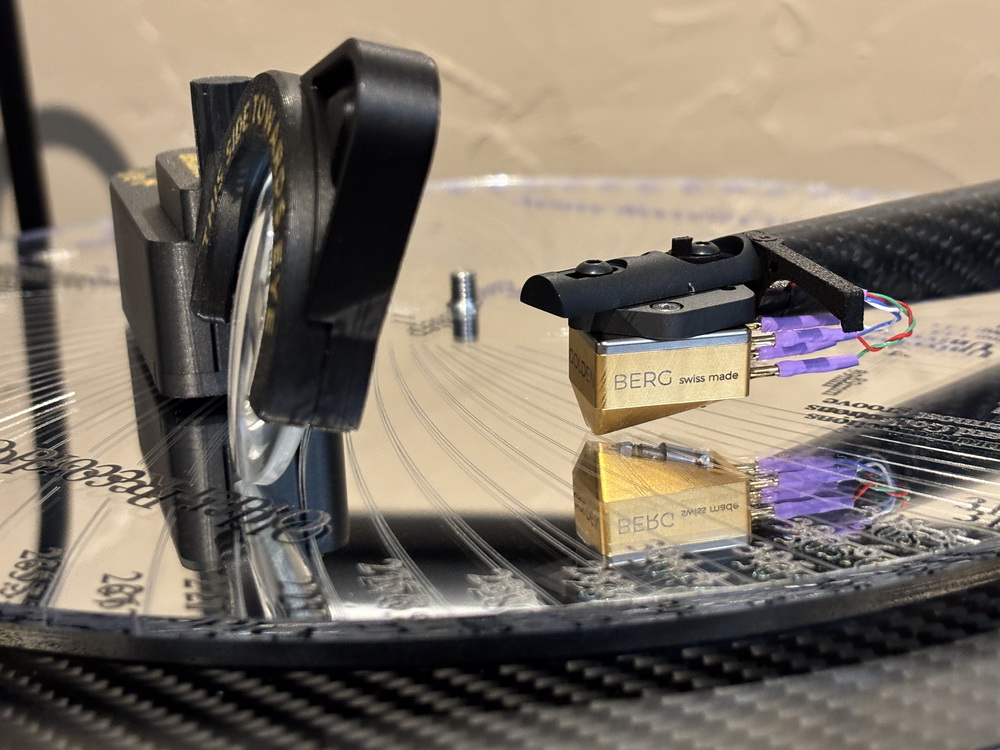 Part of what makes that usability possible is the inclusion of two glass lenses with different focal lengths, 55mm & 80mm, and magnifications of 15x and 25x, which I came to appreciate over time. The lower-magnification lens, with its longer working distance, gives you both physical and visual space to assess overall alignment without crowding the cartridge. Its lower viewing angle is especially useful for cartridges with hard-to-see cantilevers. The higher-magnification lens lets you move in closer to cartridges with more exposed cantilevers. Having both options available in a single tool creates a natural workflow: step back to understand, then move in to refine. It’s not just about seeing more; it’s about seeing at the right scale for the task at hand. After using it just a couple of times, I quickly realized that this device is clearly purpose-built by someone who understands the challenges of aligning a diamond stylus on a point that is only slightly larger than the stylus itself.
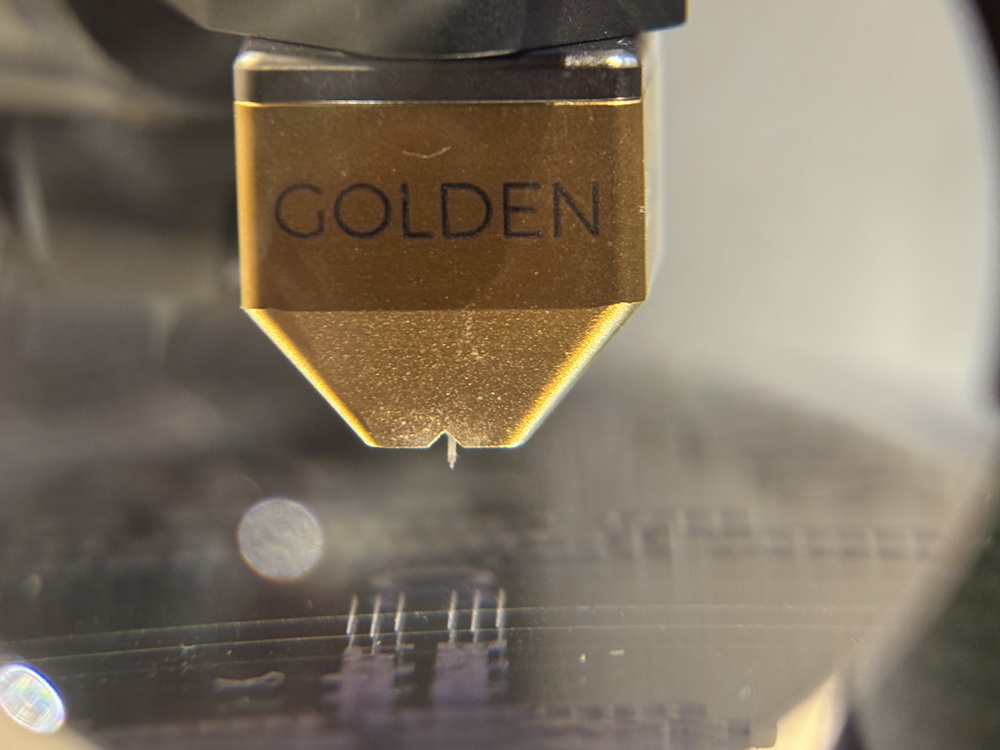 The first time I positioned it in front of my cartridge, what struck me was not just the clarity of the detail, but also the ease of access. Instead of fighting to line up my eye and avoid bumping the tonearm, I was suddenly looking directly at the cantilever from a natural angle. It sounds like a small thing, but it completely reframed what I was doing. I didn’t have to infer alignment from the cartridge body or trust that things were “close enough.” I was seeing the relationship between the stylus/cantilever and the alignment protractor, in this case, the laser-etched grooves in the WallyTractor tool. The WallyLoupe clearly (pun intended) revealed the gap between what I thought I was doing and what was actually happening down at the stylus. And that gap, it turns out, was where a lot of the music had been hiding.
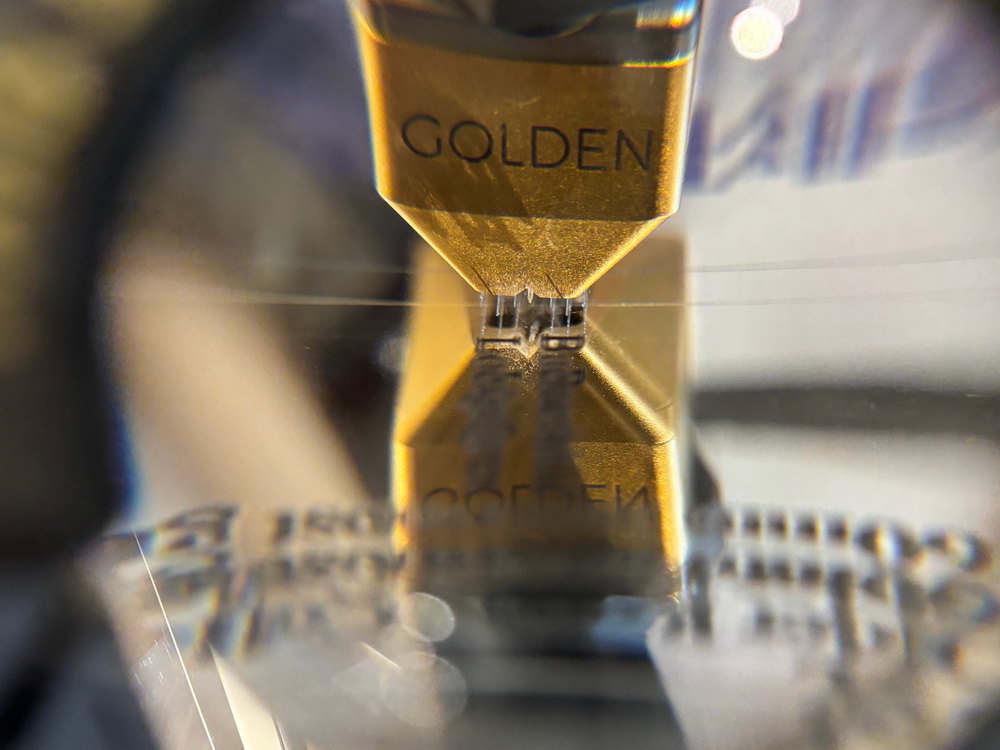 What I had assumed was a well-aligned cartridge revealed that the cantilever was slightly askew, nothing dramatic, but enough to matter. That moment stuck with me because it wasn’t about catching a mistake. It was about realizing how much I’d been relying on visual shortcuts that didn’t reflect what was really happening at the stylus level. From that point on, the WallyLoupe stopped being a curiosity and became part of my setup process.
Over time, I found myself using it not just to inspect, but to confirm. Overhang and azimuth adjustments became more deliberate. Instead of nudging things and listening to changes alone, I could see the alignment shift in real time. The glass optics are clean and distortion-free, and just as important, they work at distances that don’t make you feel like you’re about to crash into your cartridge. I’d switch between magnification levels depending on what I needed, and the process started to feel less like trial and error and more like actual calibration.
A turning point came one evening while listening to Miles Davis’s “Kind of Blue.” It’s a record I’ve used for years as a tonal and spatial reference, the way the trumpet hangs in space, the placement of the saxophones, the subtle air around the cymbals. After making a small adjustment guided entirely by what I saw through the loupe, I dropped the needle again. The change wasn’t dramatic in the hi-fi sense; it wasn’t louder or brighter, but it was unmistakable. The trumpet took a more defined position, and the interplay between the instruments felt more cohesive. The space between them became quieter, more stable, allowing the music to breathe in a way that felt closer to live performance than reproduction. That was the moment it clicked. The WallyLoupe wasn’t improving the system; it was removing the small errors that had been holding it back.
Since then, my entire approach to setup has shifted. I no longer trust cartridge bodies as alignment references, and I don’t assume that factory tolerances are good enough. Maybe even more importantly, the WallyLoupe encouraged me to slow down, be more patient, make smaller adjustments, and observe the results. There’s a tactile rhythm that develops—adjust, check, recheck, listen—that starts to feel less like a chore and more like part of the ritual. In a hobby that often chases upgrades, this was a reminder that refinement can be just as rewarding.
Most of you reading this know that more precise cartridge alignment yields improvements not just in obvious areas like imaging, but in subtler aspects of playback. Vocal recordings, especially, benefited from more precise alignment. Singers occupied space more convincingly, and on well-recorded acoustic material, the sense of air and separation improved in a way that felt more natural than analytical.
It’s worth acknowledging that the WallyLoupe doesn’t exist in isolation. It comes out of a larger, carefully considered approach developed by J.R. Boisclair and the broader WallyTools system—one that treats analog setup less like a loose collection of best practices and more like a repeatable, almost methodical craft. What stands out to me is how everything in that ecosystem points you back to the same fundamental idea: the cantilever and the stylus orientation is the truth, and everything else is just a reference at best, a distraction at worst. The WallyLoupe reflects that philosophy perfectly. It doesn’t try to overwhelm you with complexity; it simply lets you see clearly enough to make better decisions. And even on its own, without the rest of the tools, or used with another brand of alignment system, you can feel that underlying discipline at work quietly nudging you toward a more precise, more intentional way of setting up and ultimately listening to vinyl.
Compared to the optical tools I’d used before, the difference is less about capability and more about intent. Generic loupes can magnify, but they’re not designed for this specific job. They force you into awkward positions and make the process feel more difficult than it needs to be. The WallyLoupe, on the other hand, feels like it belongs in the analog setup ritual. It works with the physical realities of a mounted cartridge instead of against them, and that alone makes it far more effective in practice.
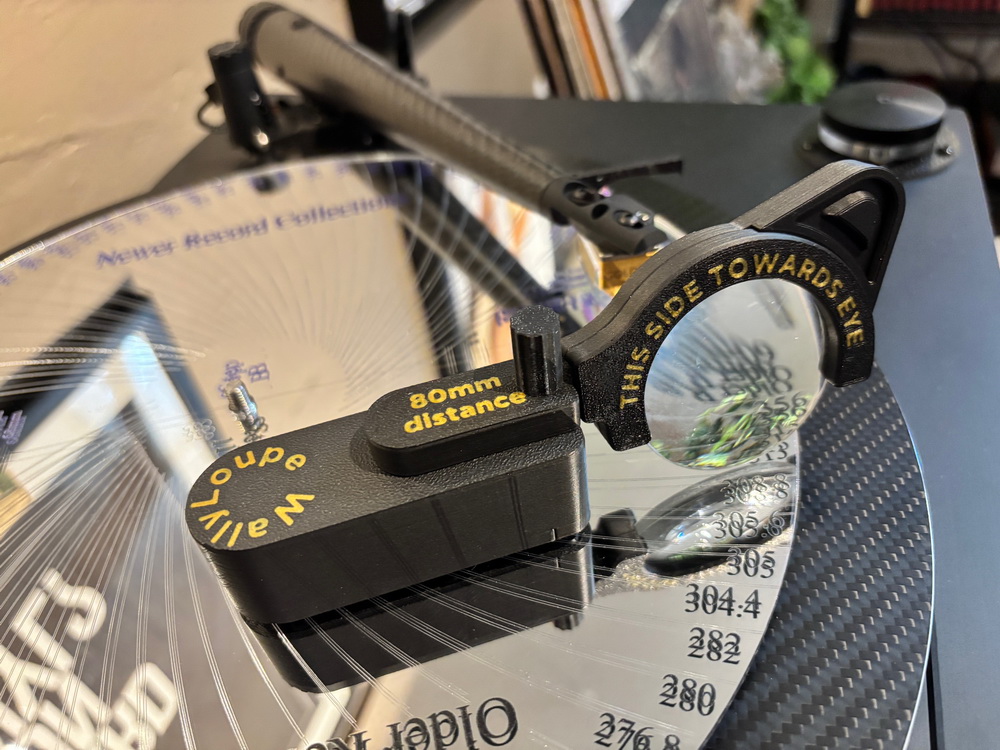 To some, the $195.00 price may seem a bit pricey for what appears to be a simple magnifier. But in the context of what I’ve invested in vinyl playback, it ended up feeling less like an indulgence and more like a necessary step toward getting the most out of what I already own. There is also a certain peace of mind that comes with it. Once everything is aligned and verified visually, I find myself second-guessing less. I’m not wondering whether a bit of distortion is in the pressing, the setup, or the system, as I now have a literally clearer baseline.
At this point, it’s become a permanent part of my setup process. I don’t mount a cartridge without it, not because I have to, but because I’ve heard what happens when I don’t. It’s one of those tools that quietly changes your standards. Once you’ve seen the stylus and cantilever clearly, once you’ve understood how small misalignments translate into what you hear, it’s hard to go back to doing things that were previously “close enough.”
UPDATE: J.R. has informed me that he has decided to offer a case option for storing the WallyLoupe. The case features designated slots to hold the lenses and base securely, and it comes with a cover that attaches magnetically. This case will be available for $100.00, making it a nice option for those who need portability or plan to use the WallyLoupe frequently.
 In the end, what the WallyLoupe provided wasn’t just better alignment; it gave me a clearer connection between what I see and what I hear. Vinyl playback operates at a scale that’s easy to overlook yet impossible to escape. The groove responds to precision, whether you acknowledge it or not. The WallyLoupe makes that precision more visible and, in doing so, reshapes how you approach the entire experience.
Simply said… With its optical clarity and correct viewing orientation, the WallyLoupe helped me achieve precise cartridge alignment with less effort and more confidence than any other product I have used.
My highest recommendation.
WallyTools website
Here is the WallyTools video that covers the WallyLoupe
Specifications
WallyLoupe $195.00
WallyLoupe Case $100.00