
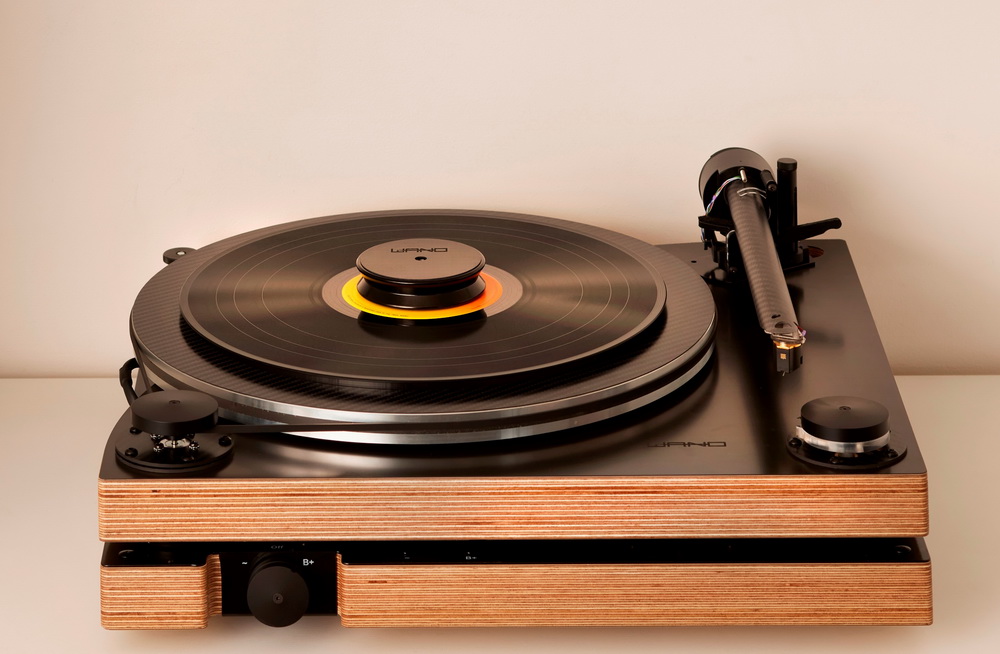
The Wand Master 14-4 Turntable
Not Quite Direct, Not Quite Belt, Not Quite Idler.... All Music
In today’s vibrant high-end analog market, numerous turntables dazzle us with their stunning looks and impressive sounds. However, many fall short over time, prioritizing style over true musical integrity. The Wand Master 14-4 takes a refreshing approach, focusing not on flashy design but on preserving the delicate temporal and harmonic connections that bring music to life. It’s all about delivering an experience that is coherent, expressive, and deeply emotionally resonant.
What distinguishes the Wand Master is not just its remarkable resolution or dynamic capability; many modern turntables can claim those attributes. What sets it apart is that its design is entirely centered on one key goal: controlling, dissipating, and redirecting energy at every stage of playback.
After using the Wand Master in my reference system for several months, I stopped viewing it as merely a collection of individual components. I began to see it as a tightly integrated mechanical system. The platter, bearing, motor, suspension, plinth, and tonearm function as interconnected parts of a larger ecosystem, each influencing the others' behavior. This system-level perspective explains many of the unconventional design choices in the table—and, importantly, clarifies why it sounds the way it does.
Spoiler Alert….
There are many detailed reviews of this turntable’s physical features, so I won’t repeat them. You can find plenty of information, review links, and videos on the Design Build Listen website. My goal in writing this review is to focus on this turntable's “sound” while also highlighting the design elements I believe contribute to it. I feel it is unique at its price point, and I wanted to share it with you.
With that said, let’s get started!
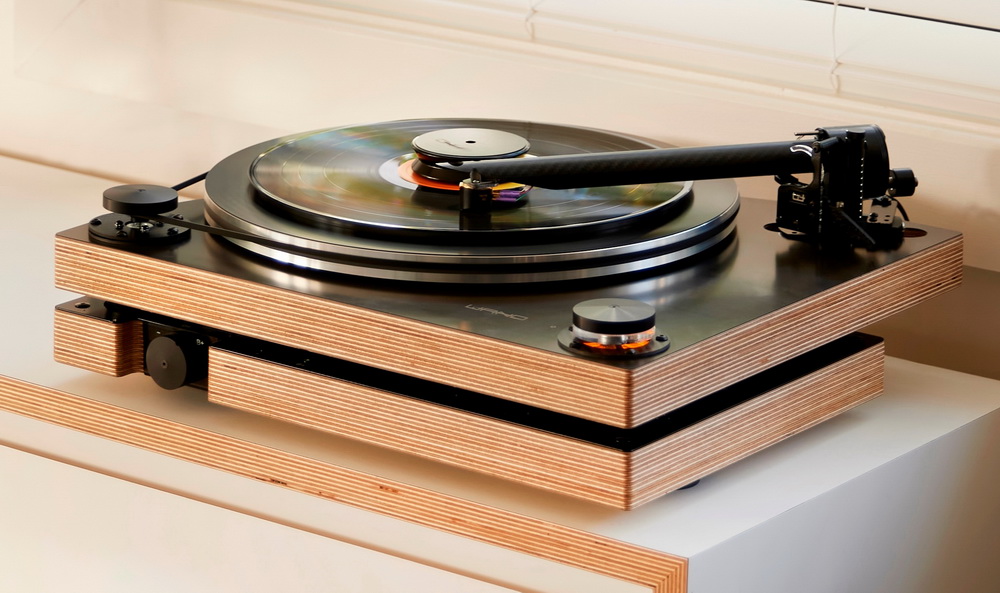
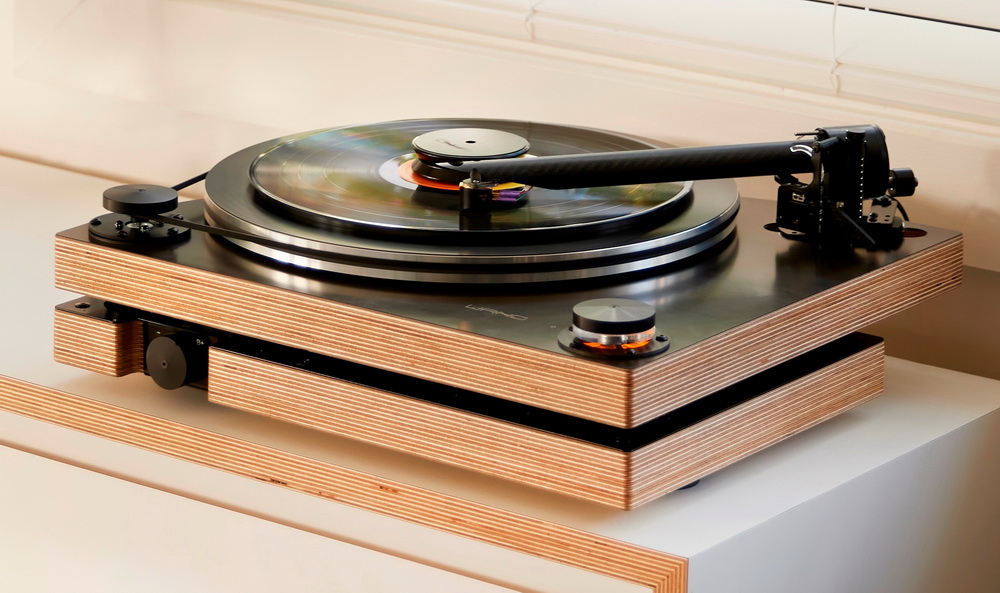
The Wand Master 14-4 distinguishes itself from traditional high-end analog designs through its asymmetrical plinth, larger platter diameter, layered constrained-damping architecture, integrated isolation base, and unique mass distribution, setting it apart from both classic suspended turntables and modern ultra-mass-loaded models. Certainly, other turntables incorporate some, if not all, of these design features. But to do so at this price point is quite unique.
The longer I lived with the table, the clearer it became that these choices were not aesthetic gestures. They were direct expressions of designer Simon Brown’s underlying engineering philosophy. Brown appears fundamentally concerned with managing vibrational behavior throughout the playback chain. Rather than treating the turntable as a rigid support for the cartridge and motor assembly, he treats it as a dynamic system in which energy must be carefully controlled across multiple interacting domains: rotational inertia, structural resonance, environmental feedback, motor-induced vibration, and reactive energy generated by the stylus.
The audible consequence of this philosophy is a presentation that combines unusually high rotational stability and low-level resolution with a degree of rhythmic naturalism and temporal elasticity that many technically accomplished, and much more expensive, designs fail to preserve.
Rotational Inertia and the Acoustic Consequences of the 14-Inch Platter
One of the more striking features of the Wand Master is its oversized 14-inch platter. While visually dramatic, the design's engineering rationale is grounded in straightforward rotational physics. Increasing platter diameter raises rotational inertia because angular momentum increases as mass is distributed farther from the rotational axis. I have to give a “shout out” to my college Physics teacher for that gem! This approach offers substantial speed stability without the extreme mass of ultra-high-mass platters. While heavy platters provide stability and low wow and flutter, they can create a sense of dynamic inertia in music. I've found some high-mass turntables to be rhythmically dull. The Wand, however, seeks to balance rotational authority with transient responsiveness.
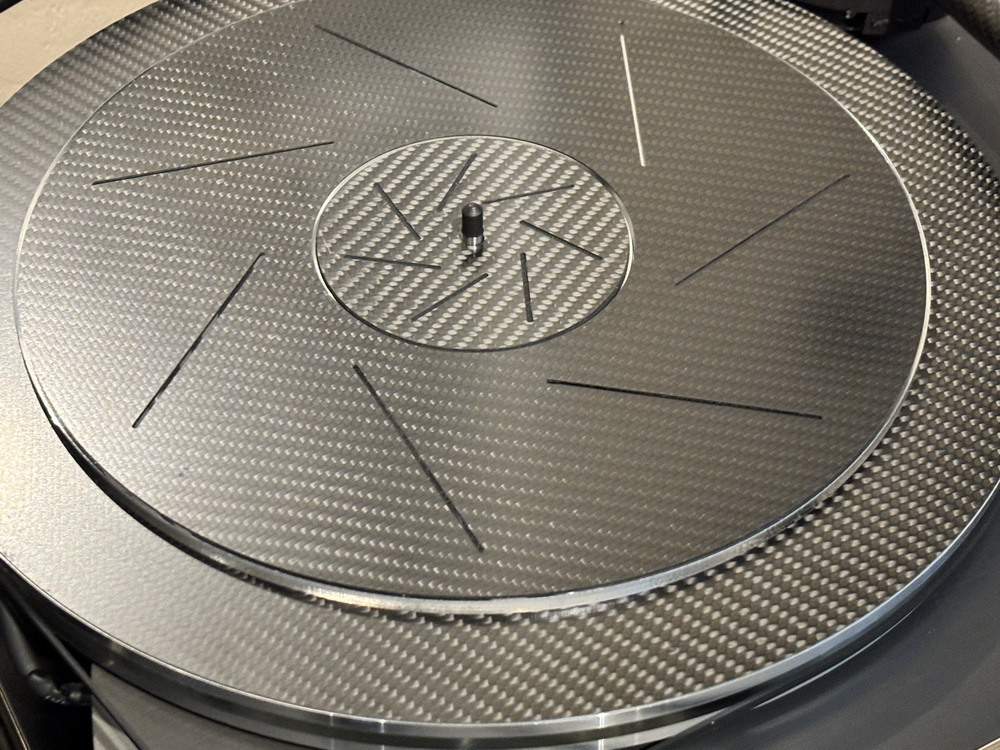
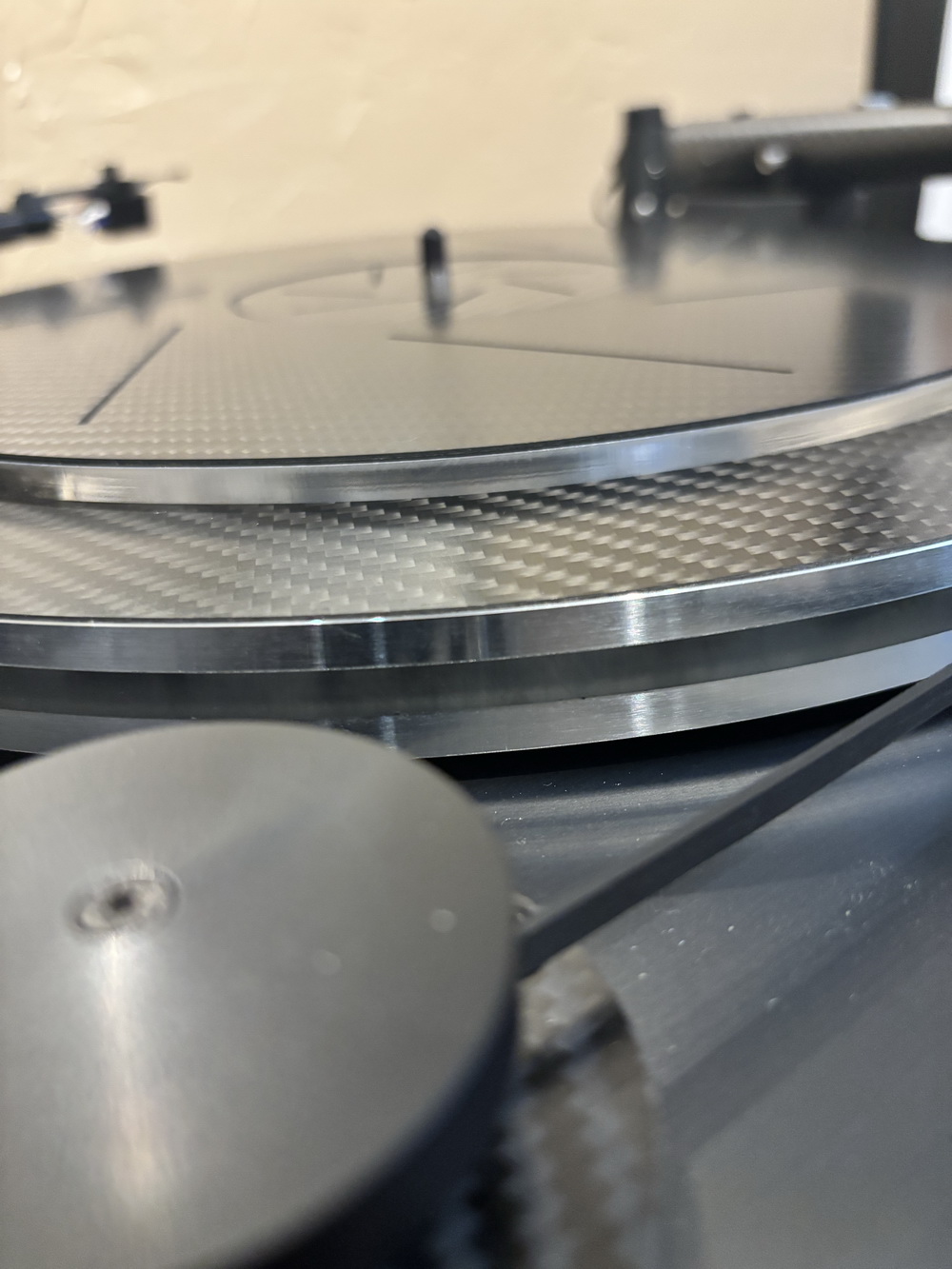 The Wand platter employs a 4-layer aluminum-acrylic-aluminum-acrylic composite structure to distribute and dissipate resonance across multiple frequency ranges rather than allowing vibrational energy to accumulate in a single dominant mode. The acrylic upper interface establishes a more controlled impedance relationship between the record and the platter surface, encouraging the dissipation of stylus-generated vibrational energy from the vinyl substrate. This is topped with a very thin, slotted carbon fiber mat to break up and isolate vibrations transmitted to the platter by the stylus as it tracks the record's grooves. The oversized platter certainly is not unique to the Wand Master, but it is a rarity at its price point.
 On Patricia Barber’s Modern Cool, the opening acoustic bass passages on “Touch of Trash” demonstrate excellent preservation of note envelope structure. The initial transient attack, harmonic bloom, resonant sustain, and ambient decay all remain individually intelligible rather than collapsing into a generalized low-frequency mass.
Piano recordings showed consistent quality. Sustained harmonics maintained stable pitch relationships throughout long decays while preserving the subtle microdynamic fluctuations that convey the physical interaction between the performer and the instrument.
Motor Architecture, Belt Behavior, and Servo Philosophy
The Wand Master features an electronically regulated DC motor connected to the platter via a custom, low-stretch flat belt from Switzerland. While traditional belt-drive systems aim to isolate motor vibration, excessive compliance can cause transient lag and torque-recovery delays. The Wand’s optimized low-stretch belt balances vibrational isolation with efficient torque transmission. It preserves the harmonic richness and spatial openness of advanced belt-drive systems while delivering the rhythmic articulation and speed consistency typical of high-quality direct-drive designs.
This was evident while listening to Talking Heads’ Remain in Light. Tracks such as “Crosseyed and Painless” contain dense layers of interlocking rhythmic information that frequently become temporally homogenized on systems with insufficient speed stability or transient discipline. Through the Wand Master, however, individual rhythmic lines retained structural independence while still functioning cohesively within the larger rhythmic framework. The presentation never fragmented. Instead, the Wand preserved both separation and momentum.
The motor-servo implementation also warrants recognition. It's not just about hitting 33.33 RPM; the real test is how well a turntable maintains stability under load. In this regard, the Wand Master truly excels. Many servo-controlled turntables achieve good speed accuracy but often sound mechanical. Overly aggressive correction systems can disrupt the natural flow of music by imposing constant adjustments. The Wand Master avoids this by using a restrained servo approach, allowing the platter's inertia to aid speed stabilization and minimizing intrusive corrections by operating the servo correction below audible frequencies.
Listening to Bill Evans’ Waltz for Debby, I was struck not only by pitch stability but also by the preservation of microdynamic conversational interplay among Evans, Scott LaFaro, and Paul Motian. Subtle hesitations, temporal inflections, and dynamic fluctuations remained intact, preserving the illusion of spontaneous musical interaction. The Wand does not simply maintain rotational speed; it preserves the elasticity embedded within musical timing itself.
Zentroidal Suspension and Localized Vibrational Control
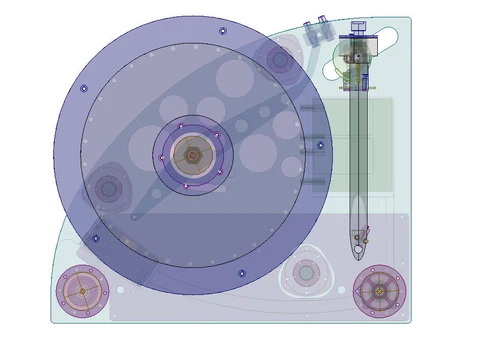
A seemingly simple yet conceptually sophisticated feature of the Wand Master is its Zentroidal suspension. Traditional suspended turntables distribute isolation symmetrically across the chassis, treating the entire structure as a mechanically unified suspended mass. By contrast, Simon Brown approaches suspension as a problem of localized vibrational referencing. The Wand Master’s asymmetrical plinth geometry and suspension topology are designed to concentrate mechanical stability around the stylus tracing region and the bearing-tonearm relationship. Rather than attempting to uniformly isolate the entire turntable, the Wand prioritizes stabilizing that critical region most directly responsible for preserving groove information. The sonic consequences extend far beyond simple footfall isolation. The Zentroidal architecture effectively reduces low-level vibrational haze, an accumulation of vibration, resonance, reflected energy, and motor interactions that obscures microdynamic information and destabilizes spatial coherence.
On Nick Drake’s Pink Moon, the acoustic guitar displayed rich harmonic density and body resonance, yet the silence between the notes was equally revealing. The Wand Master produced an unusually low apparent mechanical noise floor, allowing ambient decay structures and low-level spatial information to emerge with excellent continuity.
On Miles Davis’ Kind of Blue, Cannonball Adderley’s alto saxophone possessed both dimensional density and ambient openness simultaneously. Images emerged organically from the acoustic field rather than being artificially spotlit. This distinction is crucial because exaggerated edge definition often creates an illusion of heightened resolution while reducing spatial continuity and harmonic integration.
Battery Power, Electrical Isolation, and Noise-Floor Reduction
Another feature of the Wand Master is its integrated battery-powered power supply system incorporated into the lower isolation platform. Before hearing the table, I viewed this “feature” cautiously. Previous battery-powered audio components I have experienced have frequently produced improvements that are sometimes measurable yet musically ambiguous.
The Wand Master proved otherwise.
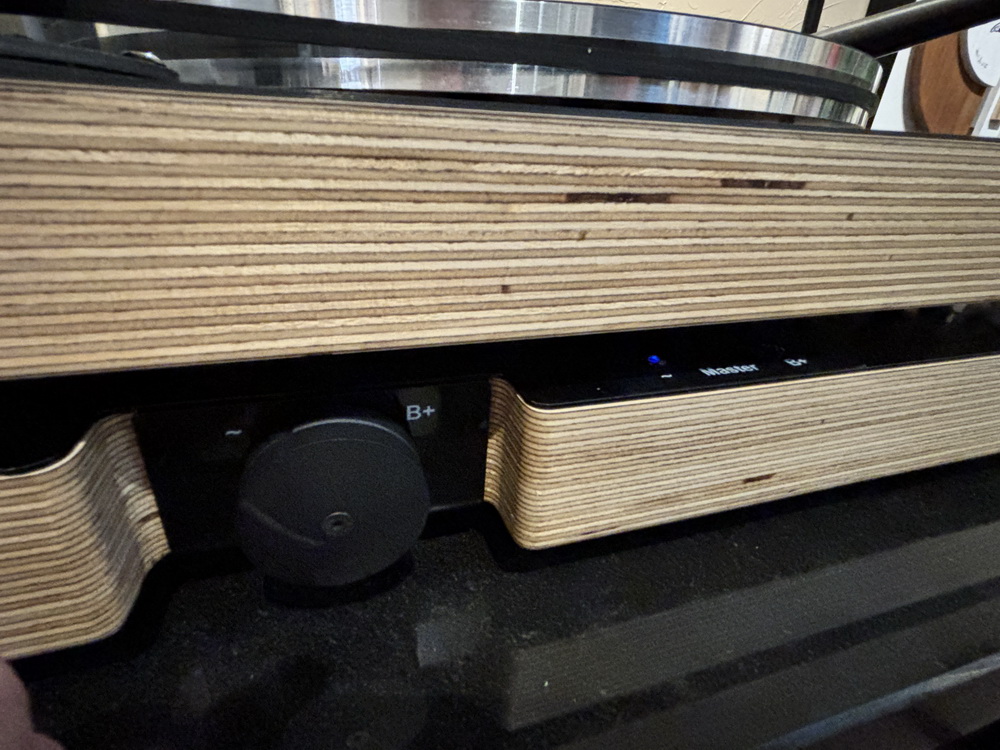
On the Wand Master, you can easily switch from AC power to battery power with the flick of a switch. Transitioning from conventional mains operation to battery power does not change the tonal quality; however, it enhances the clarity of low-level details. The acoustic background becomes noticeably quieter, and the reverberation decay extends further into silence. Additionally, instrumental textures exhibit greater separation and a sense of dimensional continuity. On Peter Gabriel’s So, “Red Rain” displayed enormous dynamic contrast while remaining composed. Percussive transients retained physical impact without hardness or glare, and layered synthesizer textures remained spatially distinct rather than collapsing into a flattened density. Battery operation also seemed to improve microdynamic differentiation. Why? I have no freakin’ idea… but color me surprised.
Main Bearing Design and Mechanical Silence
Another contributor to the Wand Master's sound is its unique main bearing design. While the Wand employs a more traditional steel-shaft-and-sleeve arrangement, it is optimized for vibrational damping rather than visual spectacle. What matters here is not architectural novelty but the suppression of microscopic mechanical instability.
I asked Simon to share his thinking on the main bearing design.
“I was influenced by the Well-Tempered approach (which was also made in New Zealand for a time), particularly in how it challenges the usual ‘bigger and tighter is better’ bearing mindset. In reality, the forces involved are very small—essentially just the sideways pull of the belt—so in engineering terms they’re close to negligible. That led me to keep the bearing deliberately small, to reduce noise. As bearing diameter increases, so does surface velocity, and with it the potential for vibration and noise. So the focus is less on brute stiffness and more on controlling how the bearing behaves at a micro level, including careful selection of materials, which were chosen to deal with vibration. As per the Well-Tempered, the slight ‘freedom’ in the bearing is intentional. But here it’s stabilized by the motor position, geometrically, the line from the motor to the spindle is arranged to closely match the line from the stylus to the arm pivot at the midpoint of the record. That means stylus drag acts along the same axis, reducing modulation of that force—particularly during high-energy passages.”
Keith Jarrett’s The Köln Concert illustrated these characteristics beautifully. Solo piano remains one of the more revealing tests of analog playback for me because even slight rotational instability or vibrational modulation becomes immediately perceptible as harmonic wavering and pitch ambiguity. Through the Wand Master, Jarrett’s sustained notes maintained stable harmonic relationships throughout extended decays while preserving dynamic vitality and tonal complexity. Equally important, the presentation never became overdamped.
Tonearm Design, Structural Rigidity, and Resonance Control
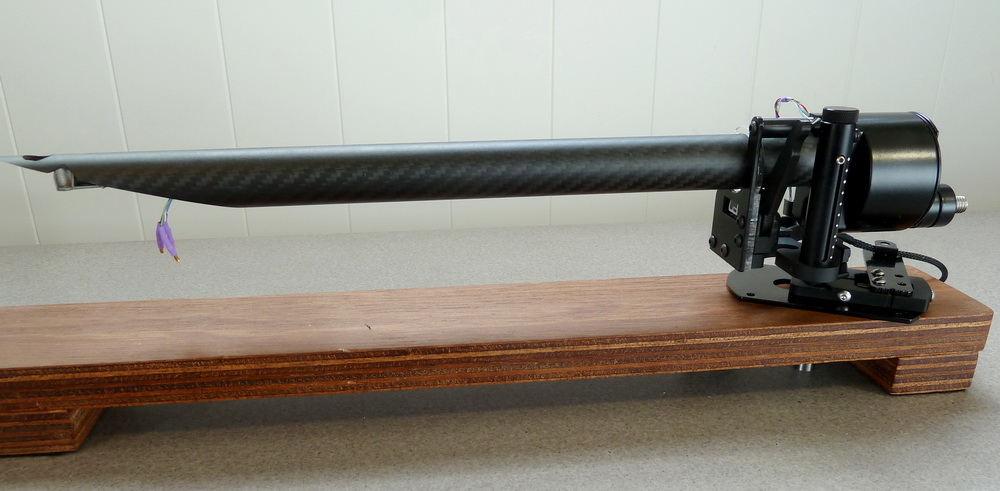
The current Master Series B tonearm is a somewhat unconventional design. Although fundamentally a unipivot design, the Wand departs from traditional minimalist unipivot philosophy by using a large-diameter carbon-fiber arm tube engineered primarily for structural rigidity. The engineering logic is straightforward. Increasing tube diameter increases stiffness and shifts structural resonances to higher frequencies, making them easier to damp and less likely to interfere with critical midrange information.
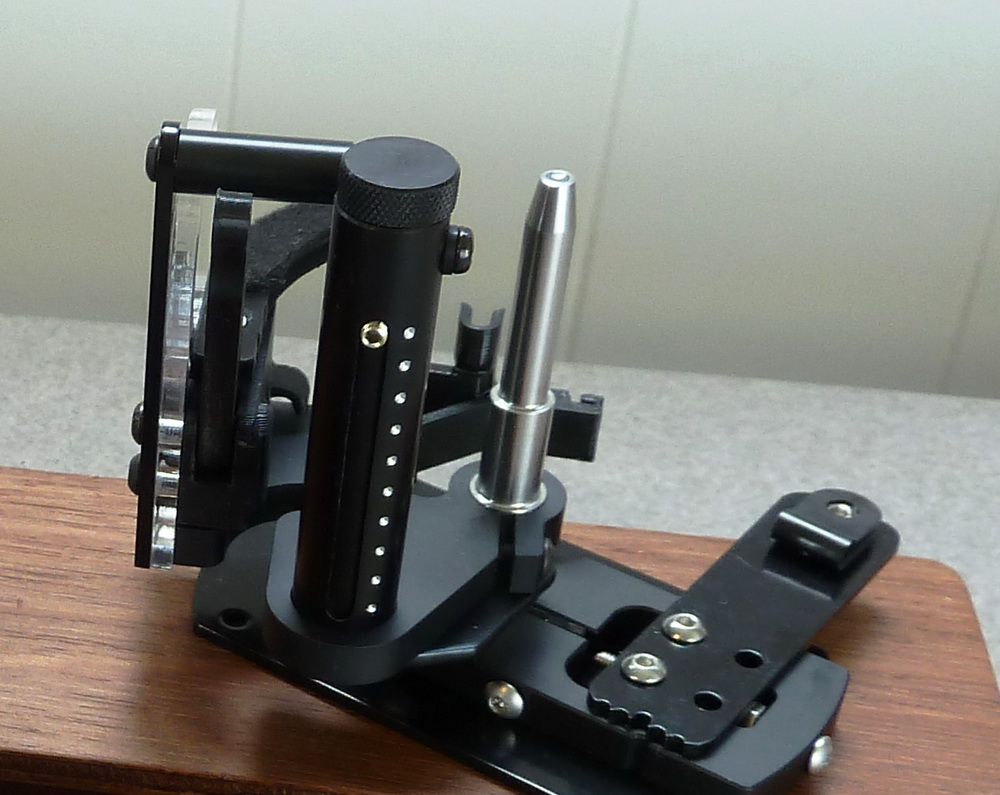 Wand Master tonearm mount
Also, rather than a “needle -like” point for the bearing, the Wand Master arm uses a Zirconium Oxide Ball that sits in a Tungsten Carbide cup. The reasoning behind Simon’s tonearm bearing design is provided in the tonearm manual.
“Rolling ball bearings can be manufactured to extremely high tolerances. However, they require small clearances (gaps) in order to roll freely. While these gaps are tiny, they are still thousands of times larger than the smallest modulations in an LP groove. This introduces the risk of losing fine musical detail. Spike bearings are sometimes adapted for use in unipivot tonearms. These typically involve a fine metal spike resting in a hard jewel cup. While they perform well in applications with little to no sideways force, tonearms are subject to a constantly shifting drag force as the stylus traces the music in the groove. This can cause a delicate spike to flex, potentially degrading performance. While the Wand bearing is essentially a single-point bearing, it is designed to be far more robust than jewel-based systems. Its design is more comparable to a hip joint: a very hard synthetic diamond ball resting in a tungsten carbide cup. This is our ZeroPoint bearing. The stylus drag force naturally pulls the contact point of the ball slightly to one side of the cup. This creates a resistance line (vector) that aligns approximately with the axis of the stylus cantilever. As a result, the bearing is always under consistent load, preventing it from jittering due to changing groove drag. This improves both fine detail retrieval and bass stability.”
Physics aside, I feel this arm combines the openness and fluidity I associate with high-quality unipivot designs with the bass articulation and image solidity I associate with a fixed-bearing design.
Comparative Perspective … Three Turntables in One
What fascinated me over time was how the Wand Master seemed to borrow strengths from multiple drive philosophies without fully inheriting their weaknesses. Over the years, I’ve lived with enough direct-drive, rim-drive, and belt-drive turntables to quickly recognize their sonic fingerprints. Most analog enthusiasts eventually gravitate toward one school or another because each approach tends to emphasize a particular aspect of musical reproduction. The Wand Master blurred those traditional categories in ways that, frankly, surprised me.
Direct-drive turntables, like those from Technics or high-end designs like Brinkmann Audio, are praised for their speed, accuracy, and torque stability, delivering precise timing and focus in music. While they excel in rotational control—making piano notes and bass lines impactful—they can sometimes sound emotionally restrained. However, the Wand Master captures the advantages of direct drive without sounding mechanical. Rim-drive turntables are known for their dynamic energy, and classic idler-wheel designs from Garrard or Thorens provide a visceral sense of momentum. The Wand Master captures much of this rhythmic drive while being quieter and more refined. Traditional belt-drive turntables excel in high-end audio for their isolation advantages, delivering rich tonal color and a deep soundstage. However, some may sacrifice transient clarity and bass authority, resulting in softened rhythms and less impactful dynamics. The Wand retains the emotional depth of great belt-drive designs while enhancing precision and grip.
Ultimately, I came to understand that the Wand Master excels not by highlighting audiophile traits but by minimizing contradictions.
It has excellent transient speed without sounding sharp.
It has strong bass authority without sounding heavy.
It has superb detail retrieval without sounding analytical.
It has rhythmic precision without sounding mechanical.
It has tonal richness without sounding slow.
Compared to similar-cost competitors, the Wand Master may give up:
a little industrial glamour,
a little ultra-mass bass gravitas,
a little quartz-locked precision,
and a little hi-fi spotlighting,
in exchange for:
extraordinary timing,
natural dynamic flow,
tonal integrity,
and a uniquely lifelike sense of musical propulsion.
My Takeaway
The Wand Master 14-4 is one of the more musically compelling turntables I have encountered in recent years, anywhere near its price point. Each design element, from the oversized platter and main bearing to the unique tonearm, servo drive system, Zentroidal suspension geometry, and battery-powered isolation platform, is engineered to enhance temporal stability, vibrational control, spatial coherence, harmonic integrity, and dynamic continuity. The Wand Master possesses that rarest of turntable qualities; it sounds mechanically calm while remaining rhythmically alive.
And perhaps that’s Simon Brown’s greatest accomplishment. Rather than choosing sides in the endless analog debates over belt versus direct drive, suspended versus rigid, and mass versus low mass, the Wand Master synthesizes strengths from multiple schools of turntable design into a coherent whole. With the Wand Master 14-4, you get 90% of the best from all three drive systems. Few turntables achieve that balance, and none in this price range come to mind. Although I haven't experienced turntables costing $40,000 to $100,000 or more, I'm confident my financial consultant would advise me to weigh the costs and benefits carefully.
After months of listening, what impressed me most was not any particular audiophile characteristic but the table's ability to maintain musical continuity. The Wand Master doesn’t just reproduce recorded sound accurately; it reconstructs the temporal, harmonic, and spatial relationships that allow recorded performances to regain a convincing sense of physical and emotional reality. It is a music lover's turntable.
Well done, Simon.
Well done.
Price as reviewed: $12,475
Specifications
The model under review is the Wand Master 14-4 turntable ($8500) paired with the Wand Master Series B 10.3” tonearm ($3975), on which I mounted a Goldenberg Maestro cartridge. The signal path was Goldenberg Maestro → Genesis Simplicity phono stage (review coming) → Audio Research REF6SE → SMC Audio GT25 Monoblocks → Acora VRC Loudspeakers.
The Wand 14-4 turntable without the Master Base Battery Supply unit is $5750. The Master Base can be added later for $2750, allowing you to “grow” from a Wand 14-4 to a Wand Master 14-4 at your own pace. There is a 10% package discount on the combined cost of a Wand turntable and any Wand tonearm.
Manufacturer Information
Wand products are manufactured in New Zealand by Design Build Listen, a company owned by designer Simon Brown.
https://designbuildlisten.com/
The Wand products are distributed in North America by Bob Clarke of Profundo Audio.
Tel: 510.375.8651
info@profundo.us