
Three Record Clamps/Weights Compared
where's the resonance kenneth?
I just saw a YouTube video headlined "DON'T PUT RECORD WEIGHTS ON YOUR TURNTABLE!" This is the kind of nonsense in circulation online and sadly, some people take it seriously. Turntable misinformation runs rampant on the Internet, on YouTube, on Reddit, you nammit. You’ll read or see assertions like, “It’s pretty basic: spin a platter at the correct speed, have a “needle” mounted on a tonearm tracking the record and that’s just about it. Spending more than say, $500 to play back a cheap piece of plastic is pure vanity.” Or I’ve read, “Let’s be generous and say that $5000 is the upper limit of what you need to spend. Anything above that is beyond the law of diminishing returns.” (Translation: “I can’t spend more than $5000 on a turntable”).
Those are descriptions of what a turntable does not a description of what it is. The best definition of what a turntable is, is “A Vibration Measuring Machine”, the title of Bill Philpot, (the late) Paul Messenger & Roy Gandy’s book tracing the history of Rega Research (the “Ga” in Rega is Gandy).
That definition makes clear that the first step towards making a great turntable is about eliminating and preventing unwanted vibrations emanating from without and from within the turntable from reaching the cartridge, which is the “brains” of the vibration measuring machine (some might argue it’s the motor control system, but I’ll stick with the cartridge).
The details about the vibration producing entities are for the video I plan on producing, and of course most Tracking Angle readers know all or a great deal about these issues. But unwanted vibrations also result from the very act of tracing the record groove. It unleashes a tremendous amount of energy: the pressure of 2 grams concentrated on a 0.7 mil stylus is more than 2,800 pounds per square inch!
Where does all that extraneous energy that’s bouncing around and echoing throughout the micron wide (width of a human hair) vinyl canyon go?
Without knowing precisely where, for decades people have correctly surmised that this energy turns the record into a vibrating mass in need of some kind of damping, either in the form of a mat or a record “weight”. Rega espouses no weight at all. Just rest the record on the supplied felt or wool mat. As much as I appreciate Rega’s approach to turntable design as well as the results they achieve I don’t agree with that!
Or, as a great sage wrote 20 years ago on another website in another record weight survey:
“Record weights and clamps cause a sonic difference that’s difficult neither to hear nor to explain. A stylus coursing through the grooves stamped on a slab of vinyl releases a tremendous amount of mechanical energy, some of which does not exit the system as it’s supposed to: up the cantilever. Instead, it gets reflected back into the vinyl, where it can cause the record to resonate unless it’s damped in some way. There is also potential vibrational energy coming the other way—from the tonearm, the motor, and the bearing—but the better your arm and turntable, the more likely that the problem that needs solving is that of vibrations coursing through that thin slab of vinyl”.
What’s the best weight material? What’s the best weight? What’s the best approach, damping or “tuning”? For decades it’s been based on listening and experimentation. That’s what led to the Shun Mook—a colleted weight made of rare dried ebony briar that in 2021 cost $5600. Not sure what it costs now but it’s a tuning type of weight that resonates at particular frequencies intended to enhance the sound. It’s long considered to be the “brown wood standard” of resonating type record weights.
I’ve got a “stable full” of various record weights and clamps (not a Shun Mook, which I returned after reviewing mostly due to the cost) but I’m not about to do a survey of a dozen or so of them here.
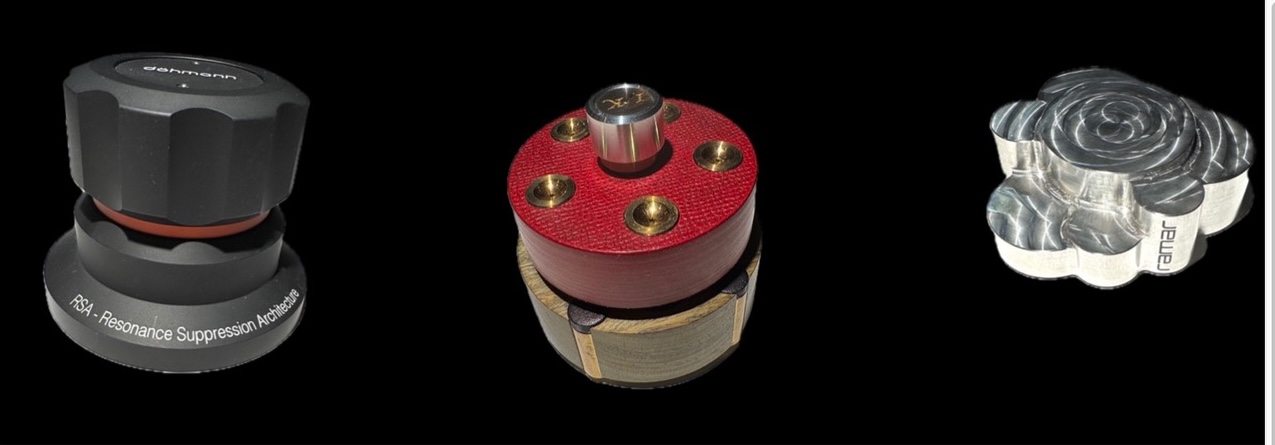
Instead, I’ve taken the three latest to arrive: The Döhmann Audio RC1 ($3500) , the I/K Audio Model 8 Mk2 Vera wood (€3200-the Canadian importer says tariffs make it difficult to price in dollars now but he will give you a price in dollars), and the Ramar JEWEL (€799), designed and manufactured by the gentleman who makes the outstandingly effective and stylish Ramar record brushes.
Enter Measured Results
The Döhmann RC1 Mk3
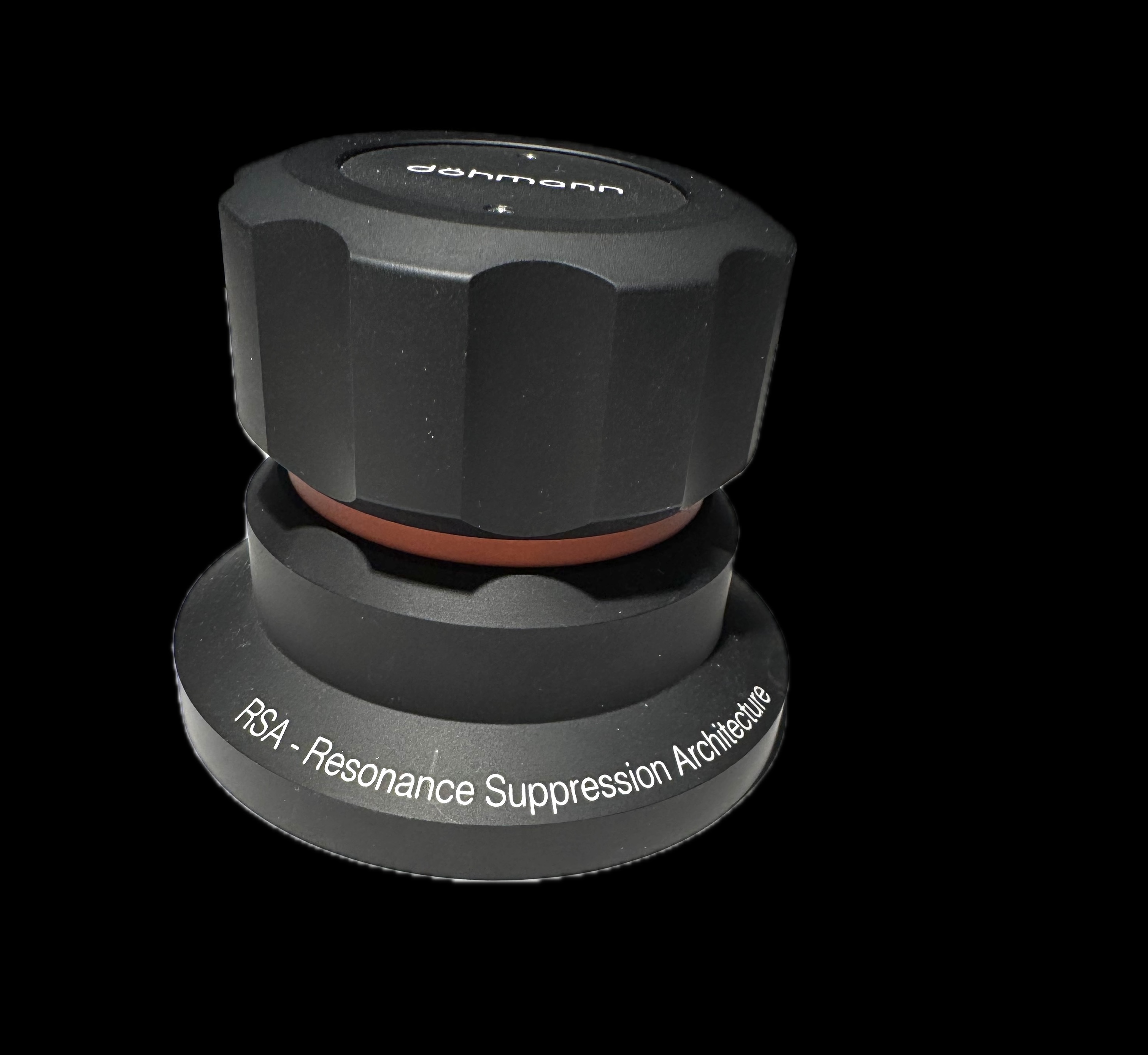
Let’s start with the $3500 Döhmann RC1 Mk3: the most expensive of the three, and the one with the most technical documentation. There’s also an RC2 Mk3, a variant with a slimmer lower section “…to allow SAT and Continuum Cobra arms to get to smallest inner runout groove found on some rare jazz and classical albums where the broad head shells can rub on the (RC1’s) clamp body”. Both are available in threaded and non-threaded versions.
Those familiar with Mark Döhmann’s designs whether his older Continuum turntables or those he now designs for his own company, Döhmann Audio, know that his aim is not to “tune” resonances to his liking but rather to reduce and better, to altogether eliminate them.
Half a decade ago his R&D lab acquired a Laser Doppler Vibrometer that can produce highly accurate, high resolution, non-contact vibrational measurements. According to Döhmann Audio the Vibrometer, “…enabled us to measure resonance propagation and behavior with a significantly higher accuracy and resolution than ever before. The period of research that followed resulted in some discoveries and insights that led to the development of the Mk3 technologies”.
Three ideas guided the RC Mk3 clamp design the first being dealing with record resonances both the external kind—sound waves in the air and from mechanical systems within the record player— and the ones produced by the interaction of stylus and record groove as mentioned above.
The laser technology allowed Döhmann to both measure the resonance andobserve how it travels within the vinyl record itself. That resulted in three clamp design features, the first of which addresses the record resonance:
· Large mating (damping) contact surface area as opposed to using high force contact points like spikes or ball bearings.
· Metallurgy specifically chosen for transmission purposes with internal chambers used for the critical damping materials; those being a carefully selected group required to cover a broad frequency spectrum because according to Döhmann, a single material cannot cover them all.
· A low profile design is also critical, the company avers, in order to minimize bearing precession (the slow, conical wobble of a spinning body's axis, like a spinning top, caused by external forces)—though no one will accuse the RC Mk3s of being squat!
The second design feature deals with spindle resonance measured by the Vibrometer that originate in the bearing system, whether caused by the thrust pad/ball interaction or the bearing sleeve and the spindle itself, or both. The RC Mk3 addresses these measured frequencies using different “tuned materials” (specialized polymers) placed within “purpose designed chambers” located in the clamp’s upper section.
The third design feature isolates the record from the spindle resonance.Though mitigating spindle resonance was useful, the design team felt that totally isolating the spindle resonance from the record was best. That was accomplished using “…a third constrained layer ring system to separate the upper and lower chambers, which under clamping pressure creates a dissipation plate (Finite Element Method) that is shaped carefully to provide an optimum boundary interface”.
The ring is the red disc in between the lower chamber and upper chamber which when clamped forms two boundaries and is designed to damp vibrations between the upper and lower sections from each other by "sliding under load", which doesn't mean it literally slides—at least not noticeably, though it is separated and the top section can be hand spun.
Mark Döhmann told me that both WAM Engineering’s J.R. Boisclair and Korf Audio’s Alexey Korf have measured and confirmed stylus tracing noise ricocheting within an LP.
Enter Tuned Results
The I/K Audio Model 8 Mk2 Verawood
I/K Audio is a Bulgaria based “full service” audio company that manufactures amplifiers, loudspeakers, turntables, audio furniture, cables and clamps. Until this clamp arrived via Canadian distributor Hearken Audio I’d never heard of the company. Interestingly, I/K does not appear to have a web presence: it has an email address: IKAUDIOEU@GMAIL.COM. The Canadian North American importer told me because of tariffs and exchange rate fluctuations to list the MSRP at €3200 and that he'd adjust the price in dollars accordingly and as more dealers come on board.
He also sent a PDF "One-Sheet" that lists and describes all of I/K Audio's hand made (by one man) vibration isolation devices. I/K manufactures five record weight/clamping devices, with a sixth "coming soon", some of which are available in multiple configurations. For instance the Model 9 MK II's body is available in copper, or leather and Lignum vitae wood. The Model 8 Mk2 I was sent is available in Verawood or copper and leather, the latter adds €130 to the price of the one sent for review.
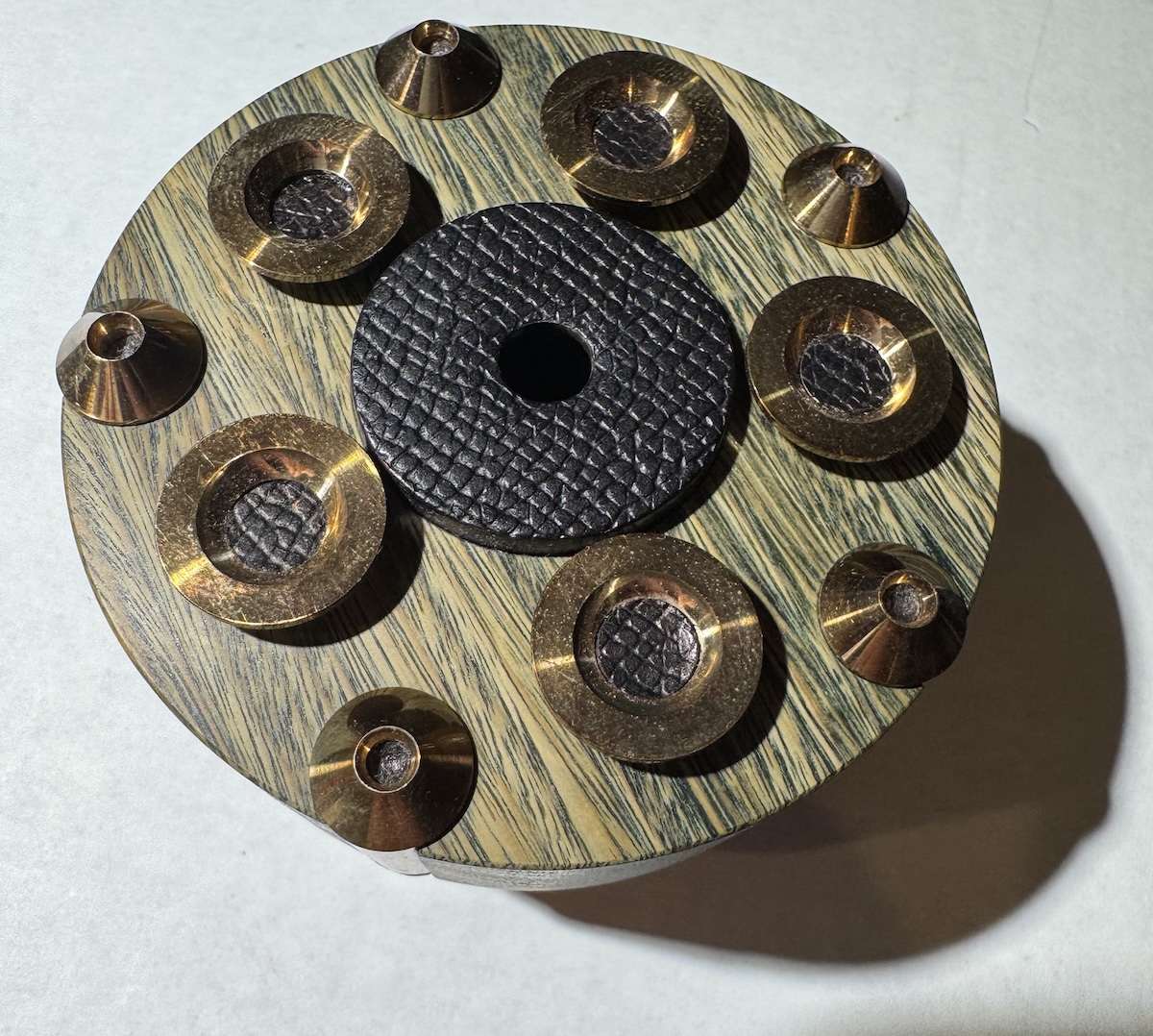
The Model 8 Mk2 (patented design, it says, no patent number or country provided) is a busy piece featuring the Verawood body, which sits on the record label, supported by five "high copper" legs each topped with a black disc I think of graphite. A second multi-layer red disc of bonded together thin layers of what appears to be leather is supported by five thicker copper and leather rods that clamp together the upper and lower discs.
 Bottom of I/K Model 8
There are leather inserts at the bottom of each rod in addition to a leather disc attached to the bottom of the weight surrounding a hole into which a large, heavy bronze pin "with graphite" gets plunged, after you've placed the record on the turntable and the weight onto the label. It's a tight squeezed-fit.
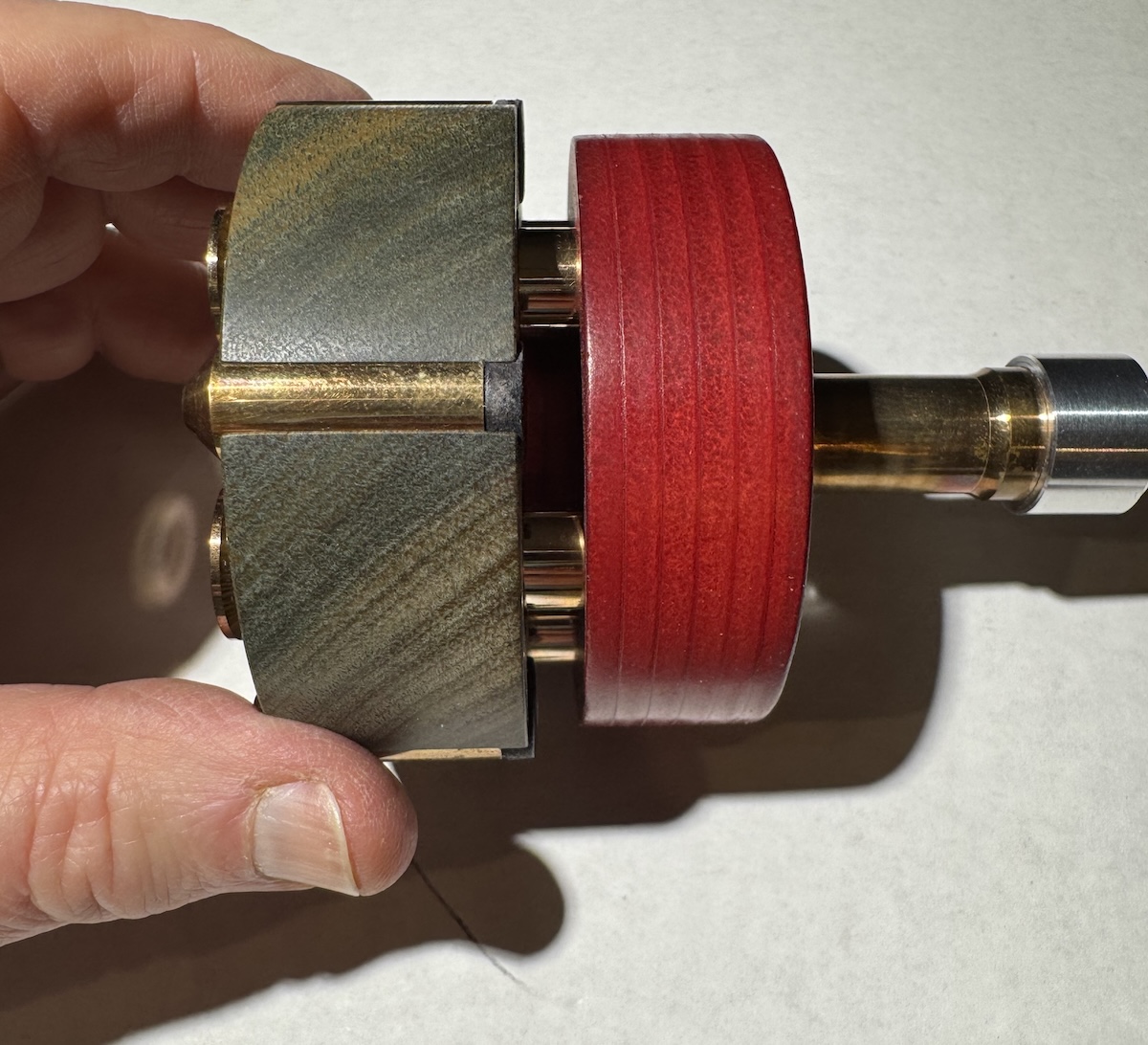 Profile
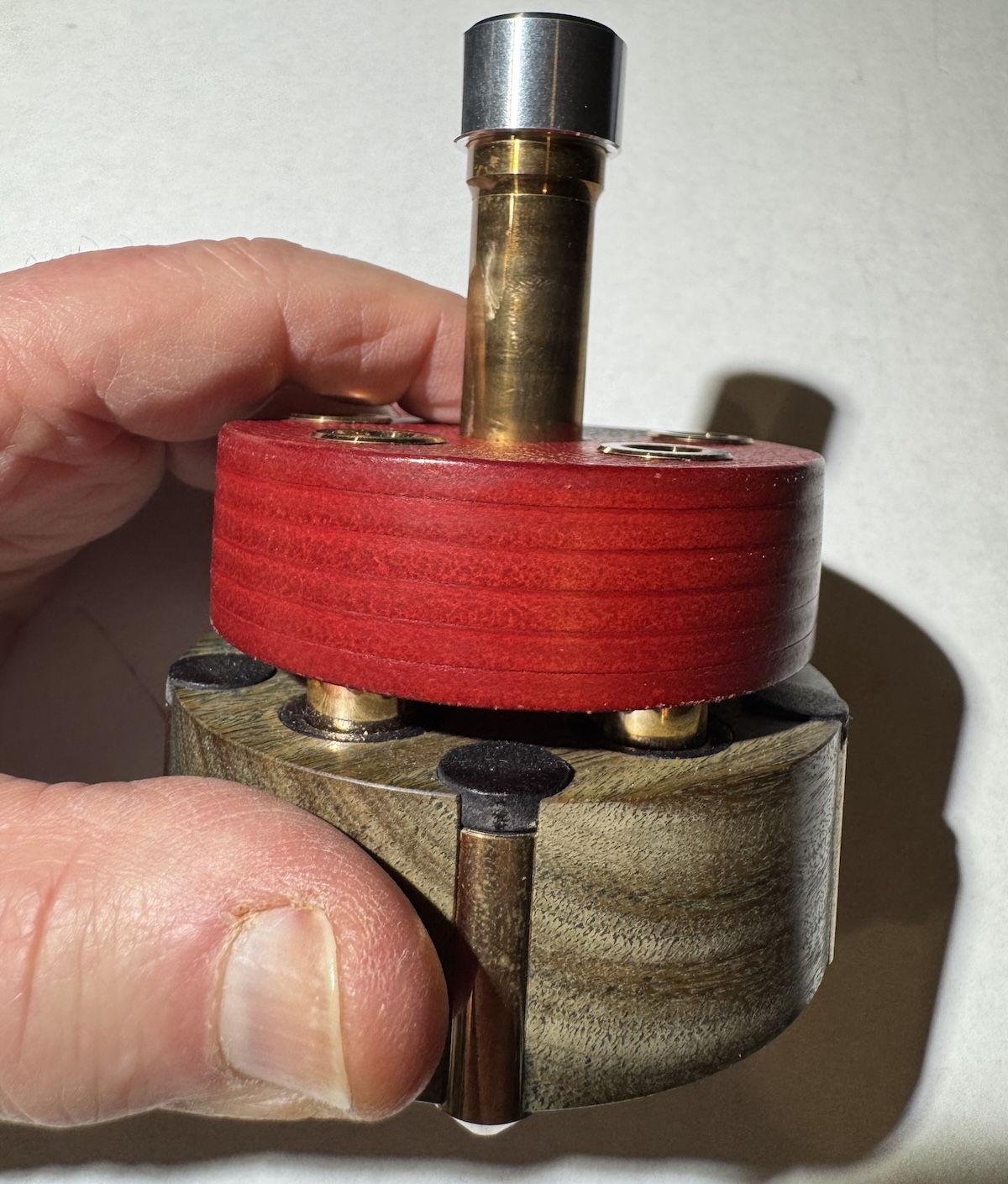 Vertical profile
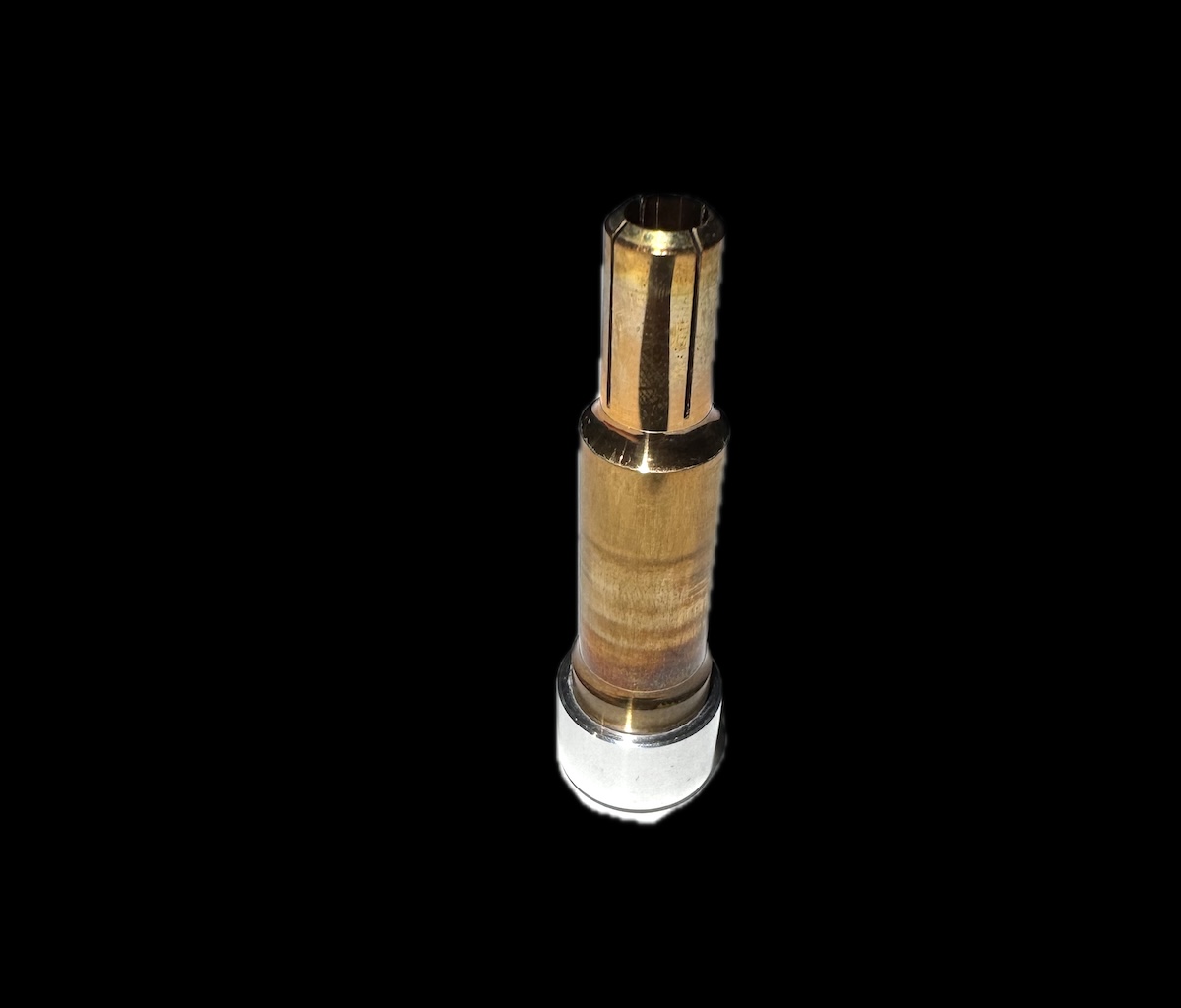 Brass pin
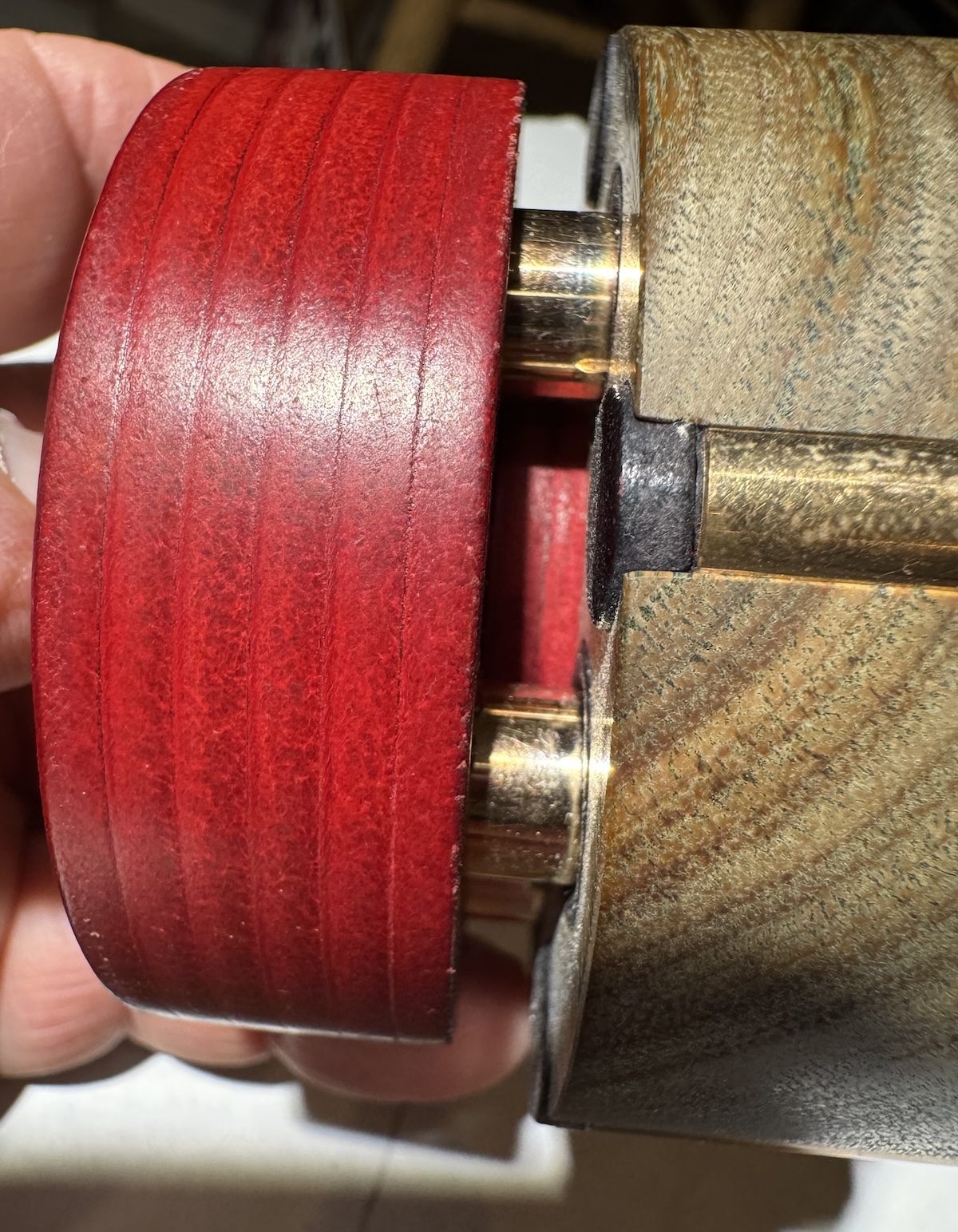
As you can see, the layered red top piece extends below and into an opening in the Verawood base. This is complex design, featuring many components. To use, once you've placed the the weight on the record, you carefully push the brass pin down into the center opening. It's a friction-tight fit requiring some force. It's important, the importer told me, to be sure the pin is pushed all the way down. The amount of force left me vaguely uncomfortable about how good this would be over time for the bearing's thrust pad. I'm sure the Wilson-Benesch Prime Meridian's bearing system can deal with the weight but just know it's a pretty heavy push.
The documentation came with no explanation for why all of these parts exist, or how they interact with one another or exactly how the assemblage functions but clearly this is a tuning device and the brass pin insert, when plunged into the weight, encases itself around the record spindle and that, I suppose, is intended to drain spindle resonances, must as the Döhmann weight does. But that's just my supposition!
The Ramar JEWEL
Berlin, Germany based Ramar claims outright that, like Döhmann, its JEWEL is designed "...to neutralize unwanted vibrations and resonances on the record, that affect the signal path". Neutralize does not mean tune. It means eliminate. How? Here's the concept as described on the website:
"JEWEL has one of a kind asymmetrical design. Although the outer contours of the body, milled from solid stainless steel, are asymmetrical we have achieved a perfectly even weight distribution.
"Ramar's three-point approach: The combination of a shaft seal, brass rods and Sorbothane damping ring minimizes the contact points with the turntable and the record while allowing the energy of unwanted mechanical noise and vibrations from the record player and the record itself to be absorbed and neutralized."
Before more prose, here's what's on the bottom:
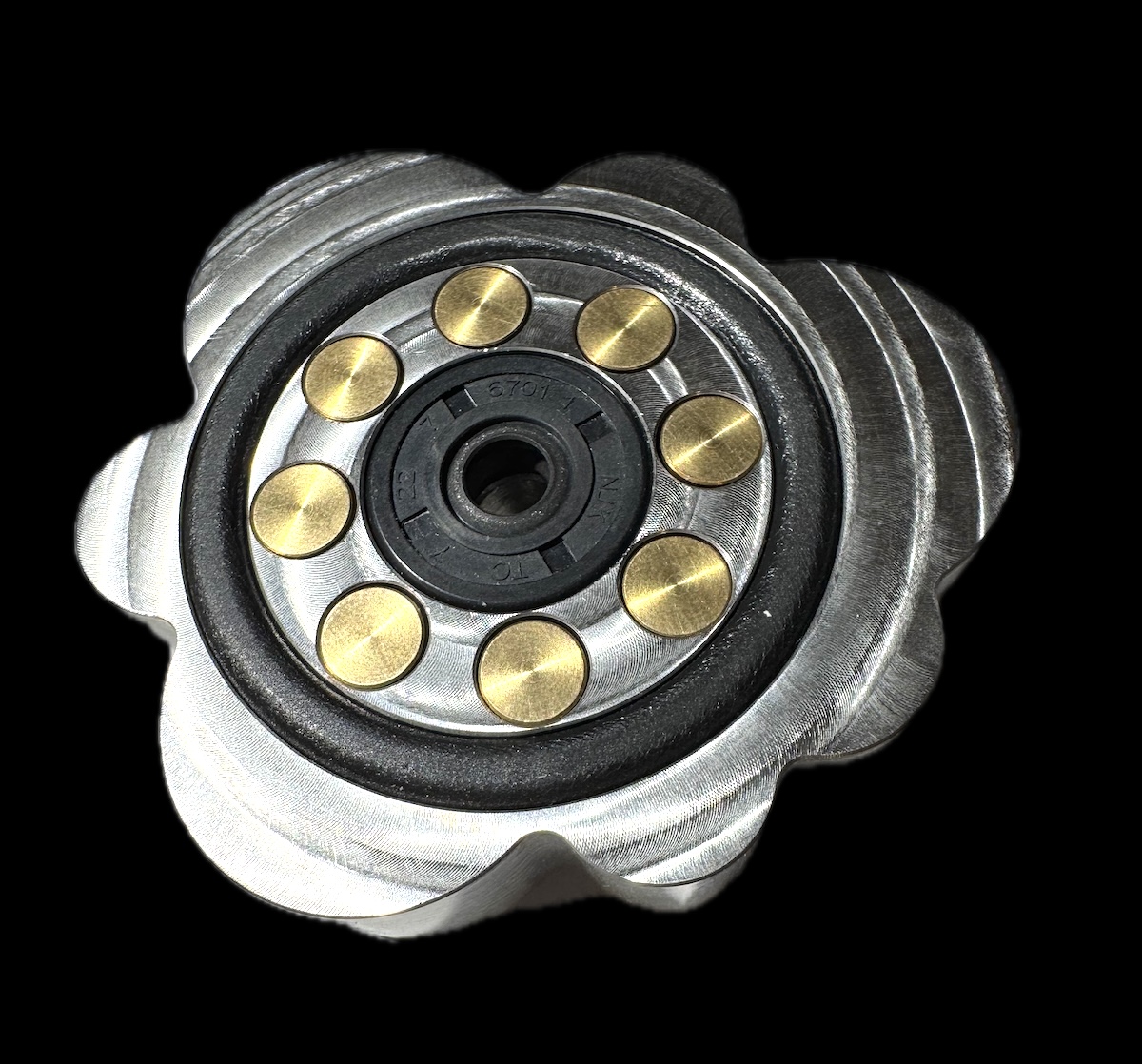 This lets you see the shaft seal, the brass rods and the Sorbothane damping ring.
In case you're wondering how the brass rods can have any effect surrounded by the Sorbothane ring:
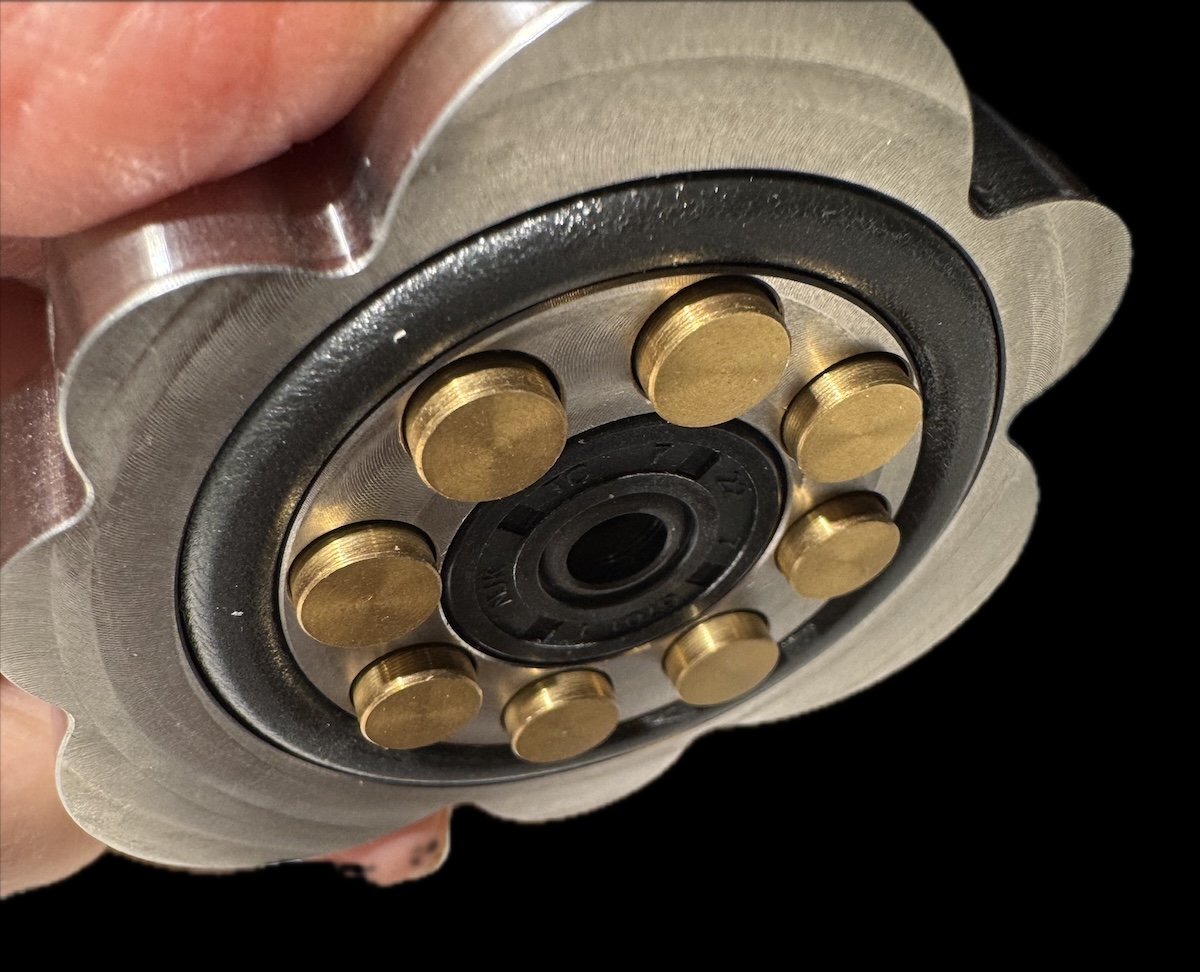 The looks, the mechanism and the asymmetry all help make this an intriguing design that looks great plopped on a platter. Ramar warns:
"In order to be able to use JEWEL properly, you need a visible (above the surface of the record) height of the spindle between a minimum of 6mm and a maximum of 20mm. With a lower or higher spindle length, the desired horizontal placement of JEWEL can be enormously impaired or even prevented."'
And in fact, the first one sent was not suitable for the Wilson-Benesch Prime Meridian's too tall spindle, so Ramar's designer/founder Rangel Vesev kindly sent one that would work.
Here's how it's said to work:
JEWEL is mounted to the spindle via a so-called shaft seal. The unique design of the shaft seal ring ensures a stable connection with the spindle. The elastic coating of the ring neutralizes the vibrations, that might be transmitted via the spindle. At the same time, the expandable NBR rubber coating allows JEWEL to be used on a wide variety of record players with different spindles. The material NBR (nitrile butadiene rubber) is an elastomer with excellent mechanical properties and has high abrasion and tensile strength. There is a coil spring around the center hole inside the shaft seal that serves to additionally stabilize the spindle mount.
• Eight brass rods are suspended independently of each other in the body. As soon as JEWEL is placed on the record, the rods plunge down and gently touch the surface. These transmit some of the resonances inside JEWEL, where they are eliminated. The suspension allows the individual rods to adapt perfectly to any differences in height of the record surface caused by different label structures. This ensures that the contact surface of the brass rods remains constant for all records.
• In collaboration with Sorbothane Inc., we have developed a unique Sorbothane damping ring. This was developed according to our specifications for the function, mass and shape of JEWEL and ensures balanced damping of unwanted vibrations and resonances from records.
Sorbothane is a proprietary, viscoelastic polymer. Viscoelastic means that the material has properties of both liquids and solids (elastic materials). Sorbothane combines shock absorption, good memory, vibration isolation and vibration damping. While many materials have only one of these properties, Sorbothane combines all of them in a stable material with a long service life."
The shaft seal here is analogous to the splits in the I/K Model 8's bronze "plunger" that insures an intimate fit.
The Listening Plan
Over the past few months there was no plan. I just played records and rotated the three weights. Doing that isn't really useful but until recently I wasn't ready to "buckle down". For record review purposes I returned to the weight/clamp Wilson-Benesch supplies with its turntable, which is a collet-type of moderate weight with a cork-like label interface.
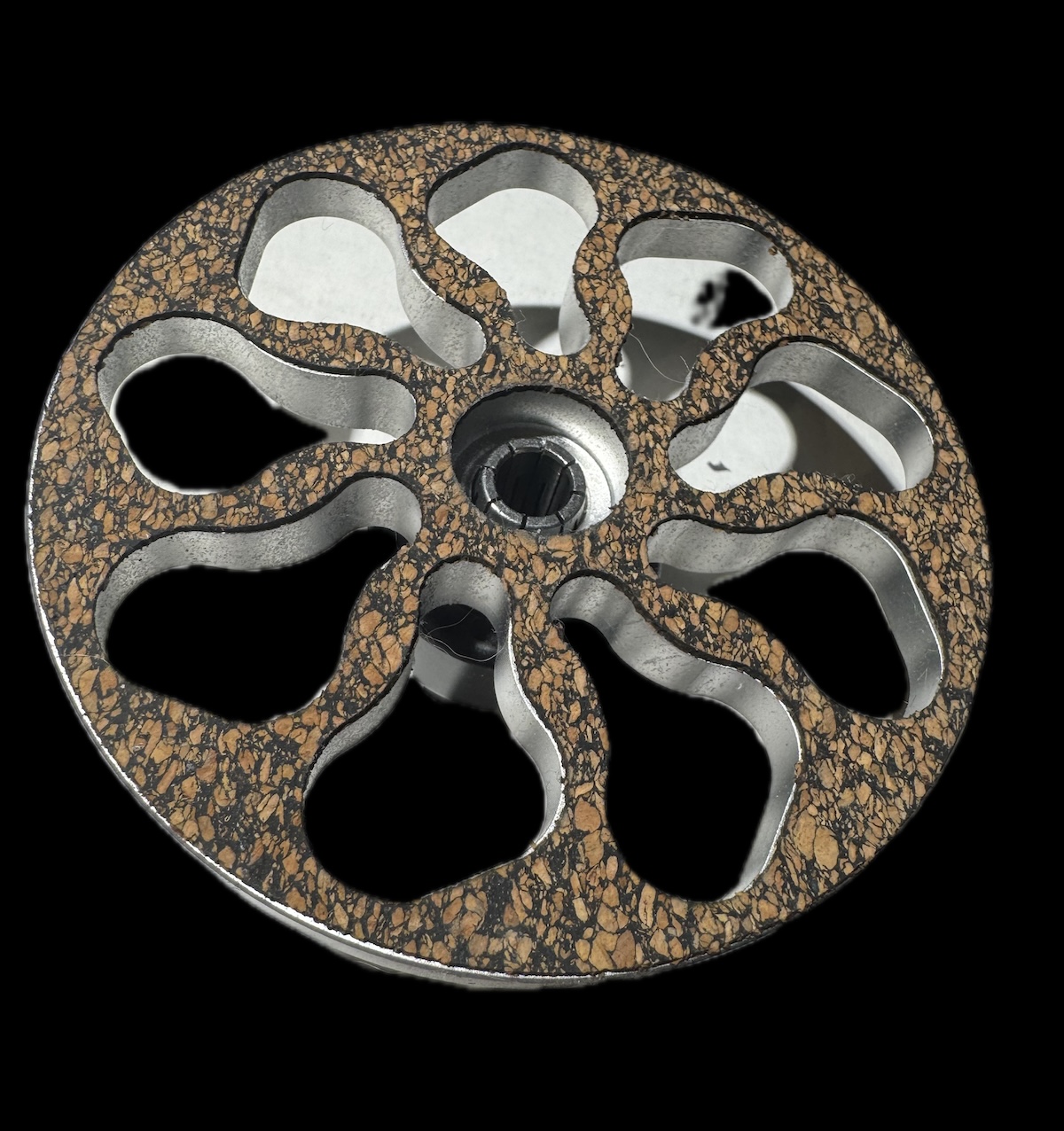
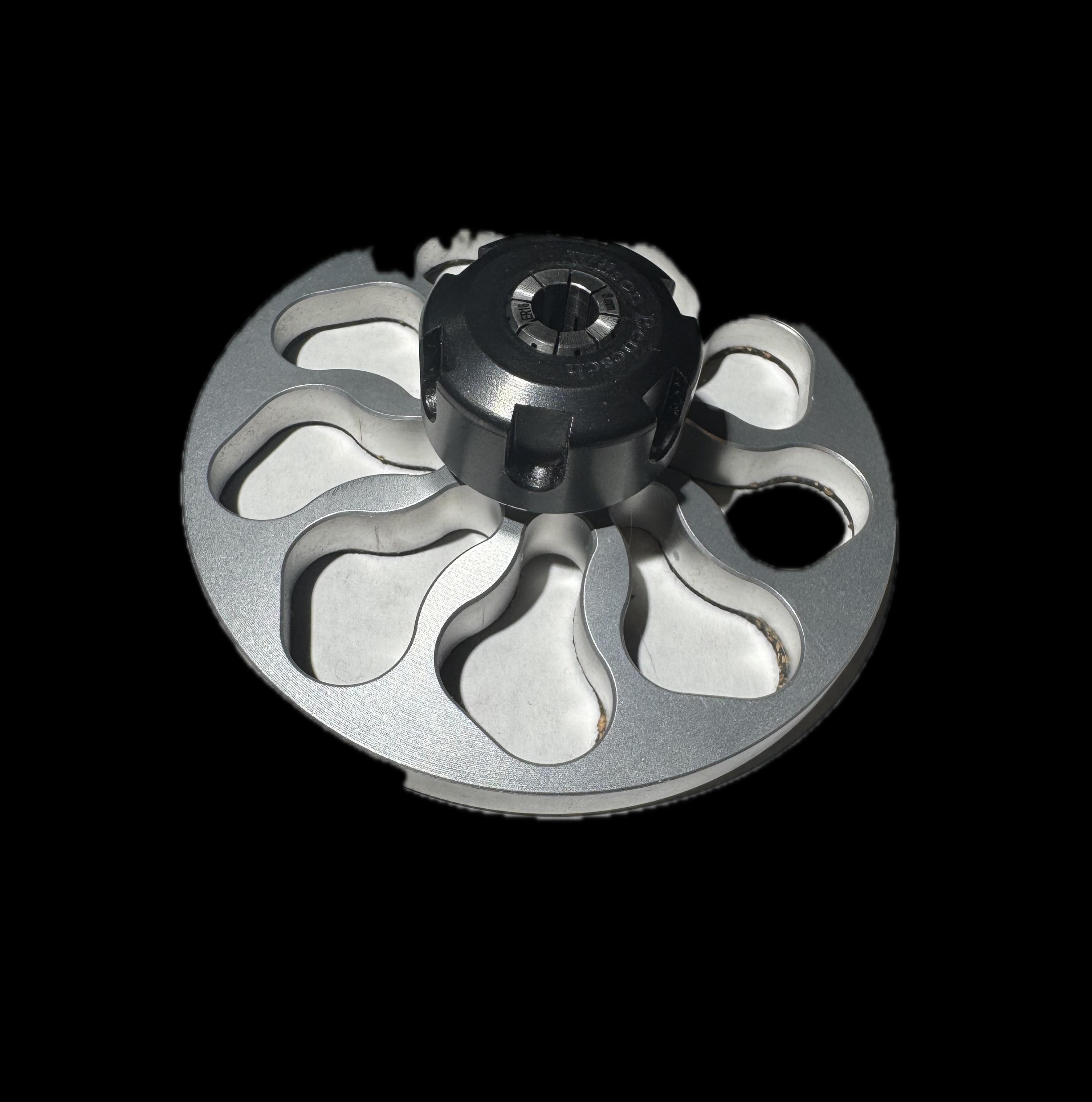 Here are the records I chose to use:
Willie Nelson Stardust (Classic Records/Sony Music 1999) back when Sony lent out master tapes
 Johnny Hartman—Once in Every Life (Analogue Productions/Bee Hive 2016)
 Johann Sebastian Bach – Brandenburgische Konzerte 1•3•4 Auf Originalinstrumenten 1721 (Telefunken SAWT 9459-A Ex 1967 black/gold label)
 Johann Sebastian Bach, The English Concert ∙ Trevor Pinnock – Overtures BWV 1066, 1068 (Archiv 2533 411 1979) and Original Source Series (00289 486 7584)

The Verdict
First I played selections from each record with no weight then with each weight. Every record and every play sounded far better with any of these weights on the platter. Without the weight the sound was kind of "tentative" when compared to any weight on the platter. Keep in mind that Wilson-Benesch supplied its own weight and recommends using it and not playing records without it.
On the Willie Nelson record's title tune the Döhmann weight produced a dramatically more three dimensional image of Willie center stage. Without the weight it was ill-focused with a haze around his voice. "Vague" would be a good word, though it sounded fine until the weight was on. Then the difference was immediate and dramatic—and I'm not exaggerating for the sake of to make the point that it was better. Each bass pluck had added weight and definition, each guitar note played I think by Willie appeared 3D in a space, Booker T's organ floating eerily in the background. The drum stick tap on the snare rim was well-defined and clear without losing it's woody quality.
Switching to the I/K Model 8 Mk2 Verawood, produced a totally different presentation, with everything somewhat softened, especially the bass and guitar plucks, which became more luxurious and rounded, each lingering a bit longer before decaying. With the transients slightly blunted, the guitar notes were warmer and softer. Willie's voice was better defined than with no weight but the immediacy and three-dimensionality the Döhmann revealed were lessened. Though it also pushed his voice back on the stage, it was a pleasant enough presentation.
The Ramar weight kind of split the difference between the other two. Willie's voice was better defined and more three-dimensional than through the I/K, the bass plucks had more weight and better definition, the guitar plucks were sharper, etc. Take the Döhmann's presentation and drop it down evenly a few notches and you have the Ramar.
Moving on to the Hartman record, without any weight his deep mellifluous voice almost sounded as if it was coming through a megaphone. The piano was soft and indistinct, with the studio space MIA. The Döhmann weight put Hartman's voice into sharply but naturally drawn focus. Billy Taylor's piano appeared in a studio space stage right convincingly real. When Joe Wilder's flugelhorn appeared it just about blew my Lorna Dunes.
Part of the problem here is that I've known the original Bee Hive record for decades and unless my vanity is at work I was the one who suggested to Chad Kassem that he reissue it. I haven't played it in probably the decade since it was reissued and my system has gotten that much better. I didn't realize just how great this recording is. You're remarkably in the studio.
What would switching to the I/K do to the mouth wide open wow? No change to the volume control but it sounded as if I was sitting further back in the studio. Still in the studio though. The blackness behind Taylor's piano was diminished as was the sparkle, but it was still pleasing. Bass was also notably softer, yet still shapely and Wilder's flugelhorn had a rich warm midrange but less brass. Still a beautiful sound, just not nearly as dramatically transparent and immediate. It's a sound some might prefer.
Again the Ramar split the difference. Taylor's piano was back in a defined studio space, piano transients sharpened, Victor Gaskin's bass lines tightened and Hartman's voice more focused and three-dimensionalized. But compared to the Döhmann all was partially submerged into the "ether" instead of appearing starkly out of the blackness. Taking either of the two other weights off while music played and lowering the Döhmann onto the label made an immediate and obvious, not subtle difference.
This Brandenburg Concerto recording really deserves reissuing. It's spectacular! As the notes confirm "The present recording of the Brandenburg Concertos was made without any "artificial" technical effects, in the wonderful baroque hall of the Schönburg Palace in Vienna. The ensemble played in its usual concert seating plan; two microphones, deputized for the listener, picked up all the concertos from the same unchanged position." The notes claim this was the first time "in our age" that the performance used original or copies of original instruments.
This is probably the most difficult recording because of the "midrang-y" room sound that both puts the listener in the space and amplifies any resonances in a very sensitive area. And the original instruments are loud. Number 3 is all strings: 3 violins, 3 violas, and 3 cellos (one played by Nikolaus Harnoncourt) sawing away (with a harpsichord tagging along) in a fairly lively space "deputized" by a pair of microphones.
With the Döhmann "deputized" on the record everything stays in place, nothing jumps forward over time as none of the notes excite resonant modes. The I/K slightly homogenizes the entire picture, warming things especially in the lower midrange, which gives everything a richer more inviting tonality but you hear less of the space in which the recording was made because it blends in with the instruments. At the same time the violins are somewhat brighter and forward sounding. When the cellos have their say the sound gets a bit "cuppy", though in a musical way.
With the Ramar "deputized", there's far more room sound behind the instruments and less homogenization. The soundstage opens up and deepens. Considering that it costs about 1/4 the price of the Döhmann, it delivers a far greater percentage of the Döhmann's performance. When the cellos dig deep it goes there.
On the Archiv Overtures record the results were fascinating: the original record that I've been playing since it was first released has a warm, soft and somewhat indistinct but pleasant overall sound. The new reissue is far more revealing of inner detail and the strings sound far brighter and "in your face". Depending upon your system and what you like, here you might listen and say "that I/K is the best of the lot". For my taste and in my system the Döhmann clarified the warmer original and solidified the OSS version, while leaving the strings forward and somewhat bright but that recording as well is on original instruments and I'd say the new OSS is more faithful to the instruments and the recording. It's possible the producers were afraid listeners would find the original instruments "a bit much" and toned them down during mastering.
Conclusion
I figure one of the reasons I was able to hear major sonic differences among these three weights is because the W-B turntable is such a neutral carrier. It is. When there's no bass on a record, you hear none, which is one reason it's somewhat less ideal for rock records that usually have a deficiency down there. Turntables with a nice upper bass resonance make many rock records sound better. Just when I wonder about the W-B's bottom end all I need to do is put on something that definitely has it, and there it is!
The most costly of the three by a considerable margin produced the biggest sonic difference. Blacker backgrounds, increased three-dimensionality, improved detail resolution and just more of everything in terms of texture, touch, harmonic structure and especially overall spatial and timbral stability. The funny thing is the Döhmann appears to be the most conventional and like just a weight, the other two more exotic, yet the proof was in the listening.
Among these three, if you can drop $3500 on a weight (I'm sorry), and if you can get the Döhmann on a 'try it first return if you don't like it' you ought to try it! But don't expect to return it. The Ramar gets you a surprisingly close second for a lot less money and it's easy to recommend. Plus it looks and feels great. The I/K has the greatest sonic signature: it imparts a pleasing warmth and billowy softness all around but in an evenhanded way, and I know it's a sound that many listeners like. If you've looking to add a kiss of warmth to an aggressive system it does that.
Specifications
Döhmann Helix RC2 Mk3— $3500
I/K Audio Model 8 Mk2 Verawood €3200
Ramar JEWEL €799