
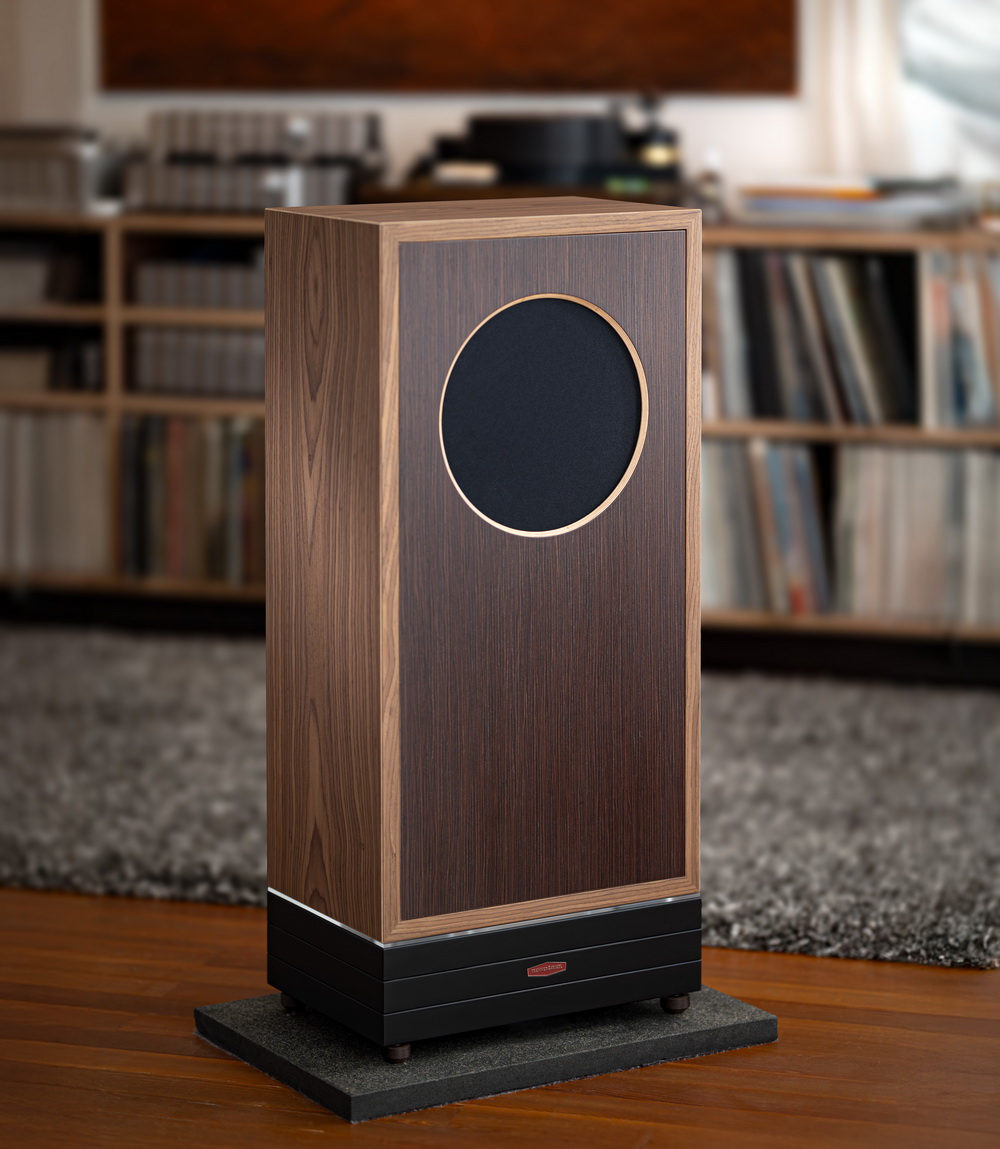
Trenner & Friedl RA v3 Loudspeaker
Coherence, Craft, and the Long Game of Listening
There’s a type of loudspeaker that doesn’t try to win me over in the first few minutes. It doesn’t sparkle under showroom lights or carve out hyper-detailed sonics to grab my attention. Instead, it sits there—quietly confident—waiting for me to meet it halfway. The Trenner & Friedl RA v3 is that kind of speaker.
Designed by Austrian partners Andreas Friedl and Peter Trenner, the RA v3 feels less like a conventional hi-fi product and more like something shaped by lived experience—through recording sessions, late-night listening, and an understanding that music is not just a collection of sonic artifacts but a continuous, breathing event. This is not a speaker voiced for effect. It is voiced for coherence, for tonal integrity, and with the intent to develop a long-term relationship between the listener and their music.
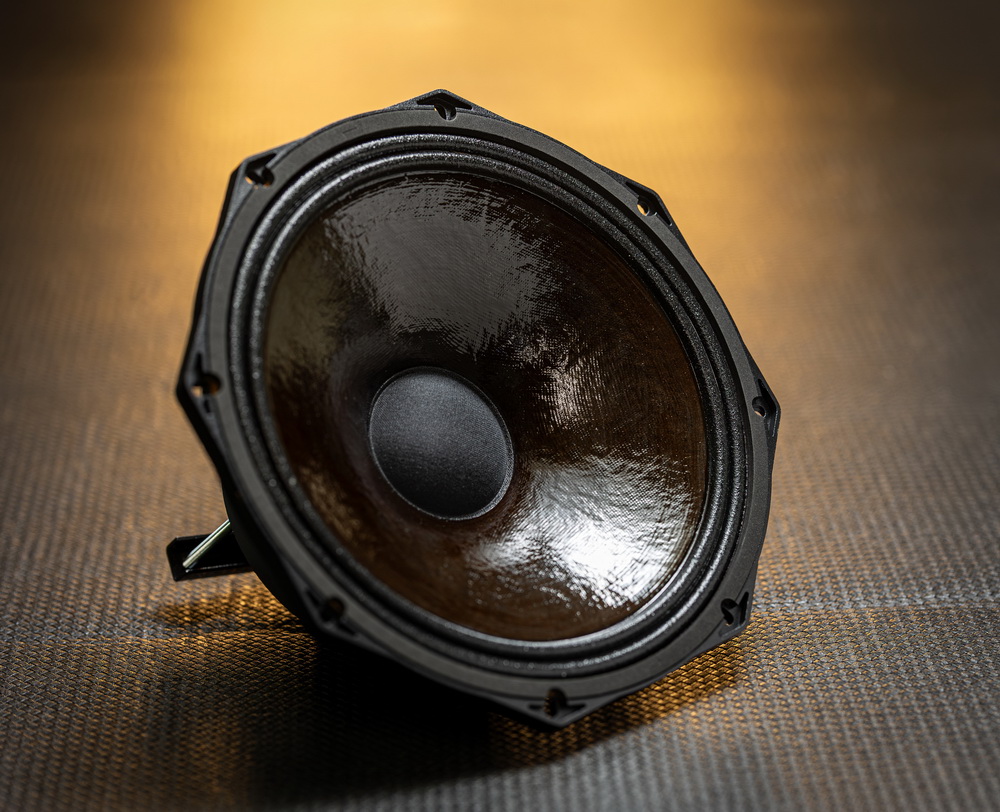 That intent became clearer the deeper I dug into how the RA v3 is built. At the heart of the speaker is its coaxial driver—a violin-lacquer coated 12-inch paper cone woofer with a centrally mounted compression HF driver, the latter firing through a carefully profiled horn integrated into the woofer structure itself. This is not simply a matter of convenience or space-saving. By physically aligning the acoustic centers of both drivers, the RA v3 minimizes phase rotation through the crossover region. It preserves time alignment in a way that conventional vertically separated drivers struggle to achieve. What I hear is not a stitched-together presentation of frequency bands, but a unified wavefront.
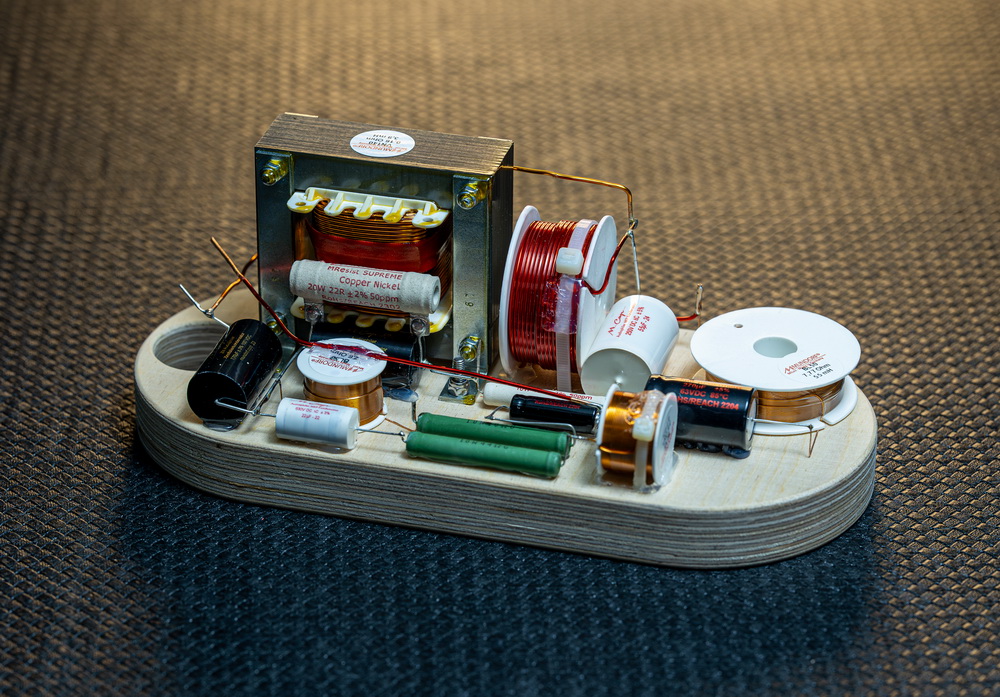 In a coaxial system, the crossover is not just dividing frequencies; it is managing the transition between two drivers that occupy the same physical space yet behave very differently in their radiation patterns, impedance, and energy storage. The woofer operates in piston motion, with increasing directivity as frequency rises, while the compression driver is coupled to a horn that provides more consistent dispersion control. Aligning those two behaviors requires more than a simple filter slope.
Here, Trenner & Friedl use acoustic (not electrical) slopes that correspond to 4th-order Linkwitz filters. The crossover itself is more complex than the speaker’s outward simplicity might suggest. Trenner & Friedl employs point-to-point wiring with a carefully tuned network of high-grade components—Mundorf capacitors, low-resistance inductors, and precision resistors—configured not just for amplitude linearity but also for phase coherence and impedance stability.
In practice, this means the RA v3 behaves as an easy electrical partner. With a nominal 8-ohm impedance and a sensitivity of around 93 dB, it presents a load that is both efficient and stable. Tube amplifiers, particularly single-ended triode designs, benefit from this stability, operating within a comfortable range where their harmonic and dynamic strengths can shine. At the same time, solid-state amplifiers are not burdened by reactive impedance dips or excessive current demands, allowing them to deliver control without strain.
There’s also a strong sense that time-domain behavior has been carefully considered. Transients arrive as cohesive events—not as layered approximations—and that subtlety plays a big role in how natural everything feels.
Putting on Bill Evans’ Waltz for Debby had an immediate impact, though not in the usual audiophile sense. There’s no exaggerated sense of “look at me” imaging. Instead, the piano appears as a whole instrument, its harmonic structure intact from top to bottom. Evans’ touch—those delicate transitions between attack and decay—flows naturally, without the slight disjunction that can occur when multiple drivers hand off responsibilities. It’s a presentation that feels continuous rather than assembled.
Compared to something like the Harbeth M40.3 XD, which renders tone with a kind of burnished beauty, the RA v3 trades a touch of that warmth for a more unified perspective. The Harbeth draws you into the midrange's texture, almost wrapping the music in a gentle glow. The RA v3, by contrast, steps back just enough to reveal the structure beneath the tone—the way notes relate to one another in time and space. Neither approach is inherently better. But the difference is telling.
The Harbeth seduces. The RA v3 reveals.
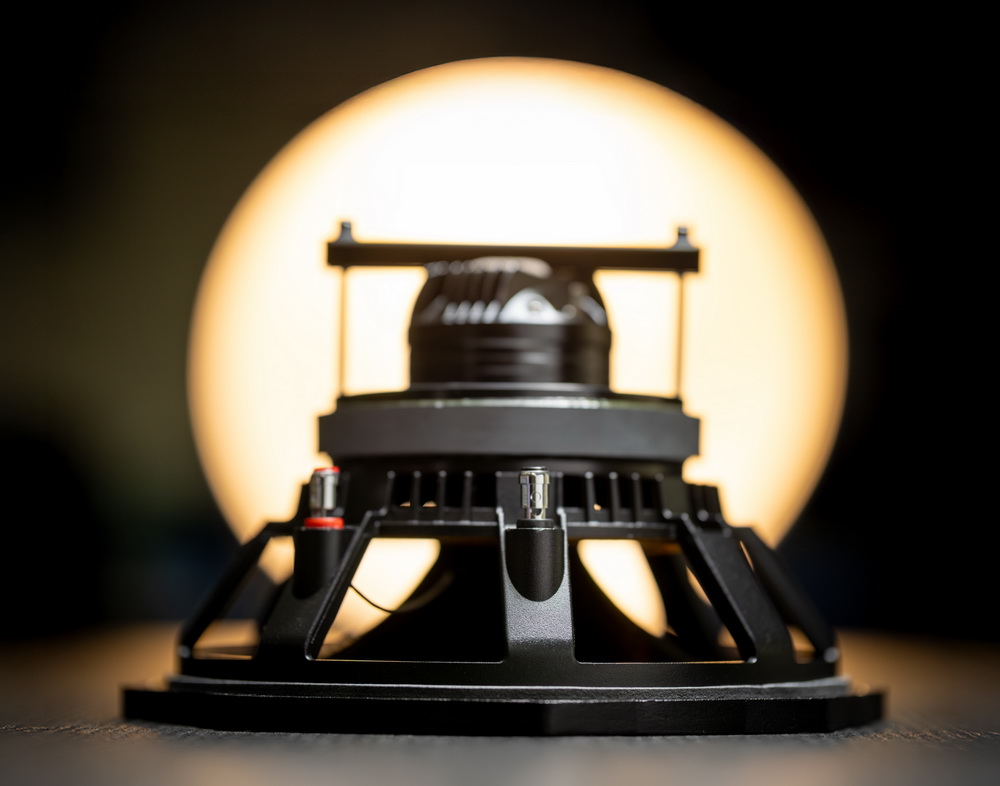 That sense of revelation extends into the low frequencies. With its 12-inch ferrite motor driver, the RA v3 has no shortage of bass capability, but what stands out is not quantity—it’s articulation. (Interesting aside…Trenner & Friedl specifically chose not to use trendy Alnico magnets. Their position is that as Alnico ages, its magnetic field becomes weaker.)
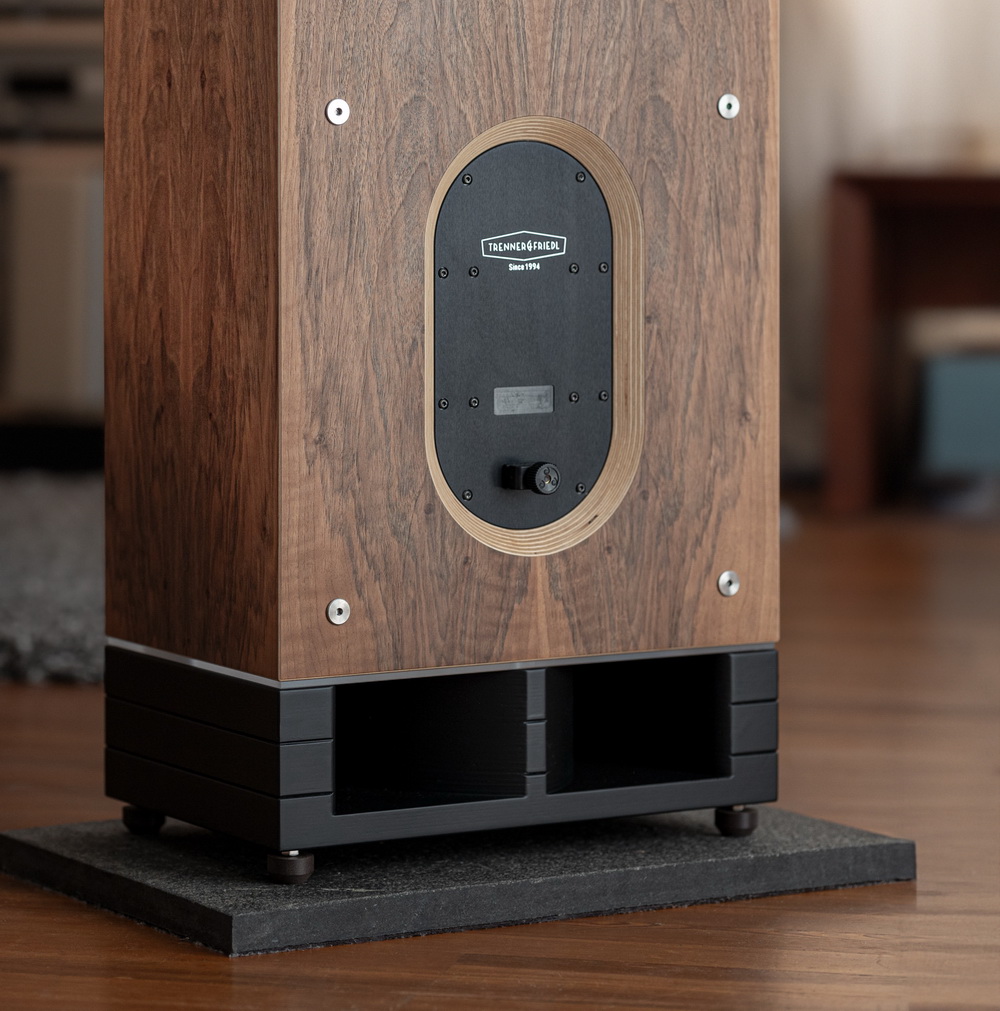 The bass reflex system also serves as the base for the speaker. Its contour is horn-shaped and opens inside the enclosure at the ideal positions, namely the corners, as far away from the woofer as possible for maximum efficiency. Through the outlet opening at the very bottom, the reflex system radiates into half- or quarter-space (depending on placement). This simplifies room integration and allows for placement near the front wall or out in the room.
On "So What" from Miles Davis’s Kind of Blue, Paul Chambers’ bass line isn’t just present—it’s intelligible. Each note has a beginning, a body, and an end. I could follow his phrasing, his intention. There’s no excess bloom here, no attempt to impress with sheer weight. Instead, the bass serves the music, anchoring it without drawing undue attention to itself.
By comparison, the Wilson Audio SabrinaX presents bass with a more sculpted, immediate impact. The Wilson offers a sense of control and grip that can feel almost architectural, each note sharply defined. But that definition can come with a slightly compartmentalized presentation—bass, midrange, and treble operating in clearly delineated layers. The RA v3 avoids that segmentation. Bass flows into the midrange as part of a continuous gesture, reinforcing the speaker’s sense of coherence.
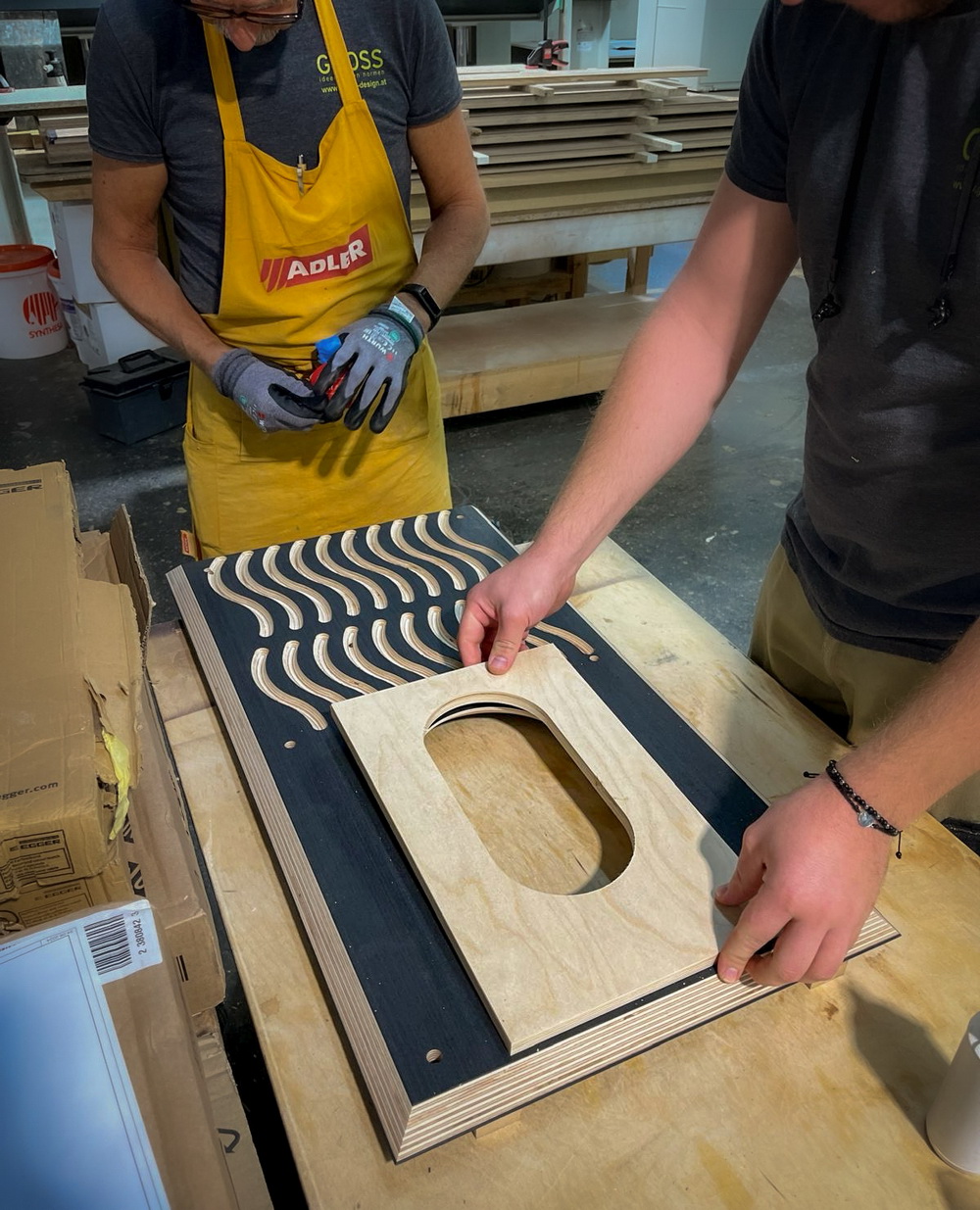 The multiplex cabinet construction further supports that coherence. Rather than pursuing absolute rigidity, Trenner & Friedl use layered birch and beech plywood with varying densities, creating a structure that distributes and dissipates vibrational energy across a broader spectrum. Internal bracing is strategically applied not to eliminate resonance but to control its behavior—shifting resonant modes out of critical frequency ranges and reducing their amplitudes. Inside the enclosure, there are wave-shaped milled grooves, partially covered by thin, soft fiber panels. This design is said to reduce weight, slightly increase volume, and, due to the grooves' design, not compromise stability. This means less damping material is required inside the enclosure to maintain as much bass energy as possible. The damping itself consists of precisely proportioned recycled felt. What I hear is a cabinet that doesn’t ring, but also doesn’t disappear completely, subtly contributing to the overall tonal character, much like the body of an acoustic instrument.
There’s even mechanical tuning at play. The front panel is tensioned from front to back, allowing the manufacturer to adjust the front baffle tension using six rear bolts.
In Nick Drake’s "Pink Moon", the guitar carries a tactile presence that goes beyond its string tone. I could hear the body of the instrument, the way it resonates, the way the notes bloom and decay into silence. There’s a physicality here that feels grounded and real.
This stands in contrast to speakers like the Magico A3, whose cabinets are engineered to disappear entirely using aluminum enclosures and extensive internal bracing. The Magico delivers extraordinary clarity and neutrality, presenting music with a kind of clinical precision that can be stunning. But it can also feel slightly removed, as though the music exists in a perfectly controlled vacuum.
The RA v3, by contrast, felt grounded. Anchored. Alive.
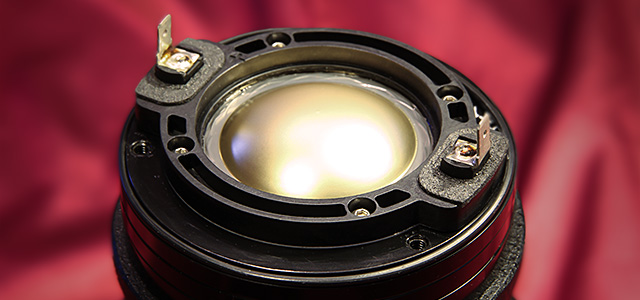 The treble performance is another area where one’s preconceived notions may need adjustment. Compression drivers often have a reputation for harshness or glare, but that was not my experience here. The RA v3 features a 1.75-inch tweeter with an efficiency of 110dB. Its titanium diaphragm, coated with titanium nitride, uses a neodymium motor, enabling it to extend its frequency response beyond 40 kHz. This tweeter is integrated into a horn that controls dispersion, ensuring a consistent tonal balance both on-axis and off-axis. This design has practical implications for how sound interacts with the room. Reflected sound in my room retained the same spectral balance as the direct sound, which helped create a more natural sense of space.
More listening…
On Patricia Barber’s Company, cymbals shimmer with natural extension, their decay trailing off into silence without any hint of etch. The top end is open and detailed but never pushed forward.
Compared to the Focal Sopra No2, which delivers a more explicitly detailed and forward treble presentation, the RA v3 feels more integrated. The Focal illuminates every nuance, presenting detail as a primary feature. The RA v3 allows that detail to emerge within the context of the music, never drawing attention to itself.
Dynamics is another area where the speaker’s engineering choices translate directly into performance. The combination of high sensitivity, low moving mass in the compression driver, and efficient energy transfer results in a system that responds quickly to transient signals. There is minimal energy storage, minimal delay, and a sense that the speaker is always ready to follow the signal without hesitation.
On large-scale recordings like Mahler’s Symphony No. 2, the RA v3 moves effortlessly from the quietest passages to full orchestral crescendos. There is no compression, no hardening of tone, no sense of strain. The music expands naturally, without the speaker imposing its own limitations.
Spatially, the benefits of the coaxial design and controlled dispersion become apparent. The RA v3 does not create exaggerated, pinpoint images. Instead, it presents a continuous acoustic field where instruments occupy space with believable scale and proportion.
At the same time, the speaker excels at microdynamics. Listening to Cassandra Wilson’s Harvest Moon, the subtle inflections in her voice—the breath, the phrasing, the shifts in intensity—are rendered with sensitivity. These are not dramatic changes, but they are essential to the emotional content of the performance.
It didn’t wow me immediately. But it convinced me over time.
On Friday Night in San Francisco, the interplay among Al Di Meola, John McLaughlin, and Paco de Lucía unfolds in a clearly defined setting. The sense of venue, the air, the reflections, the energy of the audience—is conveyed without artifice.
Something like Nina Simone’s “I Put a Spell on You” becomes almost startling in its intimacy. Her voice carries not just power, but texture—the breath, the emotional tension that sits just beneath the surface. The piano behind her is not pushed forward or recessed; it exists in its own space, fully formed, supporting without intruding. What the RA v3 captures here is not just sound, but intent. You hear not just what she sings, but how and why.
That ability to convey intent is what ultimately separates good systems from great ones.
With more complex material, the same qualities hold. On Radiohead’s Everything in Its Right Place, a track that can easily collapse into a wash of layered electronic textures, the RA v3 maintains separation without dissecting the music. Each element retains its identity, but the whole remains intact. There’s no sense of analytical disassembly—no pulling apart of the mix for the sake of clarity. Instead, the speaker allows complexity to exist, revealing structure without imposing it.
This becomes especially important with modern recordings, where production choices often blur the line between instrument and effect. The RA v3 navigates this terrain with a kind of quiet confidence, neither editorializing nor smoothing over rough edges.
Lest you think I am describing a speaker that makes everything sound acceptable by injecting its personality into the music, or by designing “smoothness” into its sound profile, make no mistake. Garbage in, garbage out. It presents what is on the recording…the good, the bad, and the ugly, trusting the listener to engage.
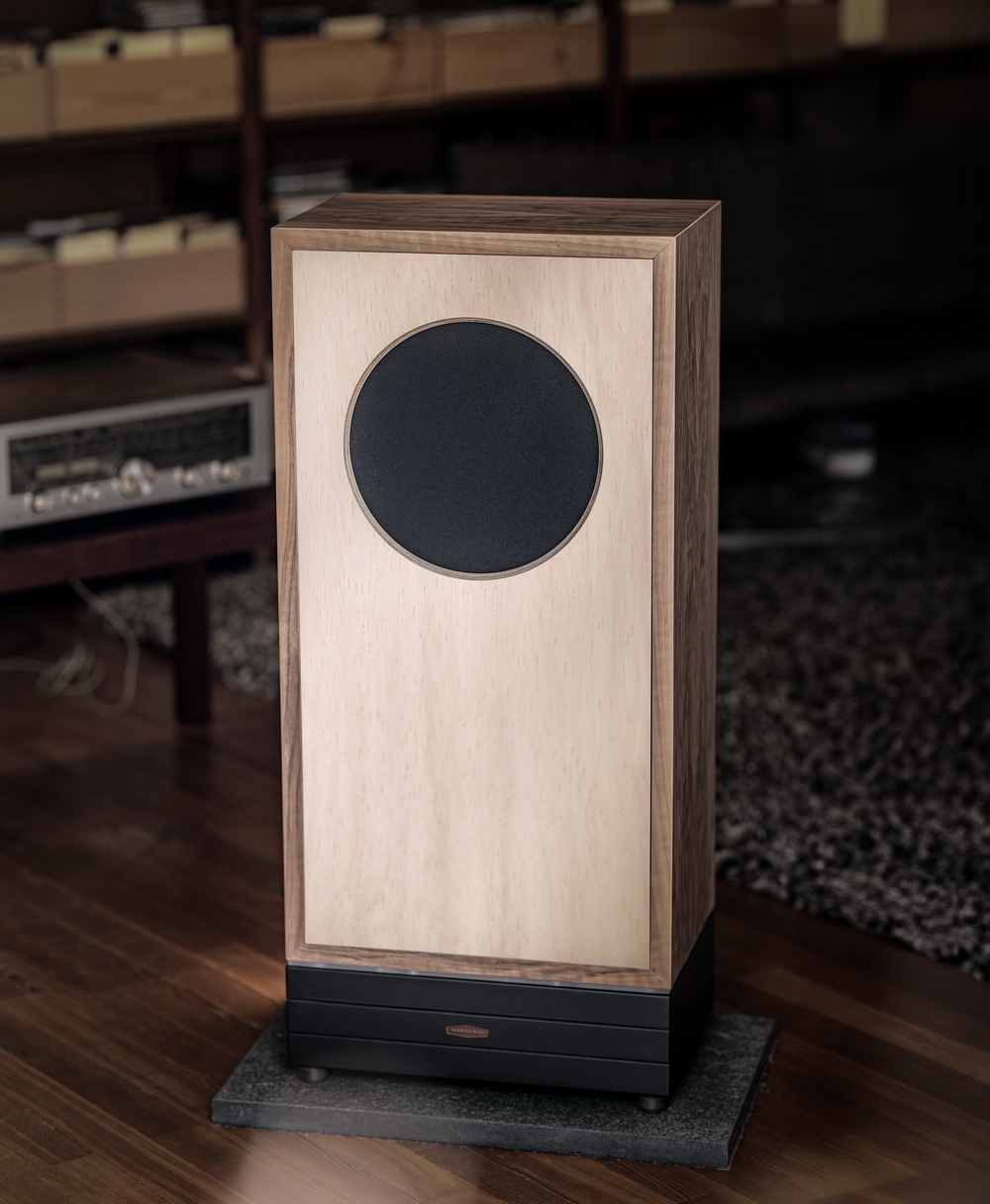 The RA v3 invites you in and encourages you to pay attention and follow the thread of a performance from beginning to end. In that sense, it shares more in common with live music than with typical hi-fi playback. There’s a sense of presence, of immediacy, of being in the moment rather than observing it from a distance.
Even at lower listening levels, this sense of engagement remains intact. Many speakers lose their coherence and dynamic nuance when the volume drops, requiring a certain level of output to come alive. The RA v3 does not. It maintains its balance and expressive capability even at late-night levels, preserving the relationships between notes and the integrity of the performance.
That quality alone makes it a compelling long-term companion.
Lastly, the RA v3 is a speaker that excels without requiring extreme placement or elaborate amplification. According to the manufacturer, it can be placed as close as 4 inches from the front wall. In my room, the closest I could position the speaker was 7 inches out from the front wall. Surprisingly, even at this close distance, the RA produced bass that was both smooth and deep, defying the typical muddled, constipated bass most speakers exhibit when I try them in that position. Of course, like any speaker, I did experience a more open, immersive bass when I moved the speakers out to 4 feet from the wall. Its understated yet elegant design, reminiscent of fine furniture, allows it to blend seamlessly into a living room setting.
At the end of my time with the speaker, what stayed with me most wasn’t any single technical achievement; it was how all those individual decisions added up. Each contributing to a greater whole.
What did I learn…
Living with the RA v3 over time, I noticed something shifting in how I listened. Other speakers often train me to focus on attributes like detail, bass weight, and imaging precision. The RA v3 shifted my attention toward relationships: how notes connect, how phrases unfold, how timing and tone interact. That shift is subtle. But it’s profound.
In the end, what the Trenner & Friedl RA v3 offers is not a particular sound, but a particular way of listening. It shifts your attention away from hi-fi artifacts and toward musical experience. It asks you to let go of analysis and trust what you’re hearing. I learned that what first seemed understated is, in fact, deeply resolved. That which felt relaxed was actually precise in a more holistic sense. The RA v3 doesn’t push detail forward; it allows it to emerge naturally, in context, where it belongs.
It’s a reminder, more than anything, that there are different paths to musical understanding. It’s no less accurate; it simply reveals the music differently. And once I heard that perspective, once I had settled into its sense of coherence and ease, it became difficult to un-hear. My usual hi-fi priorities start to feel a little less urgent, a little less convincing.
In the end, I concluded that the RA v3 wasn’t trying to impress me…It’s trying to show me the music as it lives and breathes.
And that will stay with me.
Price at the time of the review
$29,000 per pair
Products used during the review.
Turntable: The Wand 14-4 Master
Cartridges: Goldenberg Maestro, Grado Statement 3
Phono Stage: Tom Evans Groove + SRX MK2.5, Genesis Simplicity
CD Transport: Jays Audio CDT-3 MK3, McCormack Ultra SST-1
Preamp: SMc Audio VRE-1C, Audio Research Reference 6SE
Amplifier: SMc Audio Ultra GT25 DNA 0.5 Monoblocks, Audio Research S 100
Digital: Innuos Zenith Mk III, Phoenix USB, Network Acoustics Muon Pro Filter and Tempus Switch, BorderPatrol ZOLA DAC, SMc Audio Ultra DAC.
Speakers: Acora Acoustics VRC
Tape: Crown CX 822, SX 824
Cables: Cardas Clear Beyond, Audience Front Row Reserve, SilverSmith Fidelium, Genesis Absolute Fidelity Interfaces
Accessories: Stillpoints Apertures and Ultra 1 E, Kirmuss KA-RC-1, Wally Tools Cartridge tools, DS Audio ION 001, Shunyata Altaira Grounding System
Power: Shunyata Denali 6000/T v2 and Typhon T30 with Sigma-X
V2 power cords
Specifications
Features:
Floor-standing speaker
Coaxial loudspeaker for perfect point source
Multiplex birch wood of different densities
Multi-layered lacquer finish
Vented system with perfect matching to the room
Paper cone impregnated with Italian violin varnish
Internal wiring OFC strand (Oxygen-Free copper)
Cardas terminals
Finest crossover components by Mundorf
Designed for all amplifiers
Can be placed close to walls and corners
Drive Units
1 x 12” Paper cone, coated with violin lacquer
1 x 1.75” Horn-loaded compression driver, TiN-coated titanium diaphragm
Frequency response
32 Hz (f-6 DB) to 47 kHz (f-3 DB)
Sensitivity
93 dB (2.83V/1m)
Impedance
8 Ohm (minimum 5.8 Ohm at 36Hz
Dimensions
Height: 975 mm
Width: 450mm
Depth: 300mm
Weight: 45 kg
Finishes Body
Walnut ECO, Iced Oak, Others on request
Finishes Front
Ebony Eco, Others on request
Manufacturer Information
Trenner & Friedl GmbH
Sedlitzkygasse 5A/1/4, 1110 Wien
Austria
phone: +43 - 650 545 88 03
e-mail: office@trenner-friedl.com
UID: AT U68 533 688, FN 408965 w
US Distributor:
Bob Clarke
PROFUNDO
2051 Gattis School Road, Suite 540/123
Round Rock, TX 78664
USA
Phone: +1 510 375 8651
e-mail: info@profundo.us





















.png)