
Wilson Audio Specialties' LōKē Subwoofer Clears 20Hz In Style
Especially Tune Tot friendly but will work well with smaller Wilson floor standers and other brands too
Most kids growing up in post-World War II suburban America didn’t get to hear deep bass. New suburban movie theaters didn’t deliver any and unless dad was a “hi-fi nut”, deep bass didn’t exist at home or in the car or anywhere. Big city theaters produced a different story. If you’re of a certain age you can probably recall the first time you heard low reproduced notes coming from a loudspeaker. It was memorable. If it was really good it rubbed your midsection.
Bass was everywhere by the time the post war generation grew up, especially in cars where it became a fetish. Now it’s commonplace, but it’s still a big deal. Foundational. Maybe that’s why the market is flooded with subwoofers—and not just for .1 LFE home theater.
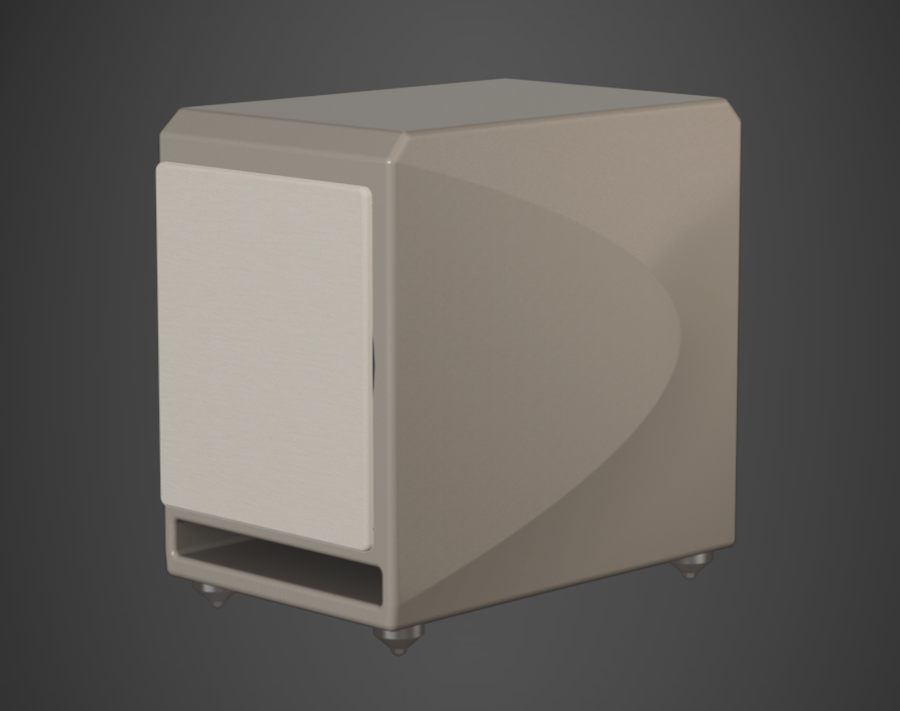
“Thor’s Hammer” is Wilson’s big subwoofer. Lōkē is Wilson Audio Specialties’ smallest subwoofer. In Norse mythology Lōkē (or Loki) is Thor’s little brother. So, there you go about the name, which can also play off of “low key” as in compared to most other Wilson speakers these are physically that. But at approximately 21 inches tall, 14 inches wide and 22 inches deep Lōkē is hardly small and at 110 pounds, it’s not a lightweight. Nor is the cost low: $8,750 to $8,950 depending upon finish. And as with all Wilson loudspeakers, what a finish. More important to some than to others.
Lōkē is intended to pair especially well with Wilson’s smaller speakers including and especially the diminutive Tune Tots, and Sabrina series, though the latter is designed to run full range and the latest iteration, the Sabrina V extends down to the lower 40Hz region.
Lōkē shares with all Wilson Audio Specialties products cabinetry designed to not “sound”. In this case Wilson’s “X” material is used throughout. It’s a super stiff, rigid material that’s ridiculously difficult to machine as I witnessed during one of a few factory visits. The way the cabinets are constructed from the machined parts and then prepped for paint and then painted is documented in numerous videos you can find online. It's a time consuming, skilled, labor intensive process. Cabinet material and construction are keys to subwoofer excellence and in this regard, Wilson is at the top of the heap.
Driver and amplification take another direction and though there’s been some online controversy about this, it’s kind of like being shocked to find that Ferrari doesn’t manufacture its own tires or raise its own cows for the seat leather.
The 10” paper pulp cone, rubber surround woofer used here is a specified version of one supplied by an unnamed American manufacturer, modified specifically for Wilson’s use in the Lōkē. Amplification, the DSP and other controls and all connections are made using another modified version of an “off the shelf” proven highly reliable, insanely flexible Dayton Audio module designed in the United States and manufactured in Taiwan that outputs 500 Class D watts. In its original edition it's an inexpensive item and whatever was the modification couldn't have added too much to the low price. The input does get (gasp!) digitized.
Set Up With Tune Tots
As with all Wilson loudspeakers, this one rolls in on casters, which makes final placement convenient. Once you’ve established where Lōkē works best you spike it using the supplied Wilson Diodes that provide a one-way low frequency ticket. The “kit” includes the four Diodes and spikes as well as a universal Allen tool and inserts, an Allen wrench and a 9/16th inch wrench all of which makes the spiking easier as does the speaker’s weight: with the bigger Wilsons you need a floor jack to lift them, which Wilson supplies. Here, a little help from your friends will do it.
Where subs go best is a long story even for online where there’s no word limitations. Some suggest putting the sub in your listening chair or where your chair usually goes and then walking around the room with a low frequency playing and you pick the spot of maximum bass reinforcement. I wouldn't put the 110 pound Lōkē in your listening chair.
Bass “gurus” have all sorts of ideas. But generally, as you probably know, room boundaries reinforce bass. If you’re using this or any sub for LFE home theater use, it will be carrying only the lowest frequencies so corner placement is usually good and easier to control. Otherwise, you could spend the rest of your life playing with location, though near the main speakers but closer to corners is usually a good place to start. Sometimes esthetics rule.
For this installation I set up the Tune Tots as the L-R speakers in my home theater living room system sitting on the Tune Tot ISObases on Tune Tot stands, the risers of which are of X material. For home theater use, speakers must go “there” relative to the screen and close to the wall and and that’s how they were positioned adjacent to a 75” Sony OLED display and a drop down 100 inch drop down Stewart screen. Same with the subs. Each sitting adjacent to the outer side of the Tune Tot and close to the wall. In my living room that's where all had to be situated.
Before setting the system up for two channel audio I used the Tune Tots with a single Lōkē configured for LFE, which is much more easily accomplished. Among the movies I watched was “Top Gun Maverick”. I’m not that big on noise movies but this one is often used in home theater demos and it was a fun, totally predictable ride. Now, I’ve used the diminutive Tune Tots as “luxury computer speakers” and in our family room informal home theater system, which never gets played loud. And they were as good as you would expect a pair of circa $10K two-ways to be in both applications—but especially as two-way near field computer speaker monitors where I wasted stupid amounts of time just streaming music instead of working.
I played “Top Gun Maverick” at room shaking, ”you’re in the cockpit” volume not expecting the little two ways to be up to the task, but they played very loud without a hint of strain or compression, filling a large room with an expansive theater soundfield, vertically and horizontally and disappearing. The size of the audio picture lights out, was never far from my mind as I watched the movie (waiting for the drivers to break up or produce audible strain, which never happened). Assorted sound effects sounded as if someone was in my room producing them. The single Lōkē outperformed my regular very good but considerably less costly Adam Audio sub, producing super tight, deep, room shaking, overwhelming low frequency “good noise” that never had an identifiable boxy sonic character, and adding well integrated bottom end weight to music cues. Was impressive! But enough of that!
A Proper Two Channel System
Parasound kindly supplied a John Curl designed $3000 Hint 6 integrated amplifier with built in DAC to power the Tune Tots. It deserves and will get a full review. It outputs 160 Class A/B watts per channel into 8 ohms and 240 into 4 ohms—plenty for the Tune Tots, which thought relatively inefficient at 86dB are easy to drive (8 ohm impedance dipping to 6.61Hz at 172Hz). You’ll have to excuse no vinyl for this review. I couldn’t carry the Wilson Benesch upstairs and the new Technics SL-1200GME had yet to arrive. I used a circa 1999 Musical Fidelity X-Ray CD player as a transport and got busy configuring the subs.
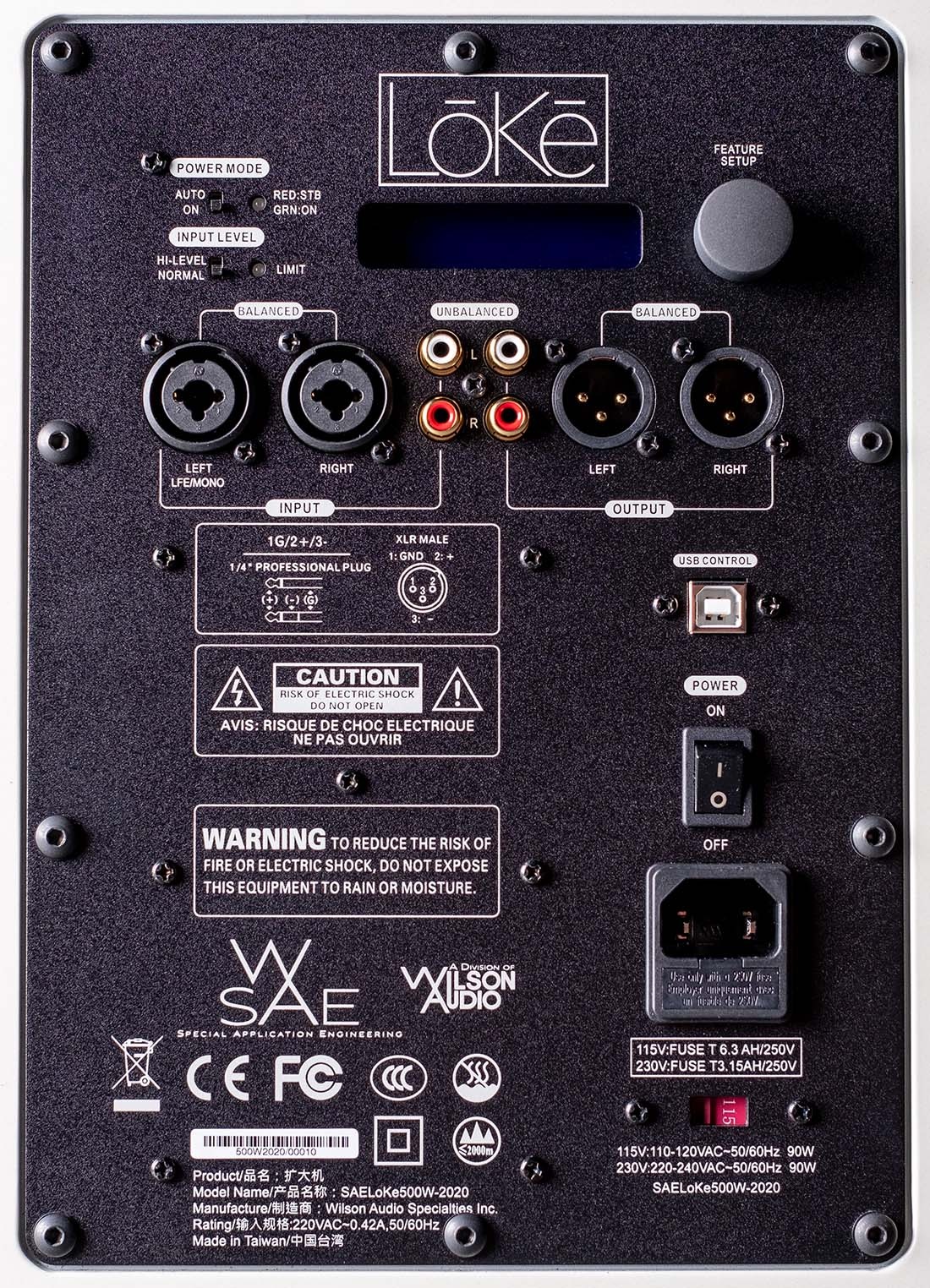 The screen below the Lōkē logo combined with the adjacent knob, gives you complete control of the many functions. Pressing the knob lights the panel up, and takes you to the "volume" setting. Rotating the knob adjusts volume, a double click sets the selected level and takes you back to the main menu. Rotating the knob takes you through high pass filter, low pass filter, phase (by 1 degree increments, (not simply 0 or 180), high pass delay, subsonic filter, PEQ (parametric equalizer), and finally three preset that can save all settings. That's a lot of flexibility.
Fortunately for me, I've had numerous subwoofers professionally set up here using a calibrated microphone and software, so I know my way around the room's acoustics. I know, for instance, that at my listening position low bass is exactly 180 degrees out of phase so the setting has to be so set, but fortunately for others, the setting goes from 1 degree to 180 degrees in 1 degree steps, which provides the utmost flexibility, though I suspect 0 and 180 are sufficient for most set-ups. I'm not going to go through the high and low pass filter settings or the parametric equalizer's either so I'll just say the configurability here allows for as deep a dive as you wish to get the Lōkē to perfectly blend with your main speakers, whether Wilsonian or others.
I ran the Tune Tots full range, bypassing the Hint 6's filters, and set the Lōkē's low pass filter to roll off at 65Hz, 12dB per octave; the frequency being within a few Hz of the lower limit of the Tune Tot's spec'd response. I chose to not mess with anything else other than the 180 degrees phase setting. A remote level control would be nice, but there isn't one so setting the subwoofer level required a lot of getting up and sitting down. Because of the phase issue, standing anywhere near the woofers produced horrendous amounts of boomy bass. Moving towards the listening position greatly improved things. Sitting down produced an almost magical "bass lock" between the Tune Tots and Lōkēs.
All that was left to do was adjust the sub level relative to the Tune Tots. That's best done by ear. And doing it can drive almost anyone crazy as you go from too much to too little bass. You don't want to hear the subwoofer but on the other hand you don''t want to not hear it. Getting that perfect blend takes a good deal of time.
I don't know how you feel but I'd rather have no bass than too much bass, or bad bass at any level. It can be the most obtrusive, music ruining element in any playback system. I do not want to hear "bass"! I want to hear the notes emanating from instruments.
A good baritone vocal disc is a good place to start so I used the hybrid SACD/CD The Nat King Cole Story (CAP 1613 SA) as a starter. It's difficult to believe it was issued fifteen years ago. Nat re-recorded almost all of the tracks for this project so the very early recordings were given new, updated stereo mixes. I was listening for Nat's voice to sound familiar and natural and not get "chesty" and "cavernous". I paid particular attention to the re-recorded early trio tracks "Straighten Up and Fly Right", "Sweet Lorraine", "It's Only a Paper Moon", (get your kicks on) Route 66" and (I Love You) For Sentimental Reasons" and set the level where I didn't hear the subwoofers at all and then adjusted accordingly to get Nat's voice and bassist Charlie Harris to sound "full" but not swamped.
I won't go through detailing how I used the other discs, but key ones were Drums & Bells Comparing Sticks (info@tonianlabs.com is the only way to get this one), Monty Alexander The Montreux Years (Montreux Records/BMG BMGCAT573CD), The Band:The Band (Mobile Fidelity UDSACD 2129), Schehererazade/Reiner, CSO ("Living Stereo" hybrid disc), Eno: Taking Tiger Mountain By Strategy (Virgin ENOCD2), Roxy Music: Avalon (ROXYSACD 9), Pavane Pour One Infante Défunte: The LA4 (East Wind 32JD-10038), Don Pullen: Random Thoughts (Blue Note Japan TOCJ5230) and of course Rufus Reid Presents Caelan Cardello (ARF-1 CD available only directly from Caelan Cardello).
Armed with those I dialed in the two Lōkē. I know the Caelan record so well and getting the piano/bass duo properly integrated was key but so was the Drums & Bells.... it has percussionist Brad Dutz playing all sorts of brushes and sticks but he also drops a few depth charges on drums that proved really useful for the final level "tweak". Actually I played all of Avalon for the first time on this system after it was perfectly dialed in and the results proved to me it had been.
How It Sounded
The seamless blend took a pair of tots to musical adulthood. The combined system went low. But in addition, the system seemed to smooth out. If I thought the Hint 6 was a bit lean, it wasn't now and the midrange had an added suppleness that caused voices to gain added body, Instrumental textures were enhanced.
I know it was good because Avalon got my wife into the room dancing and usually she's not happy when the upstairs becomes a review lab. But more to the point, when the set up had been completed I was looking at a mess: a pair of small speakers up against a wall, and a pair of adjacent subwoofers, and listening to what sounded like a seamlessly integrated full range, highly accomplished loudspeaker pair that produced excellent linearity, spatiality and all that you want from a large full range speaker. The pair managed to disappear, leaving highly refined musically vivid versions of very familiar albums. I'm not suggesting it was as good as downstairs, but it was great for a lot less money.
Avalon produced a familiar spatial picture on which were images rendered convincingly in space. Waiting for the big drum "thwack" on "India" and there it was center stage and behind were all of the percussive elements spread in space. Open your eyes and it looks wrong! But close them and there it was. The Rufus/Caelan record took me to the Klavierhaus in NYC where it was recorded, with the system doing an effective job of suggesting the space.
On Schehererazade (recorded 1960), the vast space of Chicago's Orchestra Hall was ably suggested. As big as downstairs on vinyl? No. But so what? The source here was an old CD player, and DAC built into a $3000 Integrated amp. Everything played sounded familiar and within reason, correct. I didn't hear disjointed, overbearing "bass". The blend was effective and the subs weren't audible as such. We actually kept listening late into the evening fully satisfied with the experience.
Turning off the subs made all of this disappear, leaving a pair of very fine, small two-ways inhabiting a wall space. Turning on the subs made the walls disappear and new spaces appear, depending upon the recordings. Two things that didn't audibly appear were the Lōkēs. I took a great deal of time and effort to dial them in, but it was worth it! And they went low when called upon to do so, without giving up their location.
The Tune Tots alone cost between $9800 and $10,500/pr. depending upon finish and you'll need the stands too. The Lōkē? $8950 each in standard finish, many options available. You might be able to get away with one. That's a full range Wilson system beginning at $19,000 and one that can fit into a fairly small space. If you're an apartment dweller you could disable the bass when the neighbors complain. Just an added benefit. When you add the second you'll have to turn both off to satisfy the neighbors. And back on to satisfy yourself.
Specifications
10 inch Woofer (25.4 cm)
Amplifier Power: 500 watts
Frequency Response (Amplifier)
20 Hz to 250 Hz (+/- 1 dB)
Effective Piston Area
21.75 in^2
Effective Displacement
33.42 in^3
DSP Functions:
Feature range values of the Controller (LCD matrix display, knob rotatory selector)
1. Volume Range: 0dB ~ -99dB (0.1dB/step)
2. High Pass Filter: (line level output only)
•Frequency Range: 30~125Hz (1Hz/step)
•Slope Select: Disabled/-12dB/-24dB
3. High Pass Delay: 0~10msec(0.1msec/step)
4. Low Pass Filter: (subwoofer amp output only)
• Frequency Range: 30~125Hz (1Hz/step)
• Slope Select: Disabled/-12dB/-24dB
5. Variable Phase: 0°~ 180°(1°/step)
6. Subsonic Filter: (subwoofer amp output only)
• Frequency Range: 25~40Hz (1Hz/step)
• Slope Select: Disabled/-12dB/-24dB
7. P-EQ1/P-EQ2 Adjustment: (subwoofer amp output only)
• Frequency Range: 30~125Hz (1Hz/step)
• Level Range: -12dB ~ +6dB (0.1dB/step)
• Q Factor Range: 0.6~14 (0.1/step)
8. Preset Save/Load: 3 Presets
Dimensions:
Height: 20 3/4 inches (52.71 cm
Width: 13 7/8 inches (35.24 cm)
Depth (With Grill):21 3/4 inches (55.24 cm
Depth (No Grill) :21 inches (53.34 cm)
System Weight: 110 lbs each (49.9 kg)
Total System Shipping Weight (Approximate)
175 lbs (79.38 kg)
Finishes: Five standard options, Galaxy Gray, GT Silver, Quartz, Carbon, Medio Grigo, plus two dozen "Upgrade" and "Premium" finishes.
Warranty: 5 Years
Manufacturer Information
2233 Mountain Vista Ln.,
Provo, UT 84606.
Tel: (801) 377-2233.




















.png)