
World Premier Review of Audio Research's Ref 20 Preamplifier
Vacuum tube preamp delivers the long term listening musical goods
If you think any high-performance audio company has designed, manufactured and marketed a “straight wire with gain” preamplifier, I’ve got a bridge rectifier in Brooklyn to sell you. All I’ve heard sound different from one another, some less “colored” and more transparent and neutral sounding than others, some quieter and more dynamic than others, but all impart on the output a sonic character of one kind or another—and I’m all for that. Everything “sounds” so it's best to acknowledge that and deal with it.
Some purists advocate running volume control equipped DACs straight to power amplifiers and I’ve tried that with mine, but that approach has never sounded as full bodied and satisfying as running it through a preamp solid state or tubed—never mind the straight run’s loss of input switching flexibility.
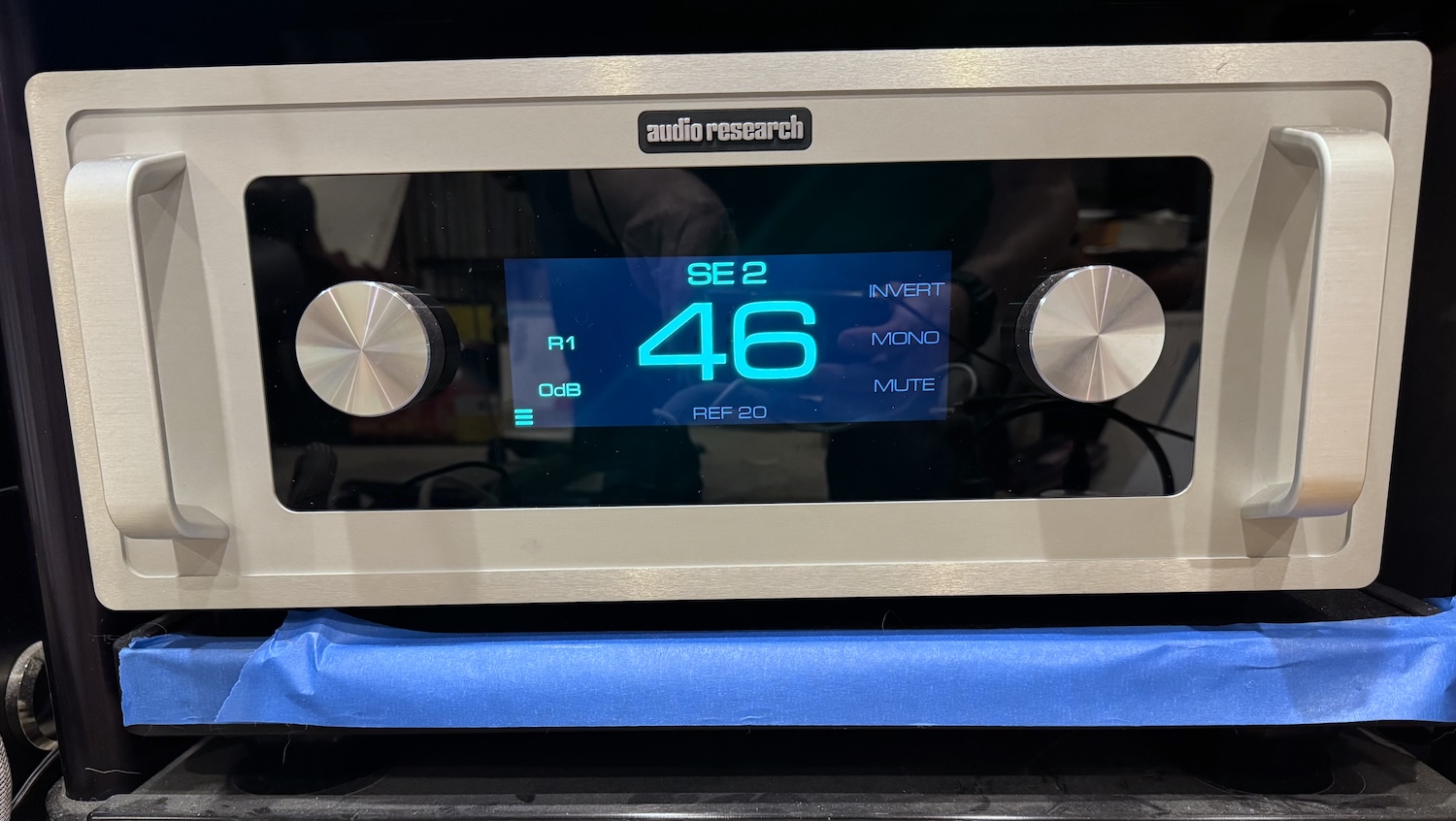
That out of the way, here’s Audio Research’s newest product, the $48,000 Ref 20 preamplifier—so new I couldn’t find an online photo of it to run with this world premier review.
My late and much missed-by-all friend Art Dudley wasn’t much into travel but one year not so long ago he managed the flight to Munich and attended the High End Show now moved to Vienna.
I remember entering with Art the big M.O.C. convention center room where Audio Reference, Audio Research’s German importer, always exhibited that brand along with its other American imports including, to name but a few, VPI, Wilson Audio Specialties, Dan D’Agostino and Sonus Faber.
Audio Research’s newest gear was in use in a few systems and on the crowded floor was a large static display table filled with ARC products, but as we approached all we could see over the crowd was the gear stacked on a top shelf.
Art remarked (obviously I’m paraphrasing), “Oh look! I’m so happy to see Audio Research return to its classic look. I’m not a big fan of the new industrial design. I like the old knob infested front panels. So glad they…..”.
Art stopped talking as we drew close enough to see the top shelf was for vintage historical gear. The new ARC stuff was on the now visible shelf below. We both laughed.
If you like the old look and don’t like the new, you’re sure to grouse that with its pair of large knobs flanking a large fluorescent screen the Ref 20 looks more like a home theater receiver than it does an ARC reference piece.
Well, times change. It wasn’t all that long ago that audio purists considered the introduction of an alien concept like a remote control a “sell-out”. Now today that sounds difficult to believe and positively ridiculous to almost everyone reading this now, but it is true.
Those purists did have a point in that in those early days a carelessly implemented remote control feature could add system noise. Die-hards reading this can be heard exclaiming “still does!”.
The Ref 10’s dual chassis design has given way to a large, massive single aluminum alloy chassis, housing the trad-large toroidal transformer-based power supply, with the transformer segregated and well-shielded off to one side and a single large board on which is traced dual-differential all-tube balanced circuitry using 6 6H30P dual triode tubes for signal gain and for the power supply a single 6550 power tube and single 6H30P. A bank of relays located on the chassis back panel innards actuate all microprocessor controlled signal switching.
Speaking of signal switching, there are four balanced XLR, four single-ended RCA inputs and three balanced XLR and single-ended RCA outputs, two of which are wired in parallel with one another. The third labeled “subwoofer” is specially buffered from the main outputs to eliminate impedance loading the main outputs.
Keeping with ARC tradition the right channel jacks are on top, left below. Spacing is generous so rows of garden hose sized connectors should easily fit. There’s also the usual RS-232 automation input, IR input and a pair of 12V “Trigger Outs” for remote control of linked components.
Screwdriver-Free Set Up
Pop off the top plate securely held in place with grommets (or some such mechanism) in a single pull and you have access to the circuit board, no screwdriver required. Install the matched sets of pre-measured, selected and numbered tubes while noting a set of oversized gold foil wrapped capacitors held in place by foam shipping inserts you’ll need to carefully remove.
Pop on the cover and you’re ready to install the large, massive chassis on a tall sturdy shelf, leaving a good amount of room for heat dissipation. 6H30 tubes have an expected 4000 hour life expectancy, the 6550 1,500-2,000 hours. The operating software counts the time for you. Audio Research supplies a generously long 20 IEC jack rubber power cord that I left in place until after a 100+ hour break in period after which, by changing it out for a good one I found out exactly how resolving the Ref 20 actually is. If you don’t think power cords make a big difference, it’s only because you haven’t tried to compare some. The cord I used was the Stealth Audio Cloude Grande Ag, full silver, broken in on a Cable Cooker before use. I didn't have time to compare to any other 20IEC cords on hand but I plan on doing that shortly. And I will amend this review to describe what I heard, but AXPONA calls.
CH Precision’s P10 phono preamplifier and the dCS Vivaldi One DAC both ran in balanced mode.I ran the Ref 20 into the darTzeel NHB 468 monoblocks using a long pair of TARA Labs Zero balanced interconnects and the combo worked and played well together and quietly for this review.
Use
Power “on/off” is a button you tap located on the chassis underside centered close to the front panel. Power up and the after a few seconds the “mute” notice will flash. Once it goes solid in about 60 seconds, pushing the remote or the touch screen’s “mute” notification will put the Ref 20 into listen mode. You can listen but it will sound better about 1/2 hour later.
The left microprocessor-controlled knob selects inputs, the right one volume, displayed in the window with LARGE NUMBERS from 0-99. Press the lower left “hamburger” and the full gamut of set-up features await, none of which should surprise any home theater pre-pro savvy user. You can name the inputs, apply gain offsets to each, so output levels remain constant among inputs. You can select an input for unity gain use with external A-V processor. You have a range of display color choices.
Settings made within the menu including stereo/mono, phase invert, and balance will be applied each time you select a particular input. Or, from the full featured remote control you can select input, adjust balance, volume, phase inversion and mono—all items every serious listener would want at his or her fingertips. You can turn off the display and adjust up and down among three brightness settings.
The full-featured remote encased in a sturdy aluminum housing is not backlit and while pleasingly “heavy in the hand” and possessing good “button feel”, is a step below “luxury”. Not a big deal. With its full functionality I found it a useful listening companion.
Tubey Or Not Tubey Is Not the Question
I wasn’t paying full attention to the Ref 20’s innards when the tubes went in, and no instructions were included because this was the first unit manufactured to be shipped to anyone and the manual wasn’t ready. After a week I had to ask “Is this a hybrid design with J-FETs on the input?” Val Cora snapped, “NO! Fully balanced, dual differential, all tubes!”
I asked only because the Ref 20 was so quiet. With nothing playing I turned it up to a stupidly high level (above 70, normal listening is 50 and below) and ear to the tweeter I heard only a slight kind of undulating sound I wouldn’t call steady “hiss”. My reference solid state preamp has a bit more steady “hiss” and definitely somewhat less midband transparency. The Ref 20 lets you see so far into the soundstage!
You might think that with both channels on the same circuit board, capacitive coupling might decrease channel separation and reduce soundstage width but whatever this preamp might measure in that regard, it produced a generously wide and especially deep soundstage on appropriately staged recordings.
Familiar recordings known for big soundstages like the Decca La Fille Mal Gardée (Decca SXL 2313) performed by the Orchestra of the Royal Opera House, Convent Garden originally released in 1962 transformed the area behind and to sides of the speakers into an enormous concert hall space, the confines of which you could see, with delicately delivered, luxuriously textured, yet diaphanous strings, and airy round woodwinds simulating bird calls and chirps in a pastoral garden. Yet when the score called for sharp “clacks” of woodblocks to simulate the clog dancing in the choreographed ballet, the smacks were appropriately sharp yet notably wood infused. On less well-textured systems I’ve heard this percussive accent sound like snapping whips. This record was as well-reproduced and as convincingly performed in the space before me as I’ve ever heard it.
One of the most ridiculous experiences during this review period was playing one of the rare experimental Classic Records 78rpm stereo microgroove records the label produced using RCA “Living Stereo” master tapes. One is an excerpt from Prokofieff’s Lt. Kije with Reiner conducting the CSO. I played it on the new Technics SL-1200GME turntable ($6599.99) fitted with an Audio-Technica AT VMN60xSL MM cartridge. Oddly I couldn’t find the cartridge cost online but the Boron cantilever line contacts/stylus stylus replacement alone costs $449. That I found.
I ran that into the $450 SOTA Pyxi phono preamp and the combination into the Ref 20 produced enormous macrodynamic outbursts on the richly textured orchestral crescendos, deep, well-textured bass from the tympani smacks and overall “tape-like” attack, decay and especially generous sustain. Compared to nothing this moderately priced “front end” inserted the goods into the Ref 20 and it delivered almost scary dynamics, rich textures and full-bodied vivid harmonic structures you’d expect to get only from far more costly front end gear—at least that’s been my experience.
Okay, that’s an aside but when you get in a high performance, boundary pushing piece like the Ref 20 it gets the sonic juices flowing.
To test the Ref 20’s transient precision and to be certain that the lush and rich string textures weren’t a sign of overall softness I played many familiar percussion records and one relatively new one that might be even better than the well-known ones like Pulse: Works For Percussion and Strings (New World Records NW 319)—Concert Percussion For Orchestra (Time S/8000) performed by the Manhattan Percussion Ensemble conducted by John Cage and Paul Price, engineered by Bob Arnold. I paid $1.00 for it!
Arnold has an amazing discography filled with many great sounding records. This one is definitely out in left field where I like to play musical ball. It’s got bongos, wood blocks, drums, Japanese temple gongs, timbales, a thundersheet and a brake drum (!) and all kinds of racket producing percussion instruments (another record on Time Records, along with the bongo and accordion records is The Kenny Dorham Quintet playing the music of Jerome Kern’s “Showboat” with Kenny Drew, Jimmy Garrison, Art Taylor and Jimmy Heath. Crazy!)
There was nothing soft about the Ref 20’s percussive production on this recording. It was razor sharp and insistent where required, yet rich and appropriately mellow on the marimba and what turned out to be a guy playing 8 rice bowls. You’d have no trouble thinking they were playing these instruments in your room, or you were in their room listening while they played, so transparent and “electronica free” was the presentation on an especially big stereo soundstage.
Every well-worn (not physically) favorite produced big “wows”—and I’m not exaggerating. For instance Mel Tormé and Friends Recorded Live at Marty’s, New York City(Finesse W2X 37484) played 100 times or more (and at least a dozen times on this system minus the Ref 20) produced a greater sense of the “room envelope” behind Mel than I’ve ever heard but more importantly a three-dimensional solid image of Mel sang, boldly placed in the room in front of the trio as you’d hear live in a caberet/nightclub. The trio of Mike Renzie on piano, either Rufus Reid or Jay Leonhart on bass and Donny Osborn on drums performed with a cohesive wholeness that took a great recording to new sonic heights. Janis Ian joins Mel on “Silly Habits” and the combination of the two have never sounded as “in the room” and well-blended yet separate as they were when I tested the Ref 20 with that familiar record.
Bright records sounded bright, dull ones dull. Records with exceptional bass extension and control exhibited that. Bass was well extended and well-controlled. The great ones sounded exceptionally great and the bad ones, ineptly produced and/or recorded had their flaws exposed with ease. It’s not as if the Ref 20 produced pleasure by covering up recorded flaws. I use the word “record” interchangeably for vinyl, CDs and files.
Of course, I auditioned both Caelan Cardello records I was involved in and Patrick Leonard’s It All Comes Down to Mood too. These all sounded in a word, “ideal”. More than how they sounded, they delivered consistent musical pleasures. The musical flow was key to the pleasures. Patrick’s record in particular can sound a bit shrill on top on some systems and on mine with my reference preamp it veered that way. The Ref 20 made Pat’s voice sound as perfect as I thought Chris Bellman had mastered it to sound. I heard no performance deficiencies, top, middle and bottom but more than the pick apart forensic sonic examination, the living soul of great recorded musical performances (not necessarily of great recordings) presented themselves with exceptional musical ease. The tuning team gets an A+.
Conclusion
If you’re looking for a “straight wire with gain” the Ref 20 isn’t that. That doesn’t exist in my experience. In fact, the products that make that claim tend to be the least enjoyable, least satisfactory for long term listening pleasure. When you hear “True, it doesn’t sound so great on most recordings, but it’s accurate” you have to wonder why you’d want that moving into your home.
Conversely, the ones that aim for pleasing colorations, especially for textural softness and /or "smoothness" fail to please over the long run as their sonic “flavors”, like company that stays too long, become too familiar.
The design team at Audio Research obviously needed to deliver excellence with this top tier effort—and with everything that exits the factory as it restores audiophile faith in the storied company and pushes the brand forward.
The Ref 20 has spent a reasonable amount of time installed in my system for me to get a good grasp on its sonic performance. An industry veteran visited last week. When I played the Original Sound Series “The Rite of Spring” (Abbado/LSO) a dynamic attack made him jump. He took note of the deep, powerful tympani hits. On one of his favorite recordings he was surprised to hear a subtle, microdynamic gesture, actually a few of them, he’d never before noticed.
I hear those kinds of things on just about every recording I play. And though I think I understand how the Ref 20 was “tuned”, there are always surprises when I try to predict how a familiar recording will sound. The only constant is that I’ve never been disappointed, never heard anything missing and always left long listening sessions satisfied.
Overall the Ref 20 is a superbly balanced, exceptionally transparent, dynamically powerful, nuanced preamplifier that any music lover would enjoy listening to and owning. Its "long comings" were obvious and will be to you. I'll leave finding shortcomings to others. I didn't hear any.
Specifications
Cost: $48,000
Specifications (note: these are based on an older ARC product and are subject to change):
FREQUENCY RESPONSE: +0 -3dB 0.1Hz to 200kHz at rated output. (BALANCED, 200k ohms load.)
DISTORTION: Less than .006% at 2V RMS Balanced output.
GAIN: Main output (SE or BAL input): 12dB Balanced output, 6dB Single Ended output. Tape output: 0dB.
(Processor input: 0dB Balanced)
INPUT IMPEDANCE: 120K ohms Balanced, 60K ohms SE, Inputs (7): 1, 2, 3, 4, 5, 6, PROCESSOR. (XLR and RCA connectors).
OUTPUT IMPEDANCE: 600 ohms Balanced, 300 ohms SE main (2), 20K ohms minimum load and
2000pF maximum capacitance. Outputs (3): 2 main, 1 tape (XLR and RCA connectors).
OUTPUT POLARITY: Non-inverting.
MAXIMUM INPUT: 20V RMS maximum Balanced, 10V RMS SE.
RATED OUTPUTS: 2V RMS (1V RMS SE) into 200K ohm balanced load (maximum balanced output capability
is 30V RMS at less than 0.5% THD at 1kHz).
CROSSTALK: -80dB or better at 1kHz.
CONTROLS: Volume (104 steps). Push Buttons: Power, Mute, Interactive Touch Screen. Rear RS-232 control
and IR input.
POWER SUPPLIES: Electronically regulated low and high voltage supplies. Automatic 40 sec. warm-up/
NOISE: 1.7uV RMS residual IHF weighted balanced equivalent input noise with volume at 1 (109dB below
2V RMS output.)
TUBE COMPLEMENT: (6)-6H30P dual triodes, plus (1) 6550 and (1) 6H30P in power supply.
POWER REQUIREMENTS: 100-135VAC 60Hz (200-20VAC 50/60Hz) 220 watts. Standby: 2.2 watts.
DIMENSIONS:
width 19” (48 cm)
height 7” (17.8 cm)
depth 15.5” (39.4 cm)
Handles extend 1.6” (4 cm) forward of the front panel.
WEIGHT: ?
Manufacturer Information
6655 Wedgwood Rd N Suite 115, Maple Grove,
MN 55311, USA
P: 763-577-9700
www.audioresearch.com
service@audioresearch.com