
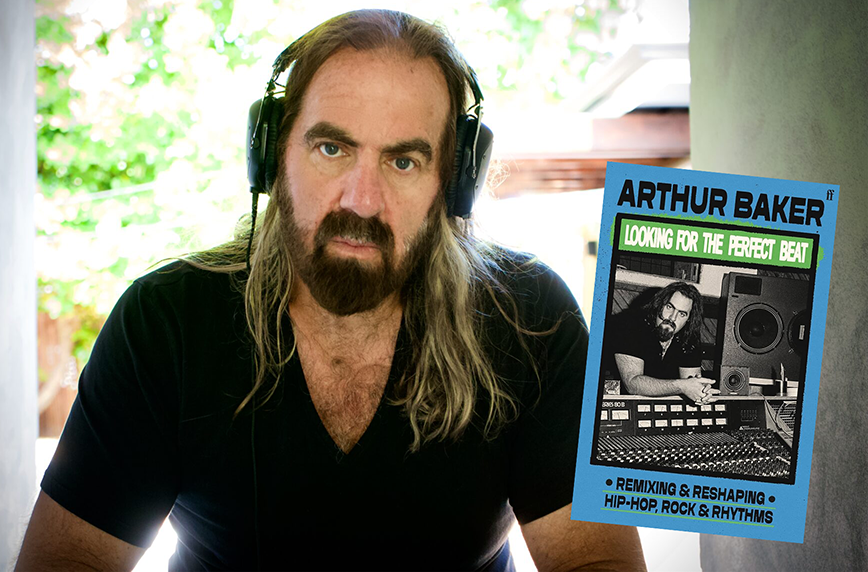
Baking Beats
Trailblazing producer Arthur Baker's memoir winds the tape back
It was one of those steamy July days in Manhattan when everyone looks and feels like a damp hot dog that’s just been pulled from a street cart. Piling on to that discomfort are the handcuffs Arthur Baker is being fastened to after being slammed up against a wall near the corner of West 37th Street for supposedly hitting a traffic warden with his car. The false charges are eventually dropped, but the memory of missing out on reuniting with Bob Dylan after one of his 1986 Madison Square Garden shows endures. The two were supposed to get together to potentially lock down Baker working on the Bard’s next album. But ultimately, that opportunity sails by the then 31-year-old producer.
It's an odd prospect until you remember how hot the young studio sorcerer was at the time. He had just helped Bruce Springsteen get a version of “Cover Me” to the north end of the Billboard Hot Dance/Disco chart, and he was instrumental in capturing Dylan’s delicate “Dark Eyes” for the tail end of the Empire Burlesque sessions. The irony bolted on here is that it was actually Baker’s idea for Zimbo to record the track with nothing more than his acoustic, a harmonica and a hint of reverb – this coming from a man who’d assembled a good bit of his reputation out of TR-808 drum machines and digital synthesizers.
And these are just a few slivers in the 473-page life of Baker, who’s new memoir Looking for the Perfect Beat: Remixing and Reshaping Hip-Hop, Rock and Rhythms (Faber & Faber) has recently been released. The book tracks Baker’s life from his time as a nine-year-old pop fanatic winning a copy of The Beatles’ “My Bonnie” off the radio, to just about the present day when he’s in the midst of bringing a live musical version of the 1984 film “Beat Street” to Broadway. The story he scratches out of the intervening years captures his rise in the Boston disco scene, his collision with the New York Hip Hop scene, and his escapades behind the console reshaping and polishing the work of many top tier artists.
Baker wasn’t a traditionally trained musician. Instead, he willed into the industry – following his ears and his instincts through 70’s clubland and small studios as he made his way up the production food chain. Along the way he learns hard lessons; like getting ripped off by upstart dance label Casablanca Records. But by keeping tabs on which platters were heating up the local bins in a Brooklyn record shop, he kept a beneficial awareness of what sounds were moving in and out of the music charts. That’s how he stumbled upon Kraftwerk’s “Numbers,” and helped transmute it into the backing track for 1982’s groundbreaking Rap single “Planet Rock” by Afrika Bambaataa & the Soul Sonic Force.
“The rappers admitted years later…that they thought ‘Planet Rock’ might be their first and last recording” Baker writes. “They felt that if it did hit, it would hit big, but they didn’t think there was much chance of that.”
They couldn’t have been more wrong. “Planet Rock’s” impact was seismic, and while the Kraftwerk tracks had long been club staples, the work Baker and his studio cohorts brought to that work created a broad appreciation for Hip Hop and a template for the Electro sound that would quickly spread to the Pop world.
Baker’s recounts his move from that corner of the underground to his Post-Punk success helping New Order cement their shift to digital, to the high dollar remixes he did for mainstream artists in a casual, conversational style. What’s impressive as he illustrates his story are the backend mechanics of how the industry changed from a place where you needed to declare your genre affiliations to a more open-ended situation where the players crossed all sorts of borders. How else would someone with Baker’s background find himself producing the Artists United Against Apartheid “Sun City” single, to working alongside titans like Jeff Beck and Diana Ross, or supervising the original motion picture soundtrack to Fried Green Tomatoes? Inside this pretty compelling read, as it turns out, there’s much history worth unveiling.
///
Interview with Arthur Baker
Tracking Angle: Was this a tough project compared to some of the other things you’ve tackled over the years?
Arthur Baker: The entire process took two years. I never sat down and wrote a chapter in full. I'd write part of it and get bored and then go to another chapter. So it was somewhat fun. I pretty much set a timeline using my tapes…cassettes and half inch mix tapes because all the tapes would be dated. I had some calendars I found…and it was interesting realizing how much work I was doing at one time.
TA: There are a lot of little-known Disco tracks that you reference or were involved with that were really fun to check out and discover how they figured into the evolution of your production work.
AB: If you’re writing your history, you want people to see where you came from (and for me it’s ) how important Disco actually was to all the Hip Hop stuff. Without that there'd be no Hip Hop. So, and a lot of people don't really give it the respect and importance that Disco actually had. And Funk.
TA: How big was your record collection?
AB: It was really big. Probably around 10,000, though not as big as a lot of people because I really stopped collecting when I was in London around 2002. And then about three years ago, I actually needed some cash. Right after COVID I sold a lot. I cherrypicked a lot and kept half.
TA: So what do you feel your level of visibility is now as a producer?
AB: Yeah, I'd say none! (laughs) I mean, the Yard Act mix is I think it's one of my best remixes ever. And it got literally no attention really. It's too bad because I really think I nailed it and it works now because anytime I play it, the energy level wherever goes up a notch. So I'm really proud of that remix.
TA: So what’s keeping you busy these days?
AB: I've been working on working on a “Sun City” documentary which looks like is going to be happening. And I'm working on the Beat Street musical. So, that's the other project I'm working on. I like making records and I'll have some new stuff coming up next year. I did a whole Rockers Revenge album which we're going to put out. And my radio show actually on SiriusXM. It's on uh it's called Baker's Revenge. It's on Studio 54 radio. I'm doing a series of three compilations from records I did in ‘85 that never came out. One's from ‘98 to 2002 and then the last one is sort of more the last 10 years of stuff that that I never released. I think it's it's going to come out on Chrysalis.