
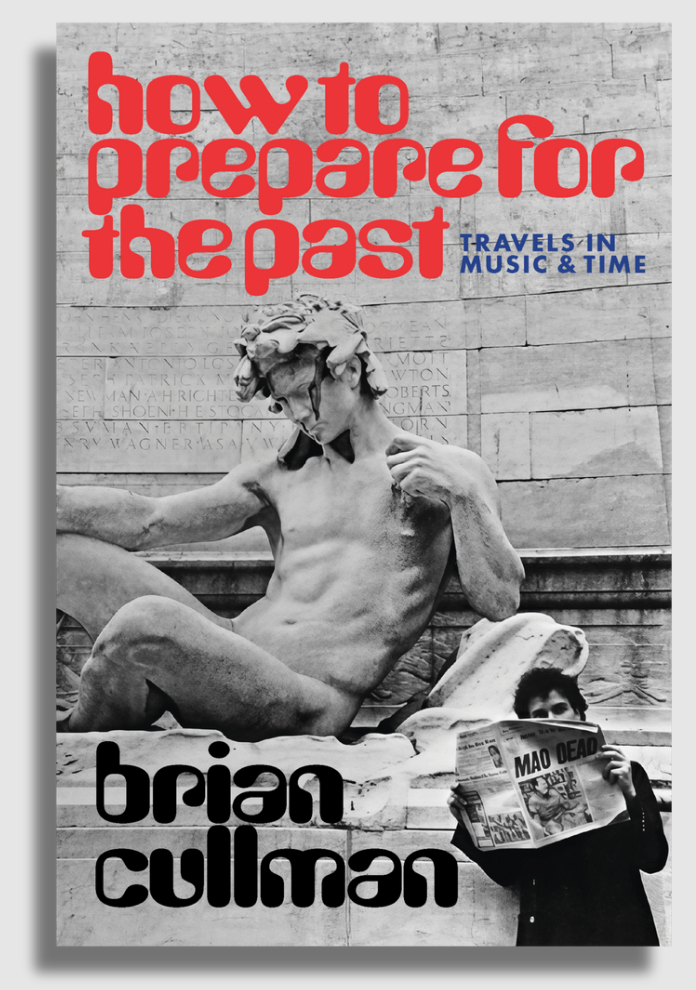
How to Prepare For The Past: Travels In Music and Time
book review and interview with Brian Cullman
It’s not much more than 20 pages deep into Brian Cullman’s memoir when we find him squinting through the enormous pressure of auditioning in the poorly lit apartment of Elektra publicist Danny Fields. He’s been dragged here by friend and soon to be renowned rock writer Lillian Roxon. But before he begins, the would-be singer-songwriter notices a notionally dressed Edie Sedgwick in the corner and an unconscious version of Jim Morrison asleep on the couch. Fields seems to like what he hears despite the fact that he has one ear pressed to the phone in order to console “Leonard Cohen about Nico.”
Cullman didn’t get a deal with Elektra, but as he goes on to detail in “How To Prepare For The Past,” he did eventually tumble into a gig writing for Crawdaddy as their UK editor in early 1970. This in itself was a staggeringly big deal for someone who hadn’t written much more than a few hundred words for his school paper. As he writes:
“No one in London had ever heard of Crawdaddy. No one. It didn’t matter. All doors were open, everyone was home, and the world was aflame and alive with possibility.”
From here, Cullman goes on a “Almost Famous” series of music-related journeys, except his are way more interesting and far less cliched. Before long he is embedded at the top end of the British folk scene, hobnobbing with the likes of John Martyn, Sandy Denny and assorted members of the Joe Boyd’s Witchseason stable. One day while visiting Martyn and his wife Beverly, he comes across an apparition.
“We’d been listening to the same album of classical guitar— Julian Bream?—for over an hour, when something by the window stirred and started to rise. I hadn’t noticed anyone there, and it gave me a fright.”
The spectre turned out to be none other than Nick Drake – the beautifully doomed musician whose shadow would go on to swaddle the Folk Rock community ever more.
All along this trek through Cullman’s memoir, it’s clear that his interest in getting his own career together was never entirely flagging. And in the brightly written passages where we see him auditioning for George Martin, rehearsing in a kind of pick up band with a “heavy metal bass player and a very stoned drummer,” and laying down post-punk tracks with none other than Yardbirds manager/producer Giorgio Gomelsky. But unlike the hairdressers out there who are sweeping up the fragments of their A-list clients and turning them into a scenester book, Cullman’s work illuminates the genuine connections to musicians and those adjacent with a tremendous amount of heart and sensitivity.
Deep into the explorations of his history, he finds himself as one member of an ad hoc quartet tasked with cleaning out Lester Bangs apartment following the infamous journalist’s death.
“(Robert) Quine opened the window, but there was too much wind and the sound of car horns was annoying, so he slammed it shut, almost shut, and stood looking out. There was a Cuban Chinese diner nearby, maybe he could see it from there. Just ten o’clock in the morning, the traffic was already bad, and the sound of salsa, the sour bleat of Latin horns and those fucking claves or cowbells keeping the offbeat, once those had gotten in through the window they weren’t ever leaving.”
Delicate moments trail behind unbelievable ones, and unlike a lot of music journos, Cullman knows how to exit a vignette at just the right time. Far from linear in its construction, this really reads like a travelogue at points – but one that is fizzy, deeply personal and quite possibly one of the best books you’ll read about music for a good long while.
Tracking Angle Interview with author Brian Cullman
Tracking Angle: You took a bold swing early on by correcting Lillian Roxon’s Rock Encyclopedia.
Brian Cullman: I have such vivid memories of her, and she was such a physical presence. She was loud and bawdy and incredibly welcoming. I thought of myself as a kid as being sort of shy and awkward, but somehow I got the nerve to correct her book. I bought it the day it came out and as I read it, I started making notes. And there were just things that were flat out stupid. What she got wrong was the names. She got the scene right and she got the spirit right, but she just transposed musicians. Someone from the Beau Brummels she put in the Turtles, and someone from Paul Revere and the Raiders, she put in somewhere else. (But) the crown jewel of mistakes was she had John Stewart from the Kingston trio being in the Buffalo Springfield. And instead of taking offense, like ‘Who is this kid and why is he questioning me?!’ she was gracious enough to say ‘How come you know this stuff?’ and ‘Why don't we work together?’ And it's not just that she (just) opened doors and let me in places that were hard to get into…I didn't know those doors existed!
TA: When it came to your music it seemed like you always had good luck connecting with great musicians, like the time you accidentally found a substitute guitarist when Richard Thompson politely bowed out of a project.
BC: I was actually in line at the Everyman cinema. It was like a revival house. It was like Bleecker Street Cinema in New York. And I was desperately looking for a guitarist because I had Rod Argent playing keyboards and Chris White playing bass and producing. I had great great players but I didn't have a guitarist. (And) all the people suggested were Disco guitarists. I wanted a Richard Thompson sound... that sort of overdriven fingerpicked Strat. And I'm in line at the movie theater and there's this sound coming out of the ticket booth and it sounds like electric Delta Blues, but fingerpicked. It was wonderful. And I got up to the ticket counter and sort of said, ‘Who's that playing guitar?’ And the woman said, ‘Oh, isn't that great? That's my boyfriend. He has this great little band called Racing Cars.’ And I was like, ‘Does he play Sessions?’ And she's like, ‘Will you pay him something?’ I went, ‘Yes’ and she wrote down his name and it was Mark Knopfler.”
TA: On the journalism side though you wound up in some fairly unique circumstances, like when you get whisked away to some country estate to meet Dr. John and Frank Zappa.
BC: I wasn't a big Frank Zappa fan, and I didn't know that much about Zappa. But I had done enough homework the night before that I knew a little bit about not only what Zappa had done. There wasn't an internet then (so) I couldn't go online, but I had talked to people and I'd seen interviews and I knew that he loved Edgar Varèse and Guitar Shorty. I expected him to be pretty hard on me, but he was very kind and he stopped me and said, "Uh, it sounds like you know some music. It sounds like you're pretty hip and you're interviewing me, so you must think I'm pretty hip…so let's get that out of the way.’ And this is like 1972 or ’73 and he said ‘You know what I want to talk to you about is if America is going to continue to be a democracy, people have to believe that it's as hip to be on a school board as it is to play bass with me.’ And he spoke about that so articulately and so persuasively, and none of us were thinking about that in the early 70’s.