
The Wondrous Vinyl Legacy of Sonny Rollins
get out your wallet or stream away!
Sonny Rollins, the “saxophone colossus,” died on May 25 at the age of 95, a profound loss for jazz. His passing marks, literally, the end of an era. He was the last jazz titan from the generation that revolutionized jazz just after World War II; the last musician to have played with Charlie Parker (the spearhead of that revolution); and the last of the 57 jazzmen and women who posed for Art Kane’s iconic 1958 “Great Day in Harlem” photo.
More important, Sonny Rollins leaves behind a massive discography over the 61-year span of his career from 1949-2010—60 albums as a leader, 26 as a sideman (to Miles Davis, Thelonious Monk, Dizzy Gillespie, and Bud Powell, among others), not to mention dozens of bootlegs—which document his stature as arguably the most inventive improviser in jazz history.
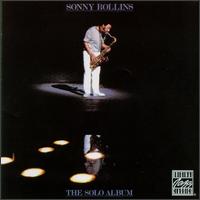
Though clearly inspired by Parker’s innovations (as any horn player in modern jazz would have to be), Rollins took more guidance from Monk. Parker, Gillespie, and their comrades in bebop improvised on the chords of the day’s popular songs. It was Monk who asked, “Why don’t we use the melody?” And Rollins explored that question in astonishing depth. In live concert, he would recite the melody of a song, maybe a few times to gain traction, then carve out a slew of variations (inspired, yes, sometimes by the chord changes but often by its similarity to another song, the mood it stirs in his mind, or any number of conscious or subconscious urges), then, just when he seemed to exhaust the possibilities, he’d find a portal to untrod territory, meanwhile never losing sight of—frequently reprising—the basic melody, repeating this process, but never recycling the pattern, over and over. (In 1985, he gave an hour-long solo concert of entirely unrehearsed, spontaneously created music in the Sculpture Garden of the New York’s Museum of Modern Art. It was recorded and released as The Solo Album.)
Rollins could pull off these feats because he was immersed in the music of his era—and, even more, in every note and interval of music that could be played on a tenor saxophone. He played all the time. (A mutual friend told me that, when they talked on the phone, Sonny would often interrupt the conversation to blow a few bars of some passage; he always had the horn on his neck strap.) In his voluminous biography, Saxophone Colossus: The Life and Music of Sonny Rollins, Aiden Levy quotes bassist Christian McBride recounting a concert that he played with Rollins and drummer Roy Haynes at Carnegie Hall in 2007. McBride, much younger than the two masters and a bit nervous, showed up for rehearsal a half-hour early, only to find Sonny already there and wailing. Thinking he had misremembered their meeting time, Christian started to apologize for being late. Sonny replied, No, you’re on time, I just wanted to go through some scales and chords. McBride thought: If Sonny Rollins feels he has to show up early to practice, then there’s no excuse for any other musician not to work all the time.
Even so, Rollins was the most self-critical of musicians. Many years ago, the jazz critic Gary Giddins interviewed him at City University of New York. In the course of their talk, Gary played snippets of Rollins recordings, all of them jaw-dropping. Yet Rollins shook his head in dismay at each playback, regretting the notes that (in his mind) he got wrong or passed by.
Rollins was best heard in live concert, before an engaged audience, unrestrained by the playing time of a tape-reel or a side of the anticipated LP, stretching out instead at his own pace—and sometimes it took a while to lock on to the launch point and build up the steam before taking full flight and barreling in zesty orbit.
It's notable that 11 of his 60 albums (and many of the unofficial bootlegs) were recorded at live concerts—and no coincidence that they rank among his best.
Which leads us to the question that you’ve been wondering about for the last several paragraphs: Which are the best of these albums? Or, more to the point, if you are a regular Tracking Angle reader: which of those best albums are also the best-sounding?
Rollins’ first albums, as a leader and a sideman, were recorded in the late 1940s and early ‘50s for Prestige Records. Rudy Van Gelder was the house engineer for both Prestige and Blue Note. The familiar riddle of the time: What’s the difference between a Prestige album and a Blue Note album? The answer: Blue Note gives you rehearsal time. This made Prestige, in its early days, the favored label of the music’s many heroin addicts: they got in and out of the studio fast, and while they didn’t get paid much, they got the money up front, so they could go out and get their fix. Rollins was one of those addicts. His early albums are pretty good, but if he’d died of an overdose back then, he wouldn’t be well known today.
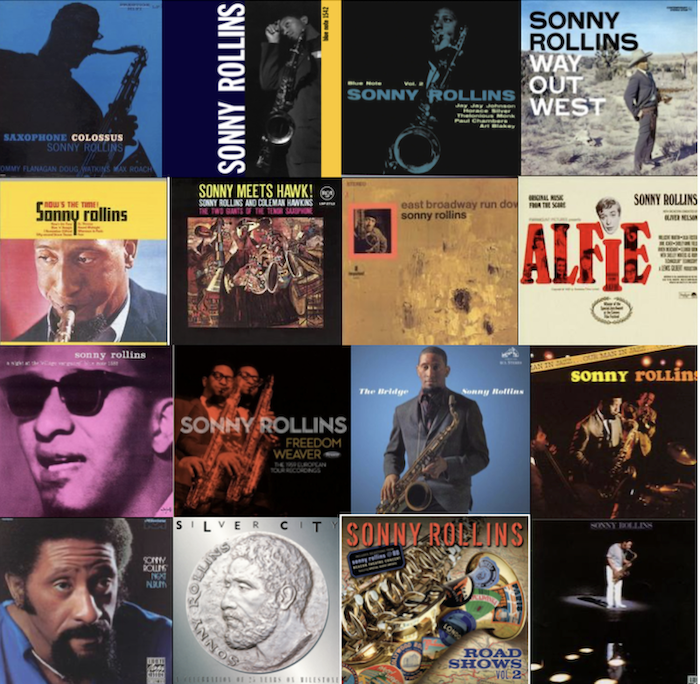
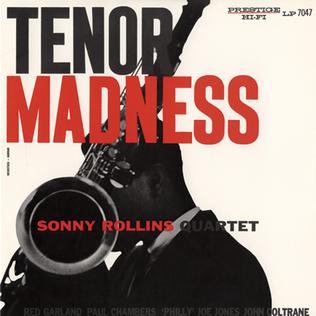
Rollins kicked his drug habit in 1955, and, not entirely by coincidence, that’s when his story as a jazz giant begins. He finished out his Prestige contract (as the former junkie Miles Davis also did around this time) with a slew of superb albums, including Tenor Madness, laid down at Van Gelder’s studio on March 29, 1956, featuring Miles Davis’ bandmates at the time—pianist Red Garland, bassist Paul Chambers, drummer Philly Joe Jones, and, on one track (the title track), John Coltrane. This is the one time the two tenor titans (who were also good friends, though the press portrayed them as rivals) recorded together, and it’s a lively chase through rambling roueés and Alpine curves. The sound is also very good. (I have it on an LP reissued by DCC Compact Classics; Analogue Productions also released it on vinyl as part of its Prestige series.)
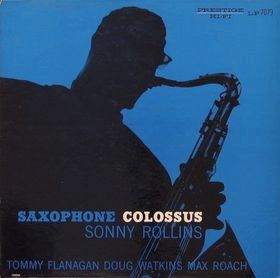
The turning point, though, came one month later, with the album that made his reputation (and inscribed his nickname), Saxophone Colossus, featuring pianist Tommy Flanagan, bassist Doug Watkins, and drummer Max Roach. This is where Rollins started to mold his style of improvisation, revolved around themes rather than chords. The critic Gunther Schuller wrote a famous essay, describing what he was doing, called “Sonny Rollins and the Challenge of Thematic Improvisation.” The other leading critic of the day, Martin Williams, wrote of the album, “It captures a great player in the discovery of his greatness.” If the album’s final track, “Blue 7,” had been a written composition, it would have been heralded a masterpiece. The remarkable thing is that Rollins unspooled it on the spot. (The album also sounds very good.)
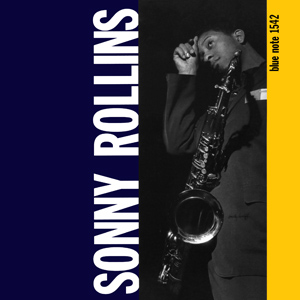
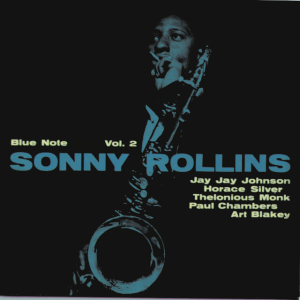
In December 1956, he recorded the first of three albums for Blue Note. Called simply Sonny Rollins, it’s a bit of a retreat musically, a solid but not especially adventurous hard-bop album (with trumpeter Donald Byrd co-fronting the line and Max Roach again on drums), but it may be the best-sounding of Rollins’ albums up to that time, perhaps a display of the improvements that Van Gelder could eke with the extra rehearsal time. A follow-up, Sonny Rollins, Vol. 2, is more spirited, as it sports Horace Silver and Thelonious Monk taking turns on piano. (I’m just reading that Blue Note will reissue the first album on its Classic Vinyl series in June.)
A few weeks before recording Vol. 2, Rollins traveled to California, signed a deal with Contemporary Records, and spent the wee hours of March 7, 1957, laying down the tracks for what may be his most famous album, Way Out West. Certainly, it’s his most artfully fun one, starting with the cover, on which he poses with a holster and a cowboy hat in a mock desert. It was an unusual sort of trio album: Ray Brown on bass, Shelley Manne on drums, and that’s it—no piano or guitar laying out chord changes. Sonny could flex his wings with a freedom he hadn’t experienced, but the music also has a West Coast softness. The album is best known for the cover of “I’m an Old Cowhand,” but Rollins’ solos on “Solitude” and “There Is No Greater Love” are among his most graceful. Recorded by Roy DuNann, this is also one of Rollins’ two or three best-sounding albums. Analogue Productions, the Electric Recording Company, and Craft all put out excellent vinyl reissues (in roughly that order of preference). If you can find it, the original pressings (one with the label Stereo, the other Contemporary, when the RIAA ruled that a company couldn’t call itself Stereo) are sonically a league or two beyond.
.jpg)
But Rollins wasn’t done with Blue Note. On Nov. 3, 1957, he trapised into the Village Vanguard, the storied Manhattan jazz club to record a live album that came to be called, simply, A Night at the Village Vanguard. There are a few things remarkable about this session. First, it was the first time Rollins ever recorded a live album. Second, it was the first live album ever recorded by anybody at the Vanguard. Third, Rollins went into the club without a band, much less a set-list. He started the session with Donald Bailey on bass and Pete LaRoca on drums; felt it wasn’t jelling, so called up Wilbur Ware and Elvin Jones to come in cold.
.jpg)
Fourth (and here’s where things get interesting), it ranks as, musically, one of Rollins’ very best, most accessible albums. I would say, if you don’t own a Sonny Rollins album, start with this one. Fifth and finally, the original Blue Note pressing sounds great; but the label’s new three-LP Tone Poet reissue sounds amazing. Rudy Van Gelder recorded the session on a 7-1/2 ips tape machine, then transferred it to his usual 15-ips machine back in his studio. A few years ago, Blue Note archivists dug up the original 7-1/2 ips tape—and, even with the slower speed, the fact that it’s the original master tape and had barely been touched since the session date makes it sound better. This isn’t a theoretical matter; the proof is in the listening.
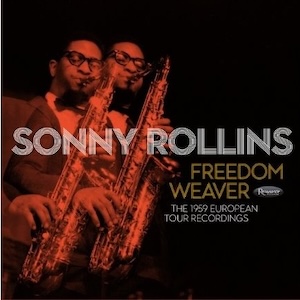
In March 1959, Rollins took a progressive piano-less trio—Henry Grimes on bass, with Pete LaRoca and Joe Harris trading off on drums—on a European tour. (In 2024, Resonance Records released the results on vinyl and CD as Freedom Weaver. The sound is so-so, but the music—mainly standards—has a gripping intensity.)
Then, jat the peak of his career, just as critics were taking notice and fans were crowding his club sets, Sonny Rollins dropped out. He wasn’t satisfied with his playing (that trait of self-criticism, on steroids). And as an artist always compelled to explore new territory, he couldn’t help but notice that some of his friends were darting out ahead. Miles Davis was moving more decisively away from chord changes (Kind of Blue), John Coltrane was scouring through every crevice of harmony with intense speed and energy (Giant Steps). Ornette Coleman was breaking free of structure altogether (The Shape of Jazz to Come). Rollins felt he had to work up his own “New Thing.”
He stopped playing in public, booked no more studio dates, and instead took his horn to a walkway on the Williamsburg Bridge, just a few blocks from his apartment in Manhattan’s Lower East Side, and spent endless hours, alone, blowing scales, arpeggios, extended chords, phrases from exercise books, variations of songs. One evening in 1961, a writer named Ralph Berton was walking on the bridge, to his home in Brooklyn, when he spotted Rollins playing his horn. Berton wrote a story about the encounter in Metronome magazine. He fictionalized it, calling the mysteriously vanished sax legend “Buster Jones,” but readers knew he was writing about Sonny.
A legend soon formed around the tale—which, among other things, forced Sonny off the bridge. (Too many fans were coming around looking for him; he’d lost his privacy.) Then the record labels came calling. RCA offered Rollins a $90,000 contract (equivalent to about $1 million in today’s dollars), the largest advance ever given a jazz musician, on the condition he call his first album The Bridge.
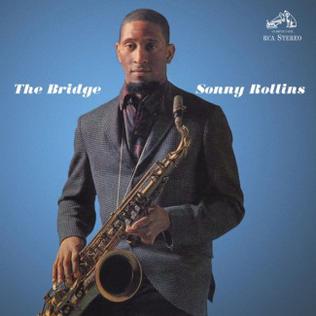
That album, recorded in January and February 1962 and released soon after, revealed a somewhat more intense Rollins: there was a more urgent restlessness in his cadences, a new fierceness in his already-husky tone, a fragmentation of melodic phrases, abrupt shifts in tempo. Yet the material still seemed a bit conventional, mainly standards and ballads; it wasn’t quite a New Thing.
He stepped up the intensity. His next album, Our Man in Jazz, was recorded in July 1962 live at the Village Gate with two of Ornette Coleman’s regulars—Don Cherry on pocket trumpet and Billy Higgins on drums—along with the more conventional Bob Cranshaw on bass. This is a wild album, the most adventurous in Rollins’ catalogue up to this time—and still rife with risk and mayhem, but also beauty and blues, more than 60 years later. (A few days ago, our editor Michael Fremer posted one of the songs, “Doxy,” from this album.)
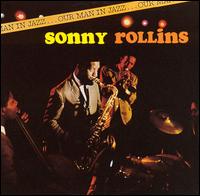
All of Rollins’ RCA albums sound superb, but Our Man in Jazz, with Paul Goodman at the console, sounds hair-raisingly real. It may be the best-sounding live jazz album ever. (This is especially true of the original pressing, though some vinyl audiophile reissues also sound very good; the CD, not so much.) The two horns are right there; you can practically see them. Higgins’ cymbals are sizzling, Cranshaw’s bass thumping, the ambience of the club full of air and smoke.
I should add that there is a bootleg six-CD box—called The Complete Live at the Village Gate, on the Solar label—that contains all of Rollins’ sets at the Village Gate in 1962 and early ‘63, many of them with the avant-garde bassist Henry Grimes replacing Cranshaw. It’s shoddy release, with mistaken dates and blank track-titles. Nothing is said of provenance, but I suspect it’s an inside job; someone at RCA must have copied the original tapes and sold the dupes to this fly-by-night company because the sound, though not as good as Our Man in Jazz vinyl releases, is remarkably good..
After stretching with Ornette’s gang, Rollins recruited some of Miles Davis’ bandmembers—pianist Herbie Hancock and bassist Ron Carter—for his next album, Now’s the Time, recorded in nearly 1964 by Ray Hall and sounding excellent. Musically, it’s a bit of a step back from the Village Gate live set (the band plays standards), but iit’s mbued with urgency.
.jpg)
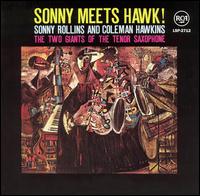
A few months before joining with Miles’ bandmates, Rollins recorded one of his most daring and remarkable albums ever, Sonny Meets Hawk, a joint session with Coleman Hawkins, who practically invented the modern tenor saxophone. When Sonny was a boy, he lionized Hawkins, emulated his tone. (There were two types of tone that young tenor saxophonists sought to copy: Hawkins’ husky or Lester Young’s silky; Sonny went with husky.) And here they were in the studio together, blowing side by side, as peers, Sonny not holding back his avant-garde tendencies, Hawkins leaning in toward the young rebel more than vice versa. And man, this thing cooks! Sonny even dares to call out “Lover Man” (Hawkins’ 1939 solo on that song helped define modern improvisation), and, toward the end, he blows a stream of multiphonics over Hawkins’ lyrical verse. It’s a phenomenal album. The rest of the band—including Paul Bley on piano with Grimes and Cranshaw trading off on bass—provides spirited backup. The sound, captured by Paul Goodman, is superb.
Beyond the initial hype of The Bridge, RCA saw no return from its hefty investment in Rollins, and after two-and-a-half years the suits dropped him. Still, on an artistic level, these sessions mark a peak in Rollins’ career—a period of fervent experimentation and awesome virtuosity.
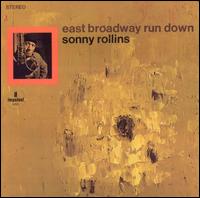
He continued his adventure by signing with the Impulse! label, which was also recording John Coltrane, Charles Mingus, and other avant-garde luminaries. On May 19, 1966, Rollins went into the studio with two of Coltrane’s bandmates—bassist Jimmy Garrison and drummer Elvin Jones—and trumpeter Freddie Hubbard. The resulting album, East Broadway Rundown, strained many listeners’ patience. Rollins pushed his penchant for fragmenting melodies to extremes; there’s an aggressive choppiness to some of the tunes, and the band doesn’t quite mesh either.
Yet a few months before, Rollins scored the soundtrack to the movie Alfie and, on Jan. 29, 1966, went into the studio to record it with a big band arranged and assembled by Oliver Nelson. It’s a gorgeous album, even romantic at times, harking back to the sort of material Rollins recorded just before his retreat to the Williamsburg Bridge. Even here, though, he flitted back and forth, ending the album with a track called “’Alfie’s Theme Differently,” which laces the lyrical theme with knife-blade edges. The sound is very good, though by this time, Van Gelder was pumping in a little more artificial reverb than he needed.
.jpg)
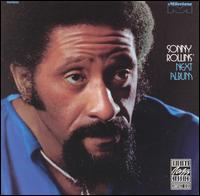
And then, Sonny Rollins dropped out of sight again, buffeted by industry pressures in the rock-and-roll era and, perhaps, by ambivalences about where he wanted to take his music. Back in 1959, his disappearance lasted three years. This time, he vanished for six. He returned in 1972 on the Milestone label with the cleverly titled Sonny Rollins’ Next Album, and those who expected another New Thing were disappointed—and remained disappointed for the next couple of decades. It was a good album, but retreading familiar standards, sometimes even looping in electronic keyboards, which further upset the purists.
Years later, when researching a book that I wrote on the many social, political, and cultural changes set off in the year 1959, I asked Rollins why he abandoned his avant-garde leanings of the early-to-mid-1960s. He replied that he realized he felt more at home with “song forms.”
The Milestone years are, musically, a mixed bag—but a more satisfying one than conventional wisdom has it. In 1996, the critic Gary Giddins wrote an article in the Village Voice, arguing that the Milestone albums, which Rollins had by then been churning out for a quarter century, were woefully underrated. Gary ended the piece by listing what he saw as the 20 best tracks from those albums and proposed that Milestone assemble them in an anniversary compilation.
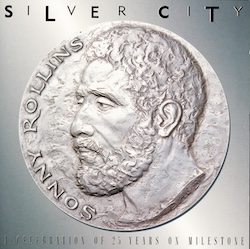
As it happened, Rollins and his wife, Lucille, who was also his manager, were thinking along the same lines; had no problem with Gary’s list; passed it on the execs at Milestone, who did just what Gary suggested, let him write an introduction to the booklet, and paid him a nominal fee. Anyway, the resulting two-CD album, Silver City: A Celebration of 25 Years of Milestone, makes a compelling case that Sonny was still cutting jewels in that era.
Sonically, though, the Milestone years were a wasteland. I don’t know of a single great-sounding Sonny Rollins album on that label. You had to go see him live to hear what magic he was spinning in the 1980s, ‘90s, and into the 21stcentury. It’s one of my life’s great bits of luck that I saw him live…I don’t know, 20 or 30 times in those years. Only a couple of those times was he less than enthralling.
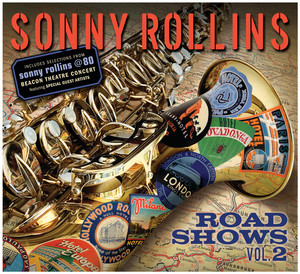
Lucky for you, one of his most captivating concerts, his 80th birthday celebration at the Beacon in New York City, on Sept. 10, 2010, was recorded and released as Road Shows, Vol. 2, on his own Doxy label—the second part of a series of live performances, many of them surreptitiously taped, over a period of several decades. He eventually released four volumes; Vol. 2 is the one to get. It has Rollins playing with a stream of friends and guests—Christian McBride, Roy Haynes, Jim Hall, Roy Hargrove, and, in a mind-bending 21-minute rendition of “Sonnymoon for Two,” Ornette Coleman. The two men had never played together in public before; they’d played together at all only once, on the beach at Malibu, in 1958, while both were out on the Coast making albums for Contemporary Records. There’s nothing like it; it’s as magical and mysterious as the musical dialogue between the terrestrial computer and the alien spaceship at the end of Close Encounters of the Third Kind. Musicologists will be studying it for years. The album’s sound quality isn’t great, but it’s pretty good—in other words, given the brilliance of the music, it’s good enough.
Sonny Rollins stopped playing in public in 2012, disabled by respiratory ailments, which may have been brought on by the Sept. 11 terrorist attack a decade earlier. He was living a few blocks from the Twin Towers at the time, and toxic particulates may have crept through his window into his lungs. He stopped playing even privately, at his home in Woodstock, in 2014.
His absence from the scene for so many years may have softened the blow to many. People who had only vaguely known his music might have been surprised he was alive until just last week. But for jazz fans and especially jazz musicians, the death came as a shock because his influence, whether direct or through osmosis, has been deep and persistent, in most cases for as long as they’ve been alive. Mike Hobson, the head of the long-defunct Classic Records, once described listening to great-sounding old jazz albums as “time-traveling.” Luckily for us all, there’s plenty of stations to visit in the Sonny Rollins Time Machine.