
UMe, Verve Label Group Announce 2026 Acoustic Sound Series Titles
LL-ANALOG SERIES MASTERED FROM ORIGINAL TAPES BY MATTHEW LUTTHANS AND PRESSED ON 180-GRAM VINYL AT QUALITY RECORD PRESSINGS (QRP)
Los Angeles – December 17, 2026 – Verve Label Group and UMe, the centralized global catalog division of Universal Music Group (UMG), are thrilled to announce the 2026 continuation of their acclaimed Acoustic Sounds Series, their audiophile vinyl reissue program presenting definitive editions of essential albums from the Verve and Impulse! Records catalogs. The 2026 slate places a special spotlight on landmark Impulse! Records sessions and classic Verve titles spanning the labels’ storied histories. The series pairs top-tier audio fidelity, offering faithful recreations of the original LPs, setting a high standard for archival jazz vinyl reissues.
As with all Acoustic Sounds series titles, the LPs will be mastered from the original analog tapes pressed on 180-gram vinyl, and packaged in high-quality tip-on gatefold jackets, replicating the original packaging. The albums will be mastered and cut to lacquer by Matthew Lutthans at the Mastering Lab at Quality Record Pressings in Salina, Kan. As always, all releases are supervised by Chad Kassem, CEO of Acoustic Sounds, the world’s largest source for audiophile recordings, and will utilize the unsurpassed production craft of Quality Record Pressings. Kassem details the 2026 releases in a new video, check it out here:
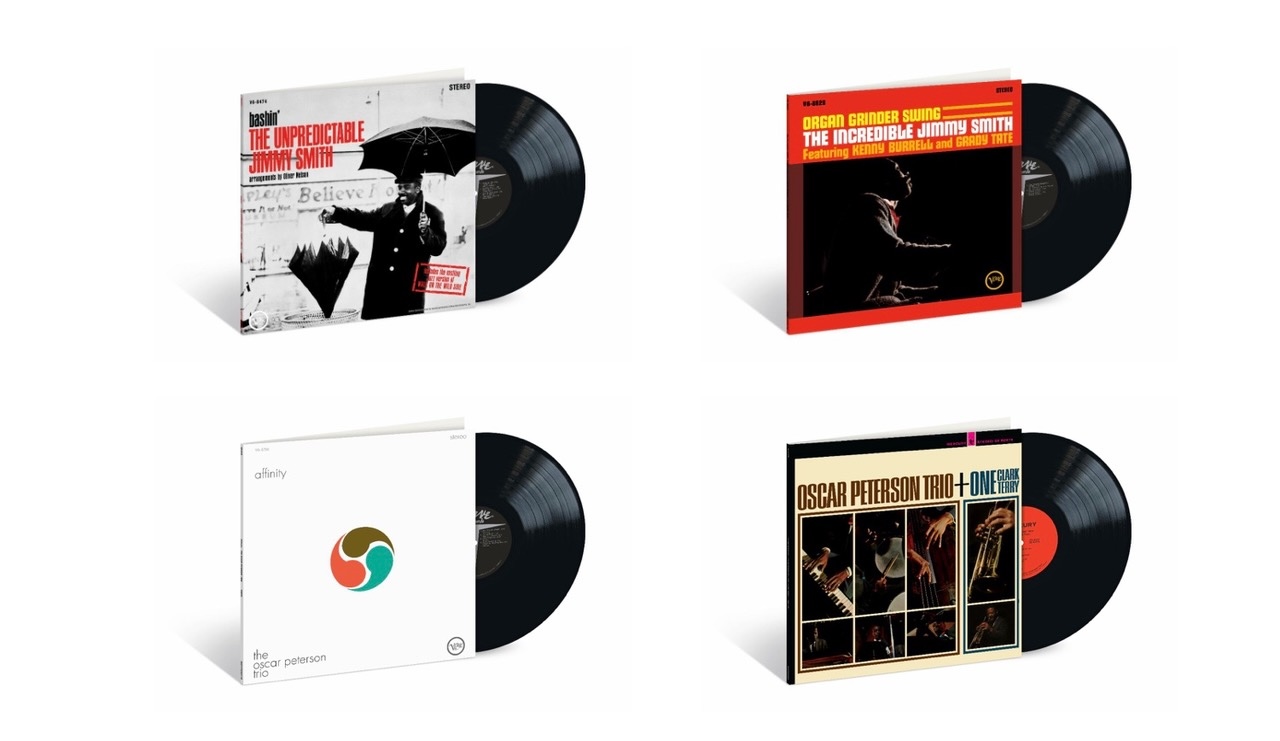
The 2026 rollout begins in January with two Jimmy Smith classics – Organ Grinder Swing (Verve, 1965) and Bashin’ – The Unpredictable Jimmy Smith(Verve, 1962) – followed in February by the Oscar Peterson Trio’s Affinity (Verve, 1962) and Oscar Peterson Trio + One (Verve, 1964), featuring trumpeter and flugelist Clark Terry. In March, the series turns to bossa nova and vocal jazz with Stan Getz’s Jazz Samba Encore (Verve, 1963), Astrud Gilberto’s The Shadow of Your Smile (Verve, 1965), and Ella Fitzgerald’s Sings the Rodgers and Hart Song Book (Verve, 1956) in a newly remastered 2LP edition.
Beginning in April, the schedule moves into its Impulse!-centric core: John Coltrane’s Africa/Brass (1961) and McCoy Tyner’s Inception (1962) lead a monthly cadence that continues through December with key recordings by Coltrane, Ella Fitzgerald, Stan Getz, Astrud Gilberto, Lester Young, Roy Eldridge & Harry Edison, Shelly Manne, Freddie Hubbard, Elvin Jones, Johnny Hartman, Wes Montgomery, Grant Green, Coleman Hawkins, Benny Carter,Lee Konitz, and the Oscar Peterson Trio.
Pre-order Jimmy Smith’s Bashin’ – The Unpredictable Jimmy Smith: https://jimmysmith.lnk.to/BashinASPR
Pre-order Jimmy Smith’s Organ Grinder Swing: https://JimmySmith.lnk.to/OGSwingASPR
Pre-order Oscar Peterson Trio’s Affinity: https://oscarpeterson.lnk.to/AffinityASPR
Pre-order Oscar Peterson Trio’s Oscar Peterson Trio + One: https://oscarpeterson.lnk.to/TrioPlusOneASPR
A full list of titles for the 2026 Acoustic Sounds Series is below.
2026 ACOUSTIC SOUNDS SERIES RELEASE SCHEDULE
January 23, 2026
• Jimmy Smith Featuring Kenny Burrell and Grady Tate – Organ Grinder Swing (Verve, 1965)
• Jimmy Smith – Bashin’: The Unpredictable Jimmy Smith (Verve, 1962)
February 27, 2026
• Oscar Peterson Trio – Affinity (Verve, 1962)
• Oscar Peterson Trio - Oscar Peterson Trio + One (feat. Clark Terry) (Verve, 1964)
March 27, 2026
• Stan Getz – Jazz Samba Encore (Verve, 1963)
• Astrud Gilberto – The Shadow of Your Smile (Verve, 1965)
• Ella Fitzgerald – Sings the Rodgers and Hart Song Book (2LP) (Verve, 1956)
April 24, 2026
• John Coltrane – Africa/Brass (Impulse!, 1961)
• McCoy Tyner – Inception (Impulse!, 1962)
May 22, 2026
• John Coltrane – Impressions (Impulse!, 1963)
• Ella Fitzgerald – Ella Fitzgerald Sings the Cole Porter Song Book (2LP) (Verve, 1956)
June 26, 2026
• Stan Getz – Big Band Bossa Nova (Verve, 1962)
• Lester Young, Roy Eldridge & Harry Edison – Laughin’ to Keep from Cryin’ (Verve, 1958)
July 24, 2026
• Shelly Manne – 2-3-4 (Impulse!, 1962)
• Freddie Hubbard – The Artistry of Freddie Hubbard (Impulse!, 1963)
August 28, 2026
• Elvin Jones – Dear John C. (Impulse!, 1965)
• Johnny Hartman – The Voice That Is! (Impulse!, 1964)
September 25, 2026
• Wes Montgomery – California Dreaming (Verve, 1967)
• Grant Green – His Majesty King Funk (Verve, 1965)
October 23, 2026
• John Coltrane – Live at Birdland (Impulse!, 1964)
• Coleman Hawkins – Wrapped Tight (Impulse!, 1966)
November 20, 2026
• Benny Carter – Further Definitions (Impulse!, 1962)
• Lee Konitz – Motion (Verve, 1961)
December 11, 2026
• Ella Fitzgerald – Like Someone in Love (Verve, 1957)
• Oscar Peterson Trio – West Side Story (Verve. 1962)
Jimmy Smith – Organ Grinder Swing (1965)
Recorded on June 14, 1965, at Rudy Van Gelder’s Englewood Cliffs studio and produced by Creed Taylor, Organ Grinder Swing marked Jimmy Smith’s return to the organ-trio format after several large-ensemble Verve projects, pairing him with guitarist Kenny Burrell and drummer Grady Tate in a compact setting that highlights the immediacy of his Hammond B-3 sound. Burrell’s clean melodic lines and subtle comping mesh with Smith’s harmonically rich phrasing, while Tate’s crisp, steady time anchors the trio across a program that includes the driving title track, the reflective “I’ll Close My Eyes,” and the blues-inflected “Blues for J.” A commercial success and one of the most enduring small-group albums of Smith’s Verve years, the record reaffirmed the trio as a central vehicle for his artistry and remains a defining document of his mid-1960s style.
Jimmy Smith – Bashin’: The Unpredictable Jimmy Smith (1962)
Recorded in March 1962 and released later that year as Jimmy Smith’s Verve debut, Bashin’: The Unpredictable Jimmy Smith marked a pivotal point in the organist’s career, presenting him in both a bold new orchestral context and the intimate trio format that had defined his earlier work. Oliver Nelson’s dynamic big-band arrangements – most famously on the breakout hit “Walk on the Wild Side,” which reached No. 21 on the Billboard Hot 100 – gave Smith a dramatic, brass-driven setting that expanded his audience and showcased the power of his Hammond B-3 in a cinematic frame. By contrast, the trio performances with guitarist Quentin Warren and drummer Donald Bailey highlight the subtle swing, blues feeling, and elastic phrasing that remained at the core of his artistry. Together, the contrasting ensembles reveal Smith’s versatility at a key transitional moment, making Bashin’ one of the most significant and enduring entries in his Verve catalog.
Oscar Peterson Trio — Affinity (1962)
Recorded in late September 1962 in Chicago and released on Verve the same year, the Norman Granz–produced Affinity captures the Oscar Peterson Trio – Oscar Peterson on piano, Ray Brown on bass, and Ed Thigpen on drums – at a moment of deep cohesion, refining its blend of rhythmic poise, melodic clarity, and conversational interplay across a focused program of standards and contemporary works. Highlights include Peterson’s first recorded version of Bill Evans’s “Waltz for Debby,” shaped with lyricism and quiet structural control, and Brown’s buoyant “Gravy Waltz,” co-written with Steve Allen, which showcases the ensemble’s rhythmic intuition and later won the 1963 Grammy Award for Best Original Jazz Composition. Often considered one of Peterson’s more understated early-1960s statements, Affinity endures as an essential Verve recording, reflecting a trio moving with confidence, curiosity, and unity of purpose during a period of intense artistic growth.
Oscar Peterson Trio + One — Plus One (1964)
Recorded August 17–18, 1964, in New York and released on Verve the same year, Plus One pairs the impeccably unified Oscar Peterson Trio – Oscar Peterson, Ray Brown and Ed Thigpen – with the warm-toned, inventive, and rhythmically buoyant Clark Terry, whose trumpet, flugelhorn, and signature “mumbles” scat style bring a fresh contrast that still fits seamlessly within the trio’s refined framework. Showcasing Terry’s crisp articulation, plush tone, and playful vocalizing on tracks like “Mumbles,” the album balances tight structural clarity on pieces such as “Brotherhood of Man” with more spacious, lyrical moments like the ballad “Jim,” all underscored by Peterson’s elegance and the trio’s instinctive cohesion. Concise, polished, and shaped by the easy rapport of four major jazz voices, Plus One stands as a quintessential mid-1960s Verve session and a snapshot of Peterson expanding his studio collaborations while preserving the trio’s core identity.
Stan Getz — Jazz Samba Encore (1963)
Recorded in February and March of 1963 and released later that year on Verve, Jazz Samba Encore reunites Stan Getz with Luiz Bonfá and Maria Toledo in a more intimate, introspective setting than the landmark Jazz Samba, shaped by Bonfá’s darker harmonic palette, Toledo’s distinctive vocal and percussive presence, and Getz’s warm, unhurried lyricism. Blending Bonfá’s originals with works by Antônio Carlos Jobim, including “Só Danço Samba” and “Insensatez,” the album deepens the evolving dialogue between Brazilian songcraft and American jazz phrasing, with Bonfá’s nylon-string guitar providing a subtle rhythmic and harmonic anchor and Toledo adding textural and emotional nuance. Featuring Jobim on several tracks, the session captures bossa nova’s transition from global sensation to mature artistic exchange, resulting in one of Getz’s most atmospheric and enduring Verve recordings.
Astrud Gilberto — The Shadow of Your Smile (1965)
Released on Verve in 1965, The Shadow of Your Smile captures Astrud Gilbertoin the early ascent of her solo career, placing her understated, conversational vocal style at the center of lush yet subtle arrangements by Don Sebesky and Klaus Ogerman that emphasize clarity, warmth, and emotional transparency across bossa nova, jazz, and mid-’60s pop material. Produced by Creed Taylor, the album frames her soft, unforced delivery with gentle orchestral color, whether on the newly minted standard of the title track, Brazilian selections, or contemporary ballads, allowing the nuances of her timbre and phrasing to carry the music. As a whole, it marks a key moment in Gilberto’s evolution from guest vocalist to fully realized solo artist and affirms her as a defining voice of the bossa nova era.
Ella Fitzgerald — Sings the Rodgers and Hart Song Book (1956)
Recorded in August 1956 and released later that year on Verve, Ella Fitzgerald’s second entry in her landmark Song Book series, Sings the Rodgers and Hart Song Book, pairs her crystalline tone, effortless articulation, and incisive phrasing with Buddy Bregman’s vibrant arrangements, which spotlight the harmonic sophistication and lyrical wit of the Rodgers and Hart catalog. Supported by top West Coast session players such as Alvin Stoller, Barney Kessel, Bud Shank, Herb Geller, Maynard Ferguson, Milt Bernhart, Ted Nash and Fitzgerald brings contemporary vitality to classics like “My Funny Valentine,” “You Took Advantage of Me,” and “There’s a Small Hotel,” revealing her unmatched command of lyric-driven interpretation and swing. The result is a cornerstone of the Song Book series and a defining statement of her Verve years, solidifying her stature as one of the Great American Songbook’s preeminent interpreters.
John Coltrane – Africa/Brass (1961)
Africa/Brass, released in 1961 as John Coltrane’s first album for Impulse!, marked a decisive shift in his recorded output, expanding his working quartet into a large, brass-heavy ensemble and creating a bold modal canvas that pointed toward the spiritual and textural explorations of his mid-1960s work. Recorded at Rudy Van Gelder’s studio and produced by Creed Taylor, the session featured arrangements by Eric Dolphy and McCoy Tyner that wove tuba, euphonium, French horns, and multiple saxophones into a powerful backdrop for Coltrane’s tenor and soprano improvisations, with key contributions from Booker Little, Elvin Jones, Freddie Hubbard and Reggie Workman. Pieces such as the 16-minute title track and a reimagined “Greensleeves” unfold as evolving soundscapes, balancing ensemble weight with intense individual statements, and the album endures as a landmark early Impulse! release that set the stage for later milestones like Impressions, Crescent, and A Love Supreme.
McCoy Tyner – Inception (1962)
Recorded on January 10–11, 1962, at Rudy Van Gelder’s studio, Inception marked McCoy Tyner’s debut as a leader for Impulse! Records, introducing a cohesive new trio with bassist Art Davis and drummer Elvin Jones, both colleagues from the Coltrane ensemble, whose familiarity lends the session its focused clarity. Across a six-track program featuring four Tyner originals (“Inception,” “Sunset,” “Effendi,” and “Blues for Gwen”) alongside “There Is No Greater Love” and “Speak Low,” the trio setting foregrounds Tyner’s distinctive voicings, pedal-point harmonies, and rhythmic drive, supported by Davis and Jones’s firm, responsive interplay. Released in 1962 as Impulse! was rapidly expanding, the album established Tyner’s identity as a bandleader and stands as an essential early statement in his solo discography.
John Coltrane – Impressions (1963)
Recorded between 1961 and 1963 and released on Impulse! in July 1963, Impressions captures John Coltrane’s classic quartet – McCoy Tyner, Jimmy Garrison, and Elvin Jones – at a pivotal early-1960s peak, blending live and studio recordings that chart the ensemble’s rapidly evolving modal language. The extended live performances “India” and the 14-minute title track showcase the group’s growing command of sustained improvisation and rhythmic interplay, while the studio cuts “Up ’Gainst the Wall” and “After the Rain” provide contrasting snapshots of hard-driving momentum and lyrical introspection. Issued amid a run of landmark Coltrane releases, the album stands as a concise yet essential portrait of the quartet’s shift toward longer forms, expanded harmony, and the exploratory balance that would define his mid-1960s output.
Ella Fitzgerald – Ella Fitzgerald Sings the Cole Porter Song Book (1956, Verve) 2LP
Released in 1956 as the inaugural album on the newly founded Verve label, Ella Fitzgerald Sings the Cole Porter Song Book marked a major turning point in Ella Fitzgerald’s career and launched her landmark Song Book series, pairing her with producer Norman Granz, arranger-conductor Buddy Bregman, and a full studio orchestra for 32 selections spanning Porter’s catalog. Recorded across February and March of 1956, the album frames Ella’s immaculate phrasing and clarity with polished West Coast orchestration that blends swing, ballad writing, and classic Hollywood sheen, emphasizing the lyrical wit and melodic elegance of Porter’s writing. Celebrated upon release and formative in shaping both Verve’s identity and Ella’s artistic trajectory, it remains a cornerstone of her discography and a defining document of 20th century American popular interpretation.
Stan Getz – Big Band Bossa Nova (1962)
Released in 1962 on Verve, Big Band Bossa Nova followed the success of Stan Getz’s earlier bossa nova projects, expanding the style into a large-ensemble setting with arrangements and conducting by Gary McFarland and production by Creed Taylor. Recorded in August at Columbia’s 30th Street Studio, the album features leading session players – including George Duvivier, Jim Hall, Mel Lewis, and percussionists José Paulo and Luiz Parga – whose interplay grounds the music in authentic Brazilian rhythms while McFarland’s polished orchestration blends samba and bossa nova sensibilities with American big band writing. Getz’s lyrical tenor sax floats effortlessly over the ensemble, unifying Brazilian repertoire and original compositions into a cohesive, richly textured program that, alongside Jazz Sambaand Jazz Samba Encore!, played a key role in introducing North American audiences to bossa nova and remains a landmark Verve recording.
Shelly Manne – 2, 3, 4 (1962)
Recorded on February 5 and 8, 1962, at Rudy Van Gelder’s studio, 2, 3, 4 is one of drummer Shelly Manne’s most celebrated small group sessions and a standout in the Impulse! catalog, produced by Bob Thiele and featuring an intergenerational ensemble of Manne, tenor legend Coleman Hawkins, pianists Eddie Costa andHank Jones, and bassist George Duvivier. The album blends swing tradition with modern improvisation, highlighting Hawkins in a late-career resurgence, Manne’s subtle rhythmic guidance, and the ensemble’s flexible interplay across duet, trio, and quartet settings. With extended readings of standards like “Take the A Train” and “Cherokee,” alongside “I’m Coming Virginia” and “Avalon,” the record showcases expressive tenor, sophisticated harmonies, and impeccable time, offering a relaxed yet richly textured session that remains a favorite among Impulse! devotees and a key document of Hawkins’ later prime.
Freddie Hubbard – The Artistry of Freddie Hubbard (1963)
Recorded on July 2, 1962, at Rudy Van Gelder’s studio and released in 1963 on Impulse! Records, The Artistry of Freddie Hubbard captures the trumpeter at a pivotal early stage, showcasing his technical brilliance, warmth, and rhythmic command within a versatile ensemble of Art Davis, Curtis Fuller, John Gilmore, Louis Hayes and Tommy Flanagan. Produced by Bob Thiele, the album blends originals and standards, highlighting Hubbard’s compositions like “The 7th Day” and his arrangement of the Ellington-Tizol classic “Caravan,” while balancing hard bop, balladry, and modal harmony. Gilmore’s distinctive tenor complements Hubbard’s sculpted lines, Fuller and Flanagan provide harmonic depth, and Davis and Hayes drive a responsive rhythm section, resulting in a cohesive session that documents Hubbard’s emergence as a defining voice of 1960s jazz.
Elvin Jones – Dear John C. (1965)
Recorded on February 25, 1965, at Rudy Van Gelder’s studio and released later that year on Impulse! Records, Dear John C. marked Elvin Jones’s first album as a leader for the label after several seminal years defining the rhythmic architecture of the John Coltrane Quartet. Produced by Bob Thiele, the album honors Coltrane while showcasing Jones’s dynamic, polyrhythmic drumming across contemporary standards, ballads, and originals such as Thad Jones’s title track “Dear John C.,” with saxophonist Charlie Mariano’s lyrical alto and pianists Hank Jones and Roland Hanna and bassist Richard Davis’s harmonically rich support complementing the rhythmic foundation. A defining early statement of his bandleading identity, the album blends modernist swing, tonal clarity, and rhythmic sophistication, capturing the transition from his tenure with Coltrane to his emergence as a leader with a broad, exploratory vision.
Johnny Hartman – The Voice That Is! (1964)
Recorded over two sessions in August 1964 at Rudy Van Gelder’s studio and released on Impulse!, The Voice That Is! was Johnny Hartman’s second album for the label, following his landmark collaboration with John Coltrane. Produced by Bob Thiele, the album centers Hartman’s warm, precise baritone within a mix of small-group balladry and lightly orchestrated arrangements by Bob Hammer, featuring Hank Jones on piano, Richard Davis on bass, Osie Johnson on drums, and expanded ensemble passages with reeds, brass, and strings. Blending standards like “My Ship” and “The More I See You” with contemporary material such as “Waltz for Debby” and “Charade,” the album showcases Hartman’s interpretive depth, clarity, and ease, making it one of his most fully realized solo recordings and a testament to his mastery as an interpreter of the American songbook.
Wes Montgomery – California Dreaming (1966)
Recorded in September and October 1966 at Rudy Van Gelder’s studio and released on Verve, California Dreaming captures Wes Montgomery in the final phase of his Verve period, pairing his signature octave-driven guitar with lush arrangements by Don Sebesky that blend contemporary pop repertoire, large-ensemble writing, and Montgomery’s melodic improvisation. Produced by Creed Taylor, the album features woodwinds, brass, and rhythm section providing a vibrant backdrop for Montgomery’s lyrical solos, including the title track, a reimagining of the Mamas & the Papas hit, alongside other contemporary tunes like “Sunny” and originals such as “Mr. Walker,” nodding to his hard-swinging roots. Part of the creative bridge between his Verve and A&M years, the album combines high-level arranging, ensemble polish, and the unmistakable warmth of Montgomery’s playing, exemplifying the mid-1960s jazz-pop crossover aesthetic.
Grant Green – His Majesty King Funk (1965)
Recorded on May 26, 1965, at Van Gelder Studio and released on Verve, His Majesty King Funk is Grant Green’s only album for the label and a defining mid-1960s soul-jazz statement, pairing the guitarist with organist Larry Young, tenor saxophonist Harold Vick, drummer Ben Dixon, and conguero Candido Camero. Produced by Creed Taylor, the session features four extended tracks, including the topical opener “The Selma March” and a spacious reading of “Willow Weep for Me,” with Green’s melodic clarity and tone complemented by Young’s modern, harmonically rich organ, Vick’s blues and gospel-inflected tenor, and a propulsive rhythm section. Capturing Green at a creative intersection of hard bop, R&B, and emerging soul-jazz, the album remains prized for its deep grooves, ensemble interplay, and enduring influence within his catalog.
John Coltrane – Live at Birdland (1964)
Released in December 1964, Live at Birdland captures John Coltrane’s classic quartet – McCoy Tyner, Jimmy Garrison, and Elvin Jones – during a period of profound artistic growth, combining three live tracks from Birdland on October 8, 1963, with two studio recordings from Van Gelder Studio on November 18, 1963. The album showcases the quartet’s mastery of extended form, modal structure, and spiritual intensity, from the live centerpiece “Afro-Blue,” with Coltrane on soprano navigating shifting rhythms, to the dramatic ballad “I Want to Talk About You,” featuring his unaccompanied cadenza. Studio tracks include the solemn elegy “Alabama” and the rhythmically layered “Your Lady,” concluding with the devotional “The Promise,” together highlighting the ensemble’s expressive and spiritual range. Bridging the live energy of Impressions and the introspection of Crescent and A Love Supreme, the album remains a pivotal document of the quartet at full strength.
Coleman Hawkins – Wrapped Tight (1966)
Recorded in early 1965 at Rudy Van Gelder’s studio and released in 1966, Wrapped Tight presents Coleman Hawkins in a late-career surge of vitality for Impulse!, placing the tenor saxophone pioneer at the center of a dynamic large-ensemble setting arranged by Frank Hunter and produced by Bob Thiele. Spanning ballads, blues, standards, and contemporary material, Hawkins’ commanding tone and phrasing shine on tracks like “Intermezzo,” “Red Roses for a Blue Lady,” and “She’s Fit to Be Tied,” while Hunter’s rich brass, reeds, and rhythm section provide cinematic texture without overshadowing his solos. A testament to Hawkins’ enduring harmonic and rhythmic mastery, the album stands as one of the strongest recordings from his final decade and exemplifies Impulse!’s commitment to pairing jazz elders with modern, high-fidelity production.
Benny Carter – Further Definitions (1962)
Recorded on November 19 and 21, 1961, at Rudy Van Gelder’s studio and released in 1962 on Impulse!, Further Definitions stands as one of Benny Carter’s most celebrated late-period achievements, reuniting him with an all-star saxophone section – Coleman Hawkins, Phil Woods, and Charlie Rouse – supported by a top-tier rhythm team of Dick Katz, Jimmy Garrison, and Jo Jones. The album blends orchestral polish with swinging small-ensemble improvisation, featuring standards and Carter originals reimagined from earlier big band charts, such as “Crazy Rhythm,” “Blue Star,” and “Doozy,” which showcase harmonically rich, tightly voiced lines and space for each soloist’s distinct voice. Hawkins’ monumental tenor, Woods’ modernist alto, Rouse’s lyrical tenor, and Carter’s poised statements are anchored by a rhythm section of light touch and impeccable time, making the album a refined, intergenerational conversation and one of the most accomplished small-ensemble saxophone records of the 1960s.
Lee Konitz – Motion (1961)
Recorded on August 29, 1961, at Rudy Van Gelder’s studio and produced by Creed Taylor, Motion is one of Lee Konitz’s most celebrated albums and a landmark of spontaneous trio interplay, featuring Konitz on alto with bassist Sonny Dallas and drummer Elvin Jones. The piano-less ensemble creates an open harmonic and rhythmic space, allowing Konitz’s long, airy lines to unfold over Jones’ shimmering, elastic drumming and Dallas’ clear, propulsive bass, as the trio transforms standards like “I Remember You,” “All of Me,” and “You’d Be So Nice to Come Home To” into vehicles for cool-toned, conversational improvisation. With its rare blend of freedom, swing, and structural clarity, the album remains a defining document of early-1960s Verve and a touchstone for minimal, open-form jazz interaction.
Ella Fitzgerald – Like Someone in Love (1958)
Recorded across several sessions in October 1957 and released in 1958 on Verve, Like Someone in Love presents Ella Fitzgerald in a lush, intimate setting, blending orchestra and small-group arrangements by Frank DeVol and produced by Norman Granz. Following her landmark Song Book projects, the album emphasizes warmth, subtlety, and phrasing over large-scale interpretation, with ballads and mid-tempo standards like “There’s a Lull in My Life,” “More Than You Know,” and “Moonlight in Vermont” framed by strings, woodwinds, and occasional jazz rhythm section. Ella’s unhurried, expressive delivery highlights her melodic and lyrical nuance, making the album a standout example of her intimate, cinematic artistry during her early Verve years.
Oscar Peterson Trio – West Side Story (1962)
Recorded in New York City on January 24 and 25, 1962, and released later that year on Verve, West Side Story features the Oscar Peterson Trio – Oscar Peterson, Ray Brown and Ed Thigpen – reinterpreting Leonard Bernstein’s Broadway score with virtuosic technique, lyrical invention, and rhythmic precision. Produced by Norman Granz, Peterson’s arrangements balance fidelity to the original melodies with improvisational freedom, transforming “Something’s Coming,” “Tonight,” and “Maria” into harmonically rich, expressive statements, while “Jet Song” and “Cool” showcase the trio’s contrapuntal clarity and dynamic interplay. One of their most popular themed albums, it exemplifies the trio’s signature swing, articulation, and dramatic sensitivity, bridging jazz and musical theatre with originality and technical mastery.



















.png)