
Yes Puts Shastras to Music on “Tales from Topographic Oceans”
A double album turns into a dozen-disc super deluxe edition from Rhino
It’s astonishing to consider that Yes was only five years shy of working together professionally when they peaked on Close to the Edge in 1972. The band saw it as a moment defining the ambitious compositional and musical scale they had set out to achieve. Drummer Bill Bruford felt that leaving the group after reaching an insurpassable milestone was the natural progression. Alan White, drummer of John Lennon’s Plastic Ono Band, joined the ranks of a band that was steadily defying the odds of what was targeted against progressive rock, selling 500,000 copies of an album before it even appeared on shelves and playing in arenas to tens of thousands. Close to the Edge was only the start of Yes’s journey into extended-form song structures, and the only direction to go was even longer.

King Crimson percussionist Jamie Muir had recommended to Jon Anderson in early 1973 Paramahansa Yogananda’s "Autobiography of a Yogi". Anderson read the book while Yes toured Japan and became fixated on a footnote explaining four shastric scriptures that symbolized every facet of human life. From this, he envisioned a suite of four movements that were centered on the four scriptures. Guitarist Steve Howe loved the idea, and the two together built the album’s framework, based on themes and leftover musical bits that turned into fully fleshed-out ideas. Their material was challenging because it was too much to fit on a single album and not enough for a double. Reactions amongst the rest of the group were mixed, but they saw its potential and agreed to pursue their first double album. The only way it would work was instrumentally ‘padding’ the album via improvisations, something keyboardist Rick Wakeman felt drove away the material’s strength; the cracks of Yes’s musically liberating organization were starting to form.
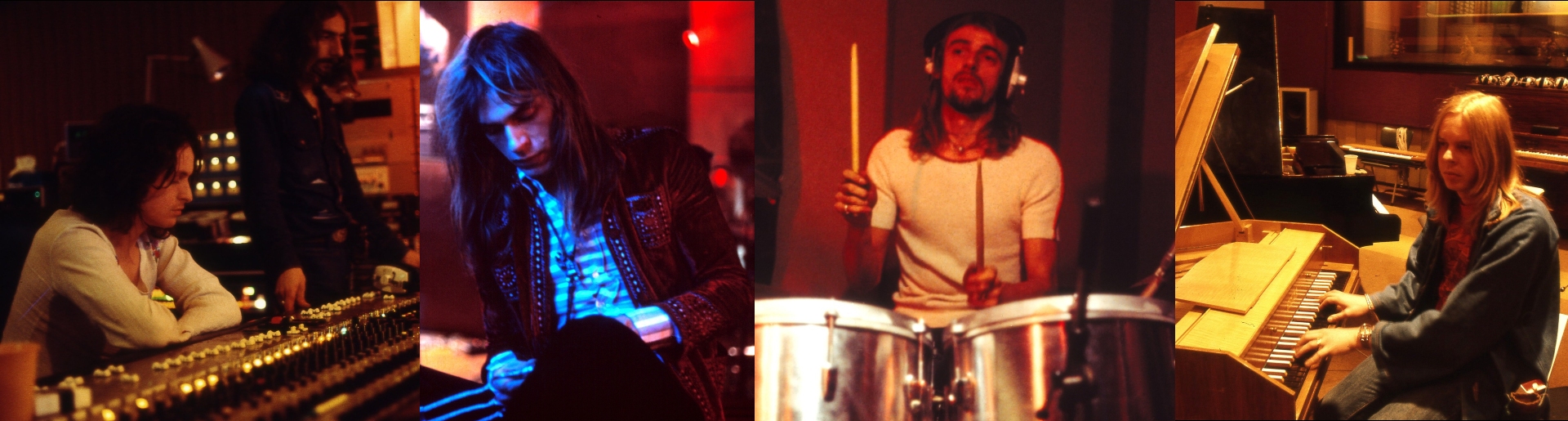
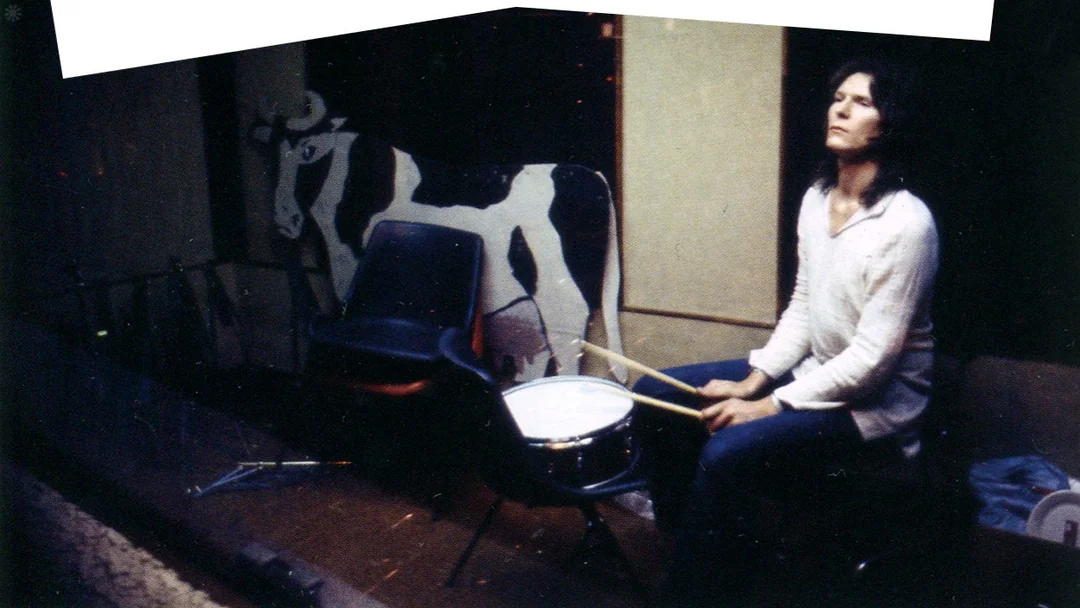
The recording sessions surrounding Yes’s new studio project have a lore of their own. Some of the band members wanted to record in the country, whereas Jon Anderson wished to record at night under a tent in the forest. Agreeing to record at Willesden’s Morgan Studios was an advantage because it was equipped with England’s first 24-track recording console, though half the time it didn’t work. Whilst recording in the city, they made the studio look like the country… literally. The makeshift scenery wasn’t limited to flowers and greenery, but hay bales propping up amplifiers and a white picket fence around Rick Wakeman’s keyboards. Anderson favored how his voice sounded in his own bathroom, so a makeshift booth, made of plywood and tiles, was installed. The most absurd yet legendary fixture was a cardboard cutout of a cow that had mechanical udders that moved. It’s without question that some of the decor almost worked against the group. Tiles fell off between vocal takes, and Rick Wakeman’s keyboards had to be repaired because of earwig infestations.
“The Revealing Science of God (Dance of the Dawn),” based on Śruti (‘that which is heard’), begins as a quest for spiritual awakening and searching for the ultimate truth behind human consciousness. The overlapping introductory chant is an ever-opening flower weaving together concepts of light, thought, power, and love before easing into motifs and melodies that reappear throughout. It's the one track on the album that’s based on a loose verse-chorus structure, making it borderline accessible and bearing the trademarks of an effective Yes epic.
“The Remembering (High The Memory),” based on Smṛti (‘what is remembered’), reflects on memory, loss, and the endurance of love and human connection over time. Steve Howe’s electric sitar has an oceanic quality, complementing the arrangement’s underlying folky/pastoral approach. Rick Wakeman’s keyboard solo and Chris Squire’s fretless bass work on this track are deemed some of their finest performances ever committed to tape.
“The Ancient (Giants Under the Sun),” based on puranas (Hindu legends and lore), taps into primal humanity and deep connections to nature and ancient wisdom. Musically, this is Yes embracing the avant-garde. Rhythmic chaos best describes most of the track, locking Chris Squire’s bass into Alan White’s mirage of skittering rhythms and bells, underlined by Steve Howe’s detuned guitar wails and Jon Anderson’s incantation of ‘Sun’ translations. The closing ‘Leaves of Green’ section, featuring Howe’s nylon acoustics and Anderson’s angelic vocals, dials the track back into wondrous serenity.
“Ritual (Nous Sommes du Soleil),” based on tantra (a system of practices), concludes the album with a sense of unity, celebration, and spiritual fulfillment. It’s the culmination of effective thematic recapitulation, bringing together previously explored concepts and ideas into a definitive closing statement. Steve Howe’s opening and closing guitar solos soar into stratospheric brilliance. Chris Squire’s bass solo in the middle yearns before the imposing orchestra of drums and tympani looms over before the track reaches its resolving climax. “Ritual” is undoubtedly the album’s highlight and, out of the four tracks, the one performed the most live over the decades.
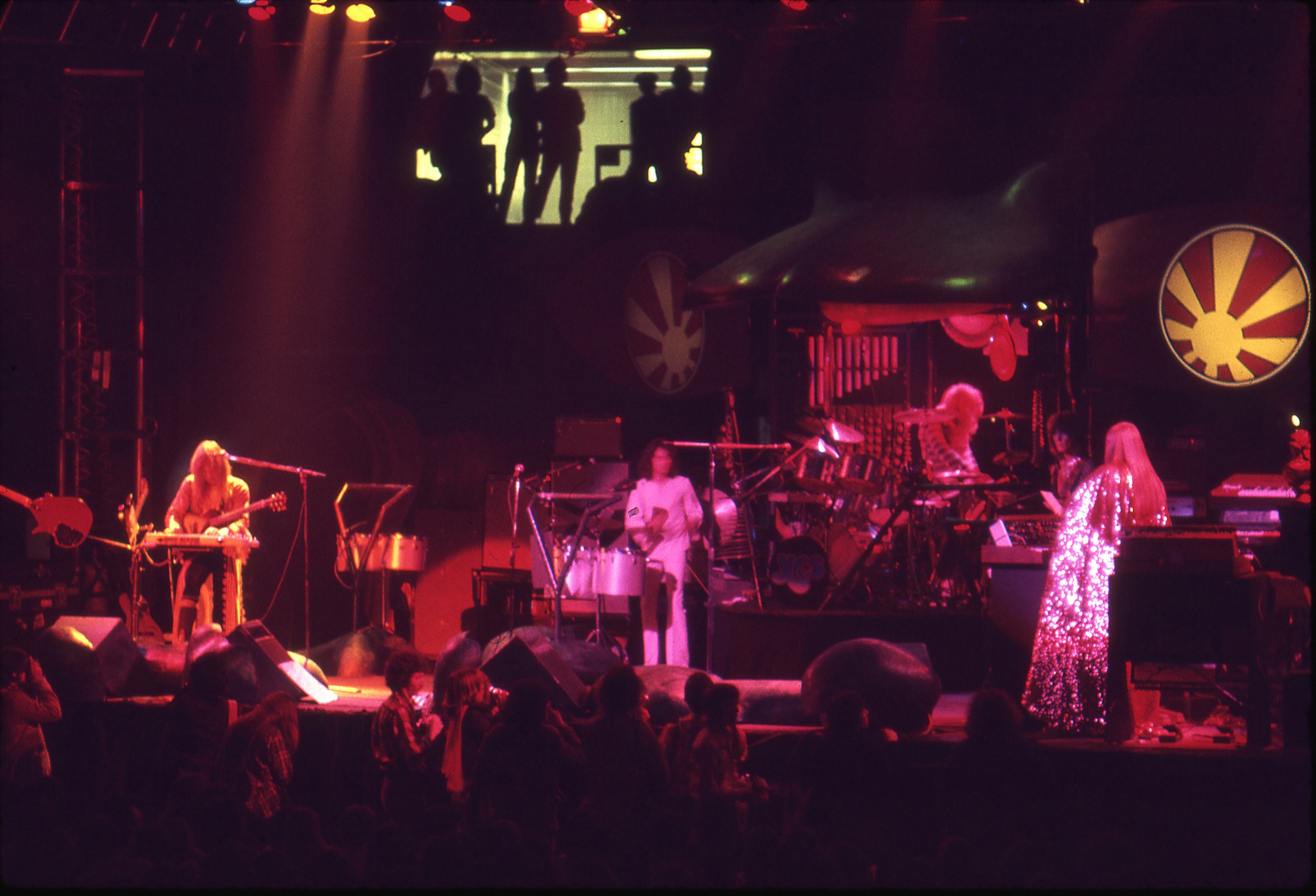
Just as Close to the Edge had set a new standard, Tales from Topographic Oceans raised the ante when released in December 1973. Its daunting presentation of four 20-minute epics made it too convenient for critics to write it off as an exercise in self-indulgence. Yes dared to test their audiences’ boundaries by performing the album live in its entirety during its touring cycle. Rick Wakeman further proved his disdain for the material both in the press and during an infamous moment at a gig in Manchester when he ate a curry on stage during another member’s solo; he left the band (for the first of many times) after fulfilling tour commitments well into spring 1974.
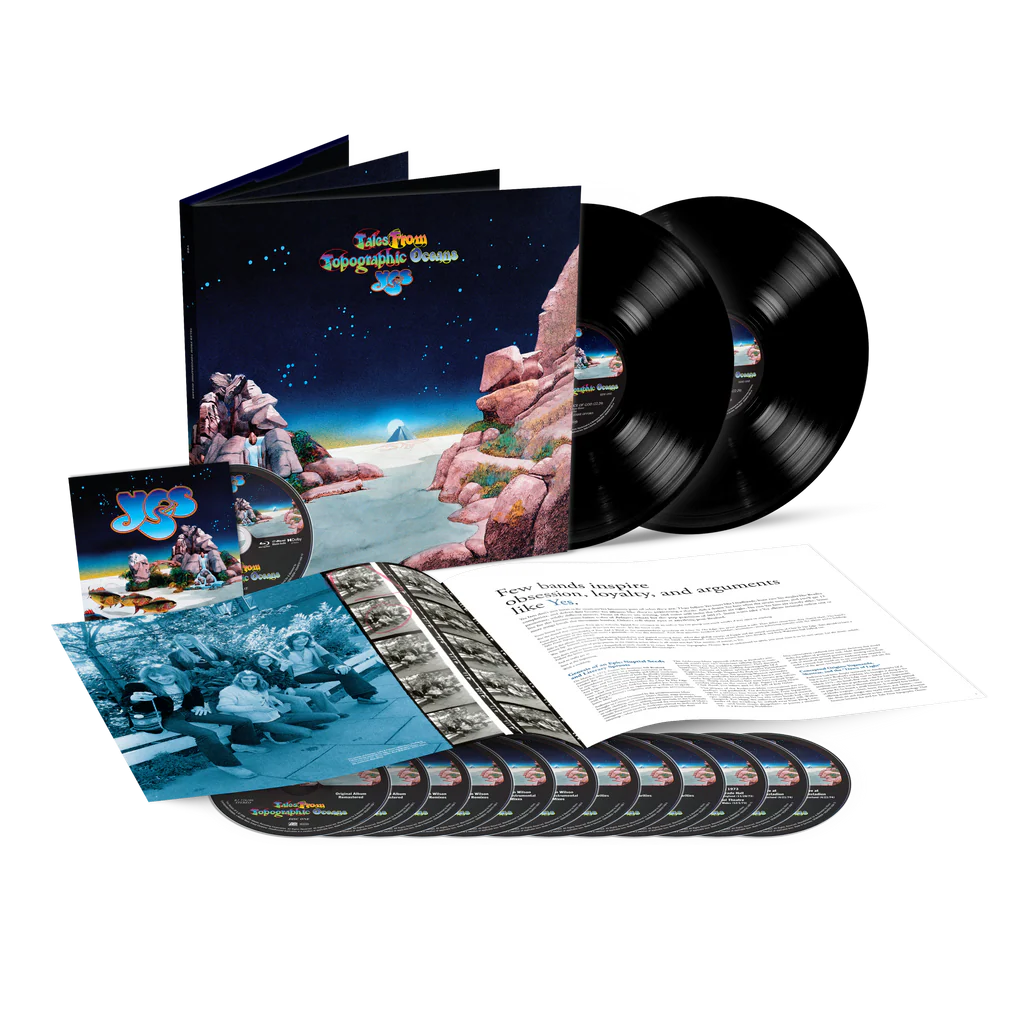
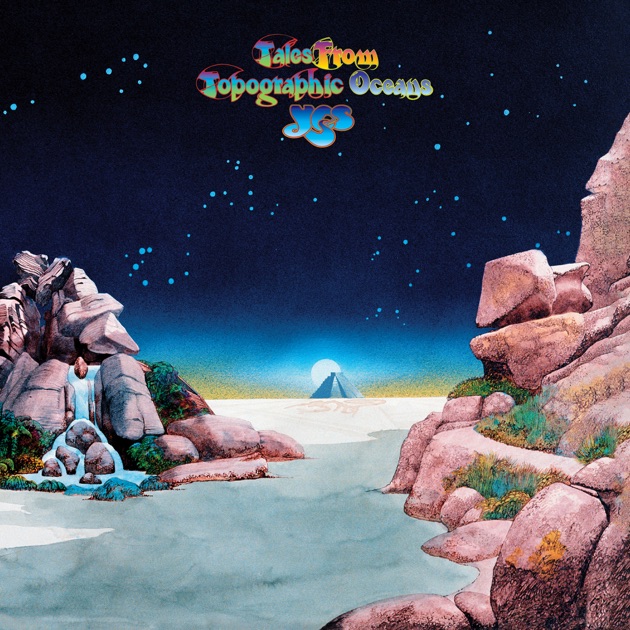
Tales from Topographic Oceans is the next album in a series of multi-format super deluxe editions Rhino has released of Yes’s classic albums since 2023. Roger Dean’s exquisite artwork, voted by Rolling Stone as the greatest album cover of all time, graces a hardbound book and reprises inside two sandwiched gatefold jackets that serve as folios holding the 12 CDs. The left and right pockets house the heavyweight vinyl LPs and a 16-page booklet consisting of Syd Schwartz’s in-depth essay, photos, and the album’s original gatefold spread–the optical discs and LPs feature the custom center label as per original pressings.
Music

Sound

The two LPs and CDs 1-2 are the remastered original mix, the vinyl being cut all analog by Bernie Grundman. Very much like the AAA cut included in the Close to the Edge set from last year, there’s an awful lot of mid-high frequency emphasis that brings the most out of the guitars and keyboards. There’s a ‘roomy’ quality to the mix that makes the album sound too laid back, hollowing out Alan White’s drumming far into the background. The only bottom-end output comes from Chris Squire’s bass runs, and that’s not even accounting for his lead-like playing style. Despite the discrepancies, each member’s performance has the appropriate type of subtlety or melodrama within the dynamics of a given track. Moments where atmosphere plays a crucial role in the arrangements, namely the syncopated madness of “The Ancient” and percussion-heavy middle section in “Ritual,” still deliver their desired effect.
CDs 3-4 are Steven Wilson’s new stereo mix of the album. This is a rare instance in which Wilson’s revisit improves what came before. The veil that shrouded the original is removed, allowing this version to breathe more efficiently. Some of the extra air in the top end can be deemed ‘too bright’ to some ears, but one can actually hear the higher frequencies in Rick Wakeman’s Moog synthesizer to a greater advantage. Instances where Steve Howe’s guitar playing sounded ‘full-bodied’ now sound more spacious. The rhythm powerhouse of Chris Squire and Alan White was once the underdogs of the original mix. Here, they command a powerful presence, making the album sound more muscular than anemic. As a minor bonus, the two-minute atmospheric introduction to “The Revealing Science of God” (originally revealed on Rhino’s 2003 remaster) is reinstated.
CDs 5-6 consist of Steven Wilson’s new instrumental mix of the album. Including these types of mixes may seem ludicrous to some consumers. In the case of Tales, magnifying the instrumental arrangements that are sometimes obscured by Jon Anderson and company’s lush vocal orchestrations will help appreciate some of the album’s underlying intricacies; it makes for essential accompaniment if you wish to host a Topographic Oceans-themed karaoke party!
CDs 7-9 are rarities, most of which have been previously available in other Tales reissues. Steven Wilson’s ‘single edits’ of each track from the album offer a unique perspective on how these extended epics could’ve been approached in concise four-minute forms. Some of the alternate versions feature different backing tracks, Jon Anderson’s loose vocal deliveries that show progression towards the finalized melodies, and arrangement approaches that didn’t make the final album. The most striking revelation is an early ‘in-progress’ version of “The Ancient.” During the song’s intro, Rick Wakeman opts for a different synthesizer other than the vibrophone preset on the Mellotron; Anderson also vocalizes Steve Howe’s guitar licks to the T. Instead of the acoustic-driven tranquility of the closing ‘Leaves of Green’ section, Howe plays it electrically, accompanied by Wakeman’s chord washes and Alan White’s percussion accents.
CDs 10-12 are live recordings sourced from Steve Howe’s personal archives. The tracks from Manchester’s Free Trade Hall on 11/28/73 (the infamous Wakeman curry gig) and Cardiff’s Capitol Theatre on 12/1/73 are far from professional quality, sounding as if they were recorded via ambient microphones positioned on stage. If the subjective recording quality is passable, it stands out for including “The Remembering,” a Tales cut that was dropped after 30 shows. The crown jewel of this portion is the tracks from Zurich’s Hallenstadion on 4/21/74. Recorded off the soundboard and mixed in mono, this could, with some post-production fairy dusting, pass as an ‘official bootleg’ recording.
For this review, I listened to the Blu-ray on a friend’s home theatre system. It utilizes a 5.1.2 speaker configuration.
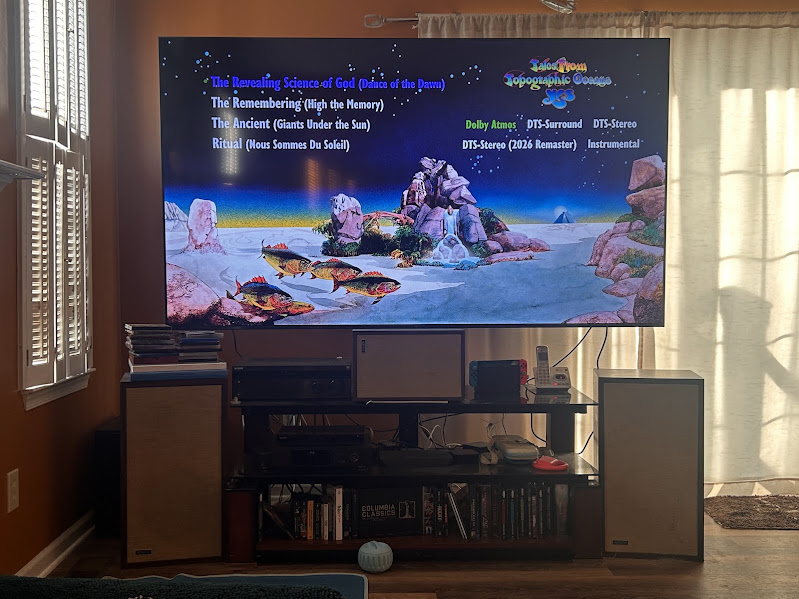
The Blu-ray features Steven Wilson’s newly prepared Atmos and 5.1 mixes, stereo remix, instrumental mix, and the original stereo remaster. It follows a loose template: vocals/guitar/bass locked to the center, drums panned across the fronts, harmonies panned across the left and right rears, and keyboards hovering around the rears and overheads–some of the instrumentation shifts depending on which member takes center stage and what effect it provides. One highlight in particular is Rick Wakeman’s solo spots during “The Remembering.” The Mellotrons shimmer in the rears, leaving the Moog taking center stage in the front. As much as “The Ancient” sounds off the wall in stereo, it sounds absolutely maddening in Atmos. The percussion and vibraphone pan back and forth between the rears, and some of Steve Howe’s wailing guitar and extra bells create contrasting atmospheres. This will be one of the most incredibly engaging Atmos mixes of a rock album you’ll ever hear!
An album as adventurous and daring as Tales from Topographic Oceans deserves an equally overblown super deluxe treatment. May this box set be the definitive AND final copy of this album you’ll ever need.