
Acoustic Sounds UHQR
Lyra

Carl Perkins

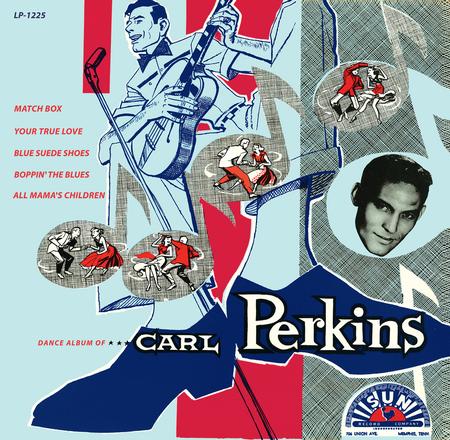
Dance Album of Carl Perkins

Music

Sound

Dance Album of Carl Perkins

Label: Sun/Intervention

Produced By: Sam Phillips, reissue producer, Shane Buettner

Lacquers Cut By: Kevin Gray at Cohearent Audio

By: Michael Fremer

January 10th, 2026

Genre:

Other Rockabilly

Format:

Vinyl

A Sun Album Every Beatles Fan Should Own

takes you into Sun studios

Colin Escott writes in the liner notes to this remarkable reissue that Carl Perkins met The Beatles at the wrap party for his first British tour before the fFab Four broke big in America and he accompanied them to the studio the next day where they recorded "Matchbox". Months later they recorded "Everybody's Trying To Be My Baby" and "Honey Don't". Over time the group or individuals in the group recorded every song on this album!

So yes, The Beatles were big Perkins fans and while this album was never recorded as an album but rather was a compilation of singles that by the time it was released November 1957 Perkins "had either left Sun or was halfway out the door", Escott writes, the Beatles did more than "parrot songs from Carl's Sun album; they internalized his work".

It's great fun listening to the originals of songs every Beatles fan knows but it's more fun catching glints of Perkins in other Beatles tunes as you listen to Perkins perform all of his tunes here—a lick reflected in some familiar George Harrison guitar solo or a vocal inflection from another Beatle.

Everything about this album is so doggone sweet, from the packaging to the remarkable sound, to Escott's notes (I helped Buettner connect with Escott through our mutual friend Ken Kessler and glad I did because the notes provide a powerful portal between Perkins and The Beatles and that should help convince more Beatles fans who are not necessarily rockabilly fans to pick this one up).

Escott delves deeply and back in time to the roots of many of the songs here and that adds additional luster to the package as does knowing that these tapes were not exactly in "ship shape" out of the vault. For more on that story, read this profile of Archival Engineer Kelly Pribble, of Iron Mountain Media and Archival services.

Congrats to all involved in this re-issue and if you have the 1986 Rhino compilation Carl Perkins Original Sun Greatest Hits (Rhino RNLP 70221) trust me, you ain't heard nuttin' until you hear this!

Music Specifications

Catalog No: LP-1225/IR-038

Pressing Plant: Gotta Groove

SPARS Code: AAA

Speed/RPM: 45

Weight: 180 grams

Size: 12"

Channels: Mono

Source: original master tapes

Presentation: Single LP

Comments

  • 2026-01-11 11:07:32 PM

    AnalogJ wrote:

    Fun and impressive reissue in many ways. But one thing that's noticeable is that there's pretty much no bass. It's apparently not the fault of the tapes. It wasn't in the recording to begin with. But while you hear Clayton Perkins' percussiveness bass slap, the notes are essentially not present. So the bass line that should be there to propel the rockabilly isn't present. To me, that's a fundamental part of rockabilly, the swing of it.

    Otherwise, the midrange, including Carl Perkins' guitar and his vocal, are VERY present. Well worth picking up, but it's not a perfect recording. But these are seminal, important recordings.

    • 2026-01-12 10:00:56 AM

      Michael Fremer wrote:

      What’s your point? If the recording is bass shy take it up with Sam Phillips’ ghost. These are important recordings preserved and presented as well and as accurate as possible and sound great! I had some friends over last weekend and played all kinds of records for them in including “audiophile classics”. They thought the Perkins was among the biggest treats and a window into the Sun Studio.

    • 2026-01-12 01:39:38 PM

      Todd wrote:

      Have there been other releases that have the bass turned up?

  • 2026-01-12 10:54:39 AM

    JEB-42 wrote:

    While this genre of music is well outside of my normal purview, it completely draws you in. It's just plain fun! It gets you moving. The lp is a sonic treat on top of that. This is a must own and a must play album. Well worth the price of admission. The liner notes were a pleasure to read and very informative for me. Looking forward to that Johnny Cash next!

  • 2026-01-13 03:04:21 AM

    Malachi Lui wrote:

    i also received a copy of this and it indeed sounds as good as i can possibly imagine for these recordings. pressing and packaging quality also great. even if this isn't your usual type of music (it's not what i usually listen to either), it's worth having even if only for historical value.

  • 2026-01-14 05:04:29 AM

    Santoro wrote:

    Hello, I’d be curious to know how the new Intervention Records reissue compares with the original Dance pressing of Carl Perkins (catalog CRM 2012 / AE 230). Does the new mastering offer a clear sonic upgrade, or is it more of an alternative presentation to the original?

    • 2026-01-16 01:26:25 PM

      IR Shane wrote:

      Revelatory differences. Sun originals are frankly not very good sound-wise. Very tiny and thin, and little warmth and detail. Mikey would know more than I, but I believe as great an engineer as Sam was, I think he used a Presto lathe that was not SOTA.

  • 2026-01-14 02:32:30 PM

    Mr. Audio wrote:

    I've listened to my copy several times through now. What a TREMEDOUS album! I don't have any other version to compare it to, but Shane did a WONDERFUL job on this one.

    I have over a dozen of the Intervention records and all are just superb.

    HATS OFF TO SHANE!!!

    • 2026-01-16 01:28:13 PM

      IR Shane wrote:

      THANK YOU! It means a tremendous amount to me to be the steward of these releases and let people hear what Sam really put on these tapes 70 years ago! An honor!

    • 2026-01-16 02:22:50 PM

      IR Shane wrote:

      SO MANY people helped make this amazing from Chase Gregory at Sun who made sure we could work from analog tapes Kevin Gray and Kelly Pribble and the folks at Iron Mountain.

      AND I'd never done liner notes before and Michael Fremer and Ken Kessler got me connected to Colin Escott!

  • 2026-01-15 07:47:49 PM

    colokurt wrote:

    Ordered! Is there a reason that 45 RPM records like this, meaning a dozen short songs, can't be made thee-sided?

    • 2026-01-16 01:27:10 PM

      IR Shane wrote:

      Why double the production costs when it fits on two sides?

      • 2026-01-16 02:20:37 PM

        IR Shane wrote:

        To be more clear, it required no alterations of any kind to make it on two sides, we cut maximum at 45 and it simply fit!

        • 2026-01-16 04:12:00 PM

          colokurt wrote:

          Doh! I've been waiting to ask that question for a while. It figures I'd pick the one 45 RPM record where it's a stupid question.

          Anyhow, for many 45 RPM reissues of older records, it is a valid question. Does Michael or anybody else happen to have the answer?

          • 2026-01-17 11:15:34 AM

            IR Shane wrote:

            If I follow correctly, I can offer some insight. If you're asking why 45s instead of 3-sided 33, it's licensing often times. Warner is a great example- they do a ton of their own stuff on 33s, and will only offer licenses for many titles as double 45s. I have turned down many titles because I didn't feel they could justify the retail prices or side flips for 45s ... the it takes sense, as with Judee Sill, I do it.

            • 2026-01-17 12:23:55 PM

              colokurt wrote:

              Thanks for the reply but my question is different. If for example these songs didn't quite fit on two sides at 45 RPM , would you have then had to stretch them over four sides or is possible to use only 3 sides and leave one blank? Maybe this problem simply doesn't arise in practice?

              • 2026-01-18 02:33:31 AM

                Malachi Lui wrote:

                i'll answer on this and shane (or others in the industry) can correct me if i'm wrong:

                back in the day (from the start of the albums era and through to the late 80s/early 90s, and still sometimes today), when an album is finished on tape, the individual mixdowns for each song are spliced together into side A and side B master tapes. these master reels will have all the correct mixes for all the songs in the correct order on the master. you can call it a 'production master' or a 'cutting master' but either way, it's a master tape that's ready to be used for cutting the full side of a record. this only stopped being the most common practice when CD took over in the 90s, which meant that a lot of people didn't assemble cutting masters anymore (they'd go to the mastering studio, drop off a massive stack of reels with each song mixdown on a different reel, and it'd be assembled digitally)

                now if you had an album with fully assembled side A and side B master tapes, cutting it to three LP sides means you'd either have to cut up the tapes and reassemble when done (your theoretical side 2 would be the end of the original side A and the start of the original side B), or play dj by running two tape machines at once and switching between them WHILE cutting a lacquer. and of course, once you start cutting a lacquer, you can't pause to switch things. it's a continuous process.

                so basically cutting something at three sides would be impractical and pretty dumb! (and there are also musical reasons for this too, it'd totally interrupt the flow of an album, and LP-era albums are often sequenced with format limitations in mind—quieter or less dynamic song at the end of a side where there's less groove space, etc). now in shane's case, he COULD do a three-sided 45rpm album with these sun releases if he wanted to, because they're making new cutting masters for them anyway. but why do that when these albums fit perfectly fine onto one disc at 45rpm? the carl perkins record is 31 minutes long, the johnny cash album is 28 minutes long. 14-15 minutes per side in MONO, cutting it at 45rpm causes no problems at all. i didn't hear any notable inner groove distortion on the carl perkins record (not sure i heard any at all even).

                also, i've heard people say that pressing a blank LP side is bad and causes a higher likelihood of disc warpage. not to mention that it feels really stupid to hold a record where one side has absolutely nothing, not even an etching!