
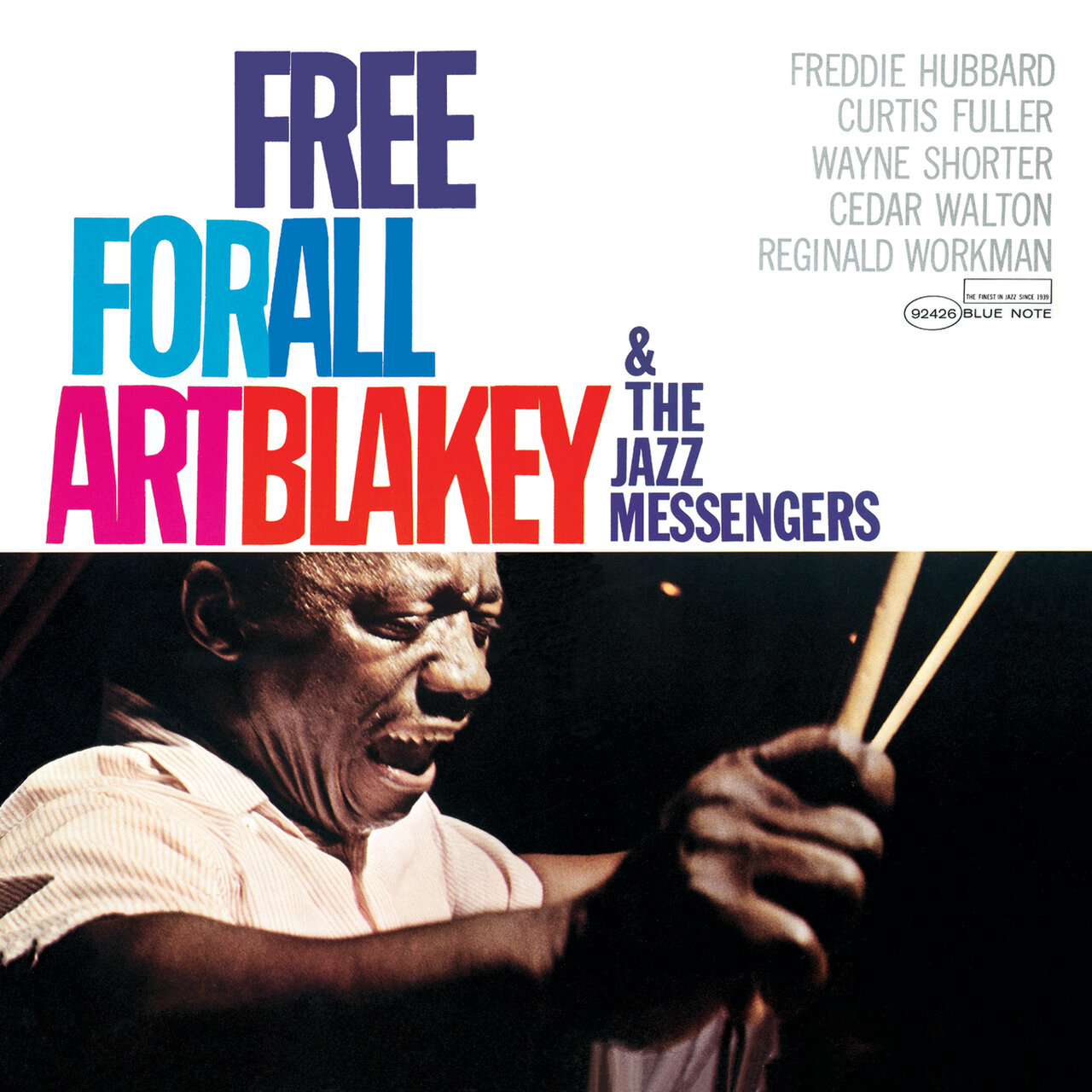
Art Blakey & The Jazz Messengers' ‘Free For All’ Gets Blue Note Classic Reissue
How does it compare to the Music Matters SRX?
The core lineup of Art Blakey’s Jazz Messengers changed regularly, but 1964 brought more drastic changes than usual. On trumpet, Freddie Hubbard had joined the Messengers on 1962’s Mosaic; he stayed until March 1964, when Lee Morgan returned. In September, tenor sax player and musical director Wayne Shorter left to join what became Miles Davis’ Second Great Quintet. Pianist Cedar Walton and bassist Reggie Workman followed in their departures, and trombonist Curtis Fuller also left shortly after. Free For All, recorded in February 1964 but released in July 1965, was the penultimate Jazz Messengers session for Blue Note, and stands as the apex of these musicians’ chemistry.
Side one features two Wayne Shorter compositions, the title track and “Hammer Head.” The latter is a perfectly fine, fairly straightforward midtempo piece, good but nothing special. “Free For All,” however, is probably the greatest 11 minutes that Art Blakey and the Jazz Messengers ever recorded, across any lineup. Shorter takes the first and longest solo, which progressively intensifies as Freddie Hubbard and Curtis Fuller occasionally layer the refrain over him. Fuller’s solo is more restrained, but by the time Hubbard gets halfway through his, it’s fully cacophonous, followed by an especially thunderous Blakey solo and concluding with Shorter and Hubbard’s abrasive final wail.
On side two, Hubbard’s “The Core” doesn’t assert itself as much as the title track does, but still has those exhilarating moments of controlled chaos when all three horns play over each other—heading towards the same direction, taking slightly different paths to get there—as Blakey moves between rhythms to contrast against the front line. Reggie Workman and Cedar Walton are the anchors of these side openers, staying composed and consistent as the others explode around them. The album ends with “Pensativa,” a slower Clare Fischer piece arranged by Hubbard, which has some nice horn harmonization, though perhaps isn’t as delicate as it should be (of course, this session couldn’t have gone all the way in the opposite direction for one song).
Sonically, Free For All is a very good sounding Rudy Van Gelder recording, but not a perfect one—it’s often blatantly in the red (there’s noticeable drum distortion), and the piano and bass are mixed low, sometimes to the point of barely being audible. That said, the stereo spread is excellent (Blakey and Shorter on the right, Hubbard and fuller on the left, and Walton and Workman in the middle), with well-established space and textural delineation, and the piano tone when you hear it is pretty good.
In 2012, Music Matters released a 2LP 45rpm Free For All cut by Kevin Gray at Cohearent Audio and pressed at RTI, followed in 2019 by a 33rpm pressing with the same specs, except pressed on Neotech VR900 premium vinyl (marketed by Music Matters as “Silent Running eXperience,” or SRX). I haven’t heard the 45, but the SRX 33 is one of the best sounding records I have. It’s appropriately bold and doesn’t hold back, yet it’s incredibly detailed and immersive. The musicians are right there and it sounds almost like tape. (That’s partly because the original VR900 compound seems to have a softer character than RTI’s normal VR100 vinyl, and more overtly imparts that character than the VR900-D2 compound, which the Because Sound Matters and Definitive Sound Series one-steps use. They also look different: VR900 is a transparent gray, like a really dark pair of sunglasses, while VR900-D2 is a frosted translucent blue-ish gray.)
Now, as Blue Note’s all-analog mass-market Classic Vinyl Series continues to supplant the digitally sourced Blue Note 75 reissues, we get another Free For All cut from the original master tape once again by Kevin Gray at Cohearent, but pressed at Optimal. It’s a new cut, and I’m not sure what upgrades Gray has made since 2019 or if he changed any EQ here, but the BN Classic is smoother, more polite, and spatially drier. Blakey’s drums don’t have the same physicality and textural detail, and Walton’s piano and Workman’s bass are less robust, though horns have more grit without sounding hard. The SRX has better dimensionality and more air, whereas the Classic is a little more forward; in some ways, the Classic sounds as if it’s a generation removed from the SRX, despite the source being the same. Plating, pressing, and vinyl formulation can make a huge sonic difference, and this is a good example.
Despite my reservations, the Blue Note Classic reissue of Free For All still sounds excellent, and some people seem to prefer it over the SRX. For the $28 retail price, the Classic is a no-brainer if you don’t already have this essential recording. If you have the SRX Free For All, you might not be replacing it with this new BN Classic, but those who don’t have any modern all-analog pressing can get the Classic and be set for life. The Music Matters SRX isn’t reasonably obtainable now: it was limited to 1500 copies, which retailed for $60 back in 2019 ($75 now adjusted for inflation), and regularly resells for $200 or more. Those aftermarket prices are probably because no one wants to sell their SRX pressings, because they’re the absolute best these albums will ever be. But the BN Classic gets you 80-85% of the way there for 14% of the current SRX price, and you might even prefer the BN Classic horn sound.
The 180g Optimal pressing for this Blue Note Classic reissue arrived slightly dish-warped with some light surface scuffs, but plays very quiet as expected. Unfortunately, though, the text colors on the front cover aren’t accurate. It’s not a major difference, but the colors are lighter and occasionally just wrong: “FREE” is supposed to be purple, except it’s dark blue on the BN Classic. Not sure how that happened. No color or resolution issues with the Blakey photo, however.