

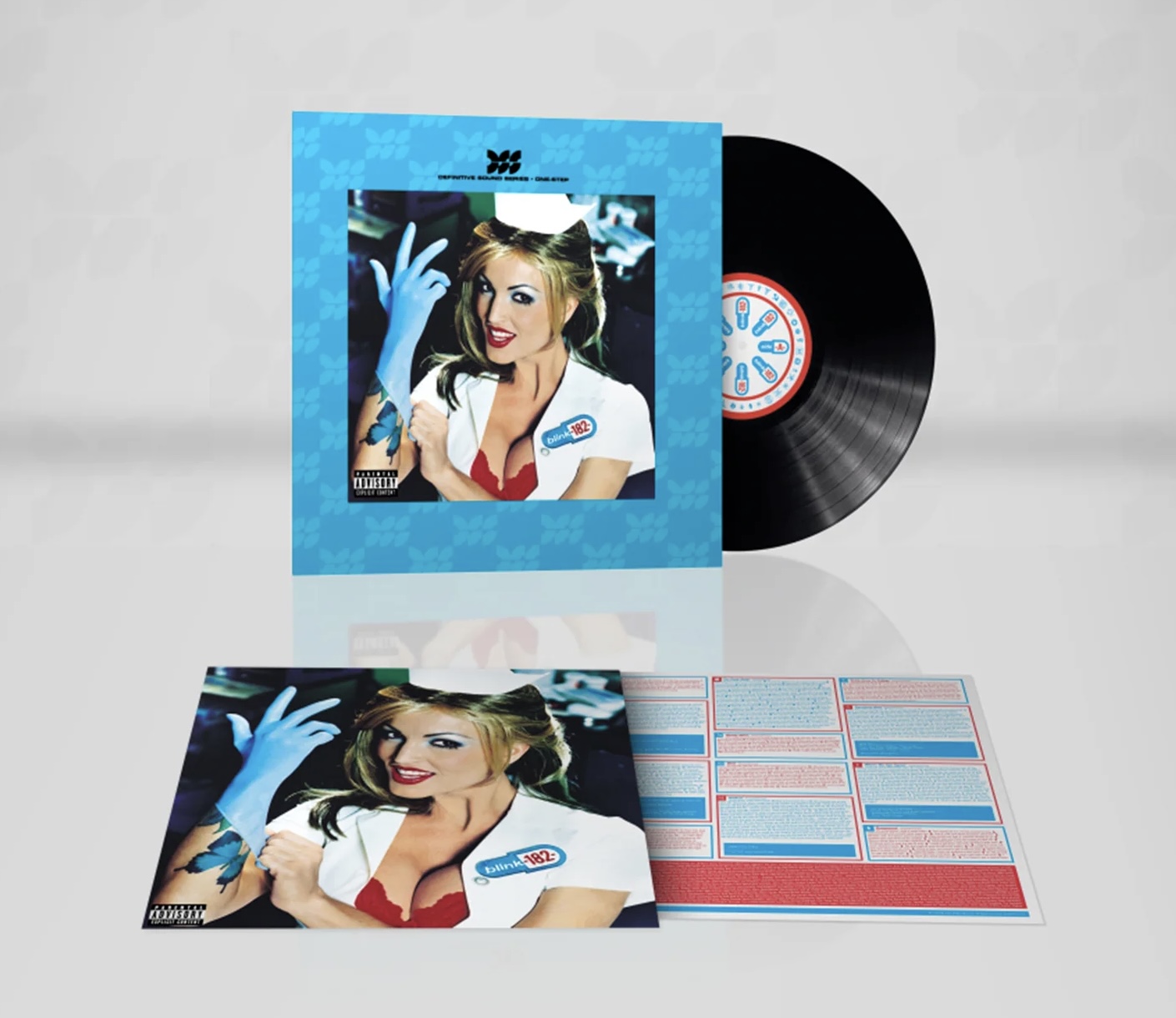
Blink-182’s ‘Enema Of The State’ Gets A Definitive Sound Series One-Step
Definitive indeed, with inherent limitations
It’s always interesting to see how bands grow up, especially a band whose younger work is as juvenile as Blink-182’s. In this case, drummer Travis Barker is now dating a Kardashian, bassist/co-frontman Mark Hoppus seems to have a fairly normal existence podcasting and working on other bands’ records, and guitarist/other co-frontman Tom DeLonge co-founded To The Stars, a company dedicated to multimedia investigation and promotion of ufology, for which he has directed films, written novels, and made concept albums inspired by secret meetings with government officials.
The first evidence of DeLonge’s UFO obsession was “Aliens Exist,” the third track from Blink-182’s world-conquering 1999 album Enema Of The State. “What if people knew that these are real/I’d leave my closet door open all night/I know the CIA would say/What you hear is all hearsay/I wish someone would tell me what was right,” goes DeLonge’s nasally drawl. But before he could sink his money into UFO research, he had to make it. Thankfully, Blink-182 was one of the biggest guitar bands of the Y2K era, inescapable on MTV, and Enema Of The State has sold 15 million copies worldwide.
Blink-182 emerged from the San Diego suburbs in the early-mid 1990s, but didn’t break through until 1997, with their first major label album Dude Ranch and its second single “Dammit.” “But everybody’s gone, and I’ve been here for too long/To face this on my own, well I guess this is growing up,” sings bassist Mark Hoppus in the chorus, marking the arrival of Blink-182 as the band for millions of pubescent teenage boys coming of age at the turn of the millennium.
A grueling tour schedule followed, including four months on the Warped Tour, followed by DeLonge and Hoppus firing original drummer Scott Raynor over his drinking problem and replacing him with Travis Barker, who’s simply a better drummer. By the end of 1998, Blink commenced work on Enema Of The State with producer Jerry Finn, known for his balance between punk power and mainstream-friendly pop polish.
Eschewing late-90s CD bloat with only 12 songs over 35 minutes, Enema Of The State arrived into a mainstream landscape ruled by the mathematical factory pop of the Backstreet Boys and Britney Spears, aggressive nu-metal bands like Limp Bizkit and Korn, and East Coast rappers like DMX and Nas. Compared to all of that, Blink-182 related to suburban teenage boys whose lives revolved around chasing girls, skateboarding and getting drunk with the bros, and the anxiety of being forced to mature soon, because that’s what Blink wrote songs about. The songs on Enema Of The State bear simple melodies, with a deliberately immature attitude. “Life just sucks, I lost the one/I’m giving up, she found someone/There’s plenty more, girls are such a drag,” goes DeLonge’s chorus on “Dysentery Gary,” which sums up the album pretty well.
Not that that’s a bad thing, though, because the songs are catchy; there’s a reason why everyone on the face of the earth has heard “All The Small Things” and “What’s My Age Again?.” And there’s still some genuine emotional depth, like Hoppus’ “Adam’s Song,” written from the perspective of a depressed young man contemplating suicide. The following year, in fact, a survivor of the Columbine shooting left “Adam’s Song” on repeat as he hanged himself in his garage at 17.
How well Enema Of The State holds up depends on how much these songs—at the very least, the hits—have been in your life, or how much fun you’re willing to let yourself have. Whether or not you were there (I was not), listening to it now is a throwback to an era when guitars were still on the radio, but with the precision (not boardroom-manufactured) of the sort of pop music emergent then and still sort of dominant now. Generally, prime Blink survives better than many of their contemporaries because they mastered such a specific approach that resonates with a specific audience that never fully fades away—there are new teenagers every year. The following record, 2001’s Take Off Your Pants And Jacket, is just as good (arguably better), but this is the one that captures not only the style, but the specific moment in cultural time when it mattered to so many.
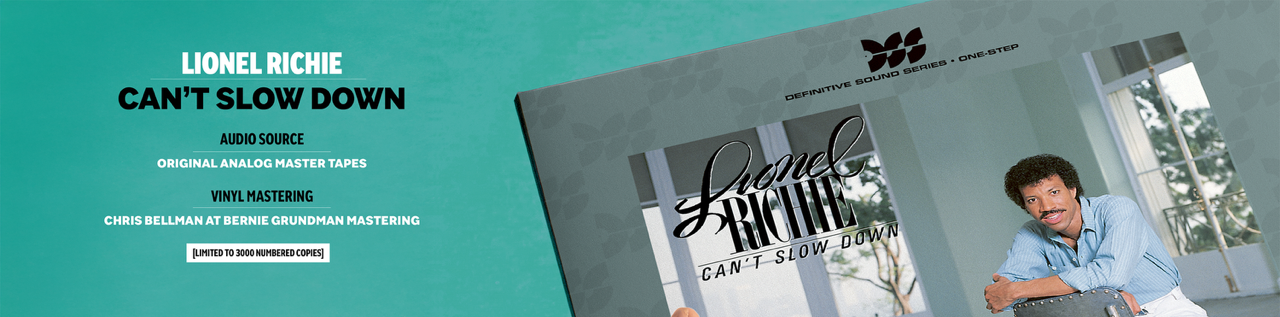
Enema Of The State wasn’t released on vinyl until its 10th anniversary in 2009, though it was finished on tape and the mixes were assembled into sides A and B cutting masters. Those fully assembled 1/2” 30ips flat masters have never been used for disc cutting until this Definitive Sound Series one-step cut by Chris Bellman, limited to 3000 copies pressed at RTI on Neotech VR900-D2 premium vinyl. All previous editions, including the 2016 SRC audiophile pressing cut by Kevin Gray, have been sourced from digital files.
So far, Warner’s Because Sound Matters and Interscope/Capitol's Definitive Sound Series one-steps, produced by Tom “Grover” Biery, have all lived up to the latter series’ name—they are the definitive pressings of their respective albums. However, some are bigger leaps than others, considering some recordings have inherent sonic limitations and others already have great existing pressings. This one-step Enema Of The State is indeed definitive, though it’s still a sterile sounding mix without much depth. That’s just what this album sounds like, and Chris Bellman more or less cut what was on the tape without trying to add “texture” or “richness” or “space” that isn’t and shouldn’t be there.
I don’t have any LP pressings to compare, but I compared the DSS one-step with the original CD master by Brian Gardner at Bernie Grundman Mastering, and an anonymous 96kHz/24bit digital remaster unceremoniously dumped out in 2020. The original CD is a bit glassy, but is nicely shaped and controlled. Meanwhile, the 96/24 remaster is a cleaner and smoother transfer, but drums get lost in the lower midrange sludge and whoever churned it out botched the track indexing. Chris Bellman’s EQ on the one-step strikes the perfect balance between clarity and weight, and while it’s still a bass-shy mix, there’s more bass than both digital masters. The real highlight is Travis Barker’s drums, which cut through with muscularity, and the digital masters can’t approach his cymbals’ physicality and natural decay on the one-step.
Generally, the one-step offers some dynamic upgrade, but mostly in little microdynamic details rather than the overall picture, because these mixes were already slammed on the tapes. “Mutt” is the most notable dynamic improvement, but despite not having the digital masters’ peak limiting/clipping, Enema Of The State is the least dynamic of the Definitive Sound Series or Because Sound Matters one-steps. That’s simply what this album is, and the one-step is a responsibly faithful presentation.
What’s interesting is that, while Enema Of The State was tracked analog and finished on 1/2” 30ips tape, the majority of the album mixed by Tom Lord-Alge has a cutoff around 22kHz, which means that it passed through some sort of digital before being mixed or printed to analog tape. I can’t find any information on what it was or why it’s there (some sources claim Lord-Alge used MIDI sample triggers for some of Barker’s drums), but the digital step back in 1999 isn’t exactly the reason for the album’s sound. “The Party Song” and “Wendy Clear,” the two songs mixed by producer Jerry Finn, go above 22kHz on the 96/24 remaster, so those were all-analog. Those mixes are just as dry and sterile as Lord-Alge’s mixes on the rest of the album, and despite being fully analog are actually cloudier with less articulation and punch.
All things considered, the Definitive Sound Series one-step of Enema Of The State is the best the album will ever sound, between Bellman’s balanced EQ and the beautiful black backgrounds of the Neotech VR900-D2 vinyl. The packaging by GPA Global is also appropriately deluxe: a matte tip-on gatefold (with the Parental Advisory label still there as needed for an album from 1999), a single sheet lyrics and credits insert (which I wish was printed on thicker stock for such a deluxe product—especially in this case, since there’s no “original pressing” to replicate), a DSS certificate of authenticity, and a spot-varnished outer slipcase. Some people hate these one-step slipcases, but I think they’re fittingly luxurious without obnoxiously taking up too much space. Whether or not this one-step is worth $100 depends on how much you like this album and how good your system is. Is it better than the recent commercial pressings done fully in-house at GZ, Connectiv, or Takt Direct? Inevitably yes. Is it a demonstration quality record that reveals revelatory new sonic detail? No, but it’d be the last copy of Enema Of The State (as the core album, at least) that you’d ever have to buy. For hardcore fans or nostalgists, that’s probably worth it. For more traditional audiophile types, keep your expectations in check but approach with curiosity.