

Cream at Royal Albert Hall, 2005, 20(ish) Years Later
or, "In Defense of the Aging Musician"
It’s funny to think of old, professor-type dudes in internet slop echo-chambers dictating what supposedly is and isn’t “rock-and-roll,” when age is antithetical to the “rock-and-roll” ideal itself. When Grace Slick retired from music, she declared, “All rock-and-rollers over the age of fifty look stupid and should retire.” Grace’s statement is faced with an immediate conundrum: the aging rock star. If these guys really look as dumb as she says they do on their reunion-farewell-reunion-farewell for real this time! tours (...okay, that cycle is pretty dumb,) then why do we pay to see it?
“Rock-and-roll’s first supergroup” were always a tempestuous combo. Fist-fights and panic attacks and Robert Stigwood, oh my! Cream weren’t meant to last into the seventies – and it’s a miracle two out of the three lasted into their seventies. When Cream booked reunion gigs at the Royal Albert Hall, the hallowed ground of their farewell concert, the announcement was met with baited breath. Would they actually go through with it? Could they get through a show without Ginger Baker cracking someone over the head with his cane? One could ask what Cream’s music would sound like as played by graying dads and grand-dads, but you can easily answer that question for yourself by dropping in on your uncle’s weekend cover band. The real question was: what would Cream’s music sound like when Cream themselves are the graying dads?
If there were any year for Eric Clapton, Jack Bruce, and Ginger Baker to set their differences aside and give the people what they wanted, it was 2005. Sixties nostalgia was in full-swing; The Who hit the road again, Roger Waters reunited with Pink Floyd for Live 8, and the Rolling Stones played the Super Bowl Halftime Show.
Now, the Royal Albert Hall reunion live album is reissued for its 20th anniversary. The classic rock nostalgia cycle continues.
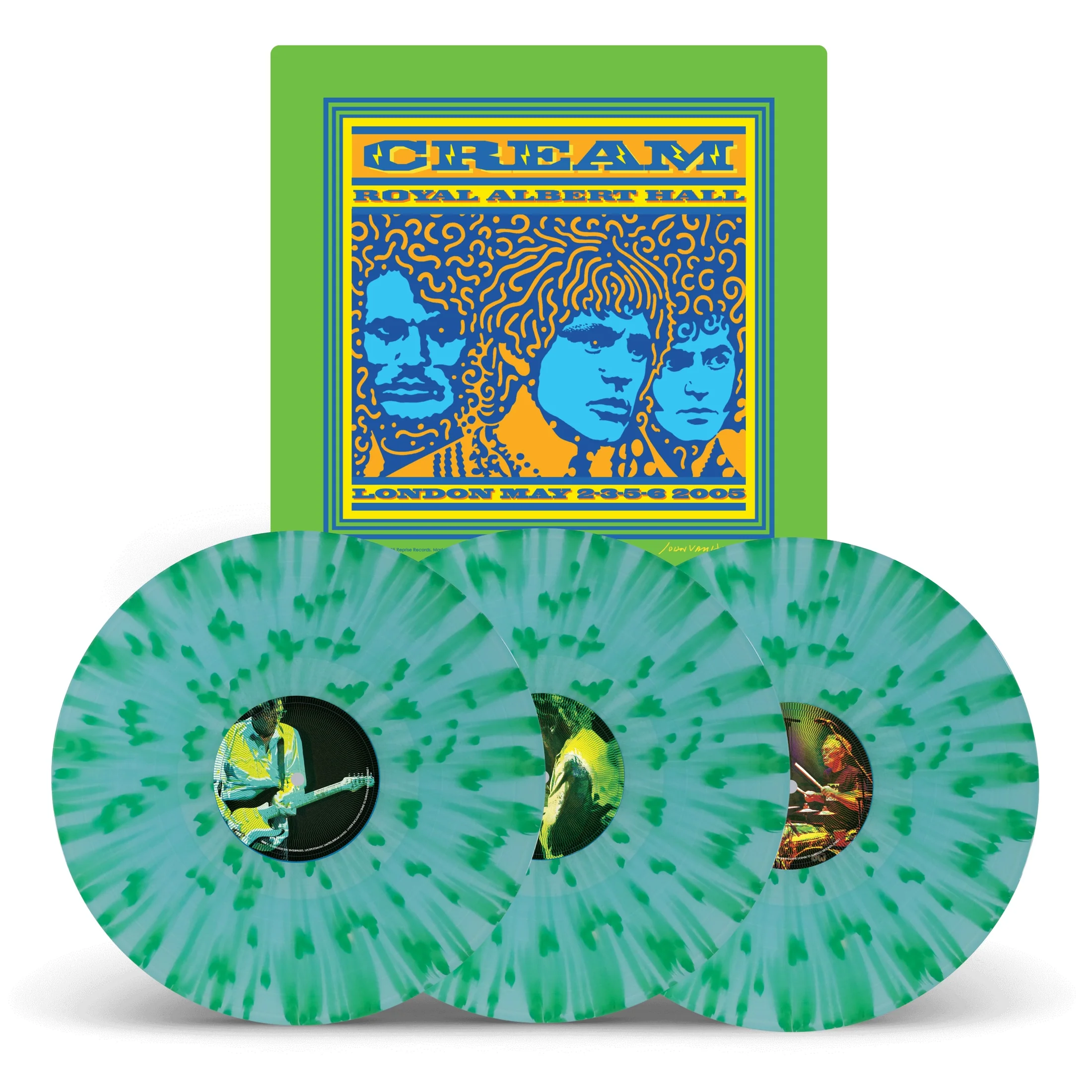
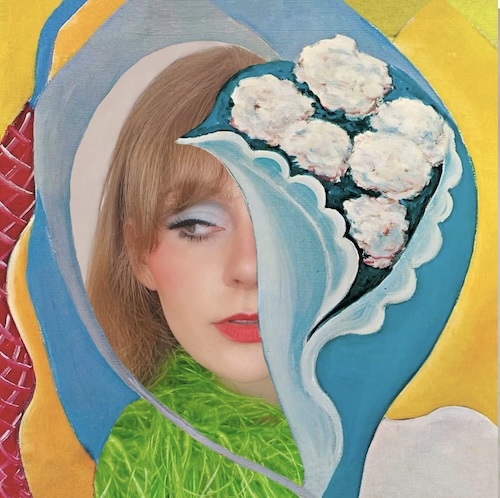
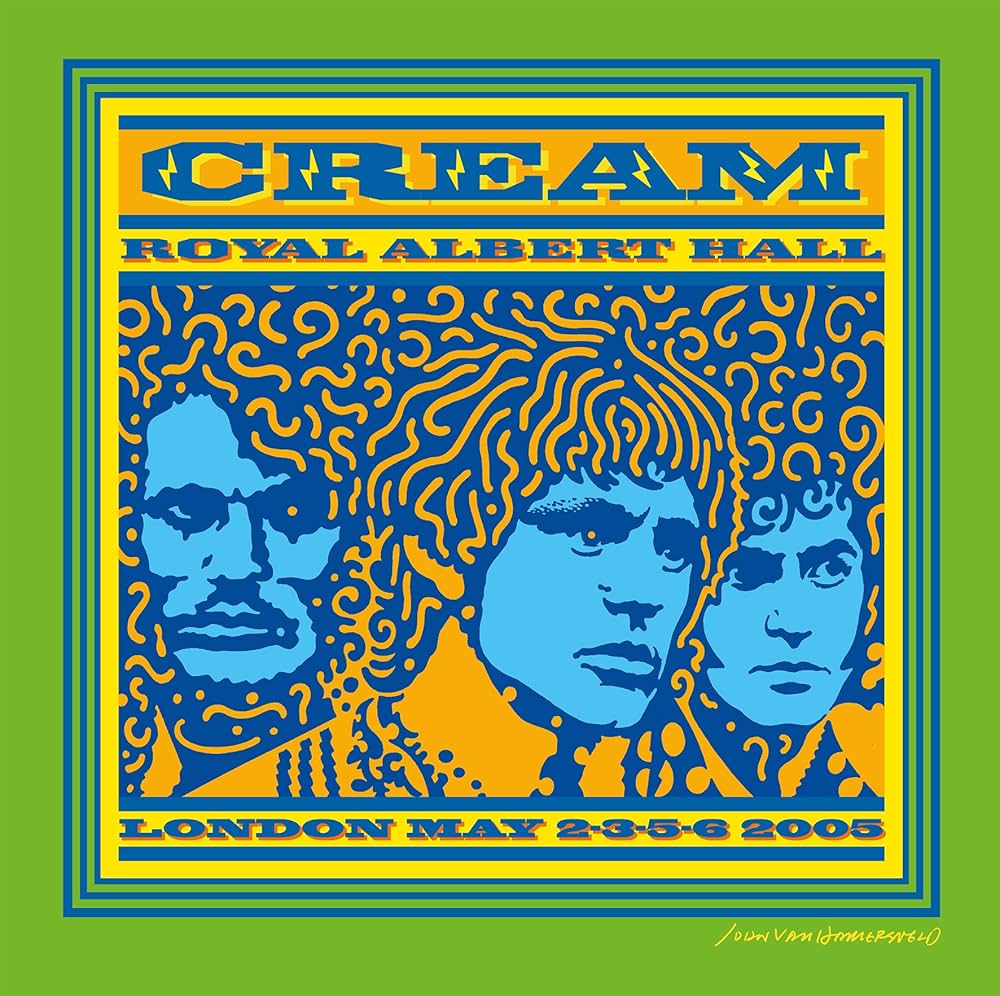
Fresh Cream, Disraeli Gears, and Wheels of Fire were the stuff of legend; a rock-solid three-album run other bands would’ve eaten their own paisley shirts for. The same went for their album art, all sumptuous psychedelic confections. The design team of this Royal Albert Hall release, consisting of illustrator John Van Hammersvied, photographers Jill Furmanovsky and Stuart Nicholls, and designer Huberto Howard, hit it out of the park. The colors are vibrant, the line work bold, the text inventive, and references to iconic psychedelic posters are intentional and clear. The packaging of this reissue is sturdy, and the mixture of matte and gloss on the front cover is a textural detail. This could absolutely stand up to the day-glo work of Martin Sharp.
Cream's studio albums didn't sound as vibrant as they looked or felt. Stereo was still in its infancy in the Summer of Love, and recording technology on both sides of the pond just hadn’t caught up to what groups like Cream were doing. Then you’d have Felix Pappalardi shoving the drums all the way into the right channel. This choice degraded Ginger’s powerful drumming; with emphasis on toms and cymbals as opposed to snare. I hoped a clean, polished live recording of Cream (and a more apt producer) would yield a more satisfying experience than their studio catalog. Thrilling as the Royal Albert Hall highlights are, the one thing Cream were best-known for in the sixties was missing. Producer Simon Climie sacrificed Cream’s obnoxious volume for a cleaned-up recording, perhaps to align with Eric’s refined wah-wah-less playing style. The power of Jack Bruce’s bass suffers, and the audience's cheering is too prominent. I’m sorry to say the sound of this anniversary edition fails to fill a room. Given the big names attached to this release – Bob Ludwig, Alan Douglas – this was disappointing. “Anemic” should not come to mind with Cream.
There’s a fine line to navigate with any band’s reunion set list. Too many deep cuts and it’s self-indulgent, too many singles and you might as well stay home and listen to the Greatest Hits albums. The Royal Albert Hall set lists had an appropriate balance. There are just the right amount of hits: “I’m So Glad,” “White Room,” “Sunshine of Your Love,” and of course “Crossroads.” No self-respecting Cream set was without “Toad,” and Ginger’s 10-minute athletic display further cements his status as one of the greatest rock-and-roll drummers to ever do it – as if he ever needed to prove that. Evident across the whole album, his skill only improved with age.
It’s also terrific to hear personal favorites that hadn’t made it into Cream sets during their original run. As a joint Fresh Cream-Wheels of Fire girlie, I love that “Sleepy Time Time,” “NSU,” “Pressed Rat and Warthog” (with Ginger battling his own thick accent to announce the namesake shop’s reopening,) and my all-time favorite “Deserted Cities of the Heart” made the cut. “Deserted Cities” is just as doomed and beautiful as it is on record. But there were some glaring omissions. I understand why the guys didn’t dust off “Tales of Brave Ulysses” – it’s literally “White Room.” Leaving out “I Feel Free” and “Strange Brew” remains confounding. Cream’s material got a little freshening up for the special occasion. They debuted a live version of the Clapton-George Harrison composition “Badge,” and added T-Bone Walker’s “Stormy Monday,” if the latter is drowsy.
One of the greatest successes of Royal Albert Hall was Cream’s revisiting of “Outside Woman Blues.” Eric’s playing sounds stiff compared to the youthful bravado of the studio recording, but his vocals retain that confidence. And hey, at least the guys weren’t dragging miles behind the song’s original tempo. “Politician” is a greasy, slinky triumph. The one audience member very audibly shouting “YEAH!!” did so on all our behalf. I’ve always preferred this performance of “We’re Going Wrong.” The song sounds better when it’s louder and heavier, and when Jack’s vocals got shouty. The guys allowed the song’s inherent storminess to brew; Ginger’s drumming anxiously circles around itself. He’s the centrifugal force, spiraling like a failing marriage. Is it the calm before the storm, or the barren wasteland after the fight?
Cream’s greatest strength was also their weakness: they had no ground wire. The other great power trio of the sixties, the Jimi Hendrix Experience, had two adventurous soloists. Ground wire Noel Redding never strayed far from the path, giving the other two a place to return to. Cream were three virtuosos soloing at once. Sometimes it was awesome. Other times, it became claustrophobic mush. Cream always had difficult personal relationships with each other; not helped by the looming presence of Stigwood, and Ahmet Ertegun trying to shove Eric into the frontman slot. For a trio, there were a whole lot of cooks in the kitchen, and sometimes they curdled the Cream.
Eric and Jack don’t always land their harmonies. It’s understandable, considering decades had passed since either had to play second fiddle. The guys’ rock-star egos seem to have tempered; what once boiled over with three soloing on top of each other now simmers at expert interplay. These shows proved Cream’s legendary chemistry was muscle memory, but the isolated experience of the album proves something’s lost without the visual element.
I will always defend Jack’s voice. It wasn’t a traditionally “blues” voice, but its folksy, androgynous quality made Cream special among the rest of the sixties white-boy blues craze. He opted out of most high notes come 2005 (he handed some “White Room” falsetto off to Eric,) but Jack’s preservation of his voice was remarkable. What he could not save augments the blues; a little rougher around the edges.
None of the hits had much life left in them; “Sunshine” and “White Room” being the greatest disappointments. Jack’s harmonica rooting-and-tooting on “Rolling and Tumbling” was self-indulgent in Cream’s day, and it was self-indulgent 40 years on. I simply prefer him on bass (and am grateful they skipped over an even worse offense, “Traintime.”) By slowing “Crossroads” down, it lost its thrill. A lot of this material slowed down without the chemical element, actually. Eric has certainly earned his “Slowhand” monicker since the nineties.
When I find myself frustrated, feeling that someone stuck their finger in Cream’s spool, I remind myself of this: rock-and-roll came from the blues in the first place. The blues are a way to cope with the worst of what life has to offer. My boss sucks, my wife left me, I’m broke. My wife left me for my boss because I’m broke. When it rains, it pours, and life has a funny way of slowing the worst parts down so we’re forced to feel it all. Bluesplayers tend to have lived through plenty of the worst. That wisdom comes with age: Muddy Waters was 30 when he recorded his first album, Lightnin’ Hopkins was 34. Both were ancient by rock-and-roll standards. As young white musicians discovered the blues for themselves, it was absorbed into rock-and-roll’s DNA. And until those pesky professor-types barged in, rock-and-roll was an economy built on youth. Young people made the music about their wacked-out hormones, and young people bought the records to make sense of them.
Everybody has to grow up sometime. Either you’re singing the blues or you’re the uncle in the cover band. Sometimes, you’re both. If you’re truly passionate about what you do, you deserve to exercise that passion for as long as you can. As an artist, that’s your birthright. If you’ve been lucky enough to build a career out of that passion, your health and finances allow you to get the band back together, if slowed-down this time, and you’re still around for that live album’s rerelease 20 years later? Why not? Cream at Royal Albert Hall shows us that being an aging rock star isn’t a punishment or a grift. It’s a gift.