
Elvin Jones' 1968 Piano-less Trio Album on Blue Note Vinyl
...and its forgotten great reedman, Joe Farrell
When the audiophile houses started reissuing Blue Note jazz albums on vinyl (Classic Records in the late 1990s, Analogue Productions and Music Matters Jazz 20 years later, a decade after Classic had gone out of business), they focused almost exclusively on the storied label’s mainstream titles from the 1950s and early ‘60s, by the likes of Horace Silver, Hank Mobley, Donald Byrd, Dexter Gordon, early Sonny Rollins and Miles Davis, and, of course, John Coltrane’s sole Blue Note release in his lifetime, the immensely popular Blue Train. I remember wondering, in a 2018 Stereophile blog post, just how many copies of Blue Train a jazz fan needed to have.
Only in the last few years has the reincarnated Blue Note label itself—through its Classic Vinyl and Tone Poet series—started repolishing its gems from the mid-to-late 1960s, albums much-revered by modern jazz fans but otherwise largely unknown, in part because of the fading appeal of jazz generally in the wake of the Beatles’ electric invasion, but more because much of Blue Note’s jazz in this era was avant-garde. Yet, perhaps because some of its strands have been adopted by some of today’s more inventive rock artists, many of these albums—by the likes of Andrew Hill, Don Cherry, Eric Dolphy, Grachan Moncur III, and Ornette Coleman (in the form of a six-LP boxed-set containing all of his Blue Note albums, most of them more “out” than his breakthrough albums, a few years earlier, on Atlantic)—have sold quite well: not as well as the Mobleys, Silvers, or Blue Train, but still impressively.
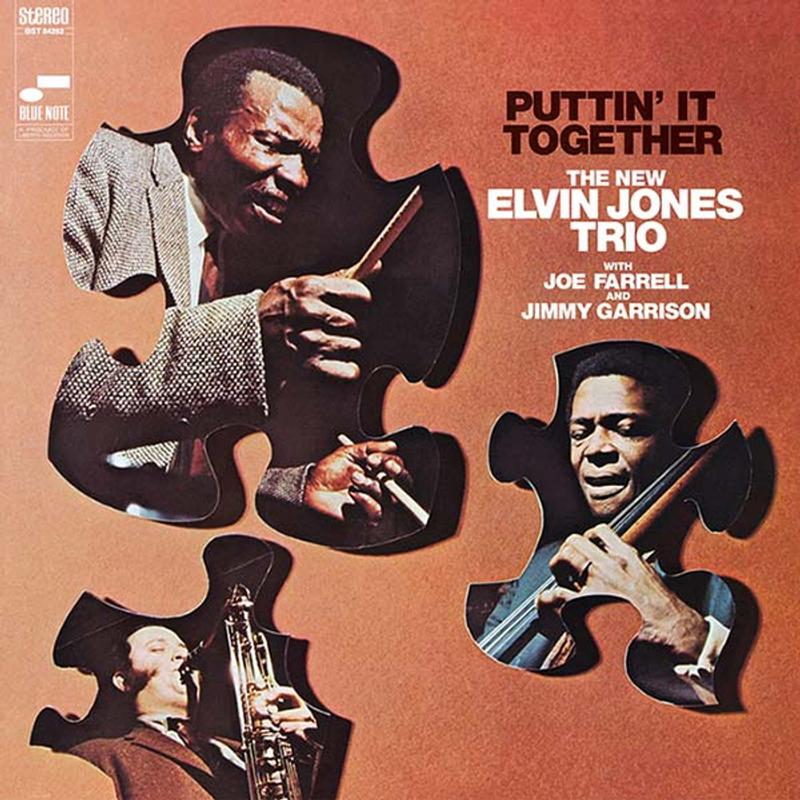
One of the latest of these reissues, on the Classic Vinyl series, is an album that I’d never heard—in fact, had never heard of: drummer Elvin Jones’ Puttin’ It Together, featuring Jimmy Garrison on bass and Joe Farrell on reeds, recorded in April 1968 and first released five months later.
Like jazz generally, Blue Note was in eclipse at the time. Two years earlier, the label—for its entire history, a genuine indie—was bought by Liberty Records, prompting its founder, Alfred Lion, to retire. Soon after, Liberty would be acquired by Transamerica Corp., a holding company that merged with United Artists. It dwindled to almost entirely a reissue house through the '70s, reemerging as an active new-and-old jazz label only in the mid-'80s.
Still, it’s surprising that this album was, and remains, so little known, and not just to me. (It’s been out of the print in the U.S. for several years, until now.) Jones and Garrison had been bandmates in John Coltrane’s “classic quartet” all through the early-to-mid ‘60s. This was their first studio album, together or apart, since Coltrane died in July 1967. The band was an ensemble—piano-less trio—new to both. Finally, it’s a really good album. And, as Blue Note sessions were still recorded at Rudy Van Gelder’s studio, it’s also (with one caveat) a very good-sounding album.
Before we get to the album’s music and sound, let’s plumb a bit into why it’s not better known. A big reason might be the horn man on the date, Joe Farrell—a name that probably drew a blank when your eyes flitted by it three paragraphs ago. From 1960 until his death from cancer in 1986, at the age of 48, Farrell played on almost 100 albums, 18 of them as a leader or co-leader. And he was a terrific player, comparable to Joe Henderson, with a big tone and fleet dexterity, adept at blues, swing, ballads, and Coltrane-ish sheets of sound. (It’s telling that Jones picked Farrell to play sax in his first post-Coltrane trio. Nor was the collaboration a one-off. The trio recorded a second album, The Ultimate, also on Blue Note; and Jones led four subsequent dates with Farrell as one of a few horn players.)
But many hard-core jazz fans looked down on Farrell at the time because he played on pop albums—lots of them. Certain jazz fans, especially those keen on hard-bop and avant-garde jazz, have long been leery of musicians who stray too deeply into pop, and Farrell strayed very deeply, not just into the jazz-rock fusion of Billy Cobham and Return to Forever, but mainstream Top 40 pop-pop—playing on albums by Average White Band, the Bee Gees, Hall & Oates, Carly Simon, and the Rascals. Farrell was very successful in this line; some of these albums were good for what they were, and his solos were diverting (non-jazz fans, who have never heard of Elvin Jones, much less Joe Farrell, would recognize them). But as a result, the critic Gary Giddins recently told me, Farrell “lost the jazz audience.” (Giddins recalls going to see the Jones-Garrison-Farrell trio the night they opened at Pookie’s Pub, a small club in Lower Manhattan, near the Holland Tunnel, where Jones led a variety of bands, over a period of several months, in the late ‘60s. The place, normally fairly packed, was almost empty that night.)
Nonetheless, Farrell remained a “musician’s musician,” recruited by a wide range of unimpeachably true- blue jazz leaders—not only Elvin Jones but Charles Mingus, Jaki Byard, Johnny Hodges, Freddie Hubbard, Andrew Hill, and Lee Konitz, among others. Farrell also kept his jazz chops strong in between the pop-studio dates. (This isn’t easy. When Branford Marsalis went on tour with Sting for more than a year in the mid-‘80s, he had lots of fun and made heaps of money, but, as he said afterward, it took him at least that long to build back his jazz instincts and timing.)
Finally, Jones might have done Farrell no favor by billing him as a Coltrane-successor. Though Farrell could play Coltrane’s style of music in Coltrane’s style, he couldn’t hit Coltrane’s peaks, and putting him in a nowhere-to-hide trio where comparisons were invited and therefore inevitable, he fell short.
Which leads us back to Puttin’ It Together (which, besides all this, has a pretty lame title and sports an even lamer jigsaw-puzzle cover). Lay aside the backstory, don’t compare what you’re hearing to a Coltrane album (how many jazz albums, by anybody, could pass that test?), and I think you’ll enjoy it a lot. Jones, as always, propels the music in all directions (or as many as he wants to steer it) all at once. Garrison lays down anchors, time-tracks, chord roots, arpeggios, counterpoints, turnarounds, bass walks, speed bumps, express lanes—whatever the music needs. And Farrell carries the improv melodies—storm centers of blue notes, scales, arpeggios, and sometimes pulses of pure energy: all in pure hard tones (no squawks or multiphonics).
The sound is excellent late-’60s Rudy Van Gelder, which is to say the balance is poised, the ride-cymbal crisp, the tom-toms eye-blinking, the bass-plucks clear and plucky, the horn brassy. The caveat is an absence of air. I don’t know exactly when RVG rearranged his New Jersey home-studio from an open space to a series of isolation booths, or shifted from two-channel to multi-channel mixing, but it was around this time, and Puttin’ It Together might have been an early product of the transition. (I don’t know; Rudy was secretive when it came to such matters.) Compare it with Tony Williams’ Spring, a similar album both in its quasi-free style and its minimalist ensemble (though Spring also had a piano), which RVG laid down in 1965, still in the days of one room, two channels, and bushels of air. By comparison, Jones’ drumkit, especially the bass drum, is a bit smeared; Farrell’s sax sounds a bit hemmed-in. Still, heard on its own, this is a fine-sounding, as well as a fine, album—lively and brash, worth getting to know well.