
Frank Sinatra's "Songs for Swingin' Lovers": Comin' On, Hangin' On, Movin' On
Sinatra's classic concept album of romantic dance songs with jazz arrangements by Nelson Riddle Gets the deluxe Tone Poet Treatment in Blue Note's latest vinyl remastering.
Songs for Swingin’ Lovers is the second in Blue Note’s Tone Poet series of new vinyl remasterings that I hope will eventually include all sixteen concept albums for Capitol Records that Frank Sinatra recorded between 1953 and 1962. His fourth album[1] after signing with the label in 1953, it followed Songs for Young Lovers and Swing Easy! (both 1954) and In the Wee Small Hours (1955). Like Wee Small Hours, it became a landmark in Sinatra’s career as entertainer, singer, and artist, though for different reasons. His first two albums for Capitol generated solid sales, charting on Billboard, and were critically well received; his third, Wee Small Hours, was an immense success both critically and commercially and soon achieved the classic status it enjoys to this day. Great as it is, though, it too is an album of ballads, his mastery over which was never in dispute, and at the time it still left unanswered two nagging questions that dogged his career from its beginnings: Could he swing? Was he a jazz singer?
Unanswered but not untested. None of the five studio albums Sinatra made for Columbia between 1946 and 1950 contained up-tempo songs, so in 1950 he recorded an album that would provide the test: Sing and Dance with Frank Sinatra, his last for the label, was designed to prove he could swing as well as—hell, better than—the best of them—and it did, triumphantly. Trouble was, nobody noticed. It sold poorly and didn’t receive its proper critical recognition until decades later. But with the power he’d acquired after the stellar success of Wee Small Hours, he decided his next album for Capitol would consist in up-tempo dance music in the style of swinging jazz. Dance parties were all the rage in the fifties, especially once the 12-inch long-playing record took over: all of sudden close to an hour’s worth of dancing was possible, interrupted by only a single flip of a side.
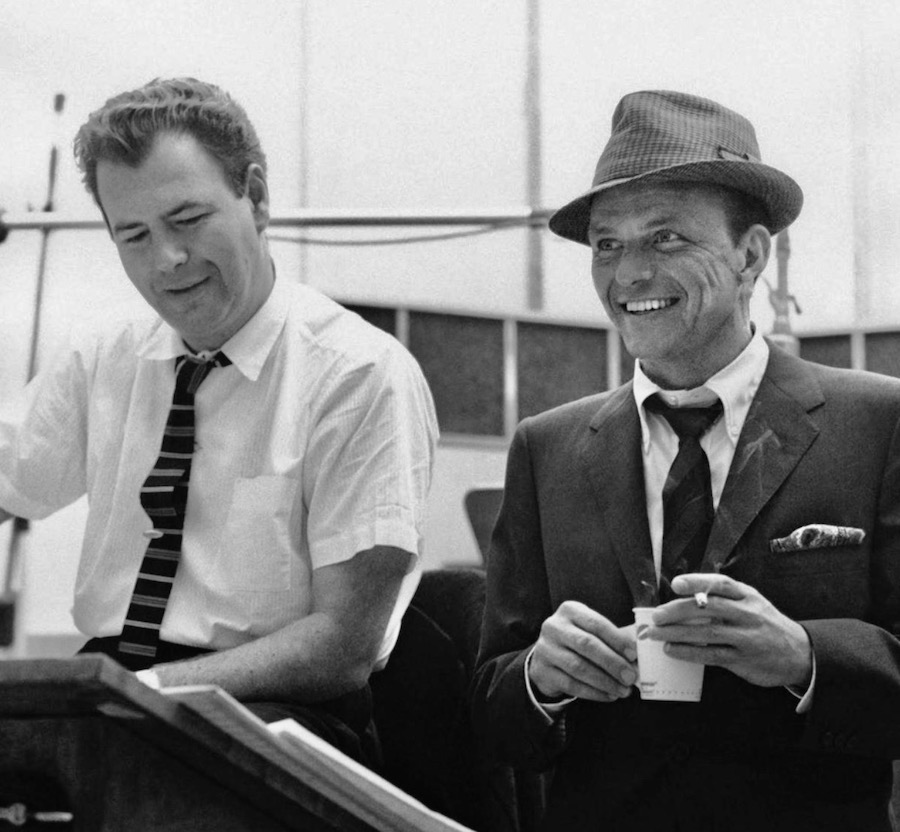 A light moment between the greatest singer of the Great American Songbook and its greatest arranger
While there is no evidence Sinatra encountered any resistance at Capitol for his decision, the album was by no means a slam dunk. For one thing, despite Riddle’s having conducted Young Lovers, arranged most and conducted all of Swing Easy!, and both arranged and conducted Wee Small Hours, the Sinatra/Riddle relationship was still in its wary stage, neither man ever quick to put complete trust in a new colleague. For another, while Wee Small Hours is by any measure a masterpiece on every conceivable level, it is still ballads only. Who could be sure the lightning of the new partnership would strike again given the kind of material that had failed to chart five years earlier? Yet strike again it did, gloriously, then again and again and again, peaking second place on the Billboard 200 and the first-ever number one album on the United Kingdom’s Albums Chart. In tandem with Wee Small Hours it initiated a three-year period during which the greatest popular singer of the Great American Songbook and its greatest arranger collaborated on five Concept albums, each one a masterpiece of conceptualizing a collection of songs around a unified theme, idea, mood, even narrative, not to mention performances of peerless singing, interpreting, scoring, and playing. It was so successful that Sinatra, Riddle, and Capitol wasted no time recording a companion collection, A Swingin’ Affair, released within a year of Swingin’ Lovers.
Songs for Swingin’ Lovers! also has a historical significance beyond cementing the creative partnership of Frank Sinatra and Nelson Riddle. In his critical study of Sinatra and his principal arrangers, Will Friedwald writes, “Before 1955, a love song was a love song and a rhythm number was generally something quasi-nonsensical.”[2] But Swingin’ Lovers! “changed the whole paradigm of pop” by proving “that a song could be a swinging jazz number and still be full of passion and eroticism, that these factors could work together instead of cancelling each other out.” And for the Sinatra biographer James Kaplan, Swingin’ Lovers is “dance music of the hippiest kind: swinging, infectious, supremely listenable. Rock ‘n’ Roll might have been on its way—1956 was the year it would land like a falling grand piano—but its appeal at first was merely visceral and primitive. Sinatra and Riddle had visceral and sophisticated in a way that would last.”[3] Though Sinatra’s tolerance for Rock was at best mixed, at worst negative, he was relatively unusual among popular singers of his generation in maintaining his superstar presence and status throughout the so-called “Rock ‘n’ Roll Revolution” of the fifties to the nineties.
Songs for Swingin’ Lovers: the Concept
There are certain singers whose musicmaking is so personal they virtually invite viewing their ongoing and collective work as comprising a kind of artistic autobiography, very much as, say, film critics and serious filmgoers view the work of auteur directors. This is particularly true of popular singers who have developed any kind of distinctive voice or style and reach a certain celebrity status. Even though Frank Sinatra never wrote any music, he is the poster child for the singer as auteur and indisputably a great “personal” singer. As I’ve observed elsewhere, for which I claim no originality, Sinatra’s life infused or was otherwise reflected in or refracted through his music, primarily his albums. Not literally, of course, or directly autobiographically (though there are many instances of unusually intimate contiguity), but what was going on in his life emotionally and psychologically certainly fueled and fired his art, at times to an almost private degree, and significantly determined the material that went into his albums, never more so than in his best Concept albums for Capitol and Reprise.
In the Wee Small Hours, Sinatra’s, and Riddle’s, first fully realized Concept album, is a collection of songs about recovering from the heartbreak of affairs, romances, or relationships that ended with the protagonist—like the great lieder cycles of the nineteenth century, all Sinatra’s Concept albums have a protagonist through whose point of the view the songs are sung—having been jilted, betrayed, abandoned, the dominant emotions some form of grief, sadness, and melancholy. (Sinatra more than once called it his “Ava” album, referring to his passionate/tortured relationship and marriage to Ava Gardner.) “Musically speaking, In the Wee Small Hours was about closure, saying goodbye, farewell, an amen to the dire nosedive period of the early 1950s,” argues Friedwald, convincingly, and it paved the way for “the real, full-length statement of rebirth” that became Songs for Swingin’ Lovers!, which “opened with the ultimate song about fresh beginnings”: “You Make Me Feel So Young”.
Now there’s an intriguing pair of metaphors: “rebirth,” “fresh beginnings.” Appropriate too—up to a point, the point being that rebirths never entirely shed the person who was there before and beginnings are rarely completely fresh or wholly new. Just a year shy of forty, Sinatra was no youngster when he recorded this album. No doubt high on achievement after winning the Best Supporting Actor Oscar for "From Here to Eternity", the fabulous success of Wee Small Hours and the substantial successes of the first two Capitol albums, being back in demand again as singer, actor, and entertainer, he was surely feeling as youthful as the song suggests and eager to embrace a new life. But Sinatra was also a complex, complicated man. Almost everyone who knew him well, let alone intimately, knew that any given characteristic, personality trait, attitude, feeling, or behavior was typically counterbalanced by its opposite, or any number in between, and he could switch in the blink of an eye.
While his Concept albums are typically uniform in mood, tone, and style, there’s considerable variety within the uniformity and they are thus richer and more layered than they might appear, including even the lighthearted ones. Heard as a whole, and attended to carefully, Swingin’ Lovers is no different. Take “You Make Me Feel So Young,” (m: Josef Myrow, l: Mack Gordon), surely one of the best songs ever written about the rejuvenating effects of falling in love:
You make me feel so young
You make me feel so spring has sprung
And every time I see you grin
I'm such a happy individual
In and of itself, the meaning couldn’t be clearer, the emotional affect simpler. Yet it’s not by itself, the whole point of Concept albums for Sinatra being that association, context, and interpretation shade, determine, even alter meaning.
As deployed here, this song kicks off a group of songs that, for all their evident brash, breeze, and bounce, puts me in mind of a talk I heard many years ago by a psychologist, whose name I cannot recall, who at one point said, “Sex addicts come on, relationship addicts hang on, romance addicts move on.” You don’t have to read very far into any Sinatra biography before you realize that he was beset by each of these addictions, often at the same time or in tandem. Songs for Swingin’ Lovers is an album about a serial romantic who falls in love far too often far too easily and never realizes that what he’s really falling in love with is the euphoric high of the act of falling in love, which Lorenz Hart in his famous song with Richard Rodgers calls make-believe.[4] The lovers differ, the pattern remains the same, the euphoria is the drug. A song about being so much in love you and your lover cavort “like a couple of tots/Running across the meadow/Picking up lots of forget-me-nots” is the perfect, indeed the necessary setup for the songs that follow it, and the songs that follow complexify the surface innocence.
Next up is “It Happened in Monterey” (m: Mabel Wayne, l: Billy Rose), where the romance of “Feel So Young” is evidently over because, tempted by “luscious lips as red as wine,” our man “left her and threw away the key to paradise”: “My indiscreet heart/Longs for the sweetheart/That I left in old Monterey.” It’s ambiguous whether the luscious lips belong to the woman he left or the woman for whom he did the leaving—my reading opts for the latter, but the song works, the meaning the same, either way. The key to paradise introduces a recurrent technique throughout several of the songs: hyperbole as idealization of past loves or the romances themselves, beginning with the next song. “You’re Getting to Be a Habit with Me” (m: Harry Warren, l: Al Dubin) makes explicit the links to addiction: “Every kiss, every hug/Seems to act just like a drug”; “I'm addicted to your charms”; “You've got me in your clutches and I can't break free/ . . . I couldn't do without my supply.”
Hyperbole also informs the next song, “You Brought a New Kind of Love to Me” (m: Sammy Fain, l: Irving Kahal, Pierre Norman), where nightingales would sing much sweeter if they could sing like her, while he casts himself as “the slave,” her “the queen.” And it positively rules “Too Marvelous for Words” (m: Richard Whiting, l: Johnny Mercer): “Like ‘glorious’, ‘glamorous’ and that old standby ‘amorous’/It's all too wonderful, I'll never find the words/That say enough, tell enough, I mean they just aren't swell enough.” The third in the hyperbole series is “Old Devil Moon” (m: Burton Lane, l: Yip Harburg), where our man is “bewitched” by “that old devil moon/That you stole from the skies/It's that old devil moon in your eyes,” which makes “this romance too hot to handle” and has him careening out of control: “Wanna cry, wanna croon/Wanna laugh like a loon.”
It's hard to believe that anyone who bought Swingin’ Lovers when it was new could have listened to this song and not thought about Frank and Ava, whose cycles of heated breakups and hotter reconciliations filled the headlines. Did somebody say something about closures and fresh beginnings? Not between this pair. Come to think of it, the slave/queen metaphor from “New Kind of Love” certainly applies to Frank’s more desperate patches with Ava, not to mention the way they hung on to each other the rest of their lives—surely her hold on him was nothing if not like unto a drug. Of course, the woman as witch/bewitcher/irresistible temptress/bitch goddess is as old as Circe in The Odyssey, and it suggests a subtext beloved of all philanderers: somehow not he but she’s the one responsible for his philandering—Did you take a good look at her? How could I resist? Could you?
Of the two songs that end side one, the first, “Pennies from Heaven,” strikes me as an anomaly, fitting in mostly because it’s certainly danceable, but written in 1936 by Arthur Johnston and Johnny Burke during and about the Great Depression, what’s it have to do with the main character and his story in this concept? [5] No matter, the next one gets us back on track and point with a new romance and more hyperbole. “Our Love Is Here to Stay” (George and Ira Gershwin) has our guy so confident he’s found both it and the one that “It's very clear, our love is here to stay/Not for a year, but ever and a day/In time, the Rockies may crumble, Gibraltar may tumble/They're only made of clay/But our love is here to stay.” The pattern here is obvious: as before, every new romance begins on a high that idealizes not just the new lover but the romance itself and projects a future where the bliss of falling in love lasts to the end of time.
Then comes the side 2 opener, one of Sinatra’s signature songs, the Cole Porter classic “I’ve Got You Under My Skin” in one of Riddle’s most dazzlingly inventive charts, climaxing in arguably the most sensational instrumental bridge ever written for a popular song. Maybe the previous lover was here to stay, the one before her too marvelous for words, and the one before that those luscious lips red as wine, but they all pale beside his latest fix:
I would sacrifice anything come what might
For the sake of havin’ you near
In spite of the warning voice that comes in the night
And repeats—how it yells in my ear:
Don’t you know, little fool, you never can win?
Why not use your mentality – step up, wake up to reality?
Of course, he doesn’t, because what is mentality against the euphoria of a hot new romance? At least the next song, “I Thought About You” (m: Jimmy Van Heusen, l: Johnny Mercer), which Sinatra evidently learned from his venerated Mabel Mercer, allows him a trip on a train that affords a brief respite from the Sturm und Drang of all that catting around from lover to lover. There’s still an element of fixation about it—everything he sees makes him think about her—but the mood is laid back, dreamy, even wistful, and provides the perfect segue into the one ballad or at least ballad-like song in the set, the bluesy “We’ll Be Together Again” (m: Carl T. Fisher, l: Frankie Lane).
This is also the only song that actually moves a breakup front and center: “Someday, some way/We both have a lifetime before us/For parting is not goodbye/We'll be together again.” Significantly, the breakup is not decisive, which serves to remind us, if necessary, how easily coming on, moving on, and hanging on get all tangled up with this guy. (Long after Sinatra divorced Nancy and Ava, he remained close to them, shared intimacies, including sexual, all the while enjoying countless flings and even some longer-term relationships that, while never monogamous on his part, were not strictly casual either.)
But at this specific time in his life, the excitement of the chase, the satisfaction of the conquest, the swinging questing romantic were what he was mostly about. And so we come to “Makin’ Whoopee” (m: Walter Donaldson, l: Gus Kahn), that deliciously mordant song in which our swinger parties himself into a hasty marriage, where the wages of sin are the trap of wife, kids, and financial responsibilities to which he never gave a thought while whooping it up. A year down the road he's “washing dishes and baby clothes/He’s so ambitious he even sews/But don’t forget, folks/That’s what you get, folks, for makin’ whoopee.” Soon enough the wife’s sitting alone, he doesn’t phone, he doesn’t write because he’s makin’ whoopee with somebody else, likely several somebody elses. Before long they’re in court, divorce on the docket, the judge warning, “You better keep her, I think it’s cheaper/Than makin’ whoopee.”[6]
The penultimate song, “Swinging Down the Lane” (m: Isham Jones, l: Gus Kahn), harks back to “It Happened in Monterey,” though without its sass and braggadocio (no luscious lips red as wine either). Watching other couples swinging down the lane hand in hand, our man is lonely, rueful, and “so blue” because “When the moon is on the way/Still I'm waitin' all in vain/Should be swingin' down the lane/With you.”
As usual with Sinatra when he really gets the bit in his teeth about a Concept, the final number, “How About You?” (m: Burton Lane, l: Ralph Freed), is perfectly chosen, perfectly placed to wrap the whole show up. Somehow or other shed of a hasty marriage, our guy’s revved up, footloose, fancy free, and back on the prowl again, with one of the best pick-up songs ever written: “I like New York in June/How about you?/I like a Gershwin tune/How about you?”[7] Since he’s still way on the young side of middle age, where he’ll wind up is anybody’s guess. But if he really is, as some of the songs suggest, searching for that lover-as-soulmate with whom he can settle down forever and a day, this much is certain: he hasn’t learned the first thing about what makes long-term relationships, let alone marriages, work, which is that faithful isn’t something you are, it’s something you do.
The album also left Sinatra himself pretty much in the same state, but with a crucial difference: he now had new worlds to conquer, new songs to sing, new albums to create, new arrangers to work with, new parts to learn, and new movies to make (he even directed one!). Perhaps that is why, despite the subject being the ups and downs, the swings and roundabouts of romance, there is nothing of “as ye sow, so shall ye reap” about Songs for Swingin’ Lovers. Even when the songs sound notes of guilt, regret, loss, or loneliness, [8] he touches them lightly, dancing off them with a wink of an eye and a smile on his face as nimbly as Fred Astaire in one of his signature moves. Sinatra’s control of tone—I use the word in its literary sense—is not just masterly on this album, it’s perfect. He’s in the pink here and having the time of his life, when even the break-ups are part of the euphoria because they provide the best reason—read excuse—for moving on. His personal life would always be a mess and he would have more episodes of deplorable behavior than even the most generous sympathizer or the loyalist of fans could countenance or excuse. But embarking as he was on that part of his career when he would do his best and most lasting work as singer and artist, how could this album, so full of the joy and passion of an artist at the peak of his powers doing exactly what he was born to do, be anything less than as wonderful as it is?
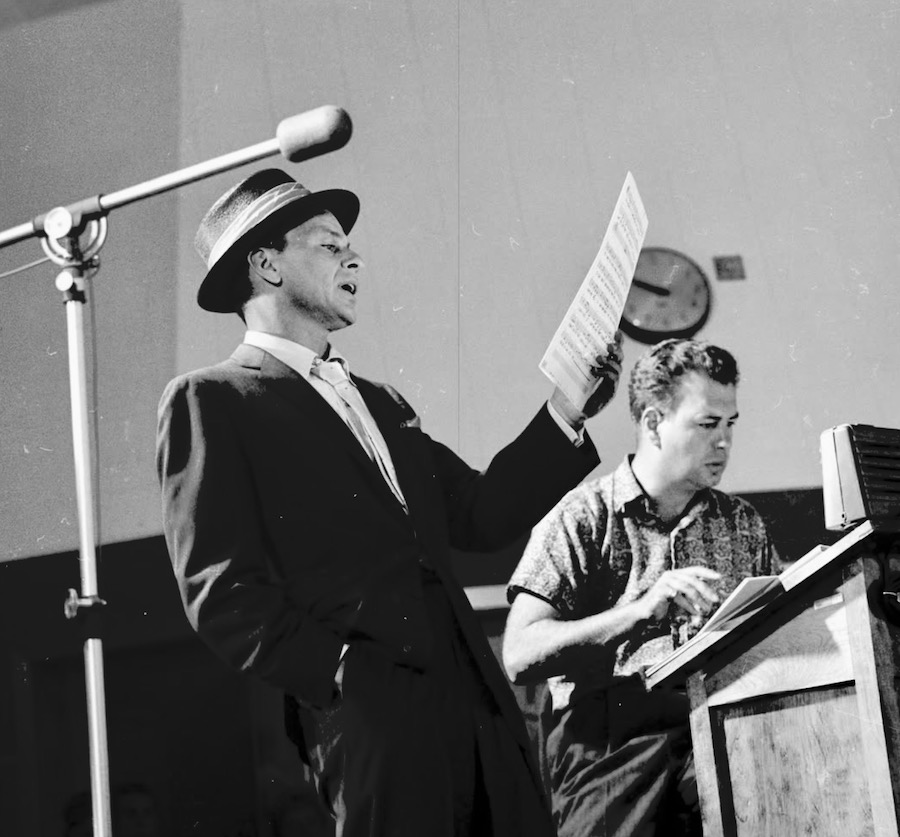 Sinatra proving he can swing as Riddle follows the chart
The Tone Poet Edition
I have a version of Songs for Swingin’ Lovers from pretty much every period it of its long history. The first reissue from Capitol came in 1962, which I’ll discuss a bit later. The first audiophile version was in the big Mobile Fidelity box from the eighties; like almost everything Mo-Fi did in those days, the sonics are thin and too bright. The Entertainer of the Century compact-disc release from the late nineties appears to have been remastered with some sort of noise-reduction, so it’s very clean but in the process has lost a good bit of the irrepressible life and vitality that are in both the performances and the original recording. After that came Capitol’s own 60th Anniversary vinyl release in 2016, which is excellent: warm, nicely dimensional, lively and involving, pressed on quiet vinyl. It’s still available on Amazon for around $29, nine bucks less than this new one.
But spend the extra money on the Tone Poet version—it’s flat out, hands down the best in every way, including sound. Joe Harley, the producer, Kevin Gray, of Cohearent Audio, who did the remastering and cut the lacquer, and RTI who pressed the LPs, have surpassed even their superlative work on In the Wee Small Hours. The overall sonic window is eye-poppingly transparent, the presence of singer and band vivid almost beyond belief, transients are sharper with superior timing yet without being in the least etched or grating, and no previous version I’ve heard lifts the ceiling off the dynamic roof the way this one does (wait’ll you hear that bridge in “I’ve Got You Under My Skin”). I asked Joe Harley if he and Gray had done anything special when they remastered it. “Virtually nothing, he answered.
"Truth is, Paul, those guys who made the original recordings, particularly the engineer John Palladino really knew what they were doing. Plus, as with our Wee Small Hours of the Morning release, we had access to what Capitol calls the 'phono reels.' These are a parallel set of tapes they made throughout the whole process. So far as I am able to tell, they look as if they’ve never been played or even listened to, but I have no knowledge of that one way or another. Why they did this was back then nobody knew if the LP format was going to last. Some people even wanted to go back to 78s! And then stereo was in the air. So these backup tapes were made just to cover themselves for any direction the industry might go, including backwards. The phono reels, by the way, are not copies. They were recorded on a separate identical recorder running in parallel, so they’re first generation."
Another reason the sound is so good is that this was the last of Sinatra’s Capitol albums to be recorded in KHJ Studios at 5515 Melrose Avenue in Hollywood. KHJ had three studios; the largest, the A studio, was used for Sinatra’s dance-band sessions. He famously did not like to be isolated in a booth, preferring to be right there in the same space with the band. On Songs for Swingin’ Lovers, “we had so many musicians on the stage,” John Paladino remembers, “that I put Frank down below on the floor, which is maybe four feet down from the stage, to get better isolation, and it worked out fine . . . . I think it was a matter of space, because that studio had the stage, and you could blow the band over the top of the room, and the kickback wouldn’t come until later. That simple process produced great sound!”[9]
Did it ever. Mono recording notwithstanding, Sinatra sounds as if he is just a few feet in front of the band, which fills the space behind and around without overpowering him, just as Palladino describes. Maybe that is why this release is the only version of Swingin’ Lovers I don’t find myself wishing it had been recorded in stereo (because of the size of orchestra). There is hardly a soundstage in the typical understanding of that term, but the central image is so big, spacious, and expansive, with plenty of depth, that everything registers with exceptional clarity and coherence. Better still, the balance between singer and orchestra and among and within the orchestra itself doesn’t sound as if it was created at the mixing board, instead in the room itself by the musicians. The gestalt is uncannily realistic and natural. This is one of the half dozen finest remasterings of a vintage recording I’ve ever heard and some of the most vibrant and exciting reproduction period.
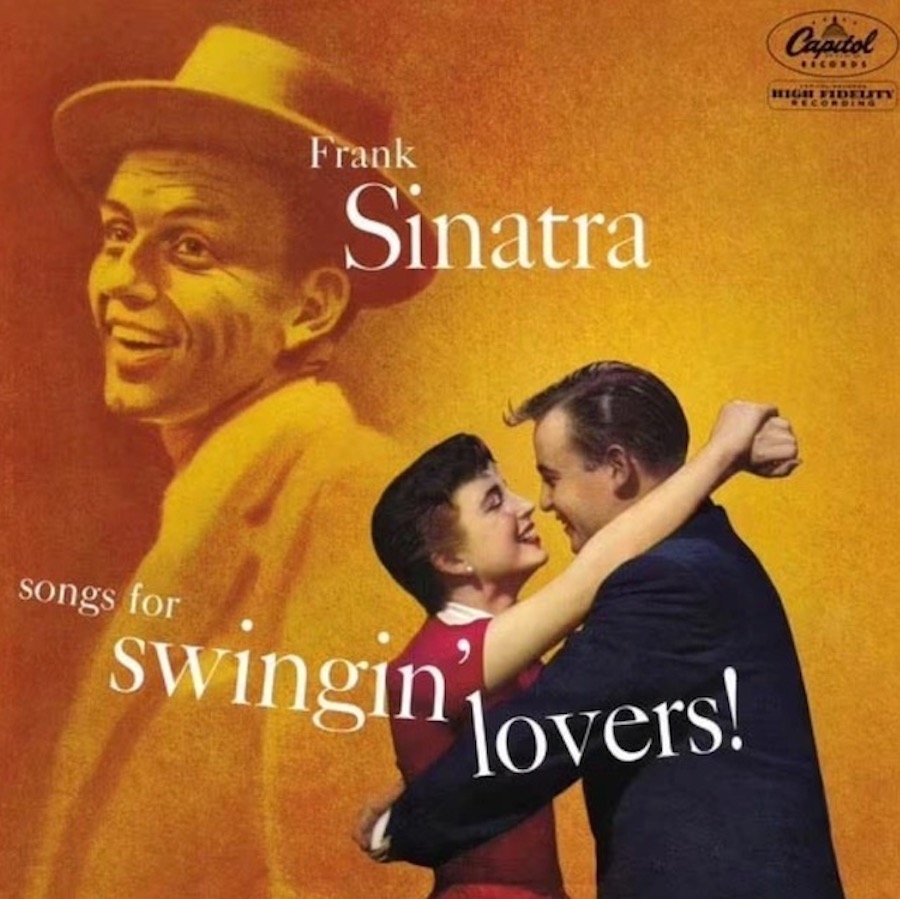
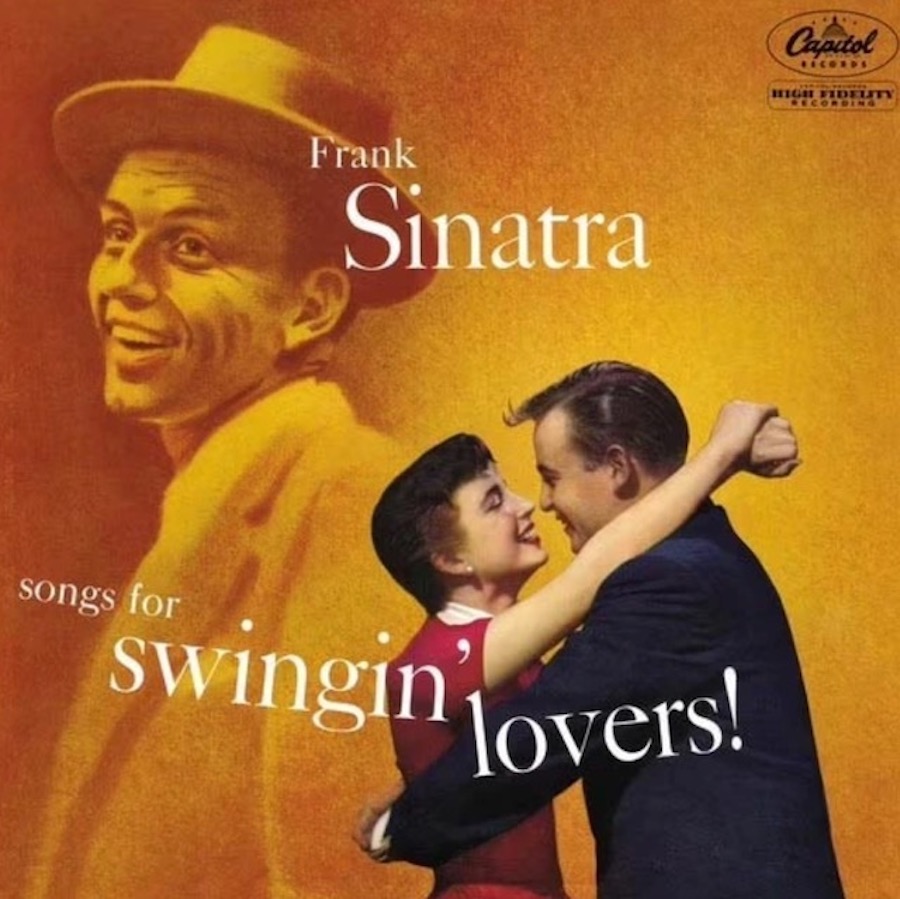
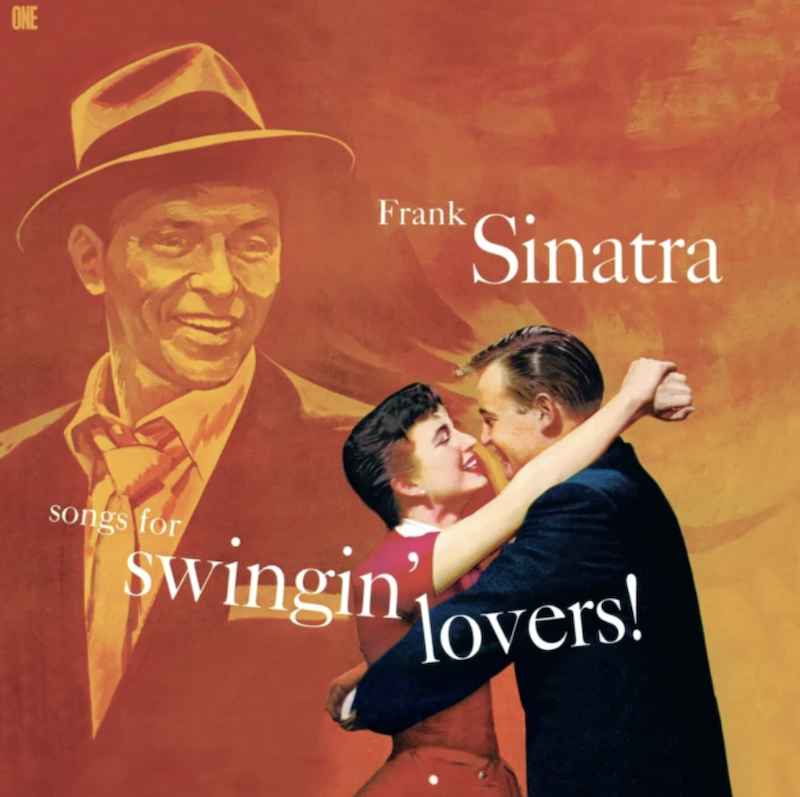 Two covers: Which is the correct one? In 1957 Capitol changed the cover so that Sinatra is looking at the embracing couple rather than away from them, as on the original. Various explanations for this change are advanced with no evidence to back any of them. The folks at Blue Note went with the original—as did Capitol themselves for the 60th Anniversary in 2016—which I prefer, as the later one makes him look rather voyeur like.
If you go in search on Discogs or other sites for a vintage copy, avoid like the plague that 1962 reissue. It’s shorn of three songs, while those that remain are differently ordered, in sound that is coarse and crude next to the vintage or the more recent reissues and remasterings. (At some point there was also a “Duophonic,” i.e., reprocessed stereo, release, to which I shall not subject myself.)
Highest commendations, then, to Blue Note for the always first-class presentations of their products. The packaging, including the weight of the cardboard for the jacket, the beautiful artwork and its printing, the gatefold presentation, the absolutely immaculate surfaces on the 180-gram pressing (my copy dead quiet both sides from cue down to runout), can serve as a benchmark for the industry.[10] In view of the shockingly high prices all too common from audiophile labels, how you manage to sell these for a tuppence under $39.00, gentlemen, I have no idea. Perhaps the best way I can express my gratitude is after Oliver Twist: “Please, sir. I want some more.” Maybe A Swingin’ Affair next time?
[1] The numbering of Sinatra’s Capitol albums can be confusing because Songs for Young Lovers and Swing Easy! were both originally released on 10-inch LPs and contained eight songs each. A year later, in 1955, Capitol combined them onto a single 12-inch LP, which leads some to number them as one album. Also, while it is common to speak of Sinatra’s sixteen Concept albums for the label as if there were no other kind, in fact there were other kinds but they were compilations and reissues, not original albums.
[2] Will Friedwald, Sinatra! The Song Is You: A Singer’s Art, rev. ed., 250, 242.
[3] James Kaplan. Sinatra: The Chairman, 80.
[4] This Rodgers and Hart favorite was in already in Sinatra’s repertoire from his Columbia days, but so far as I am aware he never put it on an album until 1961 at Reprise: Sinatra Swings (AKA Swing Along with Me). With a moderately up-tempo Billy May arrangement, this would not be out of place on Songs for Swingin’ Lovers.
[5] I feel the same about the penultimate song, “Anything Goes,” Cole Porter’s sharp witty satire juxtaposing a time when a mere glimpse of stocking was something shocking against a later period when anything goes. Porter’s sendup, unless I’m misreading him, is surely double-edged: you get the impression he felt the titillation of that glimpse was more arousing than the let-it-all-hang-out practices of later times. (One wonders how he would have written this song in the Age of Aquarius.)
[6] If you know the Sinatra discography at all well, you’ll remember that the same year Swingin’ Lovers was released he also recorded a single for Capitol of “Love and Marriage,” which celebrates the institution: “Love and marriage, love and marriage/They go together like a horse and carriage/This I tell you, brother/You can't have one without the other.” This just several months after “Making Whoopee,” where the horse was lame and the carriage busted. As always with Sinatra, he moves so easily and with such conviction from one pole to its opposite you might think he’s dissociative. It gets even more complicated. That same year he starred in a comedy, The Tender Trap, with Debbie Reynolds, the title song of which, written by Jimmy Van Heusen with lyrics by Sammy Cahn, he recorded as a single: “You're hand in hand beneath the trees/And soon there's music in the breeze/You're acting kind of smart/Until your heart just goes wap/Those trees, that breeze/. . . You're caught in the tender trap.” The song was later nominated for an Academy Award.
[7] Given that Sinatra was an avid, even voracious reader, it’s perhaps luck of the draw that the second verse begins, “I’m mad about good books/Can’t get my fill”; but I prefer to think it’s yet another example of how carefully he tailored his selection of material when he wanted to strike a really personal note.
[8] These would come much later in the Reprise years with albums like September of My Years, A Man Alone, Watertown, and his last really good Concept album, also the last album he made for Reprise, 1981’s She Shot Me Down, where he takes ownership of the title song (written by Sonny Bono for his wife Cher), and also includes “Monday Morning Quarterback” (m: Don Costa, l: Pamela Phillips-Oland), perhaps the saddest song I have ever heard about a man who realizes much too late that he never showed his wife the love he felt when he had her. “I know there were a hundred ways to tell her I loved her/It's funny how they're all so clear today/And when her face was burning with sadness and yearning/I don't know why I turned my eyes away/ . . . But then, a Monday morning quarterback never lost a game.”
[9] This and next from Palladino quoted in Charles L. Granata’s Sessions with Sinatra: Frank Sinatra and the Art of Recording , 112.
[10] What with the flimsy cardboard used for the jackets in their Original Source Series vinyl releases and the substantially higher prices, not to mention the inability of the pressing plants they employ to press records with decently quiet surfaces, Deutsche Grammophon could learn volumes from Blue Note. (I exempt Rainer Maillard, the remastering engineer, and Sidney C. Meyer, the disc cutter, from this censure.)



































.png)