


Green Day’s Best Album Gets The Box Set It Deserves
‘Warning’ expanded and sounding better than ever
If you’re of a certain more recent generation, probably white, and approximately middle class, you grew up listening to Green Day whether you wanted to or not. For a while, they were the most relevant mainstream rock band with any artistic credibility, even after the regressive 2012 trilogy transitioned them to legacy act status. American Idiot, with its well-timed conceptual framing, was (maybe still is) the most recent entry in the basic “classic rock starter pack,” and recency goes far with young children. Any suburban pre-teen/early teenager picking up a guitar or bass would learn to play Green Day songs. Aside from the drum parts, they’re really easy.
Whether you wanted to or not. I did not. It wasn’t even the “they’re not real punk!” elitist snobbery; I guess I considered Green Day too lowbrow, maybe even vapid, for their level of popular acclaim. The songs were loud and unsophisticated, the later rock operas weren’t as deep as everyone seemed to think, the production was usually too polished, whatever it was that I complained about for a long time. And while I’ve come to appreciate some of their discography, many of those criticisms still hold for me today.
Except for Warning, Green Day’s painfully underrated 2000 album that, at the time, almost made them look like has-beens. When pop punk at large was getting even more juvenile than the band’s earlier work, Green Day tried to grow up, and the result remains their most tuneful, sonically varied record. Warning finally filtered the bullshit and focused on frontman Billie Joe Armstrong’s ability to craft brilliant, compact, enduringly catchy guitar pop songs.
Warning’s prominent acoustic guitars and more nuanced lyrical approach might’ve alienated the core fanbase, as it sold significantly less than Green Day’s previous major label LPs (though a Napster leak three weeks before release didn’t help) and seems comparatively forgotten in the popular memory. “Who wants to listen to songs of faith, hope and social commentary from what used to be snot-core's biggest-selling band?” wrote Greg Kot in his original Rolling Stone review, saying that Armstrong “can't muster the same excitement for his more mature themes” and concluding “Green Day as the new Bread —who knew?” Now, however, a lavish 25th anniversary 5LP or 4CD super deluxe box set presents Warning as the excellent power pop record it’s always been.
This album carefully situates itself in a clear lineage of influences—The Replacements, The Clash, The Kinks, Bob Dylan—and makes no effort to hide it. The opening title track sounds at least a little like “Picture Book,” and the lyrics strive for the cryptic, socially conscious style of “going electric” era Dylan. Is “Sanitation, expiration date, question everything?” exactly a meaningful or coherent line? Not necessarily, but Armstrong was certainly trying and what he achieved across this album was more vivid portraiture and a greater sense of urgency. Basic rockers like “Church On Sunday” and “Castaway” were some of Green Day’s most fully formed yet, while “Misery” sounds like Brecht/Weill cabaret via Rain Dogs-era Tom Waits and the harmonica intro of “Hold On” recalls the Beatles’ “I Should Have Known Better.” The album ends with “Macy’s Day Parade,” an utterly beautiful song whose meaning I still can’t quite pin down after all these years. I think it’s the best thing that Billie Joe Armstrong ever wrote.
The core Warning album has already been remastered, recut, and reissued several times. Ted Jensen at Sterling Sound, who mastered the original CD, remastered it in 2012 for 192kHz/24bit files first released on HDtracks. There have also been many vinyl variants over the years, most recently a 2024 fluorescent green pressing cut by Chris Bellman and pressed in Italy. That reissue has decent energy and appealing guitar grit, but the first two songs have distracting compression pumping where it almost sounds like the kick and snare drums are sidechained to the vocal. Not sure how that happened, as the digital masters never had that much audible compression pumping, and I’d assume that Bellman cut the 2024 reissue from the 2012 hi-res files. (From what I can tell, Warning was recorded digitally then mixed down to analog tape.)
For this 25th anniversary box set pressed at GZ, Chris Bellman mastered and cut the bonus material while Ted Jensen remastered the core album yet again. Joe Nino-Hernes at Sterling cut lacquers for the 25th anniversary album remaster, also available separately on neon orange vinyl. Despite both 2024 and 2025 album cuts coming from Ted Jensen-mastered files, they sound very different. The 25th anniversary is significantly more dynamic; I’m almost certain that Nino-Hernes’ remaster cut was from a dedicated vinyl master (the new digital remaster is just as loud as the previous two digital masters), as it sounds and measures much better. Here are loudness-matched vinyl transfer waveforms for “Castaway” and “Misery,” with the new Sterling remaster on the top and the Bellman cut below it. You can tell that Bellman cut his version from a compressed brick:
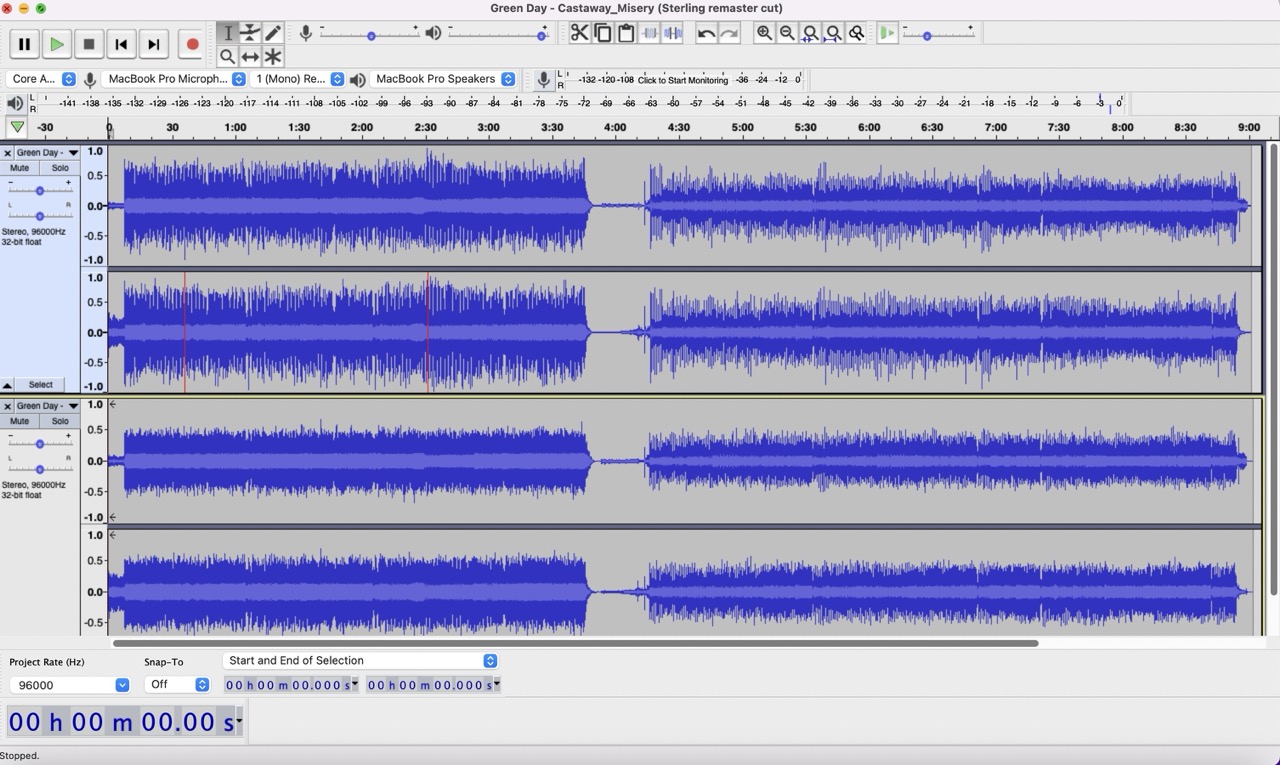
The 25th anniversary vinyl remaster is smoother at the expense of previous masters’ grittier guitar texture, but the payoff is how much more detailed and open it is. Drums have tangible physical shape, tom hits especially resolve with full-bodied resonance instead of being distorted blobs, vocals cut through better, transients are sharper, and cymbals distinctly stand out for the first time. You can clearly hear the ring in Tré Cool’s snare, whereas before it was buried amidst all the mastering compression. Is that a detail you want to hear? Maybe not, but it shows how much more you’re hearing of everything. There’s greater overall dimensionality, stronger bass foundation, and more high frequency air, but it’s not smiley-faced—rather, it’s properly balanced without losing any midrange power. It’s certainly different from the previous remasters (though not exactly revisionist), but the further I listen, the more it sounds definitively better. “Misery” on the remaster is insanely realistic, it should be played at audio shows. The standard weight green galaxy vinyl pressed at GZ is mostly quiet, though my copy has a slight warp that doesn’t affect playback.
Bonus Material
Following the remastered LP is a disc of B-sides, alternate mixes, and unreleased demos. The demos show that these songs were fully formed very early, “Misery” the only one sounding embryonic (partly because that song relies on the finer arrangement details). The unexpected highlights of this disc are the new “Otis mixes” of “Waiting” and “Macy’s Day Parade,” done by Green Day’s engineer Chris Dugan. At first, “Waiting (Otis Mix)” appears identical to the album version, but this is a less polished remix that truly makes it sound like a Replacements song. “Macy’s Day Parade (Otis Mix)” mutes the bass and drums, fully exposing David Campbell’s string arrangement rather than relegating it to a mere texture.
The demos (all on the first side) sound good for what they are. Vocals are clear throughout, though the rest isn’t as sonically consistent. The B-sides are also variable in sound quality, with two tracks randomly mastered by Robert Vosgien that sound a bit brighter than the rest. Still, this is probably the best we can expect this material to sound, and it’s never below satisfactory. The yellow and black marbled vinyl is flat and quiet.
Arguably the core focus of the bonus material is the 3LP Live At Makuhari Messe, Tokyo, Japan, March 18, 2001, pressed on orange galaxy vinyl. It’s a good set, though I personally find the middle of the show bogged down by too many earlier Green Day songs at once, and the long passages of crowd interplay (like the 10-minute version of “Minority”) don’t really work in an audio-only setting. Chris Lord-Alge mixed the recording, which is reasonably well balanced even if the audiences sound grainy and thin.
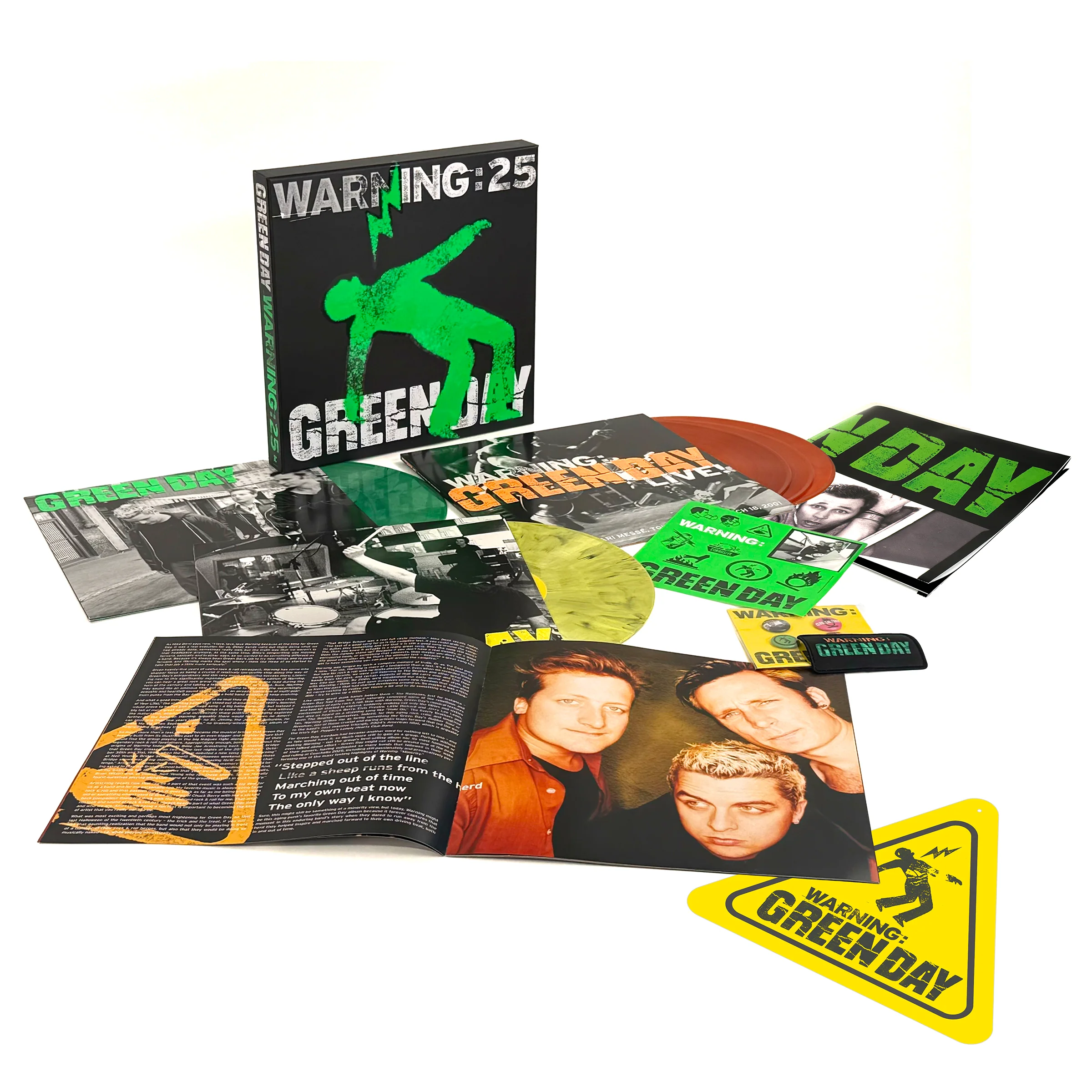
All three albums (five LPs) come in a spot-gloss lift-off box with a fold-out poster, sticker sheet, set of four pins, branded patch, and a 24-page full-size booklet with an insightful essay by David Wild. Indie retail copies also come with a large “Warning” sign. This set feels appropriately deluxe, but not in an obnoxious way that distracts from the actual music. Everything is thoughtfully presented and those involved thankfully paid attention to the sound quality. Unless a Warning one-step comes along, I can’t imagine any of this sounding better than it already does here. My only complaints are that the jackets could've been printed on thicker stock and the records didn’t come in poly-lined inner sleeves, and even then, they all arrived pretty clean. The standalone album remaster will probably suffice for most, though anyone who splurges for the $140 5LP box set won’t regret it. Across the board, it’s one of the best deluxe box sets I’ve recently encountered.