


Keith Jarrett's Legendary Köln Concert Gets a 50th Anniversary Special ECM Reissue
This is the all-time best selling solo album in jazz history & best selling piano album
MQA is a plot to take over and ruin your music and make the devious and power hungry villain Bob Stuart wealthy. Maybe run the world. The reaction to MQA borders on that level of hysteria and for now it's kind of shut down or on hiatus (Lenbrook owns it) but the first demo of it I heard at a CES some years ago was unforgettable and made me a believer even if a later demo I attended with Rick Rubin made him a skeptic or worse and that surprised me.
Keith Jarrett's The Köln Concert was Bob Stuart's demo disc of choice. Not the original all-analog vinyl issue, but the CD issue, ECM first released in 1983 at the beginning of the CD error. Those in attendance who owned the original vinyl (originally released in the United States by Polydor, and cut by Robert Ludwig at Sterling Sound) knew the recording well—and if they didn't know the entire story behind the production they at least knew it was recorded in the Köln Opera House late in the evening following a performance by the opera company and that it was the first jazz performance there ever.
Without knowing at the time how it was recorded, it was always a fine sounding production with the piano image well focused and presented in three-dimensions on a big stage, followed by hall reverb that helped define the moderately sized, 1300 seat space.
Of course such a popular best selling record would be among ECM's early CD releases and so in 1983 in the infancy of the format out it came. Until Stuart played it, I'd never heard it. The vinyl couldn't be beat at the time I figured, and boy was I right! The CD Stuart played produced a flat, unfocused soundstage. The hall reverb was mixed in with the piano. There was no hall sense and no piano focused on the stage in the hall. I think I may have remarked at the time that it was like Vincent Price in "The Fly". It came out the digital end all mixed up.
Stuart explained that the complaints about early CD sound were in part due to A/D converters that had poor phase response. They blurred the time domain. We are most sensitive to the time domain. It's responsible for our very survival.
Stuart said he'd come up with the way to "de-blur" the digital file and restore phase in the time domain. He played the "de-blur"'d excerpt from The Köln Concert and voila! Soundstage, image, piano in focus, reverb echoing off the stage wall behind the piano, or from wherever, but locked in correct time with the piano to produce a convincing three-dimensional image. "Had that been CD", I remarked, "I'd not have so strenuously objected to it". Well, maybe.
Recording engineer Martin Wieland used a simple but effective rig to put the concert to tape: a pair of Neumann U67 vacuum tube microphones feeding a Telefunken M5 studio quality vacuum tube based tape recorder (the Wikipedia page erroneously identifies it as a "portable" unit). No wonder the recording and record sounded so alive and three-dimensional.
Later the entire story became known—about how the opera hall staff had accidentally supplied a baby grand Bösendorfer, not the 290 Imperial concert grand Jarrett had requested, and how the piano was in pretty bad shape, how the pedals weren't working correctly and how the sound was tinny on top and weak on bottom, which explains why Jarrett concentrated in the midrange. You can read all about it on the Wikipedia page. As the legend grew the the descriptive language became more flowery and monumental—that's not meant to in any way diminish the greatness of the music or how Jarrett performed it.
If you're not familiar it's as accessible as hell and in no way technical noodling. It's funky, and at times oddly country and western though it never devolves into an identifiable music slot, which is part of its greatness and why it's not in any way dated now, nor will it likely ever be. Side one is the 26 minute opening improv and I'm not going to attempt to describe it, followed by applause. The second improve runs longer—36 minutes—which necessitated it being broken into two sections, one 15 minutes long and the other on side 3, running 19:19.
At the risk of annoying Keith Jarrett further in case he reads this site (I annoyed him when decades ago in The Absolute Sound I reviewed his only singing album), the second improv has an uptempo opener, with joyous feel that reminded me of A Charlie Brown Christmas (not that there's anything wrong with that!) before it intensifies into a monumental storm and then on side three turns inward, melodic and majestic.
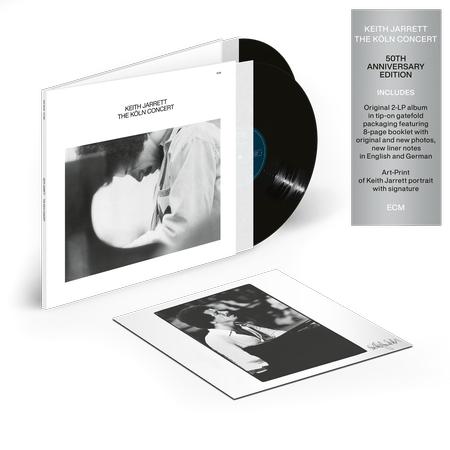
ECM celebrates the 50th anniversary with a special two LP 180g edition housed in a "tip-on" style gatefold jacket with a glued in full sized booklet containing an essay by Thomas Steinfeld in English and German that provided a useful historical background, and included two black and white photos. There's also a signed free-standing photo inserted in one of the jacket pockets.
Daniel Krieger at SST cut lacquers from what sounds like a somewhat dynamically compressed file, which brings me back to the MQA opening. The new records have good instrumental focus, but the reverb isn't expansive. It doesn't define the space. It's almost like a feeble glow behind the notes that never opens up the room space. The notes themselves are "clangy" and lack harmonic structure. The original RL vinyl sound so much better, and more like a piano in a live space, it's ridiculous. I do not know how this happens or why this happens but as with the Miles Davis Plugged Nickel set cut by Krieger at SST this one will sound "good" not referenced to anything else, but not particularly good and wholly inadequate compared to the original AAA record—and it's more than just the "sound". It's the musician's intent that's almost completely lost. Jarrett is hitting the keys with varying intensity and creating micro and macro-dynamic communication doing that, but it's totally lost in the clanging and banging, which is not at all what's expressed or communicated by the original vinyl Bob Ludwig cut 50 years ago.




























.png)