
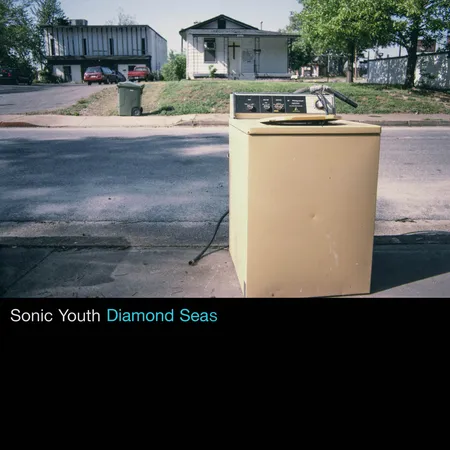
Kill Yr Nostalgia: Sonic Youth - "Diamond Seas"
Sonic Youth and John Oswald have created the most original, terrifying release on the 2026 RSD list
I’ve always thought of Sonic Youth as the Grateful Dead for insufferable people.
Hi, it’s me, I’m insufferable people!
I’ve always felt weird about making the comparison outright, but there’s a connection to be made. Lee Ranaldo is a known Deadhead, after all. Their fan cultures are nothing alike, but the bootlegging cultures might be. Certain prize recordings have received official releases. Others remain passed back-and-forth between friends and strangers. Across thousands of sets captured before and after the advent of the smartphone made bootleggers’ jobs much easier, you’ll hear such gems as:
(Crowd booing)
(Feedback)
“Alright, we’re gonna do a couple of Alice Cooper songs…”
(Two full minutes of tuning)
“Alright, we’re gonna do a couple of Grand Funk Railroad songs...”
(Plays song that is notably not by Grand Funk Railroad)
(Boos)
(Thurston Moore rambles about Princess Diana for some reason?)
Liking Sonic Youth is no longer “cool.” Their sound has been so thoroughly absorbed by the mainstream that nothing feels cutting-edge anymore. Factor in that both the fans and the band themselves have earned the reputation of being pretentious a-holes (how could anyone be mean to Nardwuar?) Save for Kim Gordon’s trap album from a couple years ago, the collective’s patience with the Youth has run out. (Were the Dead as an entity ever “cool?” Having only known them as a legacy act hawking a parade of redundant compilations, I’m probably not the one to ask.) But as Dylan said, “When you’ve got nothin’/You’ve got nothin’ to lose.” When a band realizes any previous bar cannot be met again, be it artistic, critical, or commercial success, things have the potential to get all the more exciting – and much weirder.
If anything, we can count on Sonic Youth to put out an interesting and original Record Store Day exclusive. If they go the reissue route, it’ll be a first-time vinyl press of a Starbucks B-sides compilation CD from 2010. This year, the Youth offered 3,500 copies of their challenging and fascinating equivalent to storied Grateful Dead assemblages.
The Other One
If there’s anything you can count on with the Dead, it’s being consistently inconsistent. They were experts in the art of wasting time. They toured so much, they were hardly in the studio. When they did show up, they were so zooted beyond this mortal plane they couldn’t complete much of any work. When they could work, they terrorized their engineers with requests such as “thick air.” The Dead’s chosen cover artist, Bill Walker, was still painting after eight months. Yet somehow he found the time to write, I shit you not, a 33-page manifesto explaining what it all means. By the end of 1967, the Dead only had about a third of the material needed to fill out an LP.
If this memo from Warner Bros. exec Joe Smith to manager Danny Rifkin is any indication, the Dead had exhausted their own patience reserves.
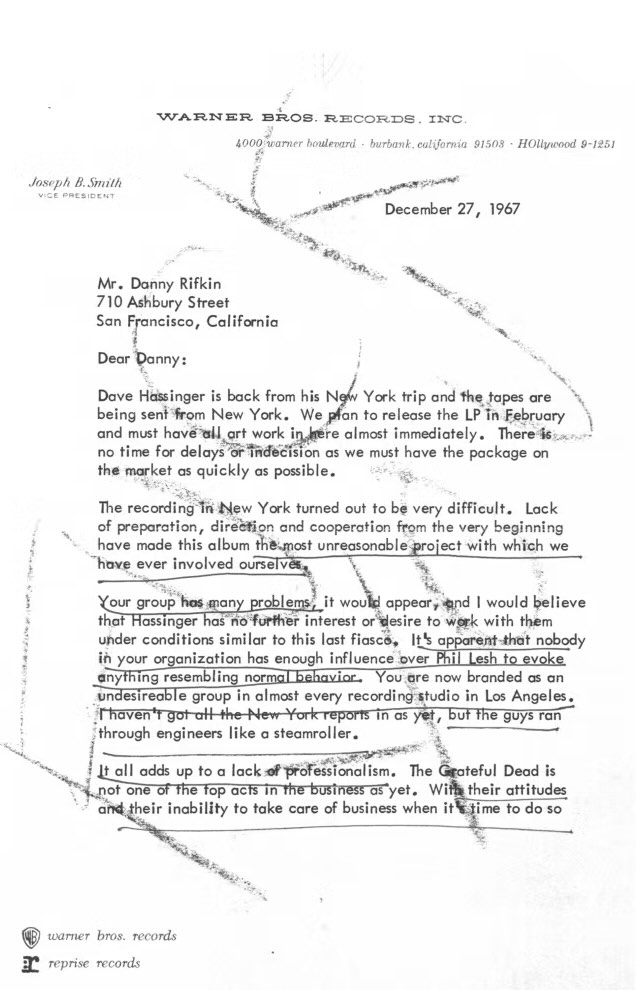
(I’d never read an exec’s eye twitching as he tries to hold back from calling Phil Lesh “an instigatory little shit,” but this certainly paints the picture!)
The Dead didn’t have a producer (Dave Hassinger quit after “thick air”) and they lost their label’s support. What would they do now? They’re the Grateful Dead, you fool! They’ll use their formidable reserve of live recordings!
In order to complete Anthem of the Sun, the Dead played detective with engineer Dan Healey; hunting for fragments from different live recordings that might go well together. With these fragments, they could pad out their limited studio efforts. Of course, this only further complicated the recording process. Tracks were jam-packed with seven players, plus overdubs plus all the vocals. There was the issue of matching 2-track, Franken-4-track, and real 4-track recordings, all captured at different speeds. Healey had to transfer and manually sync it all. There was that weird trend of fake live albums in the Sixties, but blending live and studio recordings like Anthem had never been done before.
Bob Weir’s lyrics about a bus called Furthur, Cowboy Neal at the wheel, and dropping a condom water-balloon on a police officer’s head converge upon “the thousand-petal lotus opening,” as Phil described “That’s It For The Other One.” Blink and you’ll miss it, but the “Quadlibet For Tender Feet” is some of the most fascinating twenty seconds in all of rock-and-roll. Excerpts from four different shows at the Carousel, the King’s Beach Bowl, and the Shrine Auditorium start at the same point, but slowly diverge. One’s a faster here, the other takes a detour there. Solos step all over each other, eight drum kits are battering in all corners. The bloom closes, making you wonder if you ever heard anything at all. “We Leave The Castle” is Tom Constanten’s tribute to John Cage. He used a toy top on the piano’s strings to create the spectacular croak of a drawbridge lowering. “The Other One,” and Anthem, are a rare phenomena in the Grateful Dead canon: what makes them interesting on record is impossible to replicate live.
The Diamond Sea
Released thirty(ish) years ago, Washing Machine was the end of Sonic Youth’s seven-year mainstream arc. Look at the photographs in the gatefold: front porches, closets, backyard grills. Mom, dad, cat, and baby. Even the album title is a household object: Washing Machine. The closing track, “The Diamond Sea,” is nineteen minutes of feedback, alternate tunings, sirens, tape manipulation, and noise, bookended by a Neil Young-ish melody. They were openers on the Weld tour. Lots and lots of booing. The lyric invokes Neil’s profound vagueness.
“Look out, he's here to stay,
Your mirror's gonna crack when he breaks into it,
And you'll never, never be the same.”
"The Diamond Sea" is the punctuation at the end of Sonic Youth’s decade-long exploration of what a guitar could do – or, rather, what they could make a guitar do under duress.
The song also has a history of edits. The album version chops off several minutes. The full-length version was released as the B-side to the heavily-truncated single version; gutting 20-plus minutes down to five.
After Washing Machine, the Youth grew up. They took take a three-year break from touring to be involved parents; releasing a handful of EPs in the meantime. When they weren’t tucked away in suburbia, they recorded leisurely in their very own Lower Manhattan studio. As distance between grunge and the cultural consciousness grew, Sonic Youth slipped back into the sound-over-song ethos they started with, without the feedback. Naturally, having pulled back, they lost touch with the youth. After their November 23rd, 1996 gig at Las Palmas de Gran Canaria, Sonic Youth would never play “The Diamond Sea” again. “Sunday” made its live debut as the encore.
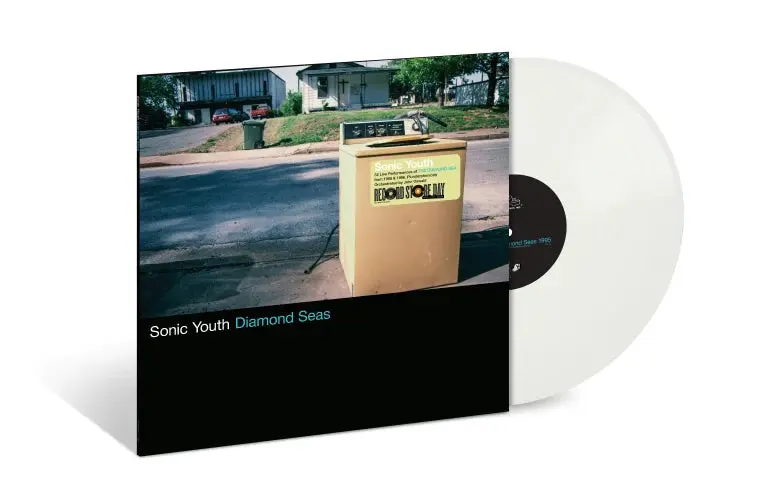
For their Record Store Day 2026 offering, Sonic Youth commissioned composer John Oswald to execute a joint Washing Machine anniversary celebration/“legacy project.” He played detective through seven hours and 33 recordings of “The Diamond Sea,” provided by archivist Aaron Mullan. (Yes, 33 of them, the 32 number repeated all over the place is wrong. There are 32 live recordings in the mix, plus the studio version that appears on Washing Machine.) The outcome is two 20-minute, 44-second plunderphonics pieces. One side of the LP is devoted to the 1995 recordings, the other to 1996. The album insert gives a color-coded “sound map,” showing very rough approximations of which recordings start and end where. It’s impossible to be sure of anything: the song has been mixed and remixed the song into something beyond recognition. Oswald made hundreds of edits, omissions, and transpositions to create his Diamond Seas. (If there were notes explaining the minutiae, they’d read like goddamn War and Peace.) By choosing “The Diamond Sea” for this project, we can infer Sonic Youth see this song as their “Dark Star.” Ergo, Diamond Seas would be their Grayfolded. The description on the official RSD promises "A sonic experience that will spin dry your ears!"
Brace yourselves: this is nothing like Grayfolded.
Quadlibet For Sonic Youths
The perverted desire to immerse ourselves in sounds that consume must be human nature. If the findings of certain scientific studies hold up, doing so might even be good for our brain health. “Use it or lose it.” It applies to body and mind. Marcus of the No Dogs In Space podcast used the phrase “the sound above” to describe music that deliberately challenges the listener; “the sound above the level you’re on.”
After false starts with most every “classic-era” Sonic Youth album, my entry point finally came...with Walls Have Ears. It’s a miraculous bootleg; captured just as the Youth turned the corner from Lower East Side noise outfit to melodic “alt-rock.” Primeval Youth meets “Expressway To Yr Skull.” They’re still brave enough to botch a song or two. It appeals to my sensibilities: gritty, challenging, and loud, with some melody in between. Brutal beauties. The sound above.
Diamond Seas presents an immediate conundrum. As Oswald explains in the liner notes, he stacked the 33 “Diamond Sea”s on top of each other and synced the music (after on-stage rambling and tuning up) to start at the same time. Unless you have two copies and two turntables, you cannot hear all 33 “Diamond Sea”s at once, as Oswald halfway-intends. But hold on: the studio recording and its alternate ending straddle both sides of the record. They can only be heard whole if one crossfades them. So would you need two copies, two turntables, and a crossfader to hear the true Diamond Seas? Four setups? Do they make an endless loop? Diamond Seas is an impossible record. Every way you listen, layered or straight-through, will be wrong. Considering the limitations of my single turntable, I listened to 1995 and 96 in succession. Given what’s on both sides of this disc, I’m kind of glad I had to break this up.
After awkward stage gab (“This is for Rita Ackermann”) and tuning up, no “Diamond Sea” on either side of the LP is really distinguishable from the other. There’s no separation of sound. There’s no hierarchy or room to breathe. That’s the point. Diamond Seas isn’t for bootleg obsessives. It isn’t for people who want to hear “The Diamond Sea,” either.
For the first two minutes or so of 1995, Oswald lulls us into a false sense of security. He goes the traditional route; sequencing one clip after another. The Thurston that sang, “You better watch yourself when you jump into it” is hilariously off-key. (I like to think Kim got some satisfaction out of that.) Then, the structure breaks apart. 1995 seats “The Diamond Sea” at a round table and conducts a séance over its head. The four players are joined by the thousands of fans who heard these recordings in the round (pre-bastardization.) Sometimes you can hear them. They happily cheer. You can imagine them waving at us. Then, Oswald applies a few more layers and thefan adoration becomes sinister. Shrieks rise from washes of feedback. The riffs are off-center. The tempo ebbs and flows. Clips warp, drag, whir, and howl in reverse. “The Diamond Sea” is at war with itself. Steve Shelley’s drumming gives something for the swirl to revolve around, but when he multiplies, it gets trippy. Then the battering folds back down into one. On my first night with this disc, I foolishly tried to leave the room. When I heard the chorus gasp for air, I was dragged right back in. The melody immediately sank into the depths again. 1995 is an overwhelming collision of so much sound. Even the final return is a din; off-key, with phrases stretched like taffy. “Time takes its crazy toll,”indeed. Side one ends with the band’s go-to sign-off: “Thanks a lot.”
Looking at the sound map, I assumed 1996 would be the more “palatable” side. How wrong I was. It goes to hell even faster than 1995 does! This is truly impressive, given there’s half as many recordings at play. One could almost pass back-and-forth between rooms on their first listen of 1995. I could not leave 1996 unattended, for fear it’d rip something open in my room. It’s outwardly menacing from the jump. Anxious, circular drums set the tone. “The Diamond Sea”’s most hopeless line, “Blood crystallized to sand,” is the first line sung on side two. Even Kim’s valley-girl coo takes on a mocking tone. Sonic Youth are eager to move on from this thing, and you can tell.
After three minutes, it erupts into what I can only describe as auditory nuclear holocaust. “You better watch yourself when you jump into it/'Cause the mirror's gonna steal your soul.” That sounds like a promise. Guitars make gurgling, awful noises, and Steve isn’t here to bring any order. It groans under the weight of itself, heaves, and pulls itself apart to reveal the rot. At its most deafening points, it genuinely triggered existential dread in me. I should’ve known: in one snippet, Thurston dedicates this “song” to Yoko Ono.
The question that's proved hardest of all to answer: does this even sound "good?" If you equate "good" to consistent sound fidelity, or any fidelity at all, then I don't know. Diamond Seas has no bottom or top. 1996 is unbelievably dense. It's disorienting all the way up/down, and the mix simply cannot be parsed out. If you equate "good" to feeling something, then yes. Regardless of how you personally respond, 1996 forces you to feel something. It has its own gravitational pull; a gas giant, its atmosphere incompatible with life. Even the band “bringing it back home” sounds wrong. It ends abruptly with a blunt, clipped,
“Goodbye-”
After this, you’re left with the static in the dead wax. By the end of each listen, all of them demanding acts which required full commitment, the noise didn't give me the creeps. The quiet did. 1996 reveals the true nature of “The Diamond Sea:” far-reaching and terrifying in its depth.
I’ve pretty much sworn off Pitchfork since their acquisition by Conde Nast (“paywall” and “reader ratings” – two things nobody wanted in the first place!) But my morbid curiosity got the best of me. The lone reader brave enough to review this thing, TOMMYCASUAL, wrote, “I just want to be a dissenting voice for any deciding whether to order this – maybe find a way to listen to it first. I was very excited for it and found it almost unlistenable.” Having anticipated something “Diamond Sea”-shaped, I, too, was taken aback by the monstrous form of Oswald’s creation. But good grief, I knew not to expect “listenable!” Respectfully, Mr. CASUAL, is “Incinerate” the only Sonic Youth recording you’ve ever heard?
Still seeking closure, I turned to fan forums. Am I seriously the only one who’s gotten anything of value from this thing? Have I officially lost it? The general consensus: we fans don’t “get” it! Sonic Youth must be trolling us! Diamond Seas is our punishment for being greedy little fucks, buying every reissue and every official issue of a bootleg.
I'm still not exactly sure what about this release resonates with me; what's on record, or the totality of the listening experience. With Diamond Seas, Oswald and Sonic Youth went for “Dark Star.” Instead, they’ve created their own bloodthirsty “The Other One.” If you played twenty-seven of Live/Dead’s “Feedback” at once, or took a heroic dose of DMT and stared at the many-headed monster on the Anthem cover for a while, you wouldn’t be far off from this. Sonic Youth have resurrected the many-headed brutality of yore, their very beginnings, when they were romping around the ruins of no wave. In doing so, this “legacy project” will kill yr nostalgia. (Not to mention it blows Grayfolded to bits.) Diamond Seas is the strangest, most challenging archival release in recent rock-and-roll history. If it isn’t “listenable,” by God, is it interesting.
If you’re looking for 40 minutes of fuzzy-wuzzy remember-whens, or if you want to hear any recognizable form of “The Diamond Sea,” do not buy this record. If you want the rock-and-roll equivalent to Bukvich’s firestorm at Dresden, go for it.