
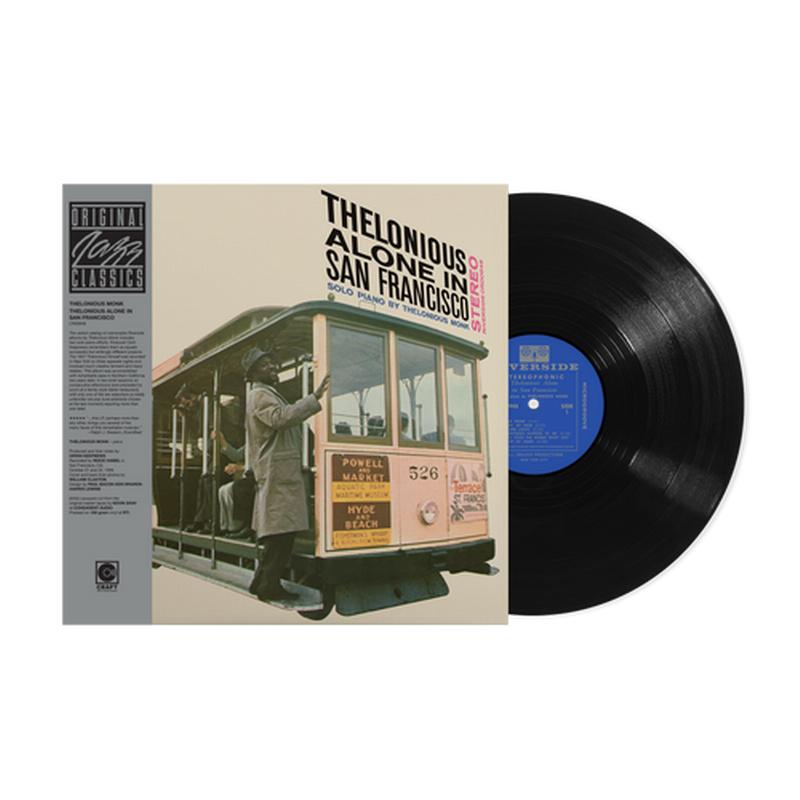
Monk's Most Alluring Solo-Piano Album
"Thelonious Alone in San Francisco" on Craft vinyl
Thelonious Alone in San Francisco is the middle of Thelonious Monk’s three solo-piano albums and, to my mind, the most satisfying. It was recorded over two days in October 1959 during his first trip to the Bay Area, where he’d been lured to play sets at the Black Hawk jazz club. Orrin Keepnews, his producer at Riverside Records, Monk’s label at the time, happened to be on the West Coast, so they decided to spend some of their free time making this album.
Maybe San Francisco’s fresh breeze and tranquil pace put Monk in an easygoing mood. In any event, this is his most lyrical album, maybe the only one that evokes this adjective—though, I should hasten to add, it is not at all mellow. Monk’s trademark touches are fully present—the jangled rhythms that somehow never stray from the beat, the dissonant chords that somehow make wrong notes sound right, the bracing mix of briskly playful and deeply serious. Yet in these sessions, he infuses these quirks, almost seamlessly, into the balladry, when appropriate the romance, of the songs at hand. Four of the 10 tracks are standards; the other six are originals, most of which (“Blue Monk,” “Ruby My Dear,” “Pannonica,” and “Reflections”) had, by this time, attained the status of standards, in the jazz world anyway.
Monk had recorded the originals before, on quartet or quintet albums, and those are worth having too, but the renditions here are gentler. He unfolds the songs at his own pace, with shifts to his own eccentric metronome, and so we get to hear the inner details and rich complexities that are sometimes overshadowed—or that Monk, understanding the balance of sounds, doesn’t bother to underline—in the group recordings.
Listen, in particular, to the opening track, “Blue Monk,” where he displays, more clearly than usual, his stride-piano roots—while at the same time plumbing deep into his modernist innovations: the fractured harmonies, tipsy cadences, and the ghost-note punctuations. Take a close listen, as well, to his cover of “Everything Belongs to Me,” which he imbues with an indigo melancholy completely free of self-pity or sentimentalism.
“Everything Happens to Me” is one of two songs from Thelonious Alone in San Francisco that he would reprise in his third one-man album, Solo Monk, recorded in 1964-65 for Columbia. A two-CD set that includes alternate takes and out-takes, released many years later, contains four takes of the song. None of them, I think, match the emotional riches of the version on the 1959 Riverside.
In general, Solo Monk is a more volubly eccentric album. Monk had achieved an unlikely fame by this time, hailed as “the high priest of be-bop” (which isn’t even accurate—Monk sometimes played with bop musicians, but his compositions and style of playing were very different, centered more on variations of melody rather than on chord changes), and he may have leaned in to the stereotype. (His bipolar condition was also starting to take hold around this time; it worsened at the end of the decade, to the point where he stayed out of the public light for almost all of his last dozen years, until he died in 1982.) Solo Monk is still a terrific album, for all that, as is Thelonious Himself, his first solo album, recorded on Riverside in 1957, though, again, on Thelonious Alone he’s more relaxed, more comfortable with his uniqueness—perhaps because in the two years since Himself, he’d emerged as a leading figure in modern jazz, playing once again in the New York clubs from which he’d been banned for a few years as a result of a drug bust.
Thelonious Alone in San Francisco is a recent vinyl reissue in Craft Records’ Original Jazz Classics series. Some of the Craft OJCs—which are mastered from the original analog tapes at 33-1/3rpm by Kevin Gray—sound better than earlier audiophile pressings, even those mastered at 45rpm. This was most impressively true with their reissues of another Monk album, Monk’s Music, with John Coltrane and Coleman Hawkins, and of Bill Evans’ Waltz for Debby.
It is not true of Thelonious Alone. Analogue Productions’ 45rpm pressing, part of its limited-edition “Top 100 Jazz” series back in 2006, betters the Craft version in several dimensions. The bass is deeper and more dynamic, which is most notable, as Monk at times pounds out a chord or a tone-cluster with his left hand in a very precise but startling way. The Analogue Production gets the full drama; the Craft falls a bit short. The AP also reveals Monk’s subtlest, most fleeting notes. Finally, the AP captures more of the overtones and ambience (the session was recorded in a large empty meeting hall); the Craft sounds more closed in.
Curiously, that Analogue Productions’ pressing was also mastered by Kevin Gray. (I emailed him to ask what might account for the contrast—had, for instance, the tape deteriorated.in the 20 years between the two projects? He didn’t reply, perhaps because he couldn’t remember, perhaps for other, more obvious reasons.)
Anyway, it’s worth stressing,, the Craft—especially heard on its own—sounds good. Besides, the AP is long out of print, original pressings in mint condition are hard to find (I don’t know how one of those sounds, but some original Riversides don’t sound as fine as audiophile reissues, perhaps due to less-than-pristine vinyl). In other words, this may be as good as you can get—and it’s good enough that the music, which is extraordinary, comes through.






























.png)