


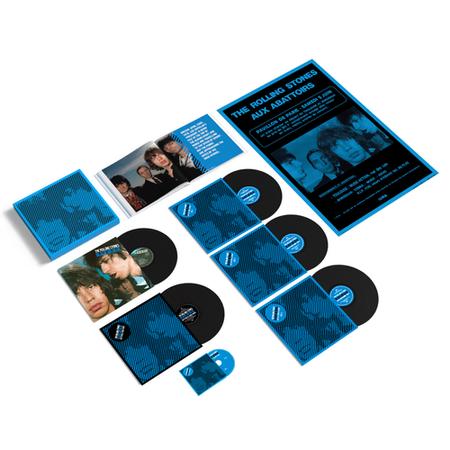
On "Black and Blue" The Rolling Stones Shop For A New Guitarist
odd choice for a "Super Deluxe Edition" but here it is with Steven Wilson's emasculated re-mix
Mick and Keith went shopping for a new guitarist after Mick Taylor exited the band. Why not conduct live auditions in the studio while tape rolled and let's produce an album out of that? The original Black and Blue release Spring 1976 was in many ways an anti-climactic affair. An unfocused set of tunes, some great, some less so. A middling quality gatefold jacket, no annotation of any kind, just an inner sleeve showing the "Glimmer Twins" as producers on the tape box repro, which offered clues for those who wanted to pay attention. Most buyers probably didn't, nor did many know how to decipher tape box road maps. They just wanted to listen to the new Stones album. Give The Glimmer Twins props for being almost 50 years ahead of the "show the tape box track assignment sheet" on the inner paperwork so common today.
Consider the decade's opening shots: Sticky Fingers, Exile on Mainstreet, the lackluster (musically and sonically) Goat's Head Soup and the revitalized Stones of It's Only Rock'n Roll and then comes this unfocused effort which has more than a whiff of "product" about it. It's interesting to learn in the box's book that the cover shot was "real time" and not a collage. Nonetheless these guys were adults, Ron and Keith with copied not original spikey hair styles, when all around another generation of fresh, exciting kids was knocking on the old guys's doors and battering them "black and blue". That's just how it felt even to many loyal fans. The reviews were mixed. None of this is meant to take away from the tight, compacted high quality of the music making itself, just the lack of a coherent perspective.
What the record buyers got was an opening stiff that any James Brown fan would react by saying "Why do I need this when I've got James? Others might say "Where's the tune? Where are the lyrics?" Others would dance happily. Those paying attention might note Harvey Mandel lead guitar credit. Some might know the name from Canned Heat or his Cristo Redentor solo album on Phillips. "Hand of Fate" is more in the Stones' pocket. A fugitive on the run. Wayne Perkins on guitar. No Internet in 1976 so for anyone bothering to note the name, what would it mean? Who knew then that he'd played lead guitar on Bob Marley and The Wailers Catch A Fire or had been a Muscle Shoals Sound Studio guitar regular?
Track assignment fans who were also Faces fans would note Ronnie Woods' first appearance on Track 3 of a cover of Eric Donaldson's "Cherry O Baby". UB40's cover on Labour of Love, its album of covers, produced the song's greatest popularity. The side ends with Mick's memorable "touring is tough" tune "Memory Motel", which is a highlight. In retrospect it sounds like a Robbie Robertson song The Band could have handled well—not that the Stones didn't!
Wood is back on side two's opener "Hey Negrita", which has rhythmic power and Perkins is on a few more tracks throughout the album as is Billy Preston. The side's highlight is the ballad "Fool to Cry" with Nicky Hopkins on piano and Mick's Fender Rhodes leading the way to a top 10 tune. No way a landmark, or even a meaningful Stones album other than as the Wood "how do you do?".
When you look at the engineering team glitterati, the uncredited mix by Keith Harwood and Glyn Johns from the 16 tracks, and the original mastering by Lee Hulko at Sterling Sound (as listed on the tape box image), you have an O.G. American pressing that best represents what everyone at the time wanted. In the Hana Umami Black review I noted after playing the original pressing, "Glyn Johns was always known for his drum mic set ups and here the snare sizzles and the kick drum has weight, definition and a tight profile. Parts hidden for decades in mediocre playback muck burst forth now, including Billy Preston's piano and organ parts. On "Hey Negrita" he sounds positively Mike Garsonized. On "Melody" Preston pounds heavily and the Umami Black effectively delivers the hard news. Vocal clarity was another highlight with images spread in space hanging three-dimensionally. Wyman's bass line was taut and tuneful. Again, the louder the better!" The recording and mix were better than most kids' systems of that time. But now the mix sounds great like a rock record should.
So why mess with that? A remix was not needed but ok, so what does Steven Wilson do with it? He turns it into audiophile crapola: he separates everything into a wide, artificially reverbed "immersive" space, destroying the band's cohesiveness and turning it into everyone's soloing and out for themselves, which is not what it was but what it sounds like. Everyone's parts are left out to hang mercilessly in space so what was an excellent contribution to the collaborative effort sounds like individual wankery. The only thing more annoying than Mick's every pucker exposed, was how Wilson did same to poor Ian Anderson on the Aqualung remix. Now you could argue that that original mix was a sonic disaster, caused by some bad monitors of whatever it was, but leaving Anderson's voice exposed like that was a bad idea too, especially since the smoked salmon master supposedly detests his own voice (I've always loved it on Aqualung at least when it was locked in place on the original mix.
But here, everything is exposed and picked apart for no reason whatsoever. The result is a limp, clinical dissection that destroys all that's great about the densely packed, artfully compressed hard rocking original. Crank up the original and it's rock'n'roll bliss. Crank up the remix and it's annoying as hell. The slippery glacial timbral balance doesn't help either.
So the main event is a mess. As for the bonus material. The repro of the original gatefold now holds the second disc filled with "outtakes and jams". Side 2's 3 tracks are instrumental jams with Jeff Beck that Beck-o-philes will appreciate for a listen or three. For what the box costs the inner sleeves should have been at least rice paper not just paper like the original pressing.
The Stones might have been at their popularity apex (like Bowie in his Let's Dance period) but this record wasn't by any means their musical peak—not even for this iteration of the band.
Triple Disc Live At Earls Court Concert and Blu-ray
20 tracks featuring the new Ronnie Wood lineup with Billy Preston, Ollie Brown and Ian Stewart is a fun listen. The band with Ron Wood had become a hard rocking juggernaut and less of a blues-rocker as it was with Mick Taylor and the sound is spacious but what's clear here and on the Blu-ray video concert filmed at Les Abattoirs in the Pavillion de Paris is that Mick Jagger's voice was already a limited bumpy road. He's shouting at a fixed pitch more than he's singing with effective modulation. He's working to salvage his voice in ways that today are obvious, and his upper range is flattened and limited. What happens when you hit 33 I guess and you've been pushing the cords hard for half your life. On the video he's more a showman than anything else. Probably wasn't obvious to rapturous audiences back then but it is now. Of course the video is 4:3 and looks a bit primitive compare to the far better sound. The Blu-ray also has Wilson's Atmos mix, which is an old school "spread the wealth around the room" affair. If you want Mick breathing down your neck you got it!
That leaves the hard covered perfect bound nicely presented book. Lots of great pictures and because there's not much to say, GIANT TYPE FACE like "STILL THE MOST EXCITING ROCK BAND IN THE WORLD, the Stones deliver in spectacular fashion." Even in these semi-literate times someone could have put this record in meaningful perspective and offered old and new fans something to think about. But that wasn't done. Oh, the MPO pressings were very good: quiet and flat.
Conclusion
At $229.98, this set is for a very specific kind of Stones fan. It's a nicely presented but costly box set. Granted I'm not a big fan of Steven Wilson's remixes, but this one takes the proverbial cake for being the absolute worst. It reduces a hard rocking original record to a soft soufflé of a disjointed audiophile wank fest. And you can quote me on that! I'd love to know what Glyn Johns thought of this remix, if he even cares. If he likes it I'll gladly stand corrected. You can buy it by itself for $29.98 if you're at all curious. The best part of this experience for moi is I pulled out the rarely played original and appreciated it more than ever before, so there's that!