

Rosalìa Goes For The Jugular On New Album 'Lux'
The Catalan Singer Collaborates With Björk And The LSO On A Searing Set Of Flamenco-Tinged Torch Songs
Rosalìa is a Catalan singer whose musical studies focused on flamenco, but that is only one aspect of her broad and uncompromising compositional and performance abilities. Born near Barcelona in 1992, she may be more familiar as a pop performer, having produced hip-hop and reggaeton-flavoured tracks with artists like Pharrell Williams. If she is not that familiar to some North American readers today, that might change rapidly; the album “Lux” reached top ten in the Billboard 200 and has since been rated at 97 out of 100 by Metacritic based on 16 reviews.
In preparing to record a new album, it would have been simple for Rosalía to decamp to a tropical studio for a few months with a hot producer, a few musical friends and a good five-piece session band. In the background, an under-appreciated engineer with a host of soft synths would DM a handful of tastefully-selected remixers - “the stems are on their way, bro”. Some sampled strings would give a classy gloss to standard pop fare; perhaps an alternate version of the expected big hit could be performed with a chamber quartet to enhance artistic credibility. The hit song is at a hundred million streams within the week, while the disposable arty version is buried somewhere in the “deluxe” streaming release. Easy. Done. Next.
That is not at all what Rosalía has done over two years to create the album “Lux”. The complexity of this vital, ambitious release can be summed up by some of the numbers. Eighteen tracks in four ‘movements’. Six choirs. Fourteen different languages. Eight studios in Spain, France, USA and UK. Numerous producers and several guests (I lost count). The orchestra, sometimes grand, sometimes more intimate, is conducted by Daniel Bjarnason, arranged from Rosalía’s charts by Kyle Gordon. Delicate piano and vocal lines cross streams with muscular strings rendered with lively, emphatic dynamics; there is always a potent, intense sound, seldom mild or mellow. Choirs are ever-present, and not merely as backing singers. Each of the four ‘movements’ (Mov I-IV) occupy one side of this double LP. “A few friendly music students will be happy to do this session for day rates, yeah?” Forget the students, she’s booked the London Symphony Orchestra. The orchestral elements here are pivotal to the compositional and emotional power, abundant in the minor key instrumental palette. The electronic elements shift into a supporting role providing sonic reinforcement. Where the technological components gain prominence they are part of a careful sound design principle - the deep pulses of electronic kick drums flutter amongst thumping timpani. There is a regular motif of suddenly-arrested reverberation, where the blasting sonics ringing through the recording environment are razor-cut to dead silence.
‘Mov I’ contains some of the most bombastic and emotionally devastating tracks on the album, with breathtaking rushes of speed and sudden, shocking terminations. In the opening “Sexo, Violencia y Llantas” a muted piano introduction morphs into electronic blasts, emotive strings and choral lines contrasting with Rosalía’s raw solo vocal. The sudden finality of the ending leads directly into “Reliquia”, a sweet melody, recalling a travelogue of cities and the ‘relics’ brought back from them, featuring some fine soprano moments. Plentiful dynamic space allows the piano parts and the ardent chorus to breathe before bursts of electronic quadruple-speed drums. “Divinize” brings another plangent piano introduction, fragile smoky soprano with pummelling, pulsing 32nd-note kick drums, pizzicato strings and hand percussion. There are passages on this side that are evocative of Björk and Arca, with startling cinematic crescendos. In “Porcelana”, strings swoon around the vocal theme until a seasick, yawning distorted bass sound takes over menacingly alongside a dark spoken passage with woodwinds and timpani. The AutoTuned male vocal seems unnecessary but acts as a counterpoint to the female lead. A long orchestral passage with horns and dramatic strings introduces a choral section of ascending hope, before another sharply cut-off finale. Side 1 ends on the explosive “Mio Cristo Piange Diamanti”. Spare piano and soaring emotive vocals in Italian lead to a delicate flute and sensitive soprano. A second passage brings hope and deep double bass with cellos and filigree violins, thumping enunciations of strings and timpani. The drama and atmosphere of the vocal is amplified by a crescendo, the solid orchestral blasts brought to a shuddering halt, whereupon the giggling Rosalía appears to give a verbal description of what comes next - “that’s gonna be the energy, and then…” - and what comes next is the orchestra providing an oppressive and bombastic replica of a collapsing building.
‘Mov II’ screams into life with the speedy violin introduction of “Berghain”, like a passage of Vivaldi played at double speed by musicians on speed. The choir here is not employed to supply angelic tones but to gallop through a forceful blast in German which recalls a full-throated “Carmina Burana” before slamming on the brakes. The soprano is shrouded in reverb as though she is singing into a cathedral dome. Yearning lyrics about a lover are underpinned by bass pulses and timpani, before Björk herself appears to stop everyone in their tracks. She restarts the song with sinuous strings which degrade into a chorus by Yves Tumor repeating the phrase apparently used by Mike Tyson to his opponent in advance of a bout - “I’ll f*** you till you love me”, like a threatening phone call from an angry vocoder. By severe contrast, a charming guitar line opens “La Perla” with saccharine strings, swelling in waltz time as the lyrics dismantle the personality of a former lover. An insouciant, rippling melody conceals and then amplifies the caustic insults directed at the former love object. The sweetness of the vocal performance in contrast to the lyric is humorously akin to a potty-mouthed nun letting rip with a stream of brutal defamations - highlights include “emotional terrorist/world-class f***-up…/ walking red flag/absolute drag/he’ll say it wasn’t him/it was his evil twin” (translated from Spanish). In “Mundo Nuevo” forceful strings underpin a flamenco melody sung in a hopeless, dramatic mood, unfolding mellifluously. “De Madrugá” is literally breathless, with repeated calls to the dawn, palmas (claps), and an ominous, pounding bassline. This vengeful theme with Ukrainian lyrics featuring Glocks and Berettas is actually the track with composer/producer credits for Pharrell Williams - which I did not predict.
‘Mov III’ seems most concerned with love and desire. “Dios Es Un Stalker” has deep double bass, a rolling cajon rhythm and a melodic line leaning more towards pop than other tracks. “La Yugular” features keening vocals, soft guitar accompaniment, dramatic lyrics in Spanish, English and Arabic, choral tones and tuned percussion - even a word from Patti Smith. “Focu 'Ranni” (LP and CD exclusive) is a proclamation of self and resistance to marriage which includes Sicilian lyrics. “Sauvignon Blanc” is a fragile ballad, with a muted piano intro, a breathy, emotive vocal suggesting the luxuries of life be sacrificed for love. This song will surely be a fan favourite live and should almost certainly be another single release. “Jeanne” (LP and CD exclusive) is a meditation on St Jeanne D’Arc - “give yourself in/the best way/to love/is annihilation” - further proof that this album is not simply Europop.
‘Mov IV’ lays bare the soul of this record - sex, death, passion and memory. “Novia Robot” (LP and CD exclusive) is a satirical dismantling of sexism, invoking a robotic sex industry which includes lyrics in Mandarin, Spanish and Hebrew. “La Rumba Del Perdón” introduces guest vocalists Estrella Morente and Silvia Pérez Cruz in turn, with stylish strings and savagely chopped cello, palmas and guitar. It is a rollicking narrative on forgiveness, a short story of drugs and betrayal, blades and sinners and lies, with a killer pay-off at the end. “Memoria” is a classic torch song performance, displaying exquisite honesty in duetted passages between Rosalía and fado performer Carminho. Harps and choirs express a hopeful tone, along with intimate, soulful fado vocals in Portuguese. This is a show-stopping and haunting expression of memory and desire, but it is not the final word. The opening woodwinds of “Magnolias” foreshadow a serenade of death, Rosalía imagining her funeral with motorbike burnouts and cigars all round. Swooning choir, a declarative soaring demand to “throw me magnolias”, an emotional eruption which leaves you in the kind of silence that makes you want to get up and play the whole record again. You will, however, need to be spiritually robust to immerse yourself repeatedly in this searing album.
Rosalía’s voice ranges from sultry alto to fragile soprano and she expresses herself via an impressive range of styles incorporating flamenco, fado, torch song and operatic stylings. The album is a lyrical outpouring, themed around female saints. Rosalía wrote the lyrics of these songs in 14 different languages and employed linguists and translators to ensure accuracy. The contrast between toughness and tenderness is frequently apparent; the propulsive techno of Arca, and the choral and orchestral work of Björk seem to be key influences in these pieces. When Björk shows up as a guest, critics might wonder if the influence has grown too obvious, but I sense from Rosalía a kind of awed respect for this artist. Flamenco is not the only genre prominently recorded here, but the lyrical volcanoes locate the writing in a bruising Mediterranean context which seldom issues mild observations. In the moments of torch song intensity it is not unfair to mention Edith Piaf, her sufferings and her vocal artfulness.
I would not refer to this album as operatic, even if it has moments reminiscent of opera, and in spite of the plentiful orchestral instrumentation and artful compositions I will avoid using the exhausted term ‘classical music’ too, because Rosalía is already the subject of a manhunt by the genre police. Previous recordings such as “Motomami” (Columbia C-286837, 2022) have also seen her face charges of cultural appropriation by Caribbean artists for utilising reggaeton, Romani musicians for performing flamenco (which was her musical degree subject), and Latin American musicians for introducing their traditions to her songs. I am agnostic about this subject. If Rosalía employed bagpipes, I would not (as a Scotsman) feel exploited, but the song would really have to prove it needed bagpipes if I were to take it seriously. Rosalía herself answers these charges with “music is universal”, which is the simplest and blandest response to these critics, whom I suggest might not raise such objections if she were unsuccessful. Let musicians make music; if it’s a tasteless rip-off of some cultural style, people probably won’t like it. If careful study and due respect allows cultural traditions to broaden and new musical discoveries to emerge, surely that’s a good thing? Apple Music lists this album under the genre ‘Alternative and Latin Rock’. Maybe Columbia/Sony chose this, or the artist herself, or even Apple Music, but it seems an ill-fitting jacket for an album full of orchestras, flamenco rhythms and ballads.
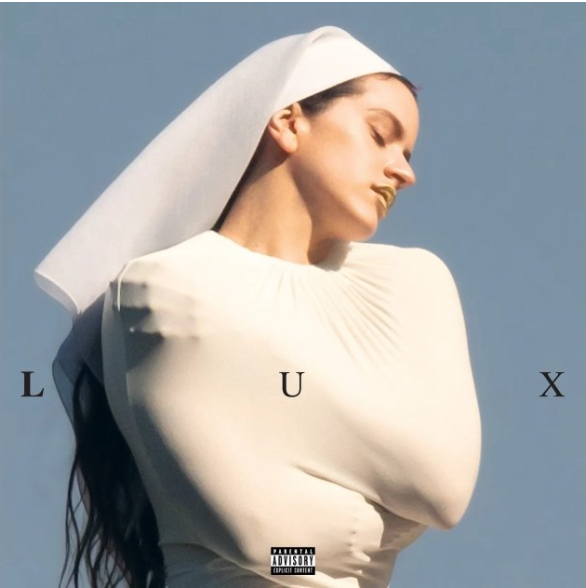
This is a well-designed package with a gatefold sleeve embossed like a heavyweight leather jacket - art direction and design are credited to Special Offer Inc. The photography is not high-end studio imagery. It has the sense of images made on the hoof in a live process, improvising scenarios, inventing poses, accepting blasts of flash to the face, or into-the-sun street-snaps, or impromptu backlit shadowy blurs. A large cruciform cardboard insert features all the lyrics (there are a lot of lyrics), in multiple languages and scripts, and with English translations too. The other side features dozens of photos of the artiste in a visual barrage, heavy with religious imagery and ‘liberated, expressive’ poses. Dedicated fans will find this a delight, and while multiple photos of the star is a crowdpleasing way to utilise the widescreen opportunities of a gatefold LP with bespoke insert, I realise I am not the intended audience for this type of imagery. The emotional honesty of her ‘performance’ in these photos is a visual counterpart to the vocal performance on the LP. This kind of public self-possession and copious religious references, in a contemporary context, combines sainthood and sexuality; our contradictory cultures still expect women to behave within strict norms while presenting themselves as objects of desire.
The double 12” is pressed on crystal clear vinyl - the deadwax is like a piece of glass. I have not seen any other vinyl pressings, so if you prefer a traditional black pressing to the new-fangled sci-fi vinyl productions, you may be out of luck. Two vinyl editions are listed by Discogs - a US pressing and a UK & Europe version. The discs are presented in transparent medium-weight plastic inner sleeves - I know this will also be unpopular with some readers, but I can report that my copy at least did not suffer from static issues as a result of this choice of material. I have not established the pressing plant for this release - the UK & Europe edition (which I have) is labelled with no more than ‘Made In The EU’. The lacquers were cut by Joe Nino-Hernes at Sterling Sound, Nashville - Joe deserves praise for translating a recording to vinyl which includes some thundering electronic sub-bass as well as delicate choral sections, blasting orchestral bombast and an intimate female vocal. The sonic qualities on these discs are impressive, particularly preserving the dynamic range of the light, quiet passages while not compromising the raw power of the orchestrations. This is a modern recording where the quiet parts are quiet and the loud parts are loud - and while I may sound like I am stating the obvious, The Loudness Wars are evidence that we do need sensitive engineers to produce records with the dynamics to render both a whisper and a scream. This is emphatically the case on this release, where all four sides offer generous physical space to ensure each track can present the heft and punch required - there will be no inner groove distortion here, as the playing surface is at least an inch from the label on all four sides.
I have highlighted the three bonus tracks which are available on physical formats only (LP and CD). This perhaps ensures that the dedicated listener will acquire one of these formats, and the extras will not disappoint. The streaming versions, shorn of three very worthwhile extras, are still a fine way to road-test your emotions when faced by this uncompromising, confrontational diva. "Lux" is a thrilling, addictive LP, and seems to have prompted some critics to scrub out their previous choices for Album of the Year - I already have.