


The Best Of Muddy Waters
Acoustic Sounds Reissues The Iconic Blues Album
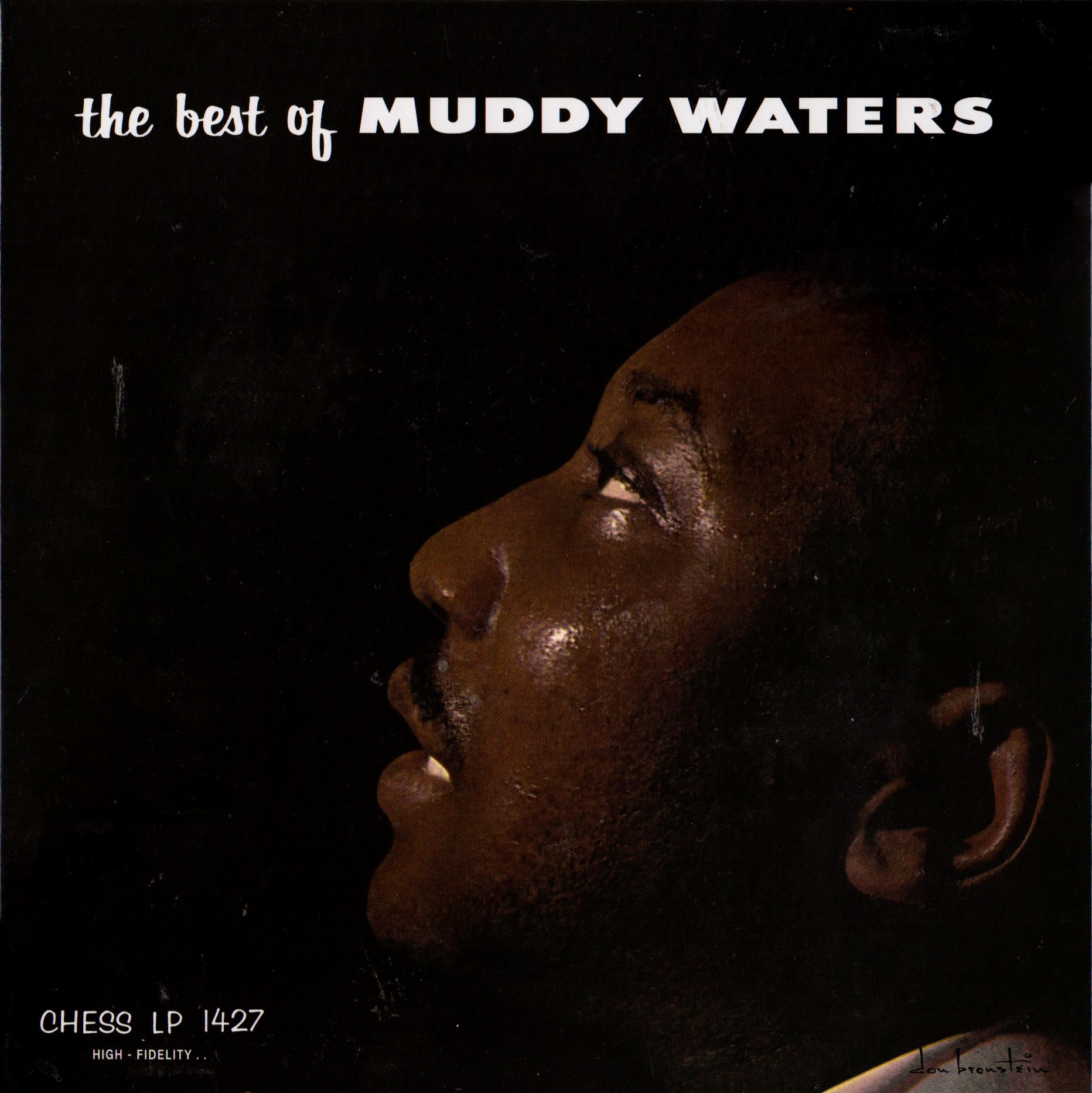
In April 1958, Chess Records released its third LP, The Best of Muddy Waters. It was a straight up, no compromises, hard blues album, a look back to earlier days of the label when Muddy, recording classic after classic, created the template for what became Chicago Blues. But now Chess was chasing crossover, big money, pop hits, and was no longer primarily a blues label. The prior two LPs, Rock, Rock, Rock, a movie soundtrack, and After School Session, Chuck Berry’s first album, were aimed at the teen market.
Muddy had been Chess’s best selling artist before rock ‘n roll. Chuck Berry, Bo Diddley, and white rocker, Dale Hawkins, were now the company’s stars. Muddy was forty-three. He played adult, very Black music, much of it overtly sexual, primarily for an audience of working class Black people who had migrated during World War II to the North from the Deep South and who were now middle aged. Muddy was never going to cross over to the teen idol dominated pop charts.

But Muddy was still having R&B hits. “Close To You,” in October 1958, made the R&B top ten. It would be his last R&B hit. His audience was aging, and Black music was changing fast.
Young Black people, many born in the North as the sons and daughters of migrants, associated “downhome” blues with life in the Jim Crow South, a life they had escaped from and wanted no part of. Instead, they listened to modern jazz, vocal groups, R&B bands, Chuck Berry, Bo Diddley, and the beginnings of soul music. Sam Cooke had a #1 hit with “You Send Me” in 1957. Smokey Robinson’s “Got A Job” was a minor hit in 1958.
Muddy’s brand of Chicago juke joint blues was now old fashioned. His career had peaked and was now heading downwards towards the fate of so many Black artists who had never crossed over to the white audience---years of playing the chitlin’ circuit of Black clubs in the South for small money and worrying if the bus would make it to the next gig. Or, even worse, obscurity and the choice of manual labor or poverty.
Muddy was lucky. Because of the never ending, but always unpredictable, fascination of white people with African-American culture, Muddy got the opportunity to make a whole new career for himself. Leonard and Phil Chess, the owners of Chess, were astute businessmen who had their fingers on the pulse of Black music. They knew that Chicago Blues was losing its Black audience, but they sensed that the heretofore unimaginable might now be possible, and decided to try to sell the music to white people. Bill Broonzy, Leadbelly, Sonny Terry and Brownie McGhee had all made successful careers playing blues for white audiences. Elvis had recorded down home blues tunes. Much of the repertoire of performers in the ongoing folk revival was blues. Most tellingly, Muddy was scheduled in the fall of 1958 to tour the U.K., a long way geographically and culturally from the Southside Chicago clubs.
The R&B and blues audience bought singles. The Best Of Muddy Waters was the first Chicago Blues album and the Chess brothers aimed it squarely at potential white listeners. The liner notes by Studs Terkel are a primer and explain what a black cat bone is, provide info about Black migration to Chicago, detail Muddy’s history, and make the case that, while his musicianship may be less polished than that of Miles Davis and John Lewis, his art is equally sensitive. All the tunes were at least four years old, some as many as ten. Muddy’s Black fans had already bought all this music on 45s or 78s. To them, the album was expensive ($3.98 in 1958 is nearly $45 in 2025) and unnecessary. To curious, neophyte, white listeners, the album was an outstanding introduction to Muddy and electric postwar blues.
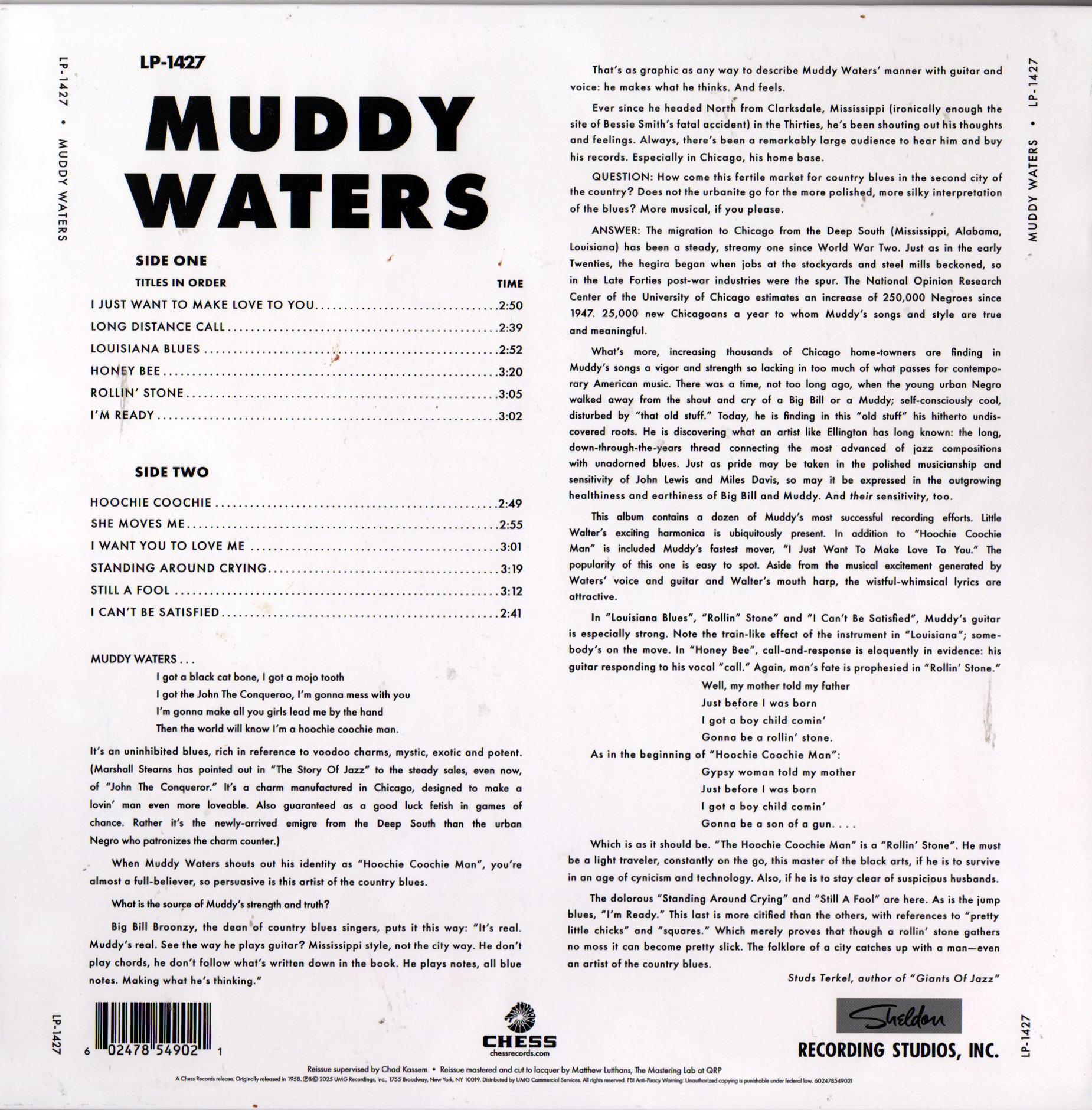
The twelve tunes were recorded between April 1948 and September 1954. Seven made the R&B Charts. A more accurate title would be Muddy Waters’ Greatest Hits. The five non-hit songs are traditional, Delta styled tunes with lots of guitar. Some absolutely great, rocking performances by Muddy’s classic band with Little Walter and Otis Spann are missing. But I am quibbling. Every song on the album is a classic.
“I Can’t Be Satisfied,” “Rollin’ Stone,” and “Louisiana Blues” are the three earliest recorded tunes on the album and are only slightly modernized Delta blues. Muddy plays electric slide through a small amp pushed to the brink of distortion. His playing is melodically simple with a beautiful, dark tone and an incredibly strong, grooving time feel that is simultaneously tight and loose. Muddy, like all the great blues players, had a very personal, supremely sophisticated, sense of rhythm. The blues, played by the greats, is not simple music.
On “I Can’t Be Satisfied” and “Louisiana Blues,” Ernest Crawford plays unnecessary, sometimes distracting, and sometimes harmonically incorrect bass lines, but Muddy is unfazed. Virtuoso harmonica player, Little Walter, on “Louisiana Blues” blows behind Muddy’s vocal, brilliantly improvising on the melody and Muddy’s phrasing simultaneously.” “Rollin’ Stone,” a version of the Delta standard, “Catfish Blues,” is just Muddy and his guitar. Over maybe the ultimate head nodding rhythm and a one chord guitar riff, Muddy sings, with a combination of ultra cool charisma and braggadocio about how women find him irresistible. Only a fool would doubt him.
“Long Distance Call,” “Honey Bee,” “She Moves Me,” “Still A Fool,” and “Standing Around Crying” were all recorded in 1951 and 1952 and show Muddy moving away from Delta blues. He is now singing coherent, storytelling lyrics instead of the collections of loosely related, usually traditional, verses that made up his earlier songs. His voice is stronger, more declamatory, and his phrasing shows the influence of jazz. The slide guitar is more heavily amplified, the distortion replaced by sweetness. The melodies are more original using some wide intervals that only a singer of Muddy’s talent could manage. The chord structures are more complex than usual in Delta blues. The rhythm played more heavily, more danceably. This is Delta blues becoming urban music.
In 1953 and 1954, Muddy finished the job and created the template for Chicago Blues and the music he would play for the rest of his life. He now has a band, a sextet — himself and Jimmy Rogers on guitar, Little Walter playing his harmonica through an amplifier, the great Otis Spann on piano, Willie Dixon on bass, and the master of the shuffle, Fred Below on drums.
The titles say it all: “I Just Want To Make Love To You,” “I’m Ready,” “Hoochie Coochie Man,” “I Want You To Love Me.” The songs are full of macho bluster and rampant horniness, but Muddy sings them without goonishness or self parody. He’s near shouting now but his vocals still show his amazing phrasing and sense of time. Behind Muddy, the two guitars lay down a solid, swinging rhythm with the bass and drums, while the harmonica wails and the piano fills in the spaces. It’s rocking, party music but it is also a music of great subtlety, played masterfully. The virtuosity is not a virtuosity of great complexity but that of a perfect unity of simple parts. The band was the virtuoso, and they created masterpiece after masterpiece.

Encouraged by sales of The Best Of Muddy Waters to white people, Muddy and the Chess brothers continued the crossover attempt. Muddy still recorded singles for the blues/R&B market but his albums were now aimed at white youth. In June 1959, Muddy recorded, Sings "Big Bill” a tribute to Bill Broonzy who had died the year before. It was a blatant attempt to appeal to the young white folk audience and probably helped him get a gig at the 1960 Newport Folk Festival. The resulting live album was a great success. Orders came in from college towns and cities in the North where Muddy had never sold records before. The next album was entitled, Folk Singer, a misnomer and a shameless commercial ploy. Then there were reissues of some of his fifties material on albums called equally disingenuously, The Real Folk Blues and More Real Folk Blues. In the late sixties and early seventies, there were albums recorded with American rock stars, others with British rock stars, and some with psychedelic rock accompaniment (dismissed by Muddy as “dogshit”). Muddy’s last recording was a live album with the Rolling Stones. He had truly crossed over.
Acoustic Sounds has reissued The Best Of Muddy Waters in their Chess 75 series, remastered, all analog, from the original analog tapes by Matt Lutthans at The Mastering Lab. The record comes in a glossy tip-on, gatefold jacket that beautifully reproduces the front and back covers of the original album. Inside the gatefold are two pictures of Muddy, one from the early fifties and one, apparently from the sixties. The original black Chess labels are exactly reproduced except for some boilerplate rights info in tiny, barely noticeable print. I commend Acoustic Sounds for their attention to detail.
My record was free of marks and pressing flaws, except for a very slight edge warp that did not affect play. The record played very quietly. It must be noted that “Rollin’ Stone” and “I Can’t Be Satisfied” play with surface noise that is on the original master tape. Apparently, these tunes were mastered in 1958 from 78s, not tape.
I own a black label, original Chess The Best Of Muddy Waters, plus a mid-60s reissue and various later reissues. All the reissues, I thought, were sonically inferior to the original black label. So, we shall use it to dare to compare.
In 1958, the audio equipment, especially turntables, that most people owned was primitive compared to today’s, even modestly priced, gear. Mastering engineers attempted to compensate for the limitations by using compression to make the records play louder and boosting the midrange to make the music sound clearer and more immediate through poor speakers. These techniques were used to master the original Chess black label pressing. There is a noticeable boost in the upper midrange, and the dynamic range is compressed. The bass seems attenuated and the whole tonal palette is tipped upward. The record plays with an aggressive, insistent sound.
The Acoustic Sounds The Best Of Muddy Waters sounds very different. It’s immediately noticeable that the sound is smoother and warmer, but not soft. The music sounds more natural, more relaxed. Bass is deeper, more tuneful, less thumpy. Soundstage is a bit wider. The ultra quiet QRP vinyl allows a bit more low level detail and more air to be heard. Dynamic range is wider and more natural. Muddy’s voice sounds slightly deeper and sweeter, less harsh. The Chess “sound” was dark “tube-ness” and pushing the level meter intensity. This mastering captures that sound.
For decades, I listened to the “compensation mastered” Chess original The Best Of Muddy Waters and always enjoyed it immensely, certain that this music could not sound better. But now that I have heard the Acoustic Sounds version of the album, I can’t listen to the original without hearing what is missing. The Acoustic Sounds reissue is the best this album has ever or probably will ever sound.
The Best Of Muddy Waters is the most influential blues album ever released. It changed people’s lives. In 1961, when Keith Richard met Mick Jagger, Jagger was carrying a copy of The Best Of Muddy Waters. Anyone interested in blues, rock, or the history of American music should listen to this album.
Copyright and all rights reserved by Joseph W. Washek 2025