
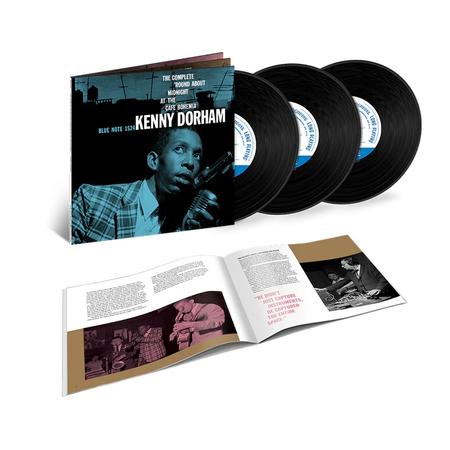
The Complete Cafe Bohemia Dorham Recordings Get A Triple AAA Vinyl Release
3 180g LPs, triple deluxe laminated gatefold, excellent annotated booklet, $73
It's a safe bet that Kenny Dorham is better known in 2026 than when he was alive and performing. He died young at 48. Another safe one would be that he's sold more records over the past few years than he did when he was active. And boy, was he active both as a sideman and as a leader. Always underrated and unfairly in the shadow of some of the big names of his time, it could fairly be stated that now is Kenny Dorham's time.
He played with Hampton, Gillespie and Eckstine big bands, joined Charlie Parker's quintet, was a sideman with Monk and Rollins and nurtured the young Joe Henderson's career. He was also an original member of The Jazz Messengers.
However, even Leonard Feather's original annotation for the excerpted appearance on a single Blue Note LP recorded May 31,1956 begins with the writer feeling "...obliged to point out that here was an artist who had been known too little for too long, whose fame had never quite caught up with his creative ability".
And so it went throughout Dorham's performing career. He also taught at the Lenox School of Jazz and for a time was a Downbeat Music critic—something I discovered researching for the IMPEX reissue of Dorham's Matador originally released on United Artists in 1962. However, more reading this previously unfamiliar with Dorham probably had the flame lit by the Craft reissue of Quiet Kenny on which he's the solo horn player on a not so quiet album. Long time fans are now saying to themselves, "Are you kidding me?" So I'll stop.
Dorham's group here post Jazz Messengers features a teen aged Bobby Timmons, a new on the scene tenor saxophonists J.R. Montrose and Arthur Edgehill on drums and Sam Jones, then with Cannonball Adderley on bass. Kenny Burrell, then 25 and a signed Blue Note artist, sits in adding another dimension to the mix.
The set list includes originals and familiar jazz tunes like "A Night In Tunisia" and "'Round About Midnight" along with songbook standards like "Autumn in New York" and "My Heart Stood Still", but the program is less important than the ensemble's work throughout, which mostly grooves under a slow simmer. If you are used to Lee Morgan's fiery trumpet on the Blakey album A Night in Tunisia (recorded 5 years later) you'll find Dorham's nimble dancing around the melody indicative of his typically understated style.
That's followed by a special rendition of "Autumn in New York" in which the teenaged Timmons delivers a most mature reading and Dorham lays out a cool breeze. Side two of the original album closes with "Hill's Edge" a more typical uptempo, tuneful hard bop number the ensemble effortlessly glides through.
This Tone Poet release is the first time the complete evening's performances have been released on vinyl. There was a 1995 CD release. The rest of the tunes, as with the original album mix standards like "My Heart Stood Still" with alternate takes that include many Dorham originals and "N.Y. Theme", that closes side six, credited to Dorham but is obviously Monk's "52nd Street Theme".
Syd Schwartz's excellent annotation in the full sized booklet covers the music track by track, the club's origins, a short Dorham bio and the gig itself. Even Rudy Van Gelder gets coverage complete with a photo.
As for the sound, it's remarkably well-layered three-dimensional, vivid mono. The cymbal hits that open "Night in Tunisia" are remarkably present and precise and all of the players sound tonally "there". Most remarkable is the piano sound RVG managed to get here: it's way better than on many of his Hackensack studio recordings.
The set is a swinging history lesson with pictures. You can read while listening or sip scotch or lose your New York cabaret card. Whatever your accompaniment, you're sure to enjoy sit night at hole in the wall that was The Cafe Bohemia



























.png)