

The Miles Davis Quintet's Live 10-LP Masterpiece Gets A Second Release
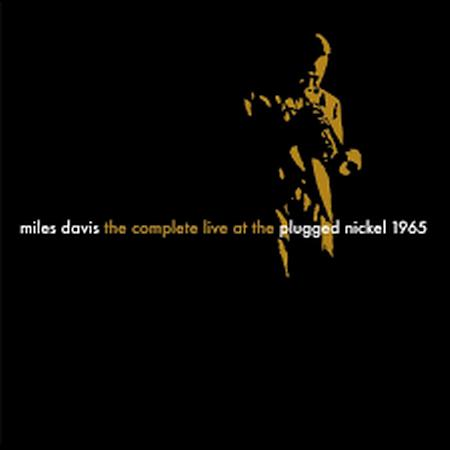
A new vinyl reissue of "The Complete Live at the Plugged Nickel"
Let’s cut to the chase: Miles Davis’ The Complete Live at the Plugged Nickel is one of the most thrilling jazz albums ever, ceaselessly captivating, “the sound of surprise” (as Whitney Balliett once defined jazz) at every turn.
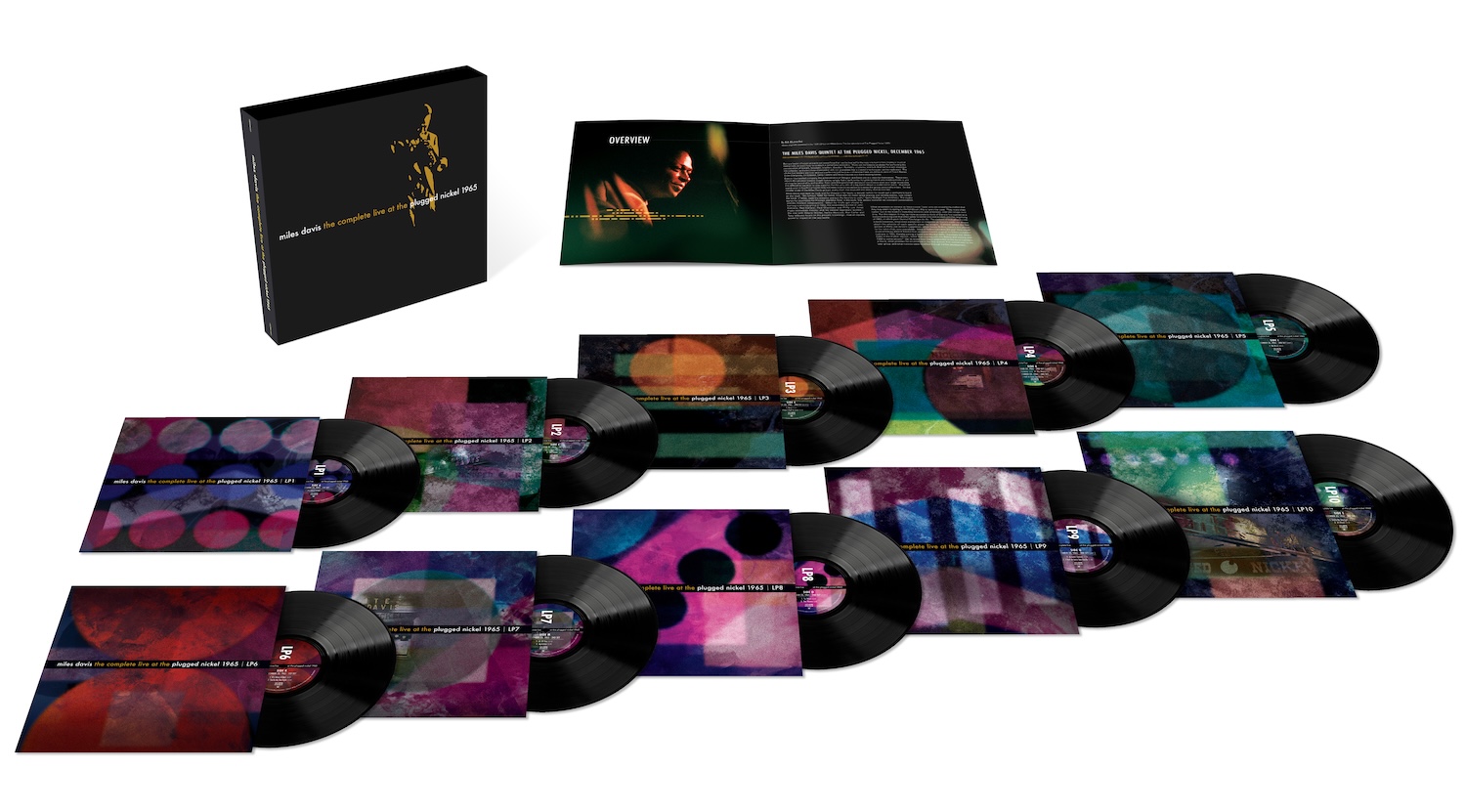
A 10-LP boxed set, recorded live at a small Chicago club called the Plugged Nickel in December 1965, it captures Miles Davis, the most masterfully innovative trumpeter of the era (perhaps of all eras), fronting what came to be called his “second great quintet”—tenor saxophonist Wayne Shorter, pianist Herbie Hancock, bassist Ron Carter, and drummer Tony Williams—at a peak of their quest to reshape modern music.
But at the same time, a fair bit of mythology has suffused this album, some of it spun by one of the musicians, perhaps to dramatize the narrative, perhaps the result of conflated memories (and much of it, alas, regurgitated in the boxed set’s otherwise informative booklet). What’s true is that, in the mid-‘60s, Miles and his young bandmates were carving two separate paths. They were recording new, highly original music in the studio (some of it composed by Shorter). At the same time, they were reprising older tunes—the blues, ballads, and standards from Miles’ playbook of the mid-to-late 1950s—in nightclubs and concert halls, though in radically new ways inspired, in part, by the “free jazz” of Ornette Coleman, Eric Dolphy, and (post-Miles) John Coltrane: , altering the tempos, staggering the rhythms, twisting the harmonies into whole new cyclones, subverting all expectations.
In his 2014 memoir, Possibilities, Herbie Hancock wrote that the Plugged Nickel date is where they made this shift. The band had been settling into an all-too-easy groove. So, on the flight to Chicago, Tony Williams proposed that they play “anti-music,” by which he meant that “whatever someone expects you to play, that’s the last thing you play.” Hancock goes on: “Whenever a song would build up, getting to a natural peak, the natural inclination would be to push it over the top—but instead I would suddenly bring it down with one quiet note. Tony did the same, building up his playing in volume and intensity and then, instead of hitting the bass drum, he'd gently tap the cymbal. We did the opposite too, suddenly ratcheting up the intensity just as a tune was winding down.”
This is a good description of at least some of what we hear on the Plugged Nickel albums, but Hancock’s account of its origins just isn’t right. No fault of his own. The thing is, nobody, not even the musicians, heard these tracks for more than a decade after they were laid down. Engineers from Columbia, Miles’ label at the time, set up their gear inside the club and recorded seven sets over two nights, but the tapes stayed in the vault until Sony Japan released a two-LP excerpt in 1976. Columbia didn’t put it out in the U.S. until 1982. An even more pared-down version came out on CD in 1989. Not until 1995, to mark the gig’s 30th anniversary, did Columbia put out The Complete Live at the Plugged Nickel in an eight-CD boxed set. In an unusual licensing arrangement, Mosaic Records released it simultaneously on 10 slabs of vinyl. And now, at the start of 2026, to kick off Miles’ centenary, Sony has reissued a new box of 10 LPs, mastered from digital files. (The Mosaic box, which was struck directly from the tapes, is long out of print.)
The release of the full seven sets made such a dramatic impact back in 1995 because, even among jazz aficionados, almost nobody knew what Miles’ second great quintet had been doing in the clubs in the mid-‘60s. It came as a shock that the band’s live re-vampings of old classics were, in their own way, at least as adventurous and original as their by-now-famous studio albums of all new material. And because the Plugged Nickel boxed-set was the only evidence of this second path the band had been carving, it was natural to assume that the Plugged Nickel was where it all began. Since even Herbie Hancock hadn’t heard the tracks since he recorded them 30 years earlier, he may have conflated his memory of when he and Tony had those conversations about making “anti-music.”
In fact, though, in the decades since The Complete Plugged Nickel first hit the bins, Sony has released long-buried tapes of concerts that Miles’ quintet played in Paris and Berlin in early 1964—almost two years before the Plugged Nickel dates of December 1965. Listen to those albums—notably Miles in France, 1963-64, a six-CD / eight-LP set marking Vol. 8 of Sony Legacy’s Bootleg Series, which wasn’t released until 2024. You’ll hear the same adventurous disruptions that Hancock described in his memoir. So he and Tony couldn’t have plotted it on the plane ride to Chicago. Maybe they did it on the earlier plane ride to Paris? In any case, when Hancock writes that Miles was surprised by what he and Williams started playing in Chicago (“He knew better than anyone that something strange was going on, but he never asked us, and we never told him, he just went with it, and he was brilliant!”), he is clearly mistaken.
It's unlikely, as well, that Miles was surprised by what the young radicals were doing on the piano and the drumkit in France in ’64. Go back to March 1960, during Miles’ final concerts, in Europe, with the band that featured John Coltrane—documented on a 4-CD set called The Final Tour, Vol. 6 of the Bootleg Series, released in 2018 (though unauthorized excerpts had been circulating for a while before then). In those concerts, played to mixed crowds, some enchanted, others bewildered, Coltrane—eager to leave the band and launch his spiritual quest for the musical equivalent of nirvana—took solos on the classics of Miles’ songbook that, for sheer out-there-ness, overshot even the wild orbits that Shorter flew a few years later. The thrill of the 1960 sets lies in the tension between Miles and Coltrane—longtime collaborators, now on the edge of new terrain, reversing their roles of mentor and acolyte. In the later sets of that tour (on the later discs of the 4-CD set), we hear Miles peering, sometimes plunging into the darkness, escaping gravity, no longer just “walking on eggshells” (as his style was once described) but insouciantly breaking some.
In other words, well before the Plugged Nickel date in 1965 or even the French tour of ’64, Miles Davis knew which way the winds were blowing. He had been a primary player, sometimes a leader, of the past few revolutions in jazz—Charlie Parker’s be-bop, backbeat-inflected hard bop, the Birth of the Cool and orchestral jazz sessions with Gil Evans, the modal jazz of Kind of Blue. Revolutionaries tend to eat their young, and Miles had notoriously mixed feelings about the “new thing” of Ornette Coleman and Eric Dolphy. Still, he navigated his own way toward adaptation. After all, he hired the young rebels, especially Williams and Hancock, because he wanted them as not just as acolytes but guides. By then, the new thing was no longer peripheral to the jazz scene but simmering in its center, and a moldy fig was the last thing Miles Davis ever wanted to be.
It's to our great fortune that seven of the sets at the Plugged Nickel were laid down on tape, but, in a sense, it was just another gig, one more stop along a thrilling path that had begun a while back and kept going for a while longer. It may be telling that, in Miles: The Autobiography, published in 1989, the man himself mentions a club date in Chicago only in passing.
One thing did change between Paris and the Plugged Nickel. In April 1965, Miles had hip surgery, which kept him in the hospital till July. In August, he broke his leg while play-wrestling with his son. For several months, then, the second great quintet was shut down. In the interim, his bandmates played a lot, for the Blue Note label, on their own and together, without him. Tony Williams recorded Spring, a puzzling masterpiece of an album, with Hancock, Shorter, and Williams. Shorter recorded Juju and Speak No Evil, the former with Coltrane’s band (McCoy Tyner, Reggie Workman, and Elvin Jones), the latter with Hancock, Carter, Jones, and, taking the trumpet seat, Freddie Hubbard). Hancock recorded Empyrean Isles and Maiden Voyage, both with Hubbard, Carter, and Williams.
In other words, by the time Miles recovered and returned, his bandmates had racked up hours of practice and studio time, over a span of months, playing together as leaders and sidemen. They’d absorbed each other’s moves, mapped out counter-moves and mind-melds. Miles remained the leader, you can hear that if you listen closely or often; but he was now at the helm of a cohesive unit; it was tighter, more supple, fully prepped for adventure.
And an adventure this is! It’s worth reemphasizing, for all the above myth-puncturing, The Complete Live at the Plugged Nickel is a fantastic set of music, an essential purchase (if you don’t already have the Mosaic box), and worth repeated listens. “Free jazz” can be a misleading term. In the best of hands, the music, while limber and playful, is tightly structured, and Miles Davis’ second great quintet are among the best of hands.
Davis, the old man of the bunch at 39, blows in choppier fragments than you might be used to hearing from him, certainly more so than listeners at the time had, but he still displays a knack—a genius—for finding just the right chord, phrase, even single note, to play at any given time. It’s hard to figure out what he’s doing, but all of it makes perfect sense. Shorter, who at the time was 22 and still fairly new, blows hot and cool with astonishing confidence. Hancock, 25, coaxes tone clusters that resolve the slantiest dissonances—or don’t, depending on whether resolution is called for. Carter, 28, the classicist of the crew, who had already played with a wide range of jazz stars, holds everything together while keeping a lot more than merely time. And Williams…what can one say? He’d just turned 20, and, even then, very few drummers (if any) could slap, soothe, or insinuate so many tones, moods, rhythms, or rhythms-within-rhythms, to such dazzling effect: at times, he seems way out of synch with his bandmates, but then listen closely: you see that in fact he’s leading the way.
Some of this may sound at first hearing a bit of a shamble, but it’s not, even when the players don’t quite know where they’re going.
Back in 2017, Jazz Times asked 40 jazz musicians and critics to analyze their choices of great jazz solo. The trumpeter Dave Douglas picked Wayne Shorter’s solo in “On Green Dolphin Street” from the Plugged Nickel album. Douglas wrote:
“It’s the counter-intuitive choices Shorter makes in this solo that really get me. By counter-intuitive, I mean: Shorter seems to use the unusual notes in a chord or voice-leading moment to connote other harmonic areas, keys and scales, and somehow always manages to resolve the dissonance tunefully but almost never in the way you expect. It helps that his dialogue with the rest of the band is telepathic, with each interesting harmonic, melodic and rhythmic choice leading to an intelligent and emotive response. The deeper you listen, the more profound those choices seem. That makes a great improvisation, no matter the music or style.”
Certainly it makes great jazz.
The quintet continued carving their two paths—striking new pieces in the studio, hair-raisingly refashioned old ones in concert—for the next two years. (Check out Live in Europe 1967: The Bootleg Series Vol. 1, first released in 2011 and way tighter and fiercer than the Paris or Plugged Nickel Concerts.) Soon after, the band split up, as Miles spawned the next revolution, fusing with electric instruments and rock, attracting new audiences while alienating or, after a while, intriguing the old ones. He died in 1991 at the age of 65. Live Around the World, a collection from live concerts in his last three years—featuring his rich old tone against a rock ‘n’ roll rhythm section (in, by the way, excellent sound)---is terrific.
The sound quality of the new Plugged Nickel albums is a mixed bag: well balanced, clear, Miles’ horn vibrant, but Williams’ trap kit paper-y, Carter’s bass flat, Hancock’s piano a bit distant. If this were mastered off a radio broadcast, like some of his live albums, I’d say it wasn’t bad, but this was taken down by Columbia engineers. Still, it’s still not bad; the music comes through, and the music is so valuable, it’s worth putting up with the shortcomings if you don’t have, or can’t find, the Mosaic. I used to own the Mosaic, don’t know what happened to it, so our editor, Michael Fremer, who has both, has offered to compare the two in a PostScript.
MF's Mosaic-Based Post Script
First, the original Japanese Miles Davis At Plugged Nickel, Chicago issued by Sony Japan in 1975 as two separate records (Sony 25AP 1 & 25AP 291) was mixed by remix engineer Tomoo Suzuki. Columbia Records in 1982 issued a double LP set At Plugged Nickel (C2-38266) from the same Tomoo Suzuki mix, mastered by Joe Gastwirt. The mix is radically different and not nearly as sonically accomplished as the 1995 remix by Debra Parkinson sourced from the original 3 track analog tapes to analog 2 track tape.
As the late Michael Cuscuna points out in his "Producer's note" in the long out of print Mosaic 10 LP AAA set (MQ10-158), "The masters for this set were remixed from the original analog three-track masters, greatly improving upon the sound of all previous issues and eliminating some distortion that appeared on the original 7-CD set issued in Japan".
Another interesting fact pointed out in the notes is that "Several tunes were edited in all previous issues because segments of these performances were missing when a reel of tape ran out, and had to be changed. By finding a second set of reels which covered those missing segments, we were able to restore all tunes to full performance". That's more than a half dozen tunes fully restored.
It's also worth noting that the original engineers on these live sessions were Frank Bruno and Edward (Bud) Thomas Graham (Buddy Graham in the credits). Bruno, who died in 2010 was a live recording specialist, with Dylan and Simon and Garfunkel among his live concert recording credits. Graham, who died in 2003 was a Grammy Award winning classical music recording engineer specialist. So the label sent its "A" team to record these performances.
I compared the Mosaic box sound cut from the analog master tapes by Duncan Stanbury at the Master Cutting Room with this new release mastered by Sean Brennan at Battery Studios in New York City (Mark Wilder has retired from Sony, but is still mastering recordings), cut at SST in Germany and pressed at MPO in France. Obviously Brennan mastered to digital files, the resolution of which is not noted in the new box's annotation but we can (hopefully) assume 96/24 or 192/24 or perhaps DSD or quad DSD but we do not know for sure.
But before getting to the comparison here's another thing worth noting: 30 years plus ago, Mosaic's early LP reissues were cut from digital sources—probably CD resolution at the time— and the sound was "meh"—not bad since at least the sources were master tapes, but as I recall, both Fred Kaplan and I independently lobbied Michael Cuscuna and his Mosaic partner Charlie Lourie (also deceased, passed away in 2000 at age 60) to release Mosaic box sets cut from analog tape. The boxes with "Q" in the catalog numbers are from tape and of course Q stands for quality and those boxes sound far superior to the ones without the "Q".
Fred asked me to compare "On Green Dolphin Street" a 12:48 long track that includes as Fred points out a Wayne Shorter solo that trumpeter Dave Douglas picked as a great jazz solo when asked to name one by Jazz Times magazine.
I hadn't played the Mosaic box in a long while (having too many records is a curse as you look longingly over a huge stash you've not heard in a very long time and may never again get to hear—I got a shelf full of these Mosaics—), which makes these "assignments" really great because you are forced to listen!.
First I played the new box set's version. Compared to nothing, the sound was enjoyable. A very nicely recorded set in a small club. Miles center stage was the star, and the mix reflects that. Hard mute trumpet gives way to more golden tone, Shorter enters for that solo from stage right, Williams and Hancock off to either side. A nice enjoyable live recording.
Moving on to the Mosaic: OH NO!!!!!!!!!!!!! Now the air and space of the club appears between the speakers. The musicians are placed in clear relief on the stage. Miles's mute trumpet has a sharper, crispier edge and when he removes the mute the brass gleams, Shorter's place on the stage is distinct, he's in three dimensions and as he plays his slight movements track. His reedy tone so further fleshed out. Same with Hancock's piano. Every hit of Williams's cymbal becomes an event. Now you're hearing live musicians playing in a well defined space as if you are there. The backdrop is blackness.
Going back to the file based LP, everything turns grey and slightly out of focus, even the applause goes from hands clapping to sort of rain on the roof. Stage depth flattens, transients soften and blur.
I wish I could write that I'm exaggerating for comparison's sake but I'm not. Yet when you do not know what you are missing the new release sounds good because the recording was for the most part excellent (though as with most live recordings, musicians step away from the mic, or play too close to it and cause distortion, so expect a few hiccups) and the mix was as well. Sometimes piano, drums and sax sound a bit more distant than you'd want but on the AAA record, set against a more black background, it sounds appropriate.
This may sound oxymoronic or maybe just plain moronic but I'm going to digitize the Mosaic track at 96/24 and send to Fred for this comment. If it's worth publishing I'll post it here. BTW: the 10LP nicely packaged box set is priced reasonably at $214.98.
FK's PPS:
I have now listened to Michael’s digitization of the track from the Mosaic LP, and OH NO!!!!!! indeed. Even through my laptop speakers and even more plugged into my stereo, Fremer’s exudes more air, detail, punch, and color than the Sony ADA LP. Have the original tapes deteriorated, or is a re-reissue in order?