


The Sensational Return of Akira’s Famous Predecessor
Or a little bit more of everything: Hypersonic Audio
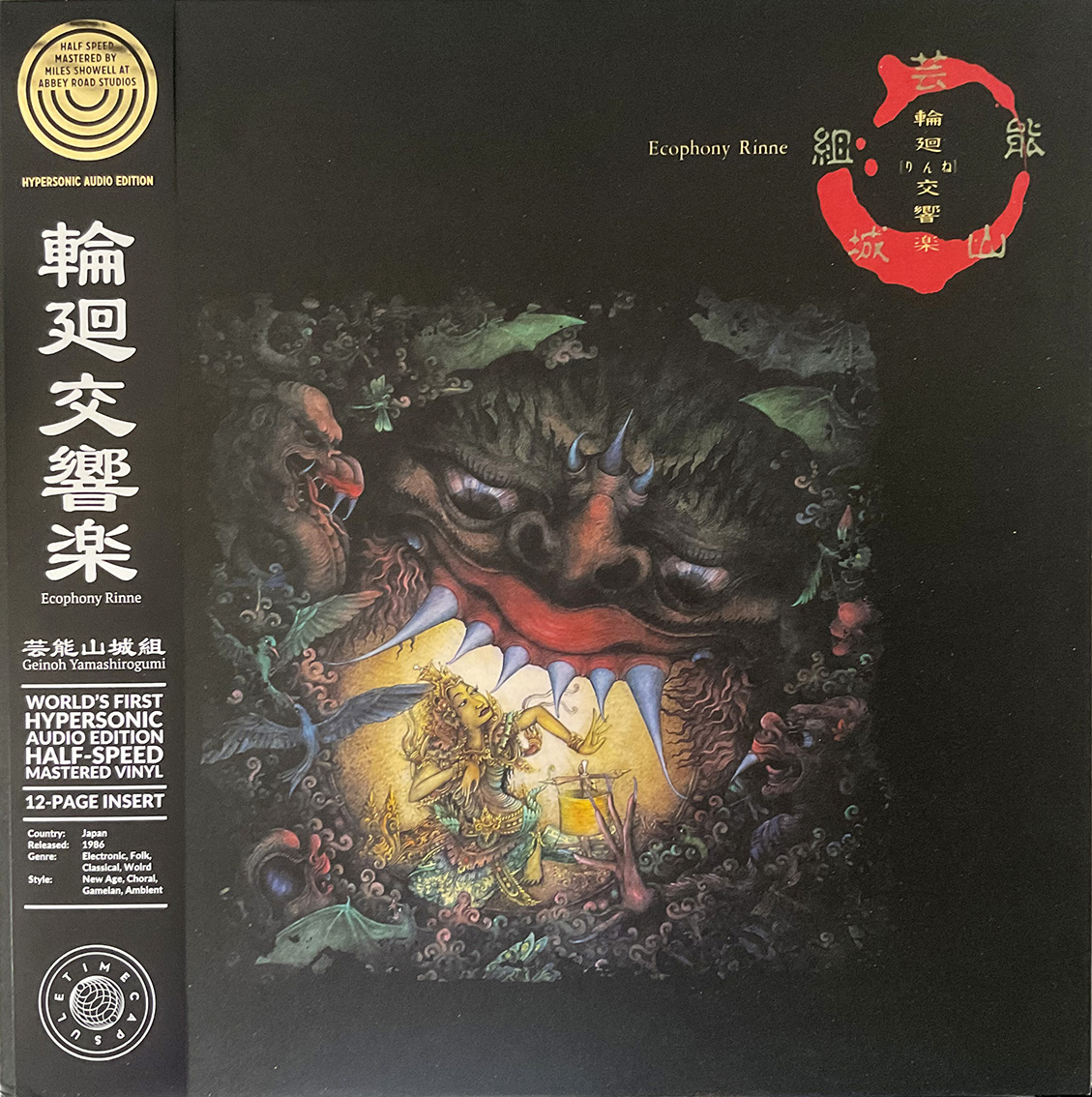
I’ll just start this text as if I’d discovered the album by chance in a store and bought it because I liked the cover or because I enjoy listening to Japanese recordings from the 1970s and ’80s (e.g., Sakamoto). Plus, the LP was a bargain at 32.99 euros. A real bargain these days, considering it’s a small limited edition with an obi strip and a 12-page booklet. Plus, it features half-speed mastering and 180g virgin vinyl.
The album was first released in 1986 on the Japanese RCA Victor label. If the information on Discogs is reliable, then Ecophony Rinne was the tenth album by the artist collective Geinoh Yamashirogumi. This group consisted of over 200 Japanese men and women who, in various ensembles, explored the appropriation of different instruments and their playing techniques. The second focus was on vocal techniques, always in a choral setting, even when individual voices are brought to the forefront. The vocal work is wordless, consisting of sounds, associative modulations, and playfully developed onomatopoeia. The vocal work imitates animal sounds and natural sounds; some of it nonverbal, similar to comic book sound effects.
Particularly interesting: since their first album (1976), Geinoh Yamashirogumi has reinvented itself multiple times, intensively adapting instruments, playing techniques, and compositions from countries that are—for the Japanese—distant lands. These include the overtone singing techniques of Bulgarian folklore (Echo of the Earth - Sings Eastern Europe), gamelan music, Silk Road folklore, and African folklore.
It is worth recalling here that after World War II—following the dropping of two atomic bombs on Hiroshima and Nagasaki, the unconditional surrender, and the abdication of the Japanese Emperor as head of state, reducing him to a mere ceremonial figure—Japan opened itself to the world for the first time in 1946. This applies in both directions! In this respect, it is understandable that, starting in 1967, a young generation sought to establish contacts around the world and familiarize themselves with the world’s cultures. I do not know how many projects existed in Japan at that time, but Geinoh Yamashirogumi is definitely the most impressive one.
While the first albums were still exploratory, a process of consolidation began at Geinoh Yamashirogumi in the early 1980s, leading to independent conceptual works that reached their absolute peak of maturity with Ecophony Rinne. The driving force behind this is Tsutomu Ōhashi (*1933), a polymath (agriculture, computer science, manufacturing technology, environmental sciences, molecular biology, anthropology, artificial life, Kansei, etc.), who co-founded Geinoh Yamashirogumi in 1974 and has led it ever since.
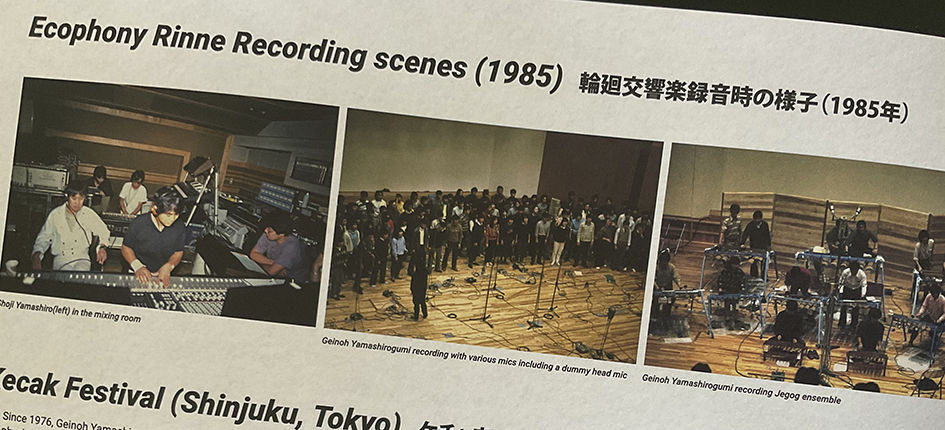 Additional Informations about recording sessions in 1985 (from the booklet)
For Tsutomu Ōhashi, the world can only be understood as a whole. In this respect, it is not surprising that he now provides a very detailed written explanation for the four-part cycle of Ecophony Rinne, which is essentially an environmental saga. In the liner notes for the album, he describes the cornerstones, mythically anchored and enriched with archaic storylines. The whole thing can perhaps be viewed as Japanese program music. Here there is a deeply hidden whole that splits into parts, allowing it to be explained and examined in such detail. If one reads the text while listening to the record, there are points of connection perceptible even to Western listeners.
In fact, Ecophony Rinne is a wonderful sound sculpture with entirely unique elements that captivate every listener. This is genuine world music, not some soft-focus wash or cheap ambient lullaby. If it were to remind one of anything at all, then perhaps selectively of Philip Glass’s music for Koyaanisqatsi (Hopi, Aztec language for “out of balance”), an ambitious documentary film (1982) by Godfrey Reggio that illustrates the modern world. In its intent and purity, Ecophony Rinne stands entirely on its own.
In terms of sound engineering, the recordings were made at the intersection of analog and digital. There are a few moments featuring an early sampling synthesizer, which provides rare percussive sounds that could not be produced in the desired sequence at the exotic location. Otherwise, the analog sound recordings were made with proverbial Japanese perfection.
Just the choral recordings alone, with elaborate free-field miking and an additional artificial head (microphone). Add to that the overtone-rich Balinese gamelan and other percussion instruments. Unusual, but very amusing, are the individual voices moving freely across the stereo stage, which eventually always rise to form very large bodies.
Ecophony Rinne is available in CD quality (16/41.1) on the relevant streaming services, but suffers there from a limited frequency spectrum and lackluster dynamics. For this reissue, Tsutomu Ōhashi has once again pulled out all the stops. Under his direction, a young team using new technology—including a monitoring system that extends far beyond the range of human hearing—has ventured a remix. Once again, it’s Japanese perfection.
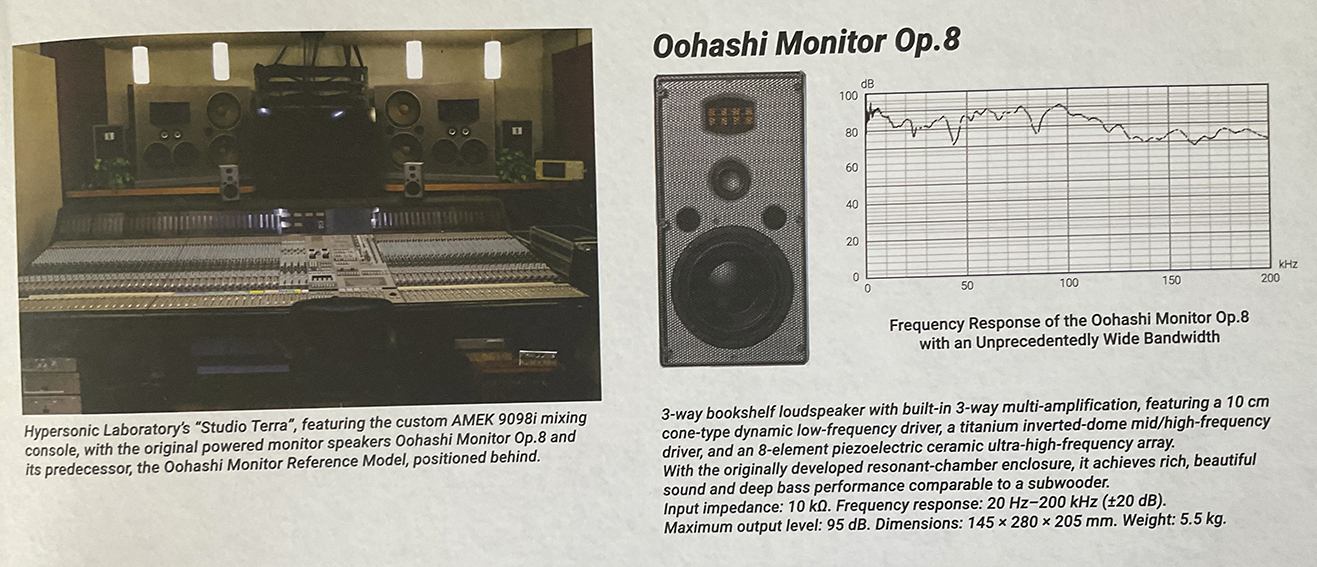 Additional Informations about the 2025 mix desk and monitor system (from the booklet)
The reissue is being released on Time Capsule, a London-based label specializing in reissues of out-of-print productions, primarily from Japan. The head of Time Capsule, Kay Suzuki, has lived and worked in London for a long time. There, he is part of a scene comprising small clubs and restaurants united by the fact that you can listen to vinyl records there. Yes, a listening bar scene has also established itself in London over the past 15 years. Suzuki has helped with some of these venues, taking care of the decor, food and drink, ambiance, sound, and, of course, the music. At the same time, he has made a name for himself as a DJ, graphic designer, curator, and label founder.
With Ecophony Rinne, Suzuki delivers his most mature work to date. The project, its execution, and design set new standards. Everything is executed with precision and excellence. The cardboard for the cover has been flipped so the matte side faces out; the reprography and printing are excellent. It also features an obi band, firmly and neatly folded, complete with gold accents. The record is very well pressed, flat, and the vinyl spins smoothly. The transfer to lacquer disc was carried out by the well-known half-speed specialist Miles Showell (Abbey Road). For this, a high-resolution Hi-Res digital file (24/96) from the current remix (Studio Terra) was used, which also reliably reproduces the distinctive overtone spectra of the exotic instruments. As is well known, the half-speed process requires less amplifier power in the high and very high frequencies (above 20 kHz), resulting in less distortion and allowing for better groove cutting.
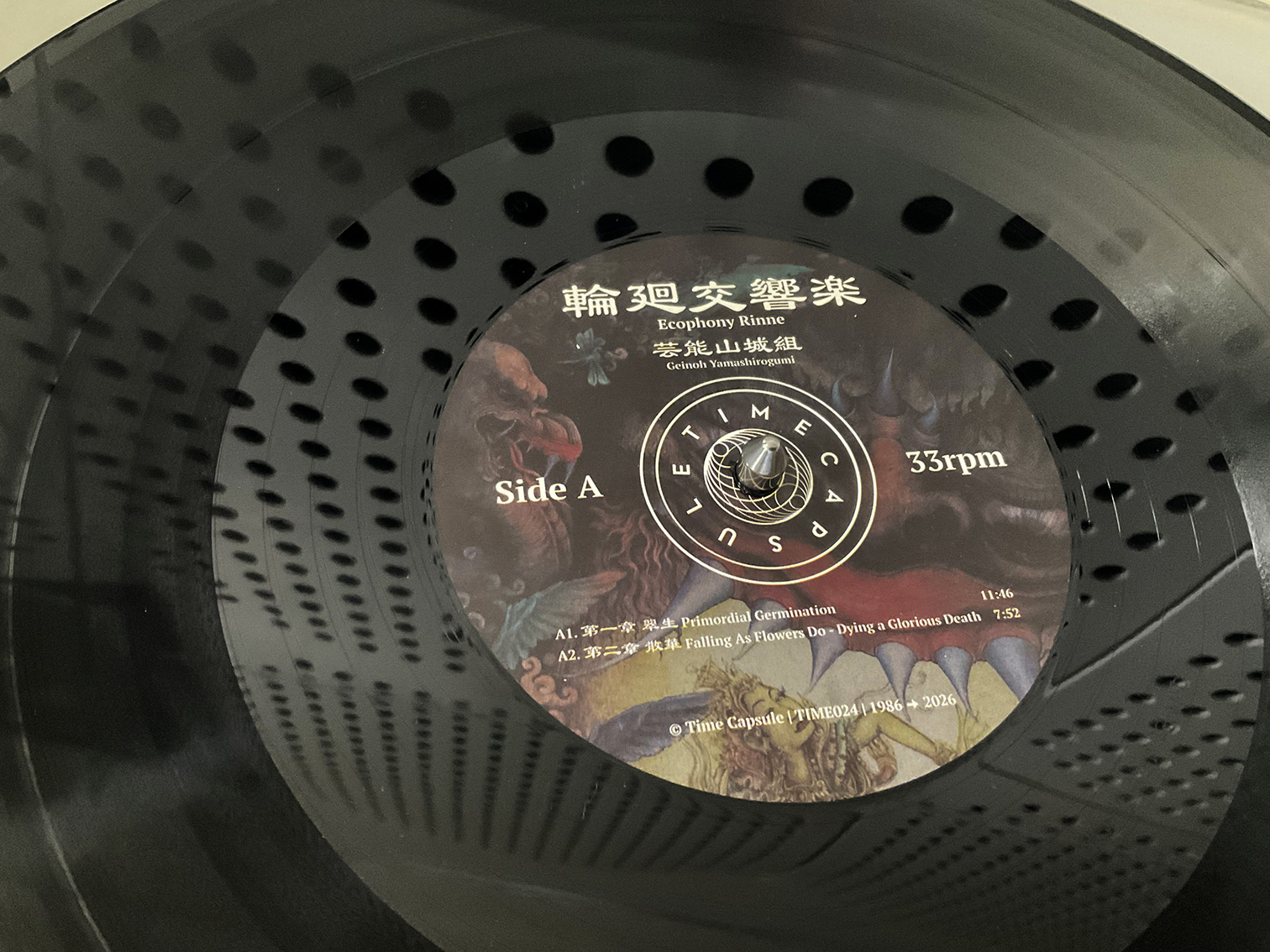 Very well-pressed record, flat and runs very quietly.
As a neurologist, he distinguishes between frequencies detected by the ear (LFC) and those that extend far beyond that range (HFC) and are perceived by the body. There is also a mathematical model explaining how the extended spectrum influences brain activity. In his laboratory tests, he worked with specialized audio equipment, such as the Denon DL-1000A cartridges (20 Hz–110 kHz), Satin M-21P (8 Hz–50 kHz), and the Oohashi Op.8 Monitor (20 Hz–200 kHz, ±20 dB).
Information about Hypersonic
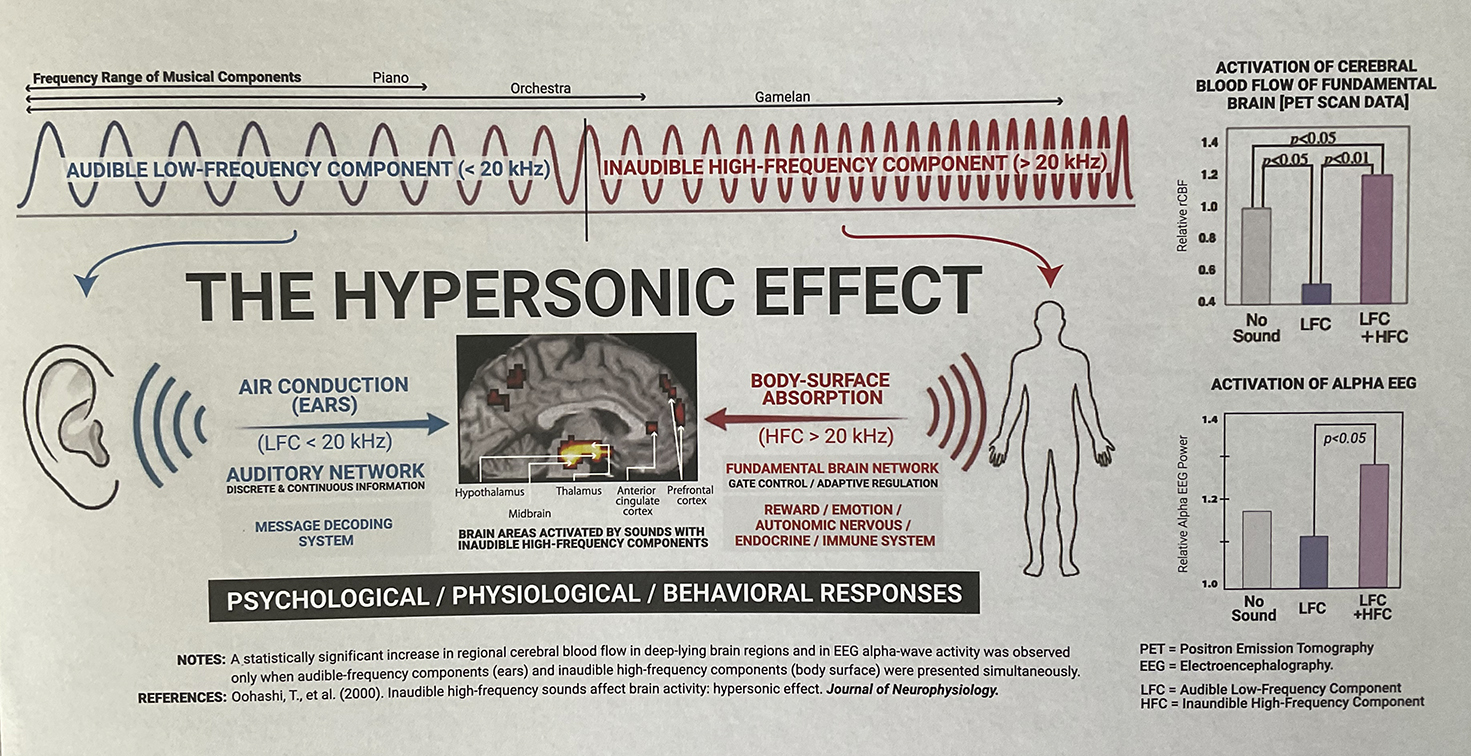 Additional Informations about the Hypersonic Effect (from the booklet)
Why do I recommend Ecophony Rinne? Because I think that amid all the current discussions about the better or even better remasters of popular pop or rock classics, one should simply flush out one’s ear canals with unfamiliar sounds once again. The album is exciting and not boring. Yes, it’s easy to listen to, provides a bit of a distraction, and might even whet your appetite for more.
Back to the beginning: No, I didn’t stumble upon the album by chance. In mid-February, Edward Forth (Audio-Technica Europe) from Leeds sent me an email saying he’d be popping over to Berlin again soon and had a record with him. We meet at Bar Neiro, a Berlin listening bar affiliated with Erik Breuer’s Brewery Studios. That evening, a listening session for the reissue of Ecophony Rinne is taking place here—four weeks before its release. As is often the case, I arrive more than two hours early. The studio is a member of the international Analogue Foundation, through which Audio-Technica connects with interested partners worldwide, providing a network for both young talents and established artists. As a specialist writer (record industry and audio technology), I’m always welcome there. It’s also where I meet Kay Suzuki; he explains the album to me, and we listen to it in the studio on a vintage setup (Oracle Delphi, tube amps, JBL 4355). I’m amazed—simply fantastic!
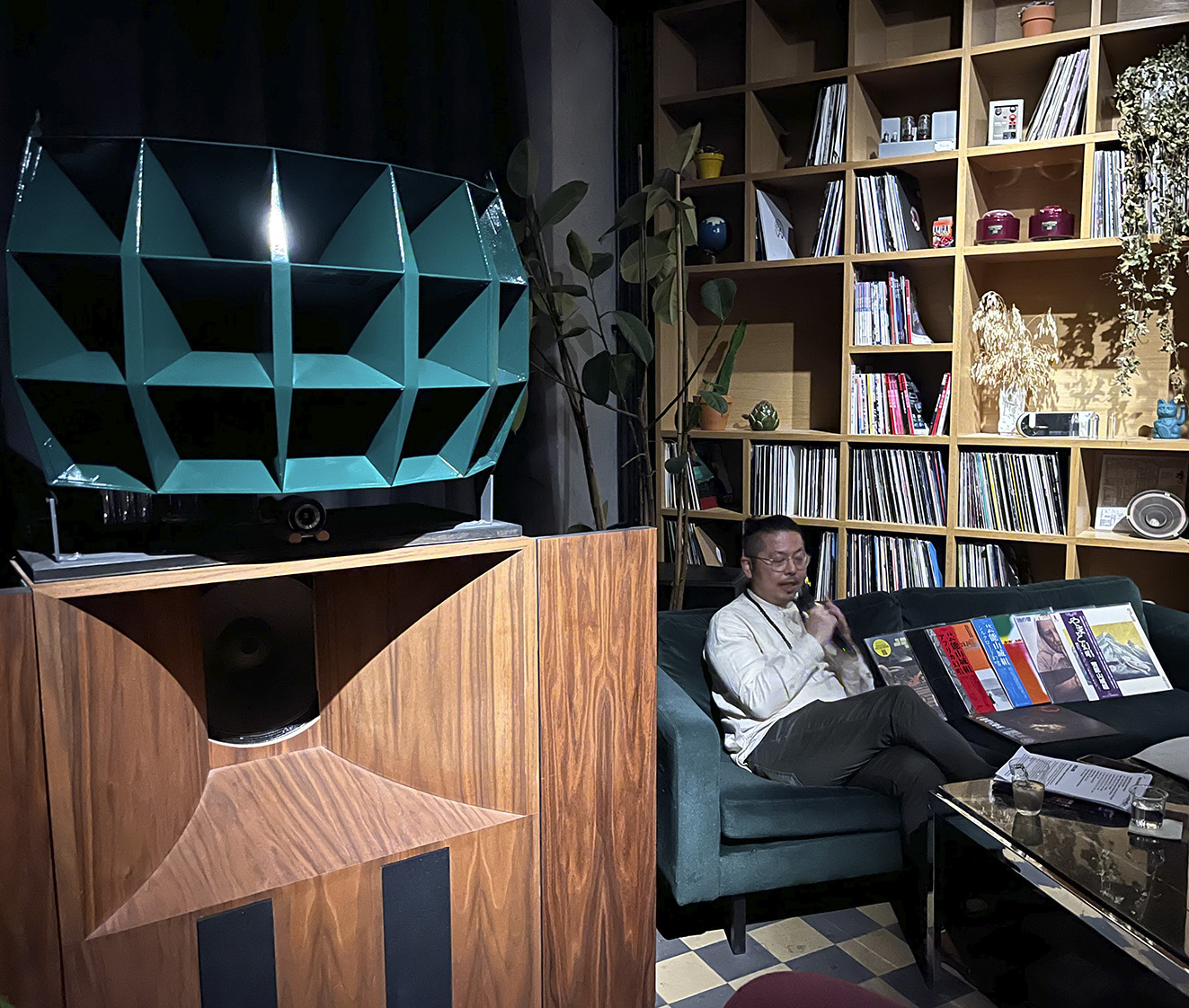 Kay Suzuki explains the evolution of Geinoh Yamashirogumi through the various albums.
Then, at 7:00 p.m., the public event. Suzuki has brought almost all of the Geinoh Yamashirogumi albums and explains their concept in the first part using audio samples. This is followed by the complete reissue of Ecophony Rinne. In the sold-out Listening Bar, a Garrard 301 turntable is playing, with a 12-inch tonearm by Thomas Schick, a step-up transformer by Consolidated Audio (Berlin), and an Audio-Technica AT-ART20. A successful event, even though I personally couldn’t handle my spot in front of the large horn speaker and made a beeline for the bar. Even though I was the oldest person in the room, I didn’t deserve that spot. Unfortunately, there were no LPs for sale that evening. It wasn’t until late March that a German mail-order company was able to deliver the album to me—which, to my surprise, had sold out within hours.
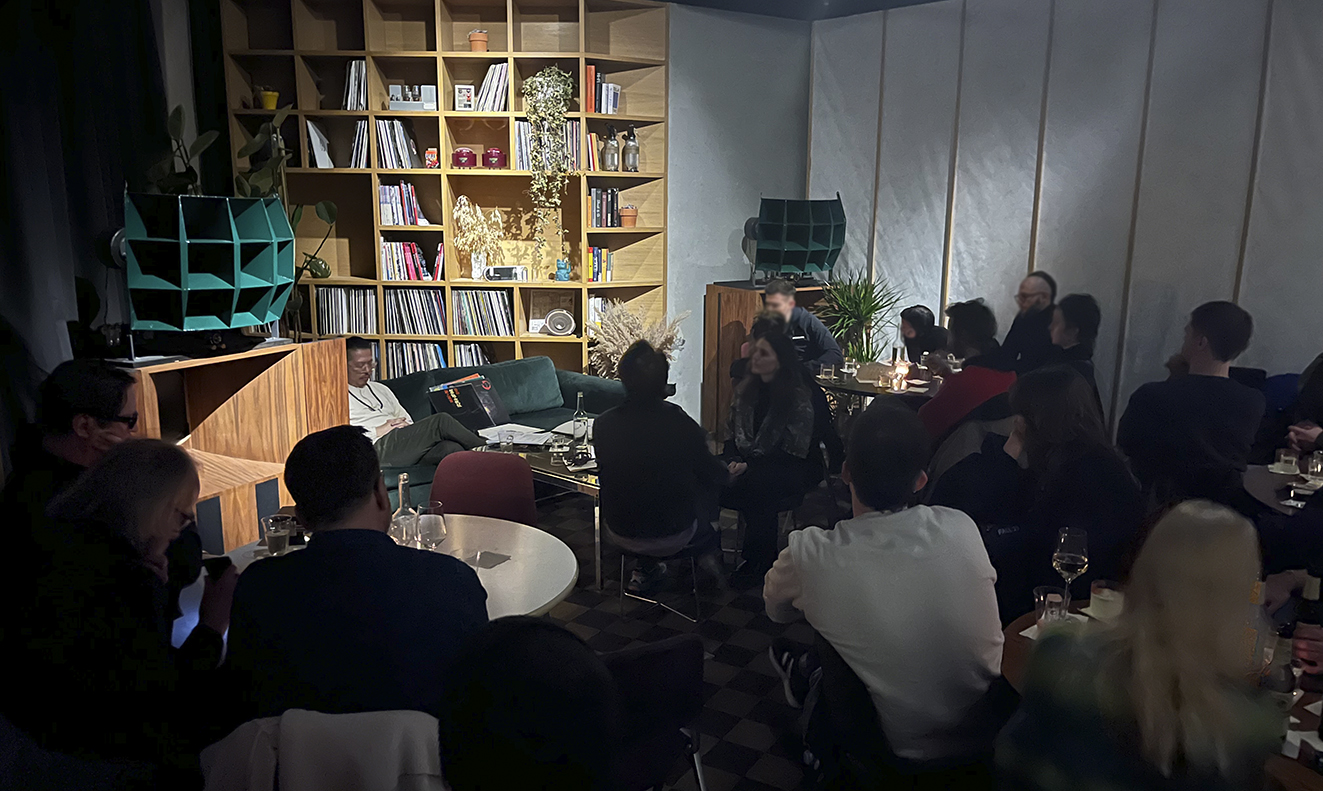 Listening session with an auditorium; my empty red chair is halfway to the left.
In fact, the album holds an enormous significance that was previously unknown to me. When manga artist, author, and film director Katsuhiro Otomo (*1954) heard the album in 1986, he immediately approached Tsutomu Ōhashi with a request to compose the music for his next manga film. When Akira was released in 1988, Japanese manga culture achieved its international breakthrough, and the film has since been regarded as a masterpiece and a seminal work. The soundtrack has also been a sought-after collector’s item for every true Akira fan ever since. This has driven the prices for the original album to astronomical heights. In that regard, it’s no surprise that the 2026 reissue sold out immediately upon release. Time Capsule doesn’t need elaborate advertising; manga fans worldwide are a guaranteed audience. A second shipment has since been made, and the album is once again available at many retailers.
As already described, the album is worth listening to. The album is a revelation. The album is audiophile-grade without patronizing the listener. The album should also find a home in high-end circles. Furthermore—and I say this quite deliberately—it is a first-class demonstration album that doesn’t get on your nerves! Be bold; just give Ecophony Rinnea try.
P.S. In April, I brought the album to the attention of a friend who runs a record and hi-fi store in Halle/Saale. The guy was very curious and had already listened to the record in the store. Even while the A-side was still playing, a customer immediately bought the copy from him. Ecophony Rinne is truly unusual. To test it further, I have a copy in my case for the High End show in Vienna.































.png)