
Triological
The Allison-Cardenas-Nash Trio Hits Its Apogee
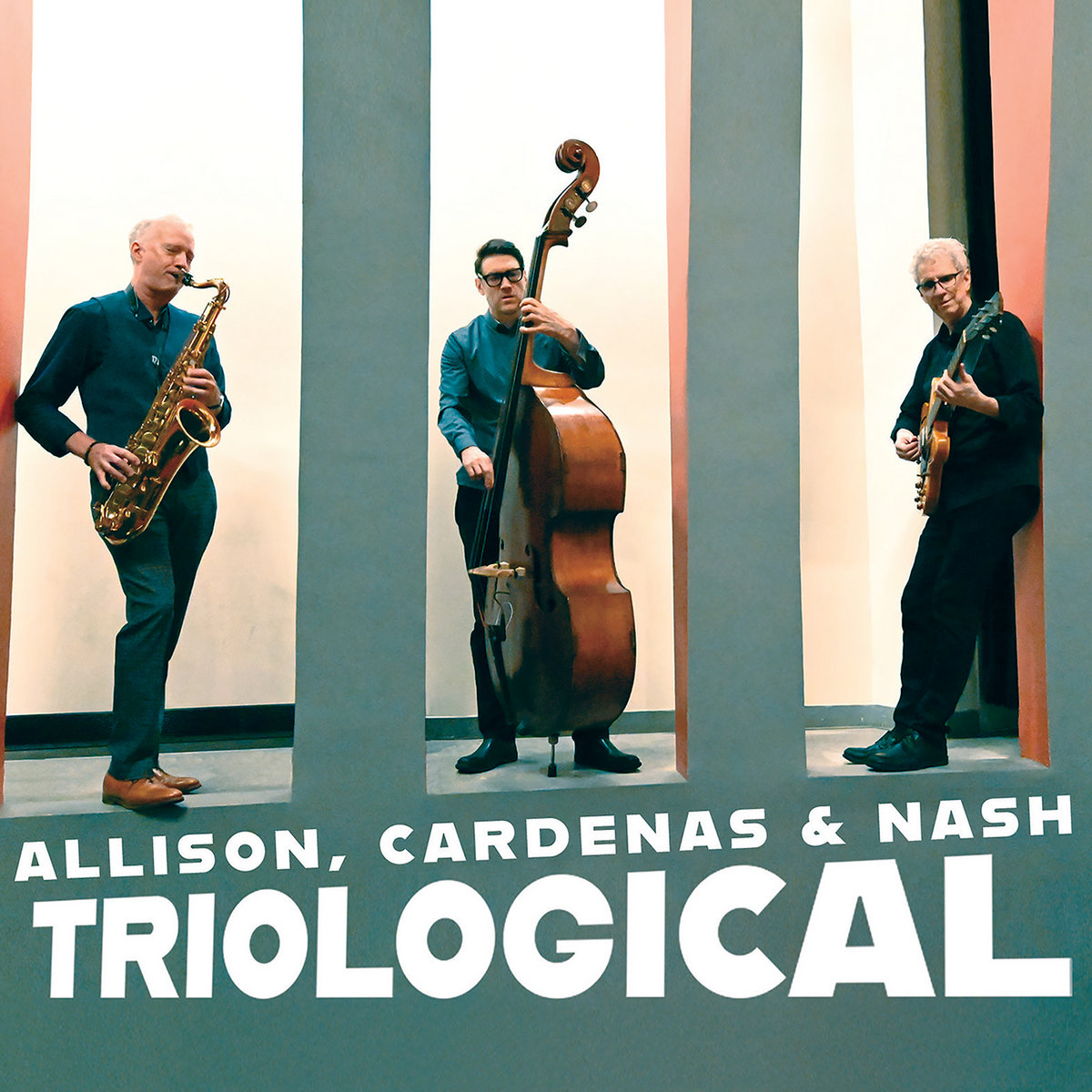
Bassist Ben Allison, guitarist Steve Cardenas, and multi-reedman Ted Nash make up an odd sort of trio (no piano, drums, or second horn), which in other hands might produce the stuff of “chamber jazz,” but in theirs spans the gamut from hot to cool, sometimes both at once, sprightly but dense with clipped rhythms, twisty intervals, and a quiet virtuosity.
Over the past decade, they have recorded albums covering the music of Jim Hall (Quiet Revolution), Carla Bley (Healing Power), Leonard Bernstein (Somewhere Else—West Side Story Songs), and Herbie Nichols (Tell the Birds I Said Hello).
Their new album, Trilogical (on Sunnyside), is their first to feature entirely original compositions—four by Allison, three each by Cardenas and Nash—though their works are clearly inspired by masters adroit in the same brand of jauntily lyrical jazz. The trio have developed—and, in the process, perfected—a distinctive sound; it’s no surprise that an album of originals wouldn’t sound much different. (If there’s one slight shortcoming to the album, it’s that the tracks sound quite a bit alike.)
They make the point explicitly in the liner notes, which succinctly tell how each song came about. Of “Peace Out There,” Allison explains, “I tried to write something evocative of Jimmy [Giuffre’s] music and ended up with something that reminded me more of Carla Bley.” Nash likens one of his pieces, “Ida’s Spoons,” to “some of the linear movement I love in the music of Lennie Tristano and Warne Marsh, specifically the way they weave lines through the chords, find certain tension notes at key times, and the atypical ways they create cadence and resolution.” (Giuffre’s early-1960s trio and the Tristano-Marsh collaborations have long been touchstones for Allison and Nash, in various groups over the last few decades.)
But these allusions aren’t derivative. For example, Nash writes that “For Bill” was inspired by Bill Evans, not by any particular tune but rather by his own quest to reflect Evans’ “beautiful harmonic movement, the subtle cadences he created and the relaxed sense of melody.” To be inspired by someone’s art, Nash writes, “is to discover certain characteristics you find attractive and develop your own personal way of expressing them.”
That’s a succinct summary of this trio’s approach to music generally—whether on this album or on their earlier covers. Its roots were planted three decades ago, back in 1992, when Allison and Nash—along with pianist Frank Kimbrough, trumpeter Ron Horton, and drummer Michael Blake—formed the Jazz Composers’ Collective, which fused the influences of undersung artists, especially Herbie Nichols, with their own individual cadences. They have since formed or joined many other groups, as leaders or sidemen. After Kimbrough died in 2020, Cardenas took up the chordal foundations and has grown in his improvisational confidence with each of the trio’s successive albums. In this sense, Trilogical marks the apogee of the band’s cohesiveness as an equilateral triangle, not merely a horn-and-rhythm-section.
Nash blows tenor sax and clarinet with a velvet tone and quicksilver dexterity. Allison, one of our most inventive bassists, plucks his instrument—on three of this album's tracks (for the first time) a Hofner electric, the same model as Paul McCartney’s—with uncanny agility and a rich plummy resonance. Cardenas picks and strums his guitar with well curated intervals and percussive zest.
Capturing their sounds requires an exceptionally sensitive engineer, and this album has that in Matt Balitsaris, the proprietor of Maggie’s Farm studio in Pennsylvania, where the trio has made most of its albums. In an email, Balitsaris told me that he put an AKG C12VR tube mic on Nash’s horns, plugged into a Neve 1073 preamp. Cardenas’ guitar was plugged into a Fender Deluxe Reverb amp, surrounded by baffles for isolation; an Electro Voice RE-20 mic picked up the back of the amp, a Shure SM-57 its front, both running through DW Fearn V-2 preamps, then to the Neve. Allison’s bass was hooked to his Ampeg B12 amp. One AKG-414 condenser mic picked up the amp, while another covered the Hofner itself, to capture its vibrations. For the tracks with acoustic bass, a pair if Neumann U-87's, one at the fingerboard, where his right hand is plucking the strings, and the other down by the bridge.
The result is a superb sound: at once warm, detailed, dynamic, and true to the colors.