

Trumpeter Charles Tolliver Leads All-Star Group on Original Compositions
1968 group leading debut gets fresh analog re-mix
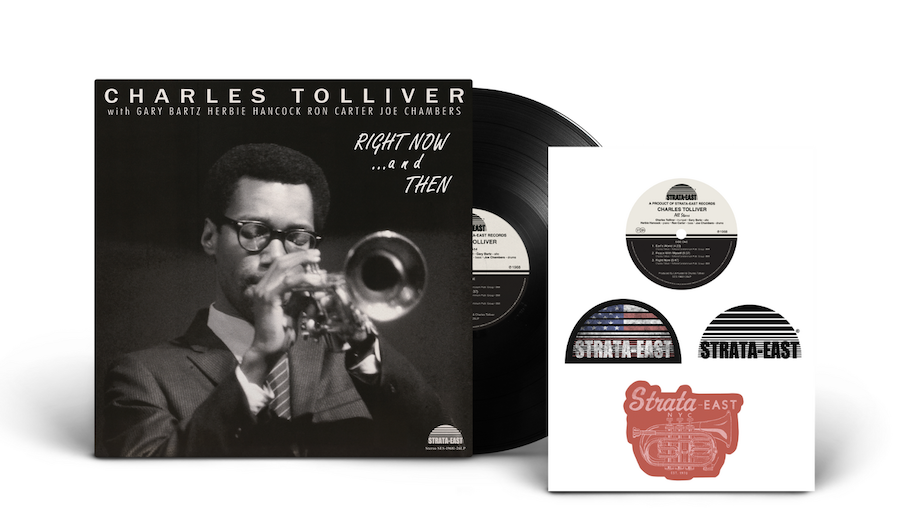
This album, available on April 18th as a Record Store Day special, is interesting and worthy of your attention on many levels beyond the music, which of course is the main attraction. First, it was co-produced by Charles Tolliver in 1968, 3 years before he and Stanley Cowell founded Strata-East Records. So clearly this was an independently produced project, though Tolliver's new annotation for this "full circle" Strata-East release doesn't provide that history, which would be interesting.
However the project came to be, Tolliver brought onboard Herbie Hancock, Ron Carter and Joe Chambers with Gary Bartz joining in only on the second side's tunes. Why Bartz is only on side two's songs was also not in the new notes. How Tolliver brought on board Hancock, Carter, Chambers and Bartz is in the annotation.
The album's first release was in Europe on Alan Bates's Black Lion label titled Charles Tolliver and His All-Stars. If ever an album deserved to be so titled, this one is it.
In the new annotation Tolliver relates that he met Bates, then an executive at Polydor Records, while on tour with Max Roach performing at Ronnie Scott's. Tolliver and Bates struck up a friendship and Tolliver licensed the title to Bates. That must have been during the group's second appearance at Ronnie Scott's in 1968, the same year Bates founded Black Lion.
Discogs lists the Black Lion release date as 1971. Why the release took 3 years would also be interesting to know, but licensing the title was a good idea because Bates, with his Polydor connections, distributed it to Germany, France, The Netherlands and Japan.
The album first appeared in America in 1975 on Clive Davis's Arista/Freedom label titled Paper Man named for a song on the record. The rear jacket annotation on this new release by the late Michael Cuscuna must be from that release.
Pure Pleasure issued it on vinyl in 2019 as Charles Tolliver And His All Stars mastered by Ray Staff at AIR Studios but including Neal Hefti's "Repitition (Take 2) as a bonus track, and doubtful it was cut by Ray from tape. Strata-East reissued it on CD that same year in the United States with that bonus track and that brings us to this reissue!
Maybe you never thought we'd get here but here were are with Right Now...and Then packaged in a laminated gatefold Tip-on jacket, re-mixed by Andrew Taub and cut by Kevin Gray. It includes the Neal Hefti tune.
So this record has been "around the block" and for good reasons. First, it doesn't sound dated. Tolliver's playing is lyrical and expressive throughout, his distinctive "flutter" adding an exciting touch when he applies it. He generously leaves room for the others to shine. Listen to Hancock on the appropriately titled (relatively) mellow and melodic 3/4 time "Peace With Myself". "Right Now", of the moment then, sounds likewise now with Chambers and Hancock delivering insistent, percussive swells.
By the time this set was recorded, Tolliver had played with Blakey, Shepp, Rollins, Hill, Gerald Wilson, McCoy Tyner and many others. On this set he demonstrated an ability to play within the group and to effectively lead it, erupting as necessary to maintain the musical flow.
Adding Bartz on the second side brings another level of groove and funk to the proceedings and when you hear "Paper Man" you'll know why someone thought it made sense to highlight it by making it the album title. "House of Saud" dedicated to McCoy Tyner and the Coltrane outfit he was part of at the time is another album highlight that's likely to get you moving.
The then 28 year old Herbie Hancock performing in the year he exited Miles' group and released his forward looking Speak Like A Child" delivers dazzling keyboard pyrotechnics throughout. Engineer O'Brien gets the mics perfectly dialed on on Hancocks keyboards to produce clarity and timbral accuracy that RVG somehow often missed. Bartz and Tolliver glide together on the second side like well-acquainted skaters, propelled by Chambers's drums.
Right Now and Then" is consistently high energy, melodic and rhythmically propulsive. Tolliver rarely slows down long enough to elicit contemplation but that's clearly the goal and he delivers the energy throughout.
I prefer to give the late Cuscuna the last word: "This album is certainly an important and lasting document in light of the musicians involved and in light of its unique context for Charles Tolliver. But basically, it is just a great album to listen to". That conclusion seconded!
As for the sound, I've not heard the original mix, but my guess that it was digitally mixed proved wrong (Charles's son Ched corrected me and I'm fixing what i wrote right now). The reason I thought it was a digital mix and that Kevin cut it from that was that It just sounds too "clean", transient-precise and lacking in "airy context" to be a to tape mix. But that observation was wrong. I could have just changed this and completely eliminate my error but I'd rather leave it up.
Hearing Hancock's piano so cleanly rendered and Chambers' cymbal hits delivered with such precision are worth whatever toll the digits took (if that is the case). That wasn't the case. The stage is wide, and it's deep and precise. It just sounds a bit cleaner than a 1968 recording should be. Maybe that's a good thing. (That's how the review originally ended. I'll just add I'm impressed by how quiet and precise is the mix to tape from the original 8 track).


































.png)