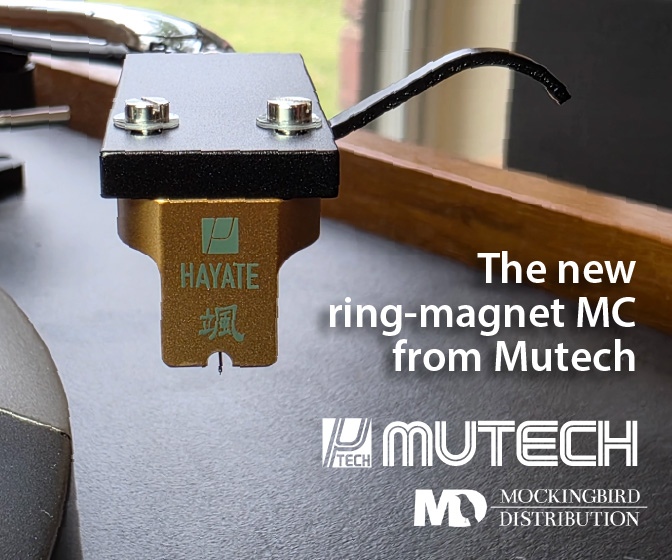

MUTECH RM-Hayate Ring Magnet Cartridge Runs Rings Around Competition
not all of it, but a good deal of it!
Cartridge knowledgeable audiophiles, which means everyone reading this, will think twice noting two of the RM-Hayate moving coil cartridge’s spec points: output voltage a generous 0.45mV (1kHz 3.45cm/Sec), internal impedance a low 1.75 Ohms. That is a highly unusual pair. Generous output usually requires more coil turns. More coil turns means higher internal impedance; low internal impedance means few coil turns yet here’s a moving coil cartridge with generous output and low internal impedance. How’s that possible?
Let’s go back a decade to the Transfiguration Proteus (and before that to a series of other memorably sounding, highly regarded Transfiguration cartridges). Sadly, designer Seiji Yoshioka who founded the company in 1992 passed away some ago and the family chose to not continue the business or sell it. The original Transfiguration AF-1 was unique in that it had a ring magnet instead of the then-usual rectangular magnet pole piece above the coil structure, associated with a U-shaped yoke.
The AF-1 had a single, hollowed-out, disc-shaped magnet, in the center of which the coil assembly was painstakingly positioned. Ultraprecise assembly, always important in the making of ultra-high-performance cartridges, was even more important in building the AF-1, and its low output of 0.1mV limited its phono preamplifier compatibility.
But as I’ve come to discover, it turns out that while Yoshioka-san had implemented the ring magnet design in the 1990s the idea had been conceived of in the 1970s, based on consultations between SUPEX founder Mr. Asakura and Eiji Kanda, who in 2015 founded MUTECH to soldier on in the ring magnet cartridge world. Mr. Kanda passed away in 2020. Conspiracy theorists might conclude that ring magnet-based cartridges create a high mortality rate.
The RM-Hayate is modified and “produced” by Kajilhara-Lab and manufactured by Akiko Ishida based on Mr. Kanda’s blueprint (that’s according to the one-sheet. Online I found the name Hiroko Ishiyama as the manufacturer). Not that in the end this matters!
Key to all the current specs are fundamental improvements in magnetic and core materials. According to the “one-sheet” I received with the cartridge, the RM-Hayate “follows the design of the RM-Hayabusa” a cartridge with similar but not identical specifications to the new Hayate, which is 1.5 grams lighter than the Hayabusa and has .25ohm higher internal impedance. Otherwise, the specs are identical. In 2019 I reviewed the RM-Kanda and I quote (I didn't have to search for this because it was on the importer's website:
“However, at less than half the price of the Ortofon and Lyras (referring to the MC Century, Atlas and Etna) , the RMKanda is a highly evolved, well-built, tonally honest-sounding cartridge that also tracked well. If you own a tired Transfiguration cartridge but still love its sound, step this way! Importer Mockingbird Distribution offers a money-back guarantee. Assuming you correctly install the RM-Kanda, chances are it’s not going back. Perhaps the designer can next come up with a double-ring-magnet cartridge as a suitable replacement for Transfiguration’s underpriced/overperforming Proteus?”
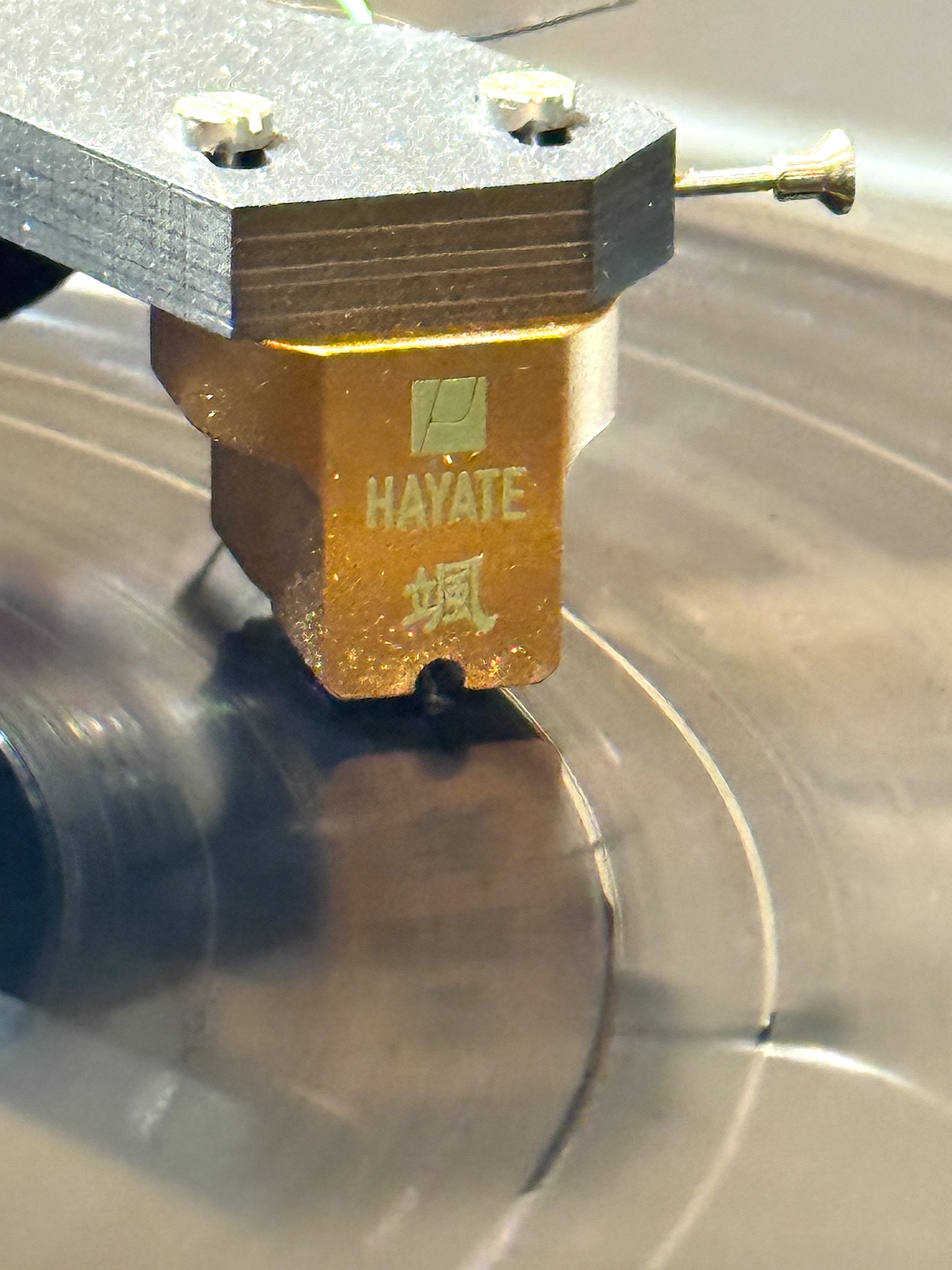
The internal differences between the older Hayabusa and the newer Hayate are that the tubular N50 Neodymium ring magnet structure in the Hayate has been designed to be as “lean as possible” (perhaps that is at least part of the reason it weighs 1.5 grams less than the Hayabusa) and is now gold plated to prevent oxidation, thus maintaining the magnetic system’s efficiency. A single “optimized” coil turn is of a “thicker OFC (oxygen free copper) wire”, wound on a former of “SS-μM an amorphous magnetic alloy. According to MUTECH, this all results in lower induction, which the company claims produces greater clarity and overall improved sound especially at higher frequencies. Other refinements include thick, gold-plated OFC output terminals and a new, specially developed solder to connect the coil to the terminals that according to MUTECH improves low frequency response. A solid 0.33mm solid Boron cantilever and a semi-Line contact stylus complete the picture.
Set Up
Lately, cartridges I’ve been sent for review have been very well manufactured and this one was no exception (I don’t believe I’m sent specially selected samples but perhaps I’m being naïve). Arm parallel to the record was close to 93 degrees and getting the azimuth correct required but a tiny nudge from cantilever perpendicularity. VTF spec is 1.8g to 2.0g and I set it for 2.0 both for sound and best tracking.
Multiple Arms, Turntables and Phono Preamps Issue the Same Guilty Verdict
First off, the RM-Hayate’s high output makes it compatible with every conceivable high quality phono preamplifier, solid state and vacuum tubed. Its low impedance makes it an ideal candidate for transimpedance phono preamplifiers—or so I initially thought.
When I ran it into a CH Precision P10 transimpedance input what emerged was very high in level, which confirmed the high output and low internal impedance. The CH offers various output levels the lowest being 12dB. Even set there (which the unit’s setup “wizard” suggested was best), I had to turn the dartZeel NHB-18NS preamp’s output down to -15dB, when normally it would be around -0.3 dB. Even at the lowest setting the output was too great, and the resulting sound was hard and just didn’t sound “right”. Switching to a voltage gain input at 54dB gain proved ideal. So, my advice if you opt for this cartridge is to be careful about using a transimpedance type phono preamp with it.
I also ran the RM-Hayate into a few other voltage gain phono preamps and the results made clear to me that voltage gain is the way to go, despite the low internal impedance. I mounted the cartridge on the Supatrac Nighthawk and later the SAT CF1-12, where it’s making beautiful music as I write this.
Based on the Ortofon test disc, the RM-Hayate is a very good but not the best tracking cartridge you can buy. When mounted on the Supatrac Nighthhawk, both the Ortofon MC 90X ($4999) and the far less costly X40 ($1149.99) sailed through even the most highly modulated test track—and that was a first in my experience. The RM-Hayate perfectly negotiated the 80µm peak track, buzzed slightly on the 90µm track and slid off the track on the 100µm band, which almost all MC cartridges do. So, it’s not like the RM-Hayate did worse than most, just that a few do better.
So let’s get to the easily described sound: combine the best qualities of the best moving magnet cartridges—linearity especially at the higher frequencies (where MCs usually go “uphill”) and full, rich timbral presentation, with the best of what moving coils offer—high resolution, detail, speed, expansive soundstages, exceptional micro-dynamics and transient precision and you have the RM-Hayate.
The moving coil sonic continuum runs from the soft, muted top end (and to my ears boring) to the ultra-detailed, “fast” and clinical, featuring (an off-putting) glaze on top, with some lumpy midrange rich cartridges in between. The best MCs effectively balance them all, though there are still listeners who go for the extremes, some of which they choose to balance out counterbalancing system personalities.
These days after doing this for so long it’s not often that I’m treated to memorable sonic thrills—the last time was hearing the Supatrac Blackbird for the first time—that was unforgettable and it was playing a Bee Gees tune! This cartridge has produced months’ worth of such experiences—and not because the presentation was “spectacular” or that the RM-Hayate extracts every bit of detail that’s in the grooves. Quite the opposite.
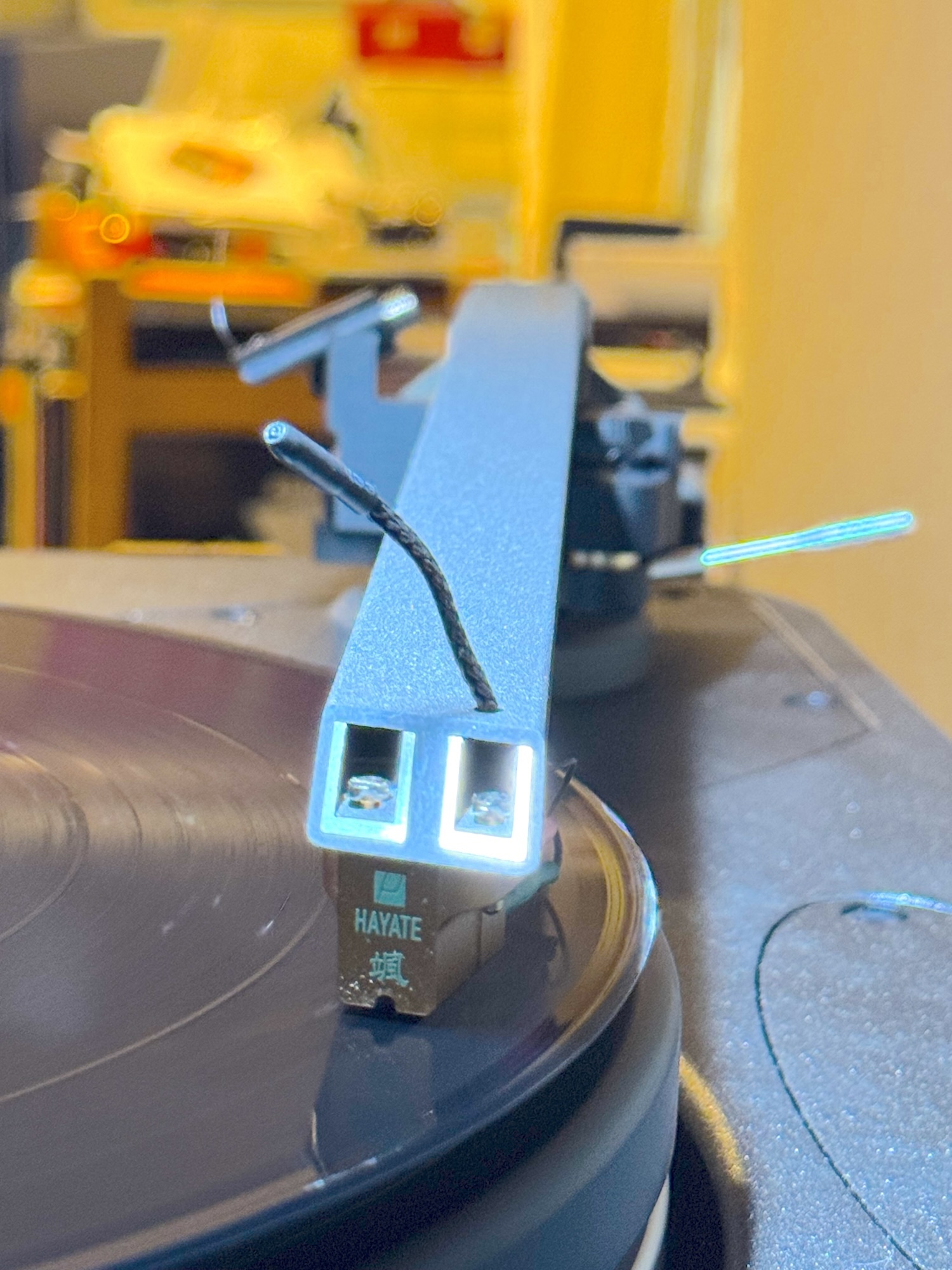 Hayate on Supatrac Nighthawk
The other evening, I played two records that confirmed to me this cartridge’s subtle greatness. First up was the 4th movement of Beethoven’s 9th from an unplayed Von Karajan/BPO box set (SKL101/8)—the one everyone should own even if you own more than a few. I learned Beethoven on it in a college course. This box was among the 100 or so unplayed greats I picked up free last Spring at a late electronic repairman’s home.
I played it because I’d just listened to a new Beethoven 9 issued by Chasing the Dragon (VALLP019) featuring the National Symphony Orchestra and the Brighton Festival Chorus conducted by Rimma Sushanskaya produced by Mike and Francoise Valentine.
I chose to audition their 9th on December 16th. The Brown University shooting was on the 13th, the Reiners had been shot on the 14th and then came the Australian massacre on the 16th. It was about all I could take. I needed some uplifting. But competent as that performance and recording was, and how well the conductor had sorted out and organized the musical pieces, I appreciated it but was left emotionally unmoved.
Some of the Chasing Dragon records are sonically and musically special. Like the EspanaDirect to Disc recording (VALDC004)—and not because I was there to witness it live, though in that write up I had to say that the performances while good couldn’t match some of the best loved ones featuring, among others The Vienna Phil conducted by Von Karajan featuring Leontyne Price, and Ataulfo Argenta conducting the LSO. Still the D2D recording offered plenty of sonic excitement.
This time the Valentines were digitally recording a live performance (on the 200th anniversary of the 9th’s first performance) at London’s Cadogan Hall— a relatively small space—and because of the logistics, did it using multiple microphones though starting for the main pickup with a spaced pair of Telefunken ELAM 251 tube mics. The sonic results are very good but not in any way remarkably so. The performance is workman-like competent and the soloists, including tenor Sam Furness, Bass Stephen Loges, Soprano Jennifer Davis and Mezzo Soprano Bethany Horak-Hallet are all young, well-regarded, experienced “rising stars”. It’s a fine, but not a “raises the hair on the back of your neck” performance, especially the 4thmovement of the 9th, which must do that!
Maybe I was just so down, even the best performances of “Ode to Joy” couldn’t lift me up. So, I put on the Von Karajan, my recollection of the recording, produced at Berlin’s Jesus Christ Church located in the Dahlem district, which I hadn’t played in many years, being somewhat distant and dark. Instead, what I heard immediately (playing just the 4thmovement) raised neck hairs as the orchestra appeared in the large, defined space of the church, layered strings ebbing, flowing and breathing across the stage; the macro dynamic contrasts only somewhat less astonishing than the micro ones wherein Von Karajan coaxes tiny volume emphasis shifts—seemingly multiples within a few bars, and the basses produce foundational weight to the enormously wide and deep picture.
“This can and should be louder” I told myself raising the volume in anticipation of Walter Berry’s “O Freunde, nicht diese Töne!” I knew he’d appear somewhere stage left but I wasn’t prepared for him living three dimensionally in a cushion of church territory about a quarter of the way between the right speaker and mid-stage and well back. The live illusion of being in the space and hearing him sing live was intense—(hair raising)—aided by a total absence of mechanical artifacts and perfect sibilant reproduction. You could see his mouth move. The DGG engineers had perfectly balanced the direct to reverberant hall space, contrary to my “watery” expectations. It was a memorable “live” event.
Last week I pulled the mono Sundazed Byrds reissues cut from tape in 2006 by the late George Ingram at Nashville Record Productions (NRP), which should not be confused with Nashville Record Pressing (NRP) and decided I needed to listen.
Flipped the CH P10 to “mono” and even though of course the RM-Hayate is a stereo cartridge what I heard on Mr. Tambourine Man (LP 5197) was also memorable, incredible since it’s an album I’ve been playing since 1965 in both stereo and mono. Large puddles of high frequency energy from McGuinn’s 12 string Rickenbacker, tambourine, Hal Blaine’s insistent snare and cymbal hits and the shimmering vocals all crammed with edgy reverb can get smeared together in a partially or almost totally undifferentiated wash of energy. This cartridge cleanly separated all of it both in space and in timbre as impressively as I’ve ever heard it and with addictive transient clarity that allowed me to turn it way up where it remained well organized and too much fun. That play forced me to play all the Byrds albums in the series with equally efficacious bottom to top results.
The Yuja Wang Shostakovich The Piano Concertos/Solo Works (DGG 486 6957) which she performed with the BSO conducted by Andris Nelsons, reviewed last July by Mark Ward (which this won the ARYA Award (Audiophile Record of the Year Award) at the LA. & O.C. Audio Society Gala and was also nominated for a Grammy) confirmed this cartridge's timbral neutrality, its dynamic excellence and its excellent resolution of fine detail, but forget all of the checklist points: it just sounds effortless because it gets completely out of the way and lets the recording speak for itself.
Here, there's a defined space, a big piano as Mark describes it, with tremendous bass power that doesn't overwhelm, and behind it the orchestra thankfully precisely laid out on the soundstage behind. And there's the trumpet—which sounds just right—the correct balance here of mellow brass—neither edgy or shrill nor muted and "velvety". But more importantly in listening to this recording and to everything I listened to over the months was the way the RM-Hayate hangs everything together. Its cohesiveness combined with its ability to separate out what's important in a mix is what makes it so special and sets it apart from all but the best cartridges—at least as my taste goes and never forget that transducers are so a matter of taste. However, in this case, I don't think anyone would hear the RM-Hayate and not like it and I can't often write that! It does everything well and especially in a well-balanced way.
Conclusion
The importer worries that priced at $7500, price conscious audiophiles (as in, if it's not really expensive, it can't really be great) might not consider the RM-Hayate. Combine the "suspiciously low" price with the less than well know brand and its somewhat convoluted history and the combo may give some pause.
So I'll just conclude this review by reiterating that while there are other cartridges that do a bit more of everything on the usual checklist: greater dynamic slam, more detail resolution, more "air" and "speed" (cartridges with diamond cantilevers), etc. none in my experience surpass the RM Hayate in its ability to disappear leaving no "MC residue" or "MM softness". I don't care how costly or sophisticated a system you have, I don't think anyone reading this would be less than enthusiastically impressed by hearing the RM-Hayate in their system. It just sounds right and manages to simultaneously hit all of the aural pleasure zones. You can just forget its there and let the music speak. All genres.
Usually I can describe a cartridge's sonic "personality" as being on the (whatever) side, be it on the warm, or cool, or analytical, or soft or sweet, or rich, or lean or whatever side but I'm at a loss here. So I'll stop. I hope you get to hear one of these and soon. And especially if you miss your Transfiguration ring magnet based cartridge.
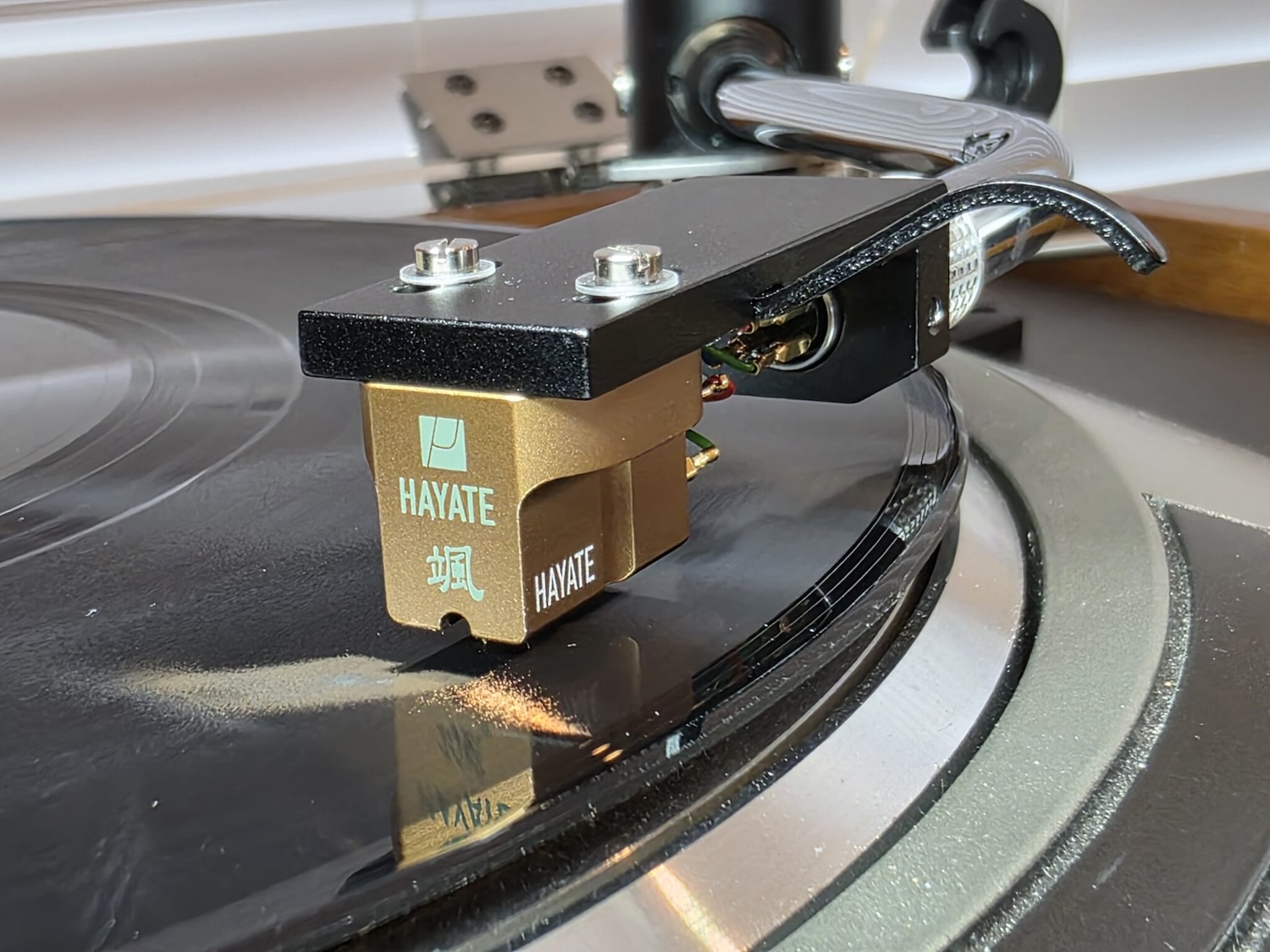
Importer's photo:
Specifications
Specifications
Model Name: RM-HAYATE 颯(はやて)
Power generation method: yokeless ring magnet type MC cartridge
Output voltage: 0.45mV (1kHz 3.45cm/sec)
Appropriate needle pressure range: 1.8-2.0g
Playback frequency range: 10-45,000Hz
Internal impedance (not resistance): 1.75Ω
Crosstalk: 30dB or more (1kHz)
Channel balance: 0.5dB or less (1kHz)
Stylus tip: line contact
Cantilever: φ0.3mm solid boron
Terminal pin: OFC copper with special thick gold plating.)
Weight: 7.4g
Price: $7500
Manufacturer Information
Imported by Mockingbird Distribution