
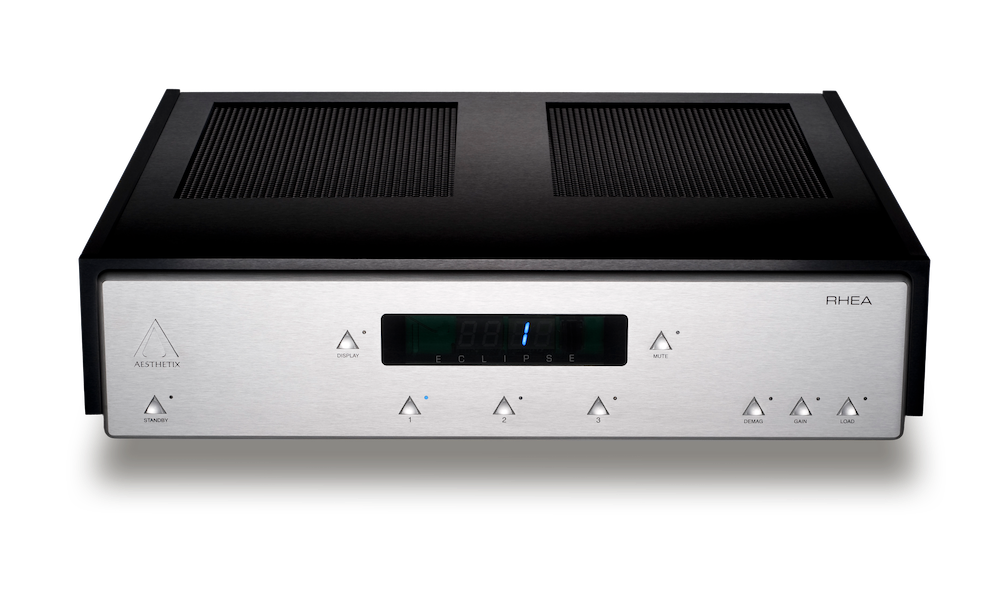
The Aesthetix Rhea Eclipse Phono Stage.
“Continuous Improvement Is Better Than Delayed Perfection”
Aesthetix Audio Corporation introduced the original version of its single chassis, tubed phono preamplifier - the Rhea in 2002 - nearly 25 years ago. The Rhea was designed to give listeners most of the sonics of Aesthetix’s reference level phono stage, the Io, but at a less celestial price point and with a lot fewer tubes.[1] Since the introduction of the original version of the Rhea (which Aesthetix now refers to as the “Standard” version), Jim White, Aesthetix’s founder, chief designer, and CEO, has launched two major updates of the Rhea design. The first update (called the “Rhea Signature”) was announced in 2009, and the second, more recent update is called the “Rhea Eclipse.” The latest Eclipse version is the subject of this review. Each upgrade has involved the use of more expensive, better sounding parts, tighter circuit tolerances, as well as other improvements—including better vibration control.
The Rhea is one of several Aesthetix products – including power amplifiers, line stages, and a DAC – that have long lineages with multiple updates over the years. Unlike some companies in high-end audio that continually introduce new and usually pricier products that render obsolete or at least much less desirable any prior products (perhaps the one you just bought. . .), Jim and Aesthetix are committed to maintaining the long-term value of the investments their customers make when purchasing Aesthetix’s products. This is why product lines – like the Rhea and Io – introduced 20+ years ago are still made today.
But even though their products’ original designs continue to have an enthusiastic customer base, Jim and Aesthetix have strived tirelessly over the years to update and upgrade the designs. Taking this approach has enabled Aesthetix to continually improve the sonics of its product line while maintaining value by offering existing owners an upgrade path.
As one quickly discovers by doing a simple web search, since each was introduced the Standard and Signature versions of the Rhea have garnered the very highest praise from a constellation of audio reviewers in the major audiophile publications, including from Michael Fremer himself in a prior incarnation.[2] In fact, for many years the Rhea Standard was the “phonostage of choice” for Robert Harley, editor-in-chief of The Absolute Sound.[3] Prior editions of the Rhea have been lauded as “unusually quiet” (for a tube phono stage), without typical tube coloration or softness, combining “the spatial and tonal bloom of tubes” with “resolute pitch definition,” lacking any “tubey midrange emphasis,” projecting wide and deep soundstages (when the recordings presented them), with “lots of dynamic oomph” and especially in its Signature iteration, robust and tight bass, among other kudos.
As best I can tell, though, no one yet has reviewed the latest iteration of the Rhea, the Eclipse version. So this review will attempt to describe the sonics of the new Eclipse version and how it carries forward the strengths of its predecessors.
During the extensive review period, I also had on hand a solid state, transimpedance (current amplification) phono stage costing nearly twice as much as the Rhea Eclipse – the excellent Van den Hul Grail SX, its top of the line phono stage offering.[4] This confluence of phono stages just begged for some comparative listening. The punchline – the Rhea Eclipse more than held its own against this much more expensive phono stage.
It’s All Greek to Me.
You might already have noticed a lot of words that come from Greek mythology and cosmology —planets and moons orbiting planets named after Greek gods and goddesses. Some kids, at least kids when my wife and I were raising children, develop an early interest in learning everything about dinosaurs or collecting and knowing every nuance of every Matchbox car or truck. For Jim White, it was celestial bodies – the planets and their moons and the names given to them from Greek mythology.
Aesthetix has two levels of products, the Jupiter series (where you will find its reference-level Io phono stage and its more recently-introduced and wonderful-sounding Metis line stage preamplifier, a tube linestage preamp that has been a cornerstone of my listening since I bought it) and its Saturn series where you will find the Rhea phono stages and all of Aesthetix’s other products. Besides being the second largest moon of Saturn, Rhea in Greek mythology was the mother of the Gods who gave birth to the gods Hades, Poseidon, and Zeus among other gods. Imagine having all those kids under one roof….
When I first began reading reviews of products in audiophile publications well over 25 years ago, I encountered terms that the reviewers apparently assumed everyone already knew – terms like timbre, transient (and the related terms attack and leading edge), pitch, and the like. Terms that at first seemed like Greek to me. I did study ancient Greek for a few years in high school, but that didn’t help much. Now writing a review and not just reading one, I acknowledge that I cannot avoid using basic listening concepts. I thus commend to readers looking for an overview of the concepts involved in audio reviewing – and more fundamentally listening – the Audiopedia published by The Absolute Sound—see the “Glossary: Sound Quality (SQ)” section. For those seeking a deeper, fascinating, and very science-based discussion of the various sonic components that make up the music we listen to – components that include loudness, pitch, contour, rhythm, tempo, timbre, spatial location, and reverberation – I enthusiastically recommend Daniel Levitin’s thoughtful and entertaining book “This Is Your Brain on Music: The Science of a Human Obsession,” including in particular Chapter 1, “What is Music? From Pitch to Timbre.”
Rhea Eclipse Circuit Topology and Differences From its Predecessors
Unlike the Io phono stage, the Rhea Eclipse’s single chassis design features a solid state power supply located at the very front of the chassis, which makes it noticeably front-heavy. The power supply and any noise it might generate are isolated from the amplification electronics by being located entirely within a stainless steel Faraday cage enclosure, which also serves to protect the power supply from ambient electromagnetic field noise (EMF) and radio frequency interference (RFI). The importance of a quiet power supply cannot be overstated given the saturation of the air with Wi-Fi signals, cellular phone transmissions, magnetic fields formed by the electrical wiring in our walls, especially in multi-unit apartment and condo buildings, and other electromagnetic hash. And this is also because when we listen to a phono stage or line stage or power amplifier, for all intents and purposes it is the power supply that we actually hear, as modulated by the amplification electronics.
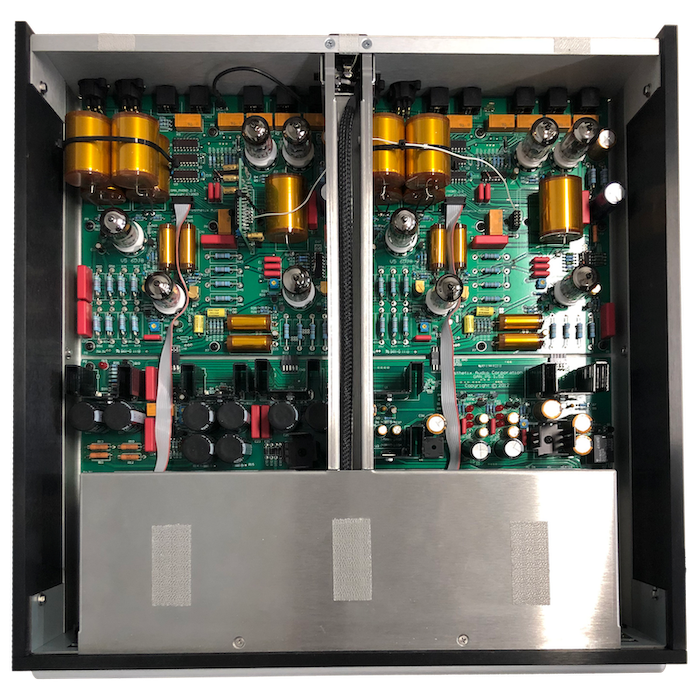 Rhea Eclipse's upfront Faraday cage
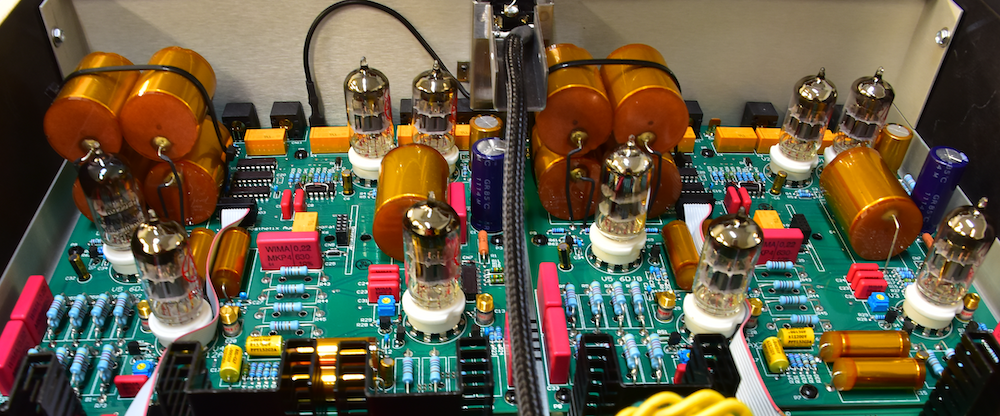 Rhea Eclipse circuit layout
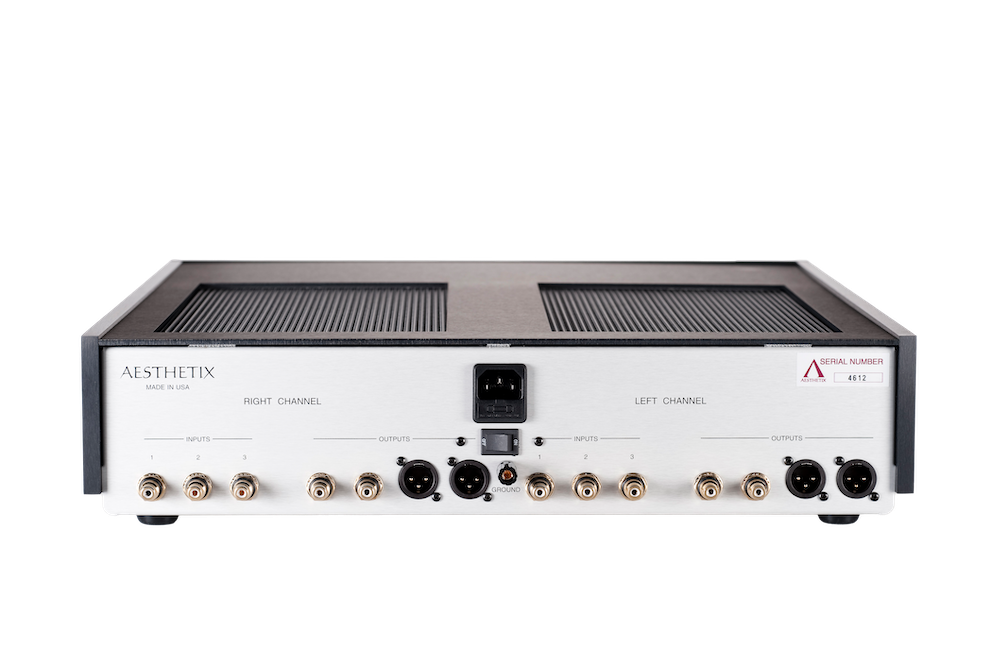
The Rhea Eclipse, like both the Rhea Standard and Signature versions before it, has three sets of single-ended RCA inputs and four sets of outputs – two single-ended and two balanced XLR . There is a grounding lug located under the rear panel's on/off rocker switch on the rear panel for turntable cable ground wire and/or a grounding cable for a star ground hub (like the Shunyata Altaira or EnKlein Sovereign devices). The choice of a grounding configuration that reduces/eliminates hum and other line noise – or one that actually may increase them - may vary from system to system. One needs to experiment to see what yields optimal sonic results.
A unique feature of the Rhea is an on-board moving coil cartridge (MC) demagnetizer. Aesthetix also sells a standalone version of its demagnetizer, but having one in the same chassis as the phono stage itself is extraordinarily convenient. There is no need to disconnect the tonearm cable in order to use the demagnetizer – just press the button on the front panel marked “Demag” and the Rhea will do the rest for you (for MCs only!)
The on-board demagnetizer functionality is not the only extremely user-friendly aspect of the Rhea Eclipse. It also enables LP listeners to make on-the-fly changes via either the remote control or the front panel to both gain and loading settings. Gain (adjustable for each input) has 8 increments: 38, 44, 50, 56, 62, 68, and 75db. For all the listening I did through the Rhea Eclipse, I used the Lyra Atlas Lambda SL moving coil cartridge – a very low internal impedance (1.52 ohm) cartridge that generates only 0.25mv of output. The Rhea Eclipse has a signal to noise (S/N) ratio of 75db/A-weighted (ref. 1mv) and 65db unweighted (ref. 1mv). Jim White told me that “counterintuitively” the best S/N ratio available from the Rhea Eclipse would be achieved at the 75db gain setting, and that is the setting I used for all listening. What I heard at other gain settings was consistent with what Jim told me.[5]
Loading is likewise very easy – no internal DIP (dual in-line package) switches to monkey with. Loading options available for each input are in 9 increments: 75, 125, 250, 500, 1K, 2.5K, 5K, 10K, and 47K ohms.[6] Both moving magnet and moving coil cartridges can be used through the Rhea Eclipse without having to pre-select one or the other, and without the need for MC step-up transformers. Of course, the appropriate loading needs to be selected first. For its Atlas Lambda SL MC cartridge, Lyra (very) broadly recommends loading of anywhere from 104 to 887 ohms. “to be finalized by listening.” I found that 125 ohms seemed to work best across multiple LPs that I used for this review, but with some records I preferred what I heard at 75 ohms.[7] The ease with which loading (and gain) can be selected when using the Rhea Eclipse optimizes users’ ability to experiment on a record-by-record basis in the search for what sounds best.
Unlike its cousin, the Aesthetix hybrid Pallene linestage that uses both tube gain stages and a solid state output stage, the Rhea Eclipse amplification circuitry is pure tube as are the Aesthetix Calypso and reference-level Metis linestages. The amplification is a “dual mono” design, with each channel having three separate gain stages and an output stage using a total of five tubes per channel. There are no solid-state components or transformers in the signal path.
The owners’ manual states that, for each channel, the first gain stage is "a high-gain, low-noise single-ended amplifier" that uses two 12AX7 tubes. The signal from this first gain stage in turn goes into a second gain stage, which is a high-gain differential amplifier that uses a single 12AX7 tube per channel to turn the single-ended signal into a fully-balanced signal, with the two halves of the differential signal identical in amplitude but 180 degrees out of phase enhancing the noise reduction available from the XLR balanced outputs.
RIAA curve equalization occurs at this point, between the second and third gain stages. Aesthetix employs “passive” equalization using Roederstein resistors and 1% polypropylene capacitors made by Reliable Capacitors.[8] The final amplification stage is again differential, using a pair of 12AX7 tubes (one per channel). The output from this third gain stage is then differentially buffered using one 68J8 tube for each channel – the buffering protects the third gain stage (and has a low output impedance optimized for driving the linestage preamp that follows in the signal chain and the interconnect cables between them).
The isolated power supply contains two separate low-flux transformers, one for the low-voltage, high-current heater filaments in each tube that excite the cathode element of the tube and the second transformer for the high voltage, low current DC supply in each tube that drives electron flow from cathode to anode. One benefit of using “low flux” transformers is lower EMF and less distortion of the AC power line. Separate windings and discrete transformer supply taps are used for each channel's heater filaments, and choke-input filtering is used for the critical high voltage supply. Aesthetix uses Nichicon Audio electrolytic filter capacitors and Wima bypass filter capacitors.
Aesthetix manufactures its own transformers and chokes in-house. Jim White explained to me that this allows Aesthetix to achieve precise design symmetry between the power supply circuits and transformer parameters. He also said that in-house manufacturing of these critical components results in power supply designs highly tailored to audio applications.
I asked if he could identify the most significant differences between the Rhea Eclipse and the Rhea’s previous Signature and Standard versions. Jim graciously provided the following explanation of the four categories (what he calls “phases”) of upgrades in the Eclipse version:
Ø First phase: Internal changes to the Rhea start with .22uF / 600v StealthCap coupling capacitors used between the second and third gain stages, and between the third gain stage and output stage. Eight of these exotic capacitors are used.
Ø Four 2uF / 400v coupling capacitors are used in each channel of the output stage of each version of the Rhea. But in the Eclipse version, Aesthetix significantly improves part quality, replacing the standard capacitors with StealthCap copper foil 4uF/400v capacitors, improving low frequency response. This same StealthCap capacitor is also used between the first and second gain stages.
Ø Second phase: High frequency tuning capacitors are installed in this phase, and then hand-adjusted to tailor the frequency response to a tight 0.1dB standard as also found in the Rhea Signature version.
Ø Third phase: The high voltage transformer, heater transformer and high voltage choke are all re-installed in this phase on vibration isolation mounts. Harmonic Resolution Systems’ (HRS) vibration-reducing Nimbus Couplers specially made for Aesthetix replace the four rubber feet of the Rhea Standard version. These same Nimbus Couplers also are found on the Signature version. Additional damping material is added to key chassis points.
Ø Fourth phase: A single point ground system is used to ground the transformer cases as they are no longer electrically grounded to the chassis via physical contact due to their isolation mounts. The Rhea Eclipse version also has a different power supply from its predecessors: this supply has increased ventilation as well as improved trace routing to reduce further any extraneous noise.
I did not begin any “serious” listening until the Rhea Eclipse had broken in fully. And “fully” meant a lot of hours of burn in. It arrived in my listening room,[9] already having gone through about 100 hours of factoryburn-in. But on initial listening, it sounded fine but somewhat “wooly.” The two other Aesthetix preamplifier products I have owned, the Calypso Eclipse line stage and the Metis reference line stage, each required roughly 400 hours of burn-in before they reached their optimal sonics. So I allowed it to rack up another 300 hours of burn-in time (for 400 hours total), which involved running an audio signal through it 24/7. Periodically, I did a status check listening session and could tell it was blossoming steadily as it continued to burn in.
What I Heard…
From Boston to Moscow.
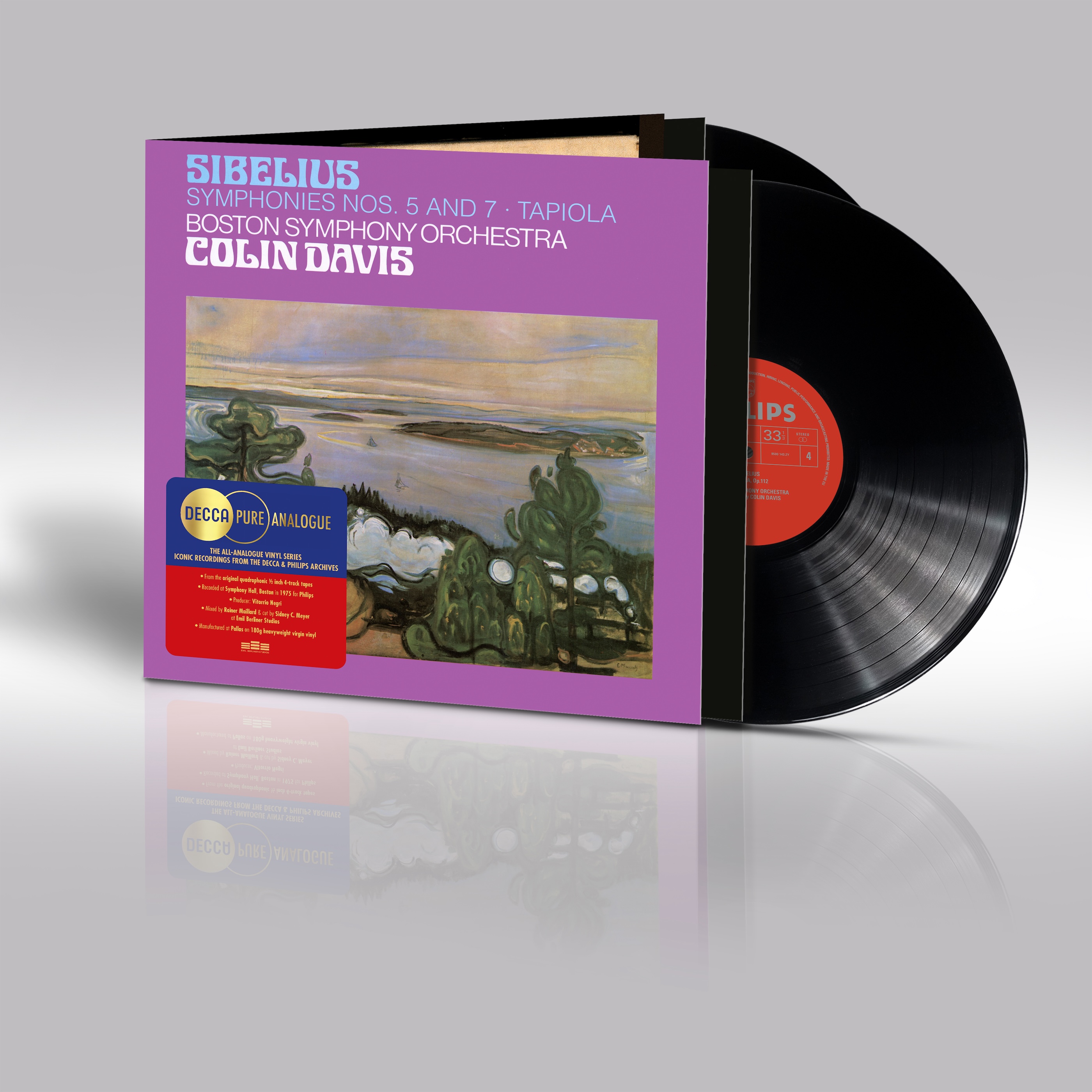
Symphony Hall in Boston, MA is considered one of the leading perfomance halls in the entire world, if not the very best one.[10] Decca recently began releasing a series of reissues of classic performances involving only analog recording and mastering called “Decca Pure Analogue.” One of those recordings is of the Boston Symphony Orchestra (BSO) conducted by Colin Davis playing Symphonies Nos. 5 and 7 by Sibelius in Symphony Hall. Read Paul Seydor's comprehensive coverage of the music and sound.
I heard the Sibelius Symphony No. 1 earlier this year played by the BSO at Symphony Hall, and I recall vividly from our seats a few rows from the stage in the center Orchestra section being able clearly to identify the location and nature of each instrument or groups of instruments on the stage. The sonics of Symphony Hall are so good that at least from where we sat the sound was crystal clear, immediate and visceral.
The Rhea Eclipse did a nice job of transporting me sonically back to Symphony Hall. Closing my eyes, I could “see” the location on the stage of the various instruments, whether it be the first violins, the cellos, the bassoons, the horns, or the timpani. I heard a very faithful sonic image of the stage and the ambient acoustics of the hall.
The Rhea created a very wide soundstage, perhaps a little wider than deep, with the violins emerging from the far left and the double basses right of center, with the woodwinds toward the back of the stage. This symphonic recording made clear that the Rhea Eclipse excels when it comes to reproducing deep bass frequencies. Timpani and double bass resonated deeply when Sibelius intended them to do so, and the notes were not only deep but also tight, taut, and well-defined. The presentation defies the stereotype of tube components having anemic or mushy bass – the bass notes one hears here, whether from double bass, timpani, or the bassoon solo in the first movement of Symphony No. 5 go as deep as on the source recording while also remaining taut and well-defined.
This LP also confirmed the fine abilities of the Rhea Eclipse at the other end of the dynamic spectrum, showcasing its resolution of fine details and microdynamics. For example, the pizzicato one hears from the violins toward the very beginning of the second movement of Symphony No. 5 - and again toward the middle of the same movement - was clearly and richly articulated. Also at the beginning of the same second movement the strings playing pizzicato alternate phrases with the woodwinds —flutes and clarinets— in a back and forth dialogue that takes one’s breath away. The Rhea Eclipse did an excellent job resolving the sustain of the woodwind sound and the delicacy of the pizzicato response.
And at the very end of the third movement—the end of the symphony, when the last notes are played, they resonated through Symphony Hall. The Rhea Eclipse did a fine job reproducing the sound as it reverberated from the stage through the hall and then decayed.
The Rhea Eclipse also clearly resolved individual instrumental lines, keeping the various sections of the orchestra distinct even when Sibelius had multiple sections of the orchestra playing simultaneously. The beginning of the first movement exemplifies this as Sibelius uses the stage as a palette of sonic colors, with violins and cellos, bassoons, flutes, oboes, clarinets and later trumpets, and also timpani all taking turns playing from their varied positions across the stage. The Rhea Eclipse enables the listener to discern precisely on the stage where the sound is coming from and – because of its spot-on presentation of timbre and tonality - precisely what instrument produced that sound.

Another all-analog recording of large-scale orchestral music that proved useful was an original pressing of the Mercury Living Presence recording of Byron Janis playing the Prokofiev Piano Concerto No. 3 in C Major, Op. 26, with the Moscow Philharmonic Orchestra conducted by Kiril Kondrashin. This is an absolutely stunning, “in the room” —or at least in the concert hall— recording of live piano music against the backdrop of a full orchestra. As recorded piano concerti go, this is among the very best I have ever heard. For this recording, I preferred 75 ohm loading to 125 ohm.
Janis’ piano appeared front and center, with great weight and realistic palpability. More than once, the Prokofiev Concerto required Janis to play from the very bottom octave to the very top on the piano keyboard, and the Rhea Eclipse presented each note clearly and articulately, with fast transients and excellent sustain and decay. Hall acoustics were resolved somewhat more clearly at 75 ohms than at 125 ohms, and the piano seemed to have greater weight and presence at 75 ohms.
At either loading setting the Rhea Eclipse did an excellent job of clearly revealing the multiple instrumental lines simultaneously playing throughout the concerto. As in the Decca Pure Analogue recording of the Sibelius 5th Symphony, the sound here was never homogenized, no matter how many massed strings or other instruments may have been simultaneously playing.
Bass frequency reproduction was excellent. At the end of the first movement, for example, Janis plays some very low, reverberating bass notes from the far left side of the keyboard followed by equally low bass notes from the strings and woodwinds. The Rhea reproduced both the piano’s notes as well the responses from the woodwinds and strings resoundingly and tautly – no mushy or lackluster bass here.
Put a Bow on It

Human beings are very sensitive to musical attack transients. The brain uses the length and type of transient to identify different instrument timbres. The transient is the most intense portion of the attack phase before the tone emerging from the instrument reaches its audibly defining “steady state” or “stable” phase where it “takes on the orderly pattern of overtone frequencies as the metal or wood or other material that the instrument is made out of starts to resonate.”[11] Violin music is especially good for testing the ability of a phono stage to resolve transient and attack information because violin music often involves sudden changes in pitch, loudness and speed of attack.
The Yarlung Records all-analog recording of Finnish violinist Petteri Livonen playing solo violin on Art of the Violin is one of the most impressively realistic recordings of violin on LP. Livonen plays Sonata no. 2 in A minor by Eugene Ysaye, the Bach Ciaccona from Partita no. 2 in D minor, as well as a Debussy sonata and a piece by David Leikowitz. The violin playing is reproduced with stunning clarity – the bite of the bow on the strings is revealed with the close miking Yarlung used, but there is a nice sense of the recording space as well.
The Rhea Eclipse did full justice to this fine recording. For example, at the end of the third movement of the Ysaye sonata, Livonen had to cover multiple octaves in short succession, from very low notes to extremely high-pitched notes. The Rhea responded effortlessly to each, very rapid change in pitch. It reproduced with richness the deep resonance of the lower octave notes as well as the delicacy of the high notes without any smearing or distortion. Leading edge attack was precise, revealing a “bite” to the sound when the bow hit the strings. There was never any sense of congealing of sound despite the rapid changes – Livonen’s playing was presented with real life fluidity and clarity.
A wonderful example of the ability of the Rhea Eclipse to resolve microdynamics is heard at the beginning of the third movement of the Ysaye sonata. The rich tone of the strings being plucked is reproduced with spot-on accuracy and beautiful sustain.
Who Ever Said Harpsichords Sound Thin?

Another solo recording that proved useful was Michel Kiener playing Bach’s "Goldberg Variations" on the harpsichord, the instrument for which Bach wrote the variations (on the Cercle Kallistos label). This all-analog recording puts the listener “in the room” with Kiener, and this LP will reveal any limitations in the ability of a phono stage to resolve small details and microdynamics. No such limitations, however, were apparent in the Rhea Eclipse – just the opposite. It presented Kiener’s masterful rendering of the Variations with clarity and delicacy. The low register notes were reproduced with resonant richness, and the high notes from the right side of the keyboard were clear and shimmering.
For example, at the end of Variation no. 1, the last notes played are followed by a brief but very clear amount of sustain/decay. Not as much as if played on a piano, but still there. The Rhea revealed that sustain/decay with delicacy and beauty. The final note Kiener played hung in the air for a few seconds until it vanished, highlighting the unit's macrodynamic resolve.
I also could hear the smallest details in the mechanism of the harpsichord's knee levers and hand stops. After Kiener finishes playing a passage one often hears subtle mechanical sounds, presumably from one of those mechanisms – or perhaps it’s just the keys coming to rest.[12] No matter, the Rhea reveals this small detail with precision, as it does at the end of Variation no. 2 as well.
I played this LP at both 75 and 125 ohm loading, and preferred 75 ohms. The highest octave notes seemed to lose the slight shrillness they had at 125, and the lower octave notes at 75 were beautifully rich.
Getting (More) Jazzed Up Over the Rhea Eclipse
Two of my favorite Pablo reissues from Acoustic Sounds are This One's For Blanton with Duke Ellington and Ray Brown and The Alternate Blues featuring Freddie Hubbard, Dizzy Gillespie and Clark Terry backed by Oscar Peterson, Joe Pass, Ray Brown and Bobby Durham on drums.

Like the violin, the piano is one of the instruments most challenging to reproduce accurately, even through the most high-end audio equipment. The piano has an extremely wide frequency range and very complex harmonics, and reproduction of the transients associated with the hammer striking the piano strings during the initial attack followed by decaying harmonics strains the abilities of many amplifiers.[13] Through the Rhea Eclipse, though, Ellington’s piano had excellent weight and heft – Ellington is in the room. The Rhea Eclipse easily handled the sharp attack as well as the sustain and decay of the notes that Ellington played.
Likewise, the lowest notes Brown plays on his double bass are reproduced in their full rich depth, with taut definition – again, the bass sound is impeccable. Deep and tight. For example, track 3 on Side 1 (“Things Ain’t What They Used to Be”) is essentially a showcase for Brown’s bass playing. He’s the main course on this track, with Ellington providing backup. The Rhea Eclipse goes as low as Brown does, with tight definition. And if one closes one’s eyes, one is sitting front row as Brown plays. On this same track, Ellington’s piano is reproduced with real presence and palpability. And the notes he plays seem to hang in the air, with beautiful sustain and decay.
Once again on this LP, the Rhea Eclipse demonstrated its fine ability to resolve the smallest details. As just one example, if one is listening closely, one can hear at various points the breaths Ray Brown takes as he bows his double bass. No, hearing the performer breathing isn’t music or even essential, but if a phono stage can resolve this small detail, it probably also is doing equally well resolving the small details of the actual music being played.
Similarly, at the end of track no. 1 on side 1 (“Do Nothin’ Till You Hear From Me”), the Rhea Eclipse revealed not only the reverberations coming from the strings of Brown’s double bass as he finished playing, but also the subtle sound of his fingers sliding over the strings. One also can hear what sounds like the creaking of Brown’s chair as he ends the piece and shifts his weight. Small details, but a good sign of the Rhea Eclipse’s ability to resolve microdynamics and small details.

The sense of the musicians being “in the room” with you, or conversely, being in the room with them, was very real when I cued the Lyra Atlas on The Alternate Blues, which is a series of alternate takes of the same tunes found on The Trumpet Summit Meets the Oscar Peterson Big 4 discarded because of missed cues, forgotten time signatures, and the like. The sound on this LP is stunningly real especially the sound from the trumpets, with the different textures and attack nuances of Hubbard’s, Gillespie’s and Terry’s trumpets all revealed with sometimes startling clarity. The Rhea Eclipse also did a nice job displaying a wide and deep acoustic in which the recording was made. Although not the principal attraction on this album, Oscar Peterson’s piano nonetheless emerges with palpable weight. And Durham’s drum strikes are sharp and deep, Pass’ guitar playing rich and resonant, and Brown’s bass resonant and well-defined. And when the group is all playing together at the same time, the Rhea Eclipse kept the individual instrumental lines distinct and clearly localized in space - nothing got lost or homogenized.
The trumpet sound is remarkably true to life, and is presented with notable transparency. The high notes jump out with realistic bite. As Hubbard and Gillespie go up and down multiple octaves on "Alternate no. 1", the Rhea Eclipse matches their speed with sharp, precise, and lightning fast transients. The trumpet blast near the beginning of Alternate no. 2 made me jump out of my seat!
“The Guitar Is a Small Orchestra. . . . Every String Is a Different Color, a Different Voice.”[14]

The final all-analog albums that I paid particularly close attention to for this review were two wonderfully-recorded acoustic guitar LPs, both of which again confirmed the Rhea Eclipse’s ability to resolve timbre, transients, sustain and decay, and microdynamics. The first album was Alice Artzt playing contemporary English guitar music on English Guitar Music (Meridian E77037), and the second was John Renbourn’s Sir John Alot Of Merrie Englandes Musyk Thyng & Ye Grene Knyghte (Transatlantic TRA 167), a fun album with Renbourn playing a Martin acoustic guitar, Terry Cox playing finger cymbals, African drums, and glockenspiel, and Ray Warleigh on flute. As with violin and piano sounds, accurately reproducing the complex guitar harmonics challenges the best of phono stages – but again the Rhea Eclipse rose to the challenge. As with the other albums in this review, gain again was set to 75db, which sounded best to me.
On English Guitar Music, when Artzt played the guitar’s thicker strings, producing lower octave notes, the Rhea Eclipse did a fine job reproducing the richness and fullness of the sound. At the very end of track no. 1 ("Five Bagatelles by Walton"), it captured the beautiful decay of the last note as it reverberated into nothingness. At the very end of track no. 2 ("Theme and Variations by Berkeley"), Artzt taps the body of her guitar, and the Rhea revealed the rich, round resonance of the hollow body. One could almost “see” inside of it. On track no. 3 ("Capriccio by Walters"), Artzt slaps the strings, which were reproduced with realistic solidity. This track ends with another beautiful example of sustain/decay as Artzt takes her fingers off the strings. The Rhea Eclipse again reproduces the reverberations as they trail off and then vanish into the ether. Throughout this LP the Rhea Eclipse conveyed the tonality of Artzt’s guitar with beauty and accuracy.
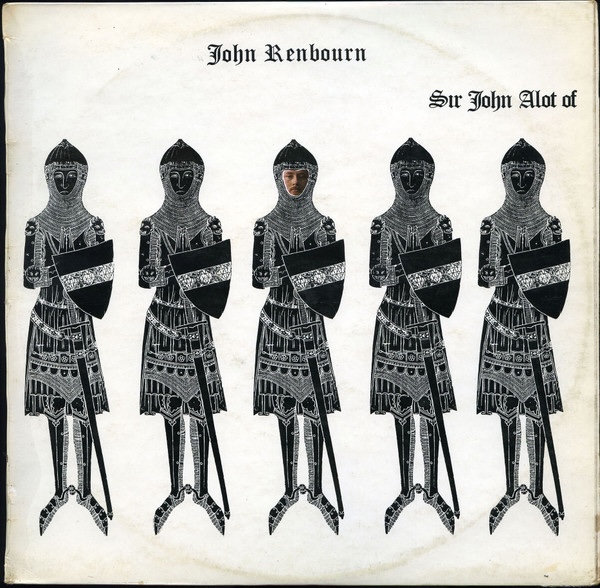
Listening to the Renbourn album produced a similar experience. The Rhea Eclipse beautifully resolved the rich woodiness of Renbourn’s guitar. Cox’s finger taps on drums were wonderfully resonant, and one almost could “see” into the space inside the drums as they resonated. The extremely high notes that Cox played on the glockenspiel on “Transfusion” were rendered with accurate tonality, delicacy and stunning sustain/decay. Each mallet strike on the glockenspiel – and its resulting transient - was reproduced with speed and crystal clarity. Overall, the experience of listening to Renbourn and his band of merrie music makers was one of the performers being in the room - transparent, three dimensional and entirely enjoyable.
Battle of the Titans
I immensely enjoyed listening to the Rhea Eclipse during the several weeks that it lived in my listening room—not unexpected since its predecessors throughout the preceding 20+ years had impressed many reviewers.
Buying a tube phono stage – indeed, almost any tube amplification-based audio product – typically involves a cost/benefit analysis. The benefits include the linearity tubes offer and also the fact that, to the extent tubes add anything to the sound, it is commonly even order harmonics that the human ear finds both entirely natural and pleasing. The costs can include tube noise, though as I noted earlier, tube rush in my system was essentially inaudible at normal listening levels when music was playing. Other undesirable tube amplification artifacts can include inter alia the tendency of some to produce overly sweet and warm sound (not the case here) or reproduce lower frequencies without sufficient heft and tautness—again, definitely not a Rhea Eclipse issue.
When I compared the all-tube Rhea Eclipse back-to-back on the same recordings with the nearly twice-as-expensive solid state Van den Hul The Grail SX[15], the pinnacle of VDH’s phono stage offerings, I found that they were sonically very close. Both did everything well – from tonality, to resolution of small details (including the all-important small details we call timbre that enable one to tell one instrument from another), to low end bass depth and tautness, to quick transients and sometimes startling dynamics. But - to my ears and in my system - the Grail SX resolved more ”air” between instruments, consistent with transimpedance phono stages producing what most reviewers describe as very “black” backgrounds. In the case of the Van Den Hul phono stage, this does not mean artificial edginess to sonic images, but rather instruments being clearly localized in the recording acoustic with no halo, glare, or bloom around them. In other words, imagine someone using Windex to clean the sonic tableau emerging from the speakers.
While tonally the same, with similar dynamics, timbre, transients, and so forth, backgrounds through the Rhea Eclipse were somewhat less clear, and instrumental images correspondingly were a little more “haloed.” But this tube artifact did not detract from the musicality of any recordings. And it did not lessen how enjoyable and emotionally powerful was the music I heard.
One example of these differences was clear on the Decca Pure Analogue reissue of the Sibelius Symphony No. 5. In the opening minutes of the first movement different instruments or groups of instruments play related motifs from their respective positions across the stage as Sibelius creates a palette of different tonal colors, including the horns, followed by the flutes, oboes, and clarinets, then the bassoons and the timpani playing a countermelody, and - about two minutes in - the strings. The music I heard through both phono stages was stunningly beautiful – to my ears, among the most beautiful musical passages any composer has ever written. But the presentation of the music was a little clearer through the Grail SX, with sonic images emerging from a blacker background with no halo or bloom.
Similarly, when playing the Pablo reissue The Alternate Blues the sense of being in the room with the performers was somewhat enhanced through the Van den Hul, with the notes from the different instruments most noticeably the trumpets a little more clearly resolved. Again this probably was due to the ability of the transimpedance-based Grail SX to present the “air” between performers with uncanny blackness and transparency.
On both Alice Artzt’s English Guitar Music and the Yarlung Art of the Violin LPs, the Van den Hul again resolved just a bit more of the acoustic of the spaces in which the recordings were made, particularly the reverberations from Livonen’s plucking of the violin strings during the Ysaye Sonata no. 2. This allowed the notes to materialize with clarity from a deep black background. That said, on both albums I found that I preferred the richness that I heard through the Rhea Eclipse. Such richness of presentation may explain why so many audiophiles like tube phono stages!
These two phono stages both excel in faithfully revealing what’s recorded in the grooves. And had I not had the Grail SX nearby to do real time A/B comparisons I likely would never have noticed the mild tube artifacts.
Conclusion
At $16,000, the Rhea Eclipse is not inexpensive. But it is a stunning realization of Jim White’s continuing efforts to improve his vacuum tube-centric product line through, among other things, strategic upgrading of critical internal components, all in the unflagging pursuit of sonic excellence as well as maintaining the value of the products his loyal customers buy.
Buyers be forewarned: this is not a typical tube phono stage. It has none of the coloration, bloat, or overly sweet warmth that some associate with tube electronics. Rather, it accurately reveals what is on the record, with deep and taut bass, lightning fast transients and powerful dynamics, and overall transparency to the source. Listening to all of the varied types of music I played was an immensely enjoyable – and very realistic and emotionally moving – experience. To call the Rhea Eclipse a “musical” preamplifier would grossly understate its ability to transport the listener to the performance hall or recording studio/
If you are in the market for a new phono stage, whether you are leaning toward solid state or tubes, voltage amplification or transimpedance, be sure to listen to the Rhea Eclipse. This latest – and significantly improved version – of the venerable Rhea phono stage deserves a place in the constellation or in keeping with Greek mythology the pantheon of the very best phono stages.
####
[1] The Io (still in production) comes in either a two-chassis (power supply and preamplifier) or three chassis version (dual mono power supplies, one chassis each, and a third chassis for the preamplifier electronics). The two chassis version requires a total of 24 tubes (16 in the phono stage chassis and 8 in the power supply); the three chassis 8 more tubes, for a total of 32.
[2]See, e.g., Paul Bolin, Aesthetix Rhea Phono Preamplifier, Stereophile (September 21, 2003); Robert H. Levi and Dave Clark, Rhea Phono Stage, Positive Feedback (Issue 13 May/June 2004); Robert Harley, Rhea Phono Stage, The Absolute Sound (Issue 151 December 2005); Michael Fremer, Aesthetix Rhea Phono Preamplifier, Stereophile (vol. 28 no. 6 June 2005); Robert Harley, Aesthetix Rhea Signature Phonostage, The Absolute Sound (Issue 196 October 20, 2009); Peter Roth, Aesthetix Rhea and Rhea Signature Phono Stages, ULTRAaudio (July 15, 2009).
[3] See Robert Harley, Aesthetix Rhea Signature Phonostage, The Absolute Sound (Issue 196 October 20, 2009)
[4] I have owned two other transimpedance phono stages, one (the Lino C 3.3 made by Channel D Corp.) that stopped functioning at about the same time that its highly personable and brilliant designer (and apparently Channel D’s sole employee), Rob Robinson, passed away unexpectedly. The Lino C 3.3 and the transimpedance phono stages that have found their way into my listening room since its unfortunate demise each have sounded different, but all shared one common attribute – subterranean noise floors that translated into pitch black (or crystal clear, depending on how you want to phrase it) backgrounds with clean air between instrumental images. And because a transimpedance device amplifies the current generated by a phono cartridge and not its voltage output, and because what the cartridge “sees” is a virtual short-circuit at the phono stage end, there is no need to set – or worry about – loading. For best results, phono cartridges with very low internal impedance are advised.
[5] Being a pure tube amplification device, the Rhea Eclipse generates some audible “tube hiss” or “tube rush.” At normal listening levels (especially at lower gain settings), any hiss/rush was barely audible with no music playing and certainly well below the surface noise of a typical LP (and thus essentially inaudible) when playing a LP.
[6] We take the term “loading” for granted (at least I did once). But it’s a little counterintuitive. The lower the resistance (ohm) value, the stiffer the coil structure inside the cartridge actually becomes (and thus less compliant and less sensitive to the LP groove wall surface). At too low a resistance setting (and thus too much damping), the sound can become lifeless and dull, with low dynamics; at too high a resistance setting (and thus too little damping), the sound can become shrill, overly bright, and edgy. In terms of electrical forces, resistive loading affects the strength of the magnetic forces generated by the current flowing through the coils inside the cartridge (a topic way beyond the scope of this review).
[7] I understand from sources I consider reliable that Jonathan Carr, the Lyra’s designer, prefers 100 ohm loading.
[8] In a very oversimplified nutshell, the RIAA EQ curve boosts the amplitude of high frequency signals contained on the source recording (by 20db) and reduces the amplitude of low frequencies (also by 20db) when mastering a vinyl record. The RIAA curve process reduces groove width (bass frequencies take up more groove space than high frequency ones do), enabling more music to be recorded on a record side, and improving sound quality by reducing surface noise. Equalization in a phono stage then reverses this process. Needless to say, any inaccuracy in the equalization process within a phono stage will result in inaccurate reproduction of the music recorded in the grooves. Some phono stages use proprietary equalization methods, but in general there are “passive” and “active” approaches. The “passive” approach uses resistors and capacitors to cut the high frequency amplitude and allow low frequencies to pass with less attenuation than used on the LP itself. In effect, active RIAA equalization uses the gain circuitry of the phono stage to increase the gain applied to the lower frequencies and decrease the gain applied to the higher frequencies in order to mirror the “flat” output levels found on the master tape or other source recording.
[9] My listening room is trapezoidal, with the following dimensions: length approx. 19’; ceiling approx. 10’ high; wall behind speakers approx. 12’ wide; wall behind listening position approx. 19’ wide. For this review, I listened in the near field position – a little over 9’ from each speaker (which are an identical distance apart from each other, for a perfect equilateral triangle).
[10] See Leo Beranek, Concert Halls and Opera Houses: Music, Acoustics, and Architecture 2d ed. passim (2004).
[11] See Levitin, This Is Your Brain on Music, at 53.
[12] See generally Koster, J., “The Cambridge Companion to the Harpsichord,” chapter 1, published online by Cambridge University Press January 5, 2019.
[13] The sound that a piano creates is more complex than it at first might seem. Yes, when the pianist’s fingers press the keys, and the hammers strike the piano strings, the strings are displaced and stretched, and their tautness causes the strings to return to their original position. When the keys at the left end of the keyboard are pressed, the piano emits low pitch sounds due to the thicker strings at that end of the piano vibrating (oscillating) more slowly than the thinner, tauter strings at the right end of the keyboard (which emit a higher pitch sound due to their faster vibrations/oscillations). Simple, right? Not so fast. As Daniel Levitin points out, each time a string is struck by the piano hammer, it does not simply return to the position it was at while at rest (pre-strike). Rather, it overshoots the original position, going too far in the opposite direction and then returns to the starting point only to overshoot it again in the other direction. With each oscillation, the distance covered by the string in relation to the starting point grows smaller, and ultimately the strike stops vibrating. As the distance covered by the string’s oscillations diminishes, the sound grows softer (decays) and ultimately stops. See Levitin, This Is Your Brain on Music, at 21. Combined with the extraordinarily wide frequency range of the piano, it is no wonder audio amplifiers are challenged reproducing this harmonic complexity.
[14] This quote is attributed to Andres Segovia.
[15] See March 13, 2024 review of the Grail SX by Michael Fremer in The Absolute Sound (“A Holy Upgraded: The Grail SX”). Because the Grail SX is a transimpedance phono stage – it amplifies current generated by the phono cartridge and not voltage - there is no loading to worry about. But one does need to make a choice of gain settings. For the listening I did I used the lowest (52db) gain setting offered by the Grail SX for moving coil cartridges, which my ears told me produced the best sonics in my system. According to Van den Hul, the signal to noise ratio at 52db is 78db/A-weighted.
Associated Equipment
Loudspeakers: Alsyvox Tintoretto ribbon planar speakers; external Alsyvox X crossovers with Hi Fi One/Wm. Eikos umbilicals.
Analog source: Dohmann Audio Helix 2 Mk. 3 turntable with Arya Labs Orbius record weight; Supatrac Nighthawk 12” tonearm; Lyra Atlas Lambda SL moving coil stereo phono cartridge; Ramar record cleaning brush; HumminGuru Nova ultrasonic record cleaner; suite of WallyTools phono cartridge set-up and maintenance tools.
Amplification: McCormack Audio Design/Hi Fi One VRE-2 (Silver Edition) reference solid state linestage (used for this review); Aesthetix Audio Metis reference tube linestage; David Berning/Hi Fi One 845 tube monoblock power amplifiers; Van den Hul The Grail SX transimpedance phono stage.
Support and vibration control: Harmonic Resolution Systems MX-3 isolation platforms; Arya Labs Rev-O-Pods.
Cables: Furutech Project Series V1-T single-ended DIN phono cable (used for this review); Analysis Plus Silver Apex balanced DIN tonearm cable; Wm. Eikos UltraLitz AC power cables, balanced interconnect cables, and speaker cables; EnKlein XerXes balanced interconnect cables; Analysis Plus Ultimate Power Oval AC cable; Shunyata Alpha v2 NR AC power cable.
Powerline: EnKlein Sovereign AC power star ground and noise reduction hub.
Specifications
Retail price: $16,000
Inputs: 3 discrete phono inputs using single-ended (RCA) jacks
Gain settings (selectable for each input): 8 total; 75, 68, 62, 56, 50, 44, 38 dB, and off
Load settings (selectable for each input): 9 total: 47 K, 10K, 5K, 2.5K, 1K, 500, 250, 125, and 75 ohms
Outputs: 2 RCA (single-ended) and 2 XLR (balanced)
Output impedance: 1K ohms RCA (single-ended); 600 ohms XLR (balanced)
Front panel controls: phono input, mute, gain, loading, demagnetizer, and standby
Remote controls: phono input, mute, gain, loading, demagnetizer, and standby
Frequency response: +/- 0.25 dB, 20 Hz - 20 KHz
Signal to noise ratio: 75 dB A-weighted (ref 1 mv input) (at 75 db gain); 65 db unweighted (ref. 1mv)
Recommended input impedance: 10K ohms or greater
Tubes (each channel): V1 & V2 (12AX7-factory graded low noise), V3 & V4 (12AX7 or equivalent) and V5 (6922)
Power consumption: 20 watts standby; 100 watts active
Physical dimensions: 4 3/8" high, 17 7/8" wide, 18" deep including jacks
Shipping weight: 40 lbs
Manufacturer Information
Aesthetix Audio Corporation
5220 Gabbert Road Suite A
Moorpark, CA 93021
+1 805-529-9901
info@aesthetix.net