
Karajan’s "Ring" Cycle Refreshed and Revisited in the Original Source’s First Opera Release - Part 1
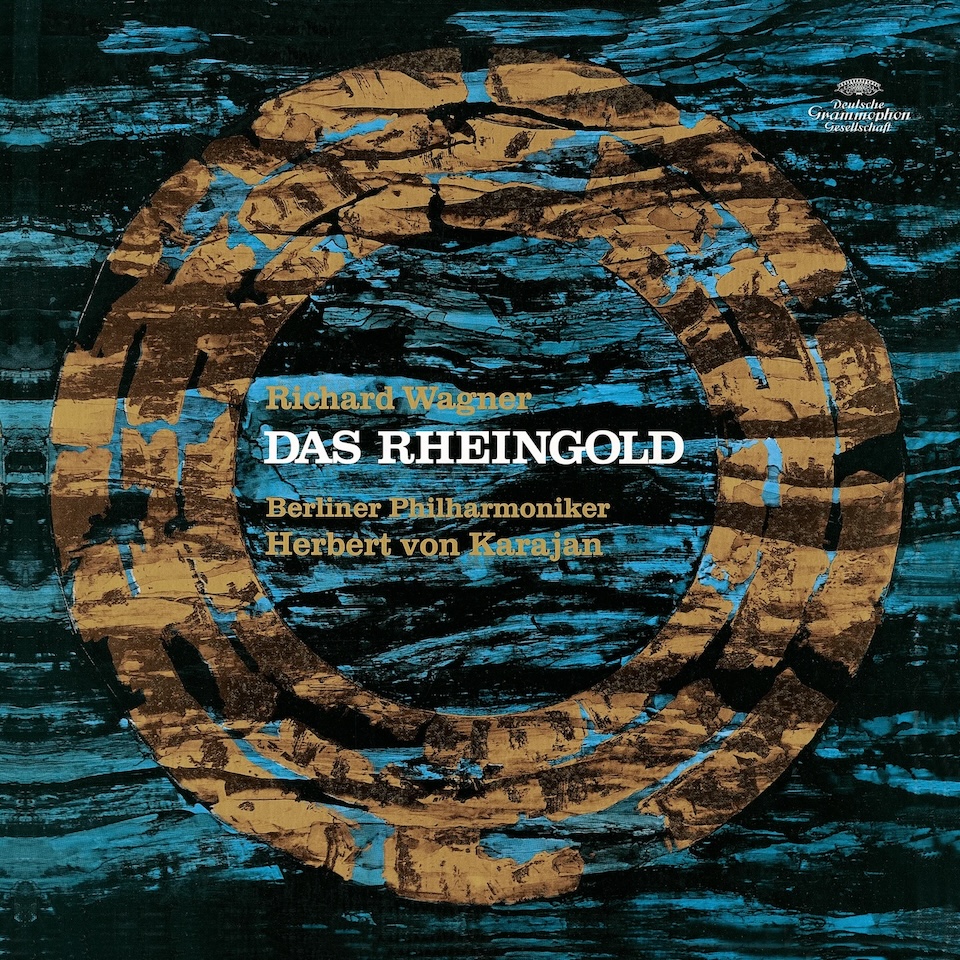
"Das Rheingold" - the first opera in the legendary conductor’s recording of Wagner’s mighty "Der Ring des Nibelungen" - gets the Original Source makeover from the 2-track master. Was it worth it?
"I have witnessed and greatly enjoyed the first act of everything which Wagner created, but the effect on me has always been so powerful that one act was quite sufficient; whenever I have witnessed two acts I have gone away physically exhausted; and whenever I have ventured an entire opera the result has been the next thing to suicide."
-- Mark Twain
“The problem with Wagner's music is that it makes you want to go out and invade Poland.”
-- Woody Allen .
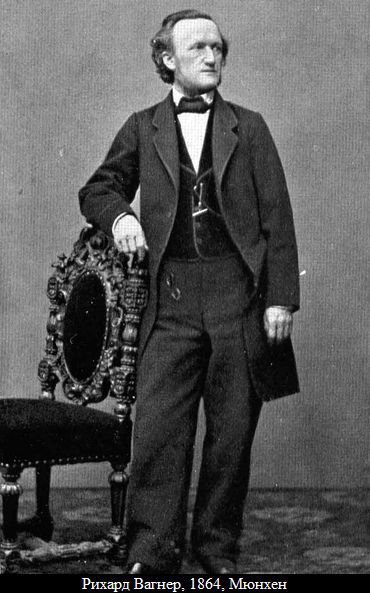 Richard Wagner in 1864
With all due deference to the misgivings of Messrs. Twain and Allen, who speak for many Wagner sceptics, for the rest of us Wagner and opera lovers, all good things come to those who wait.
And maybe a little bit more...
For this is quite the treat even for those who routinely expect great things of this reissue series.
Those of us who have been quietly (or not so quietly) waiting and hoping that DG would turn its Original Source eye towards its extensive catalogue of complete opera recordings finally have their wish granted.
But it’s a bit of a surprise as to the opera they chose - but a most welcome one.
If, like me, you thought they would play it safe with one of the well-established opera faves, like a Carmen (either Bernstein or Abbado) or a La Traviata (Carlos Kleiber), imagine my astonishment (and no doubt yours) when it was no less an opus than Das Rheingold (The Rhinegold) - the opening salvo in Wagner’s massive 4-opera cycle, Der Ring des Nibelungen - that was announced to be the Original Source’s pick for the first opera to get the Emil Berliner Studios sonic makeover, courtesy of Rainer Maillard and Sidney C. Meyer.
While Das Rheingold is very much not your typical operatic rabble rouser, and therefore maybe not the obvious choice for someone unfamiliar with the operatic canon but who is already sufficiently enamored of this reissue series to want to investigate, I would argue that it is precisely because Das Rheingold is not typical that it is a great choice. (And certainly a great choice for Mr. Twain by virtue of its relative brevity). It is a more cinematic, epic kind of work, but also psychological in a modern sense. It’s a powerful mythical exploration of the dynamics of love and power in conflict with one another across generations and social strata, with a stunningly rich and enveloping score. Believe it or not, this work which is the epitome of what many consider the most elitist of art forms, also happens to be incredibly resonant with what is going on in the world today. It also offers up a blistering critique of the very class most likely to financially support and attend a new Ring production - a delicious irony that Wagner himself would have savored.
For all these reasons and others it may be the perfect way for the opera novice to dip his or her toe into this vast and rich repertoire.
Those who already know and love Rheingold will need little persuading from me. And for those of you yet to enter the Wagnerian universe, I’d argue this is a much better place to start than Tristan und Isolde, Tannhäuser, or Die Meistersinger von Nürnberg. Or even Der fliegende Holländer, his more conventional early work. Certainly better than Parsifal, which is definitely an acquired taste.
By virtue of its story and characters, its spectacular set pieces, and, yes - its relative brevity - Das Rheingold is the best place to begin your exploration of the unique world of Richard Wagner. This is a world of ideas, dramaturgy and music that remains to this day very much sui generis. It is a world that played a key role in the development of music in the Romantic era, then pointed the way forward into the 20th century and modernism. It was (and is) embraced by passionate followers, and rejected by equally passionate detractors. You could say that the people who are into Wagner are the original fan boys and girls: informed, opinionated and obsessive. Cross them at your peril. Many’s the production team that has been booed at Bayreuth, only to be lionized a few short years later (the Pierre Boulez/Patrice Chéreau ground-breaking 1976 centenary production of the Ring being a case in point).
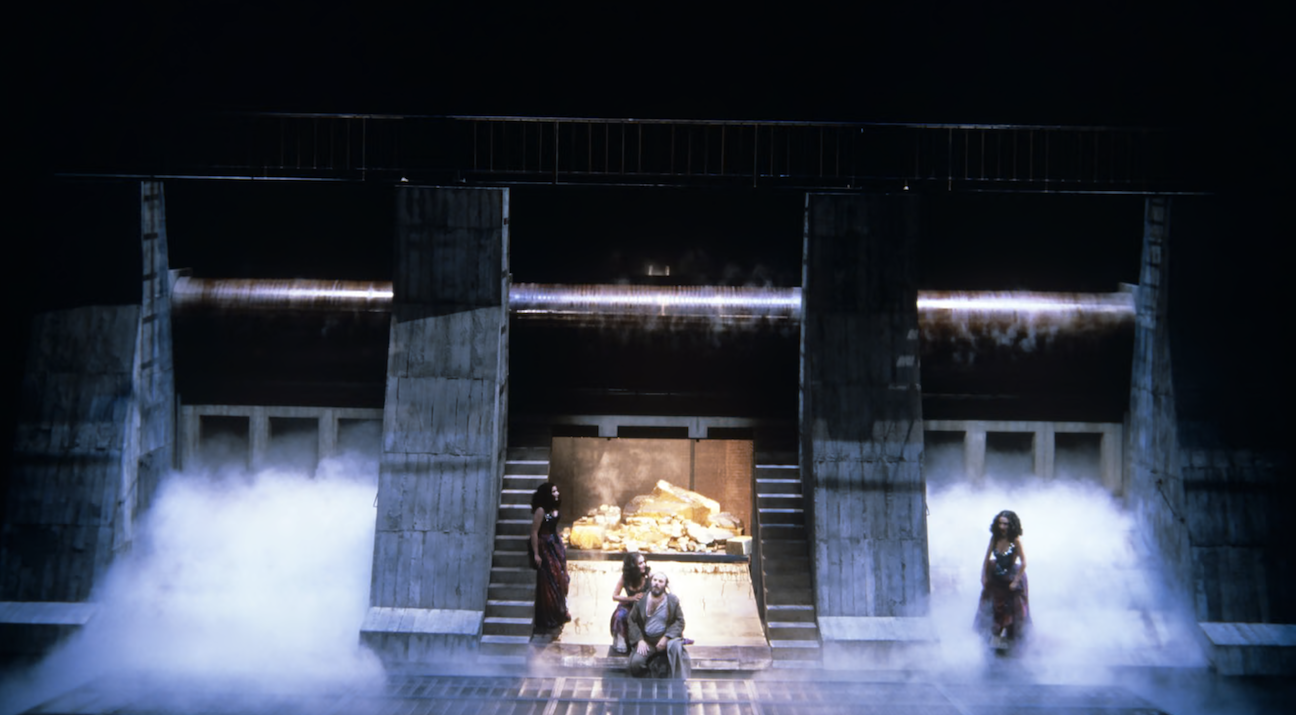 Patrice Chéreau's Das Rheingold reimagined the Rhinemaidens as "voluptuous tarts" (in the words of one writer), hanging out at a hydro-electric dam
I believe that Wagner comes second only to Jesus Christ and Napoleon in the number of books written about him. Controversial in his lifetime and beyond for his ideas and both his public and private activities, he was a true revolutionary, and - I think it reasonable to say - an absolutely odious individual. But, oh the music - it is something else, whether you judge it positively or negatively. On that point both the Wagner lovers and haters will agree. Something else indeed.
This is music that conductor Herbert von Karajan and the Berlin Philharmonic, together with one of the best line-up of singers for this work ever recorded (although with some miscasting, a bane of pretty much every Ring cycle to one degree or another), do to the max - and thoroughly make their own. Long considered one of the jewels in Karajan’s crown of great opera recordings (which is saying something, because his opera catalogue is full of widely admired recordings spread across DG, Decca, EMI and even Philips), Das Rheingold is the first entry in his account of the complete Ring cycle, marketed at the time of its release (in the 1960s) as an alternative view to Solti’s groundbreaking studio account on Decca.
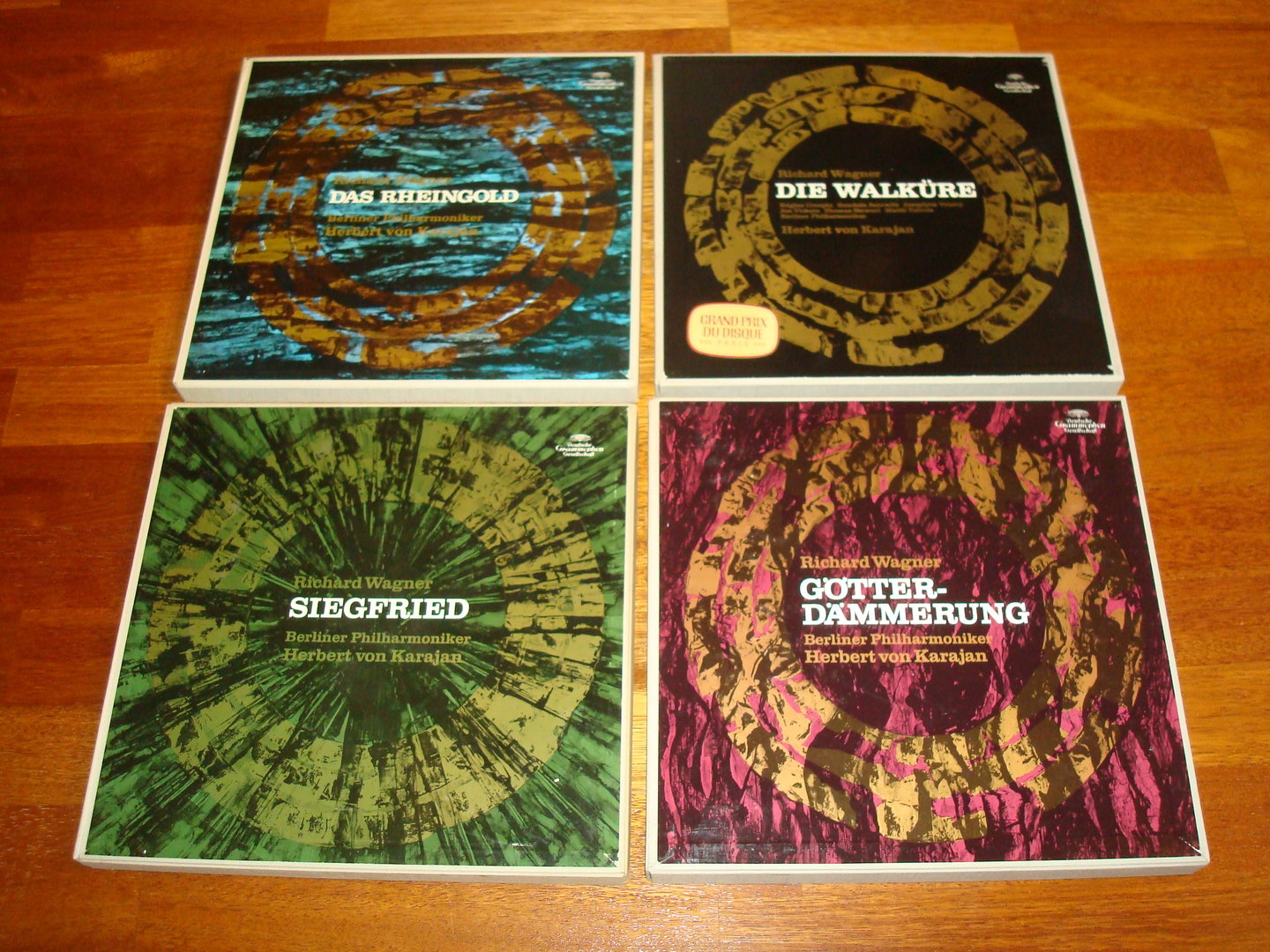 The four original box set vinyl releases of Karajan's Ring cycle
It was many years before another label would embark on another complete studio recording of the Ring (Eurodisc/BMG’s early 80s outing with Marek Janowski and the Staatskapelle Dresden). The cycle by Karl Böhm, released on Philips complete in 1973, and often considered the main rival to Karajan and Solti in modern sound, was taped at live stage performances (in Böhm’s case at Bayreuth), as have been many of the most admired historical and recent recordings dating back to early outings by Furtwängler, Clemens Krauss and Joseph Keilberth, then stretching forward to Pierre Boulez and Daniel Barenboim and beyond.
Beyond the intrinsic virtues of the Karajan Ring, and in particular this Rheingold, the other very good reason to give this set the Original Source treatment is the fact that 2026 marks the 150th anniversary of the first complete performances of Der Ring Des Nibelungen at the inaugural season of the Bayreuth Festival in 1876. (The Bayreuth Festival Theater was built specially, and exclusively, for the staging of Wagner’s works, incorporating many design innovations to accommodate the unique technical demands made by his new conception of “music drama”).
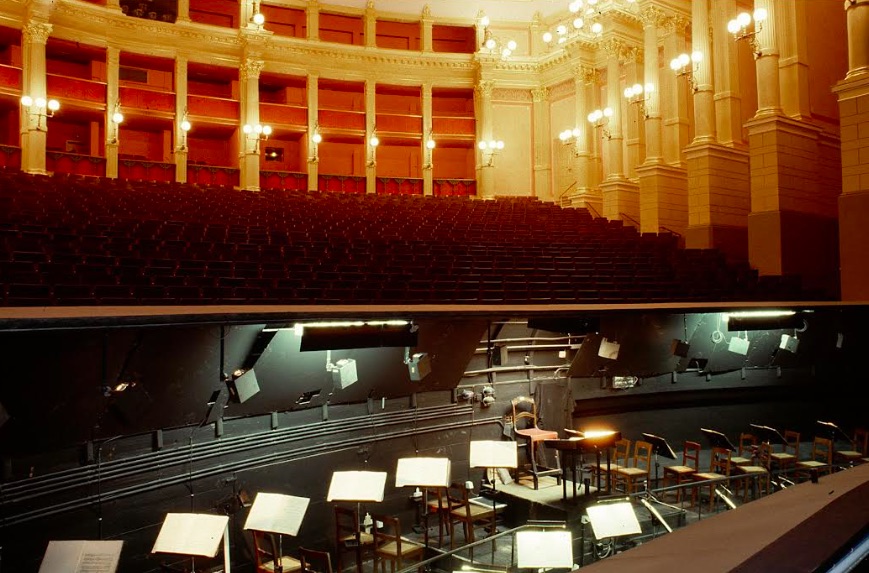 The view from the stage into the interior of the Bayreuth Festival Theatre - the orchestra pit was designed to disappear completely from the audience, focusing all attention on the stage, and allowing instruments and voices to blend together before reaching the audience (Photo by Jorg Schulze)
However, there is one important regard in which this Rheingold departs from previous releases in the Original Source series. It is not mastered from 4- and 8-track masters that include two channels of surround sound captured at the original sessions, now folded into a stereo mix by EBS going straight to the cutting lathe. No, here - by virtue of Rheingold having been recorded in 1967 - the master tapes are regular 2-track stereo, captured at the Jesus-Christus Kirche in Berlin - one of DG’s regular recording locations for many years. This is the first time that DG has delved into its pre-70s, pre-surround 4-and 8-track masters for the Original Source series. Given the goodies lurking in this earlier DG catalogue for potential Original Source reissue, all I can say is Hallelujah!
Not that Rainer Maillard and Emil Berliner Studios do not already have extensive experience remastering for vinyl from DG’s 2-track, pre-1970s catalogue. In the 2010s Maillard was doing selective AAA and ADA remasterings for the Analogphonic vinyl reissue label; some of these were then repurposed as DG releases, a good example being the box set gathering together Yevgeny Mravinsky’s legendary 60s recordings of Tchaikovsky’s last three symphonies with the Leningrad Philharmonic.
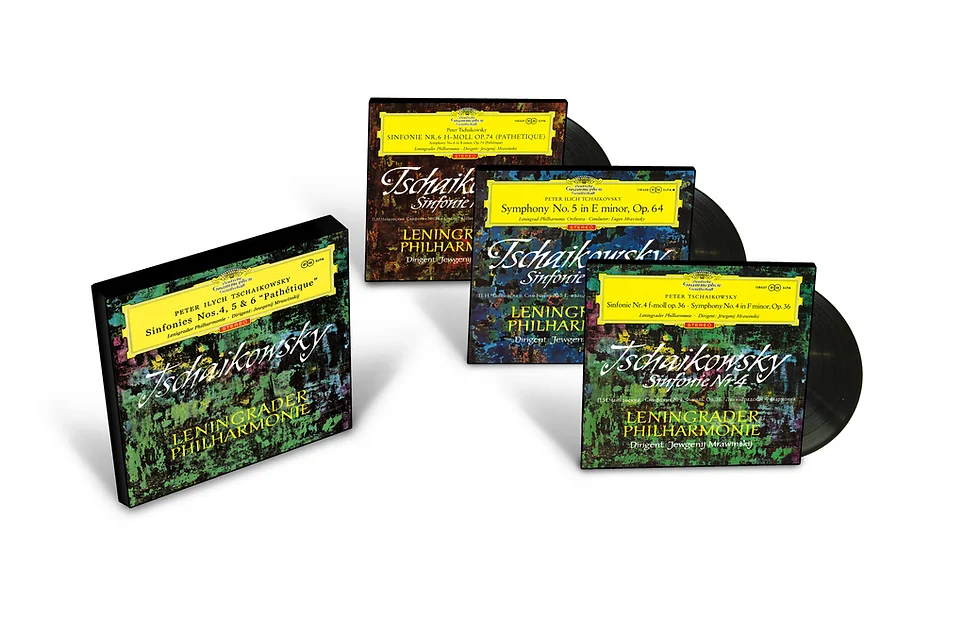 Mravinsky's famous recordings of Tchaikovsky's last three symphonies, remastered for Analogphonic by Rainer Maillard and EBS
Some other noteworthy EBS remasterings for vinyl during this period were of Bernstein’s Beethoven Symphony cycle with the Vienna Philharmonic, and the Karajan 1960s Beethoven and Brahms symphony cycles.
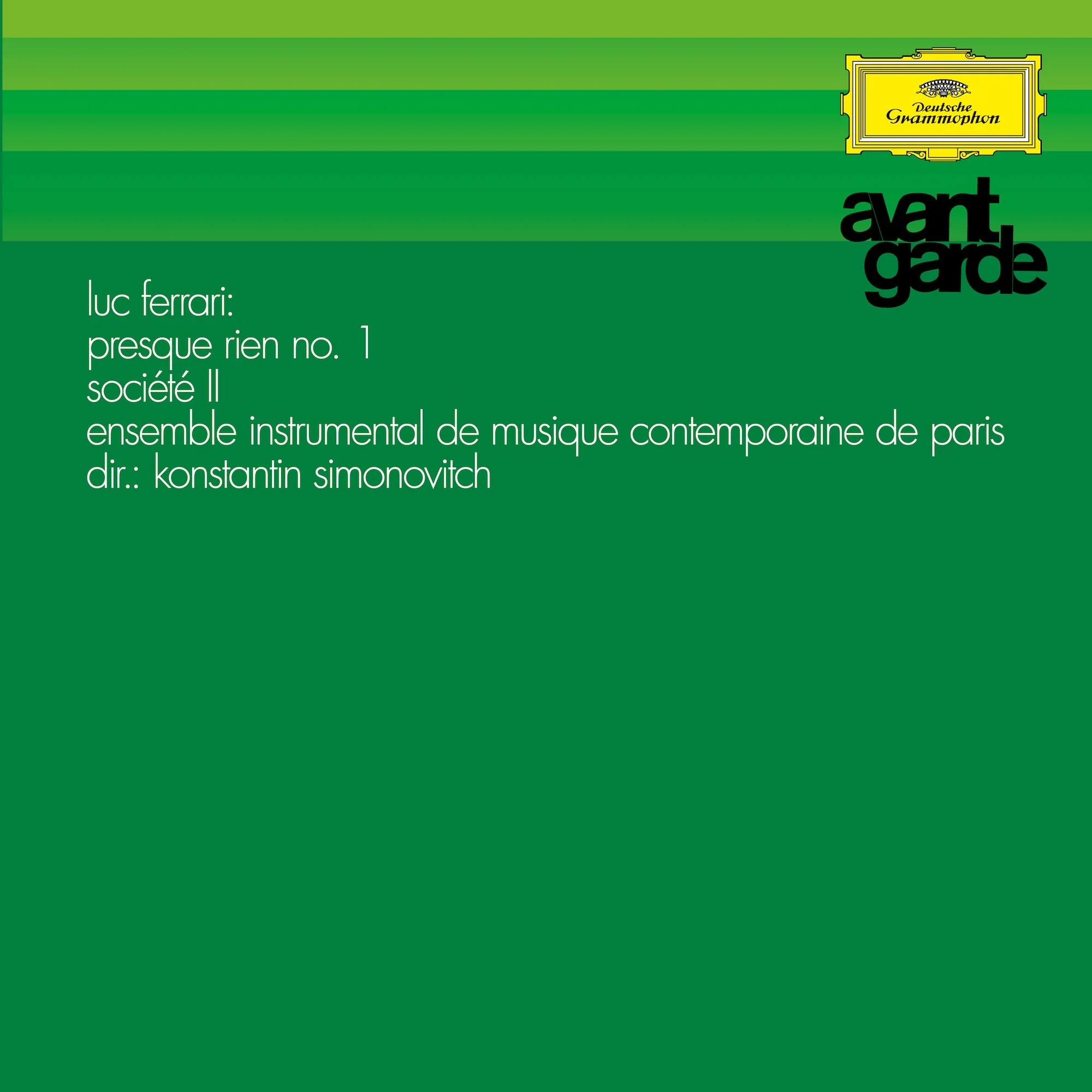
DG’s decision to move into its 2-track catalogue for premium AAA vinyl reissues coincides with the debut of the Decca Pure Analogue series, which is also mining its vintage 2-track back-catalogue (likewise mastered and cut at EBS). In the upcoming series of reissues from DG’s groundbreaking Avantgarde series of recordings, the Luc Ferrari disc is likewise sourced and cut from 2-track stereo masters.
To those of you who are skeptical of the potential sonic benefits of applying the Original Source mastering chain to the 2-track catalogue, my response is to stay open minded. Remember that one of the reasons that DG pressings back in the day lacked the audiophile verities of the rival Decca and EMI records was that they were often cut from tape copies of the masters to which a certain amount of compression and frequency filtering had been applied. Not so with Rainer Maillard vinyl remasters. I own a number of these earlier EBS-mastered vinyl reissues, like the Mravinsky Tchaikovsky and the Karajan Brahms, and they sound terrific. Yes, so-called DG “large tulip” pressings from the 50s and 60s do indeed have their own magic, but it isn’t always guaranteed.
In fact, the first pressing of Karajan’s Das Rheingold (1968) was indeed a “large tulip” pressing, as were the next two installments in the cycle, Die Walküre and Siegfried, and since I have copies of these, plus of the later non-tulip pressings, my sonic comparisons will be comprehensive. (“Large tulip” pressings are so called for the pattern on the records’ center label; these OG pressings featured tubes in the mastering chain, unlike the later non-tulip pressings you see in the later 1960s and 70s).
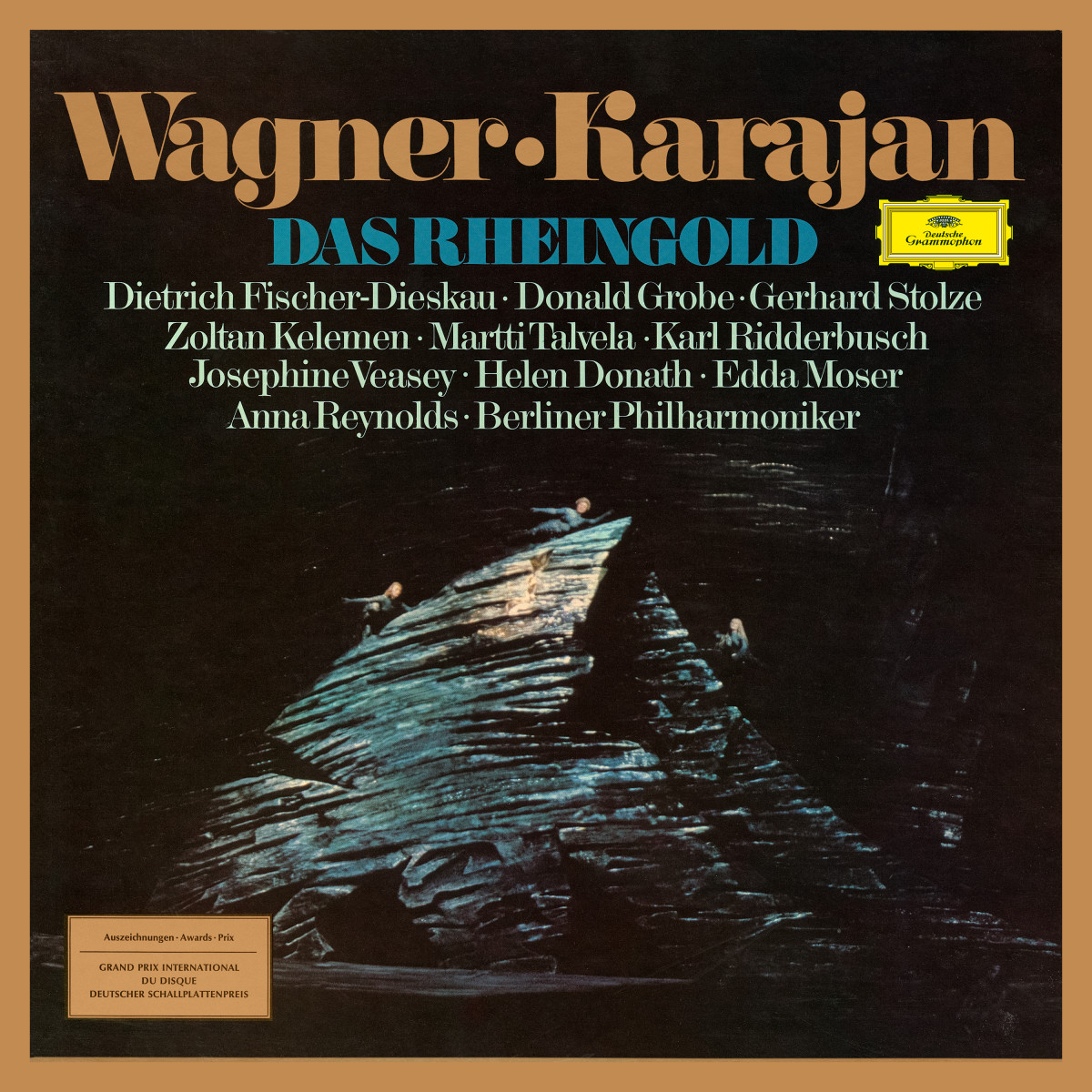 The later vinyl reissue of Das Rheingold
But before we get into an assessment of this reissue, there is a lot of ground to cover in terms of setting the stage for why Das Rheingold is such a significant and compelling work, and why it deserves your attention.
I would strongly suggest anyone unfamiliar with this background read the first part of my three article series on the reissue of Georg Solti’s groundbreaking recording of the Ring cycle for Decca, often referred to as the greatest recording ever made. Here I give an overview of the history of opera, and talk about what was so revolutionary about Wagner - and his monumental Ring cycle. It will provide a necessary orientation for the Wagner and/or Ring novice, and a necessary overture to what I am going to talk about below.
You might also want to follow up at some point with Part 2 where I go into the detail of how Decca recorded the cycle, since that offers a primer on the challenges of capturing this epic work on tape. You will then have a good point of comparison to how DG and Karajan went about their own studio recording, more conventionally mounted with fewer sound effects.
The World of Das Rheingold
A Highlights Reel of Scenes from Robert Lepage's 2012 Metropolitan Opera production of Das Rheingold
“Who could look all his life long with an open mind and a free heart, at this world of murder and theft, organized and legalized through lying, deception, and hypocrisy, without having to turn away, shuddering in disgust? Whence then would one avert one’s gaze? All too often into the vale of death. To him, however, who is otherwise called and singled out by destiny, there appears the truest reflection of the world itself, as the foretold exhortation of redemption, despatched by its [the world’s] innermost soul.”
― Richard Wagner
Leaving aside Wagner’s typically self-aggrandizing (and self-deceiving) view of himself as the agent of redemption for the world’s sins (conveniently forgetting the substantial list of his own), nevertheless this is as good a place to start as any when talking about the world of the Ring, and specifically the themes and concerns laid out in Das Rheingold, what Wagner labeled as the “Prelude” to his grand tetralogy.
In his important essay, Opera and Drama from 1851, the composer wrote:
I shall never write an Opera more. As I have no wish to invent an arbitrary title for my works, I will call them Dramas … I propose to produce my myth in three complete dramas, preceded by a lengthy Prelude (Vorspiel). ...
At a specially-appointed Festival, I propose, some future time, to produce those three Dramas with their Prelude, in the course of three days and a fore-evening. The object of this production I shall consider thoroughly attained, if I and my artistic comrades, the actual performers, shall within these four evenings succeed in artistically conveying my purpose to the true Emotional (not the Critical) Understanding of spectators who shall have gathered together expressly to learn it.
The incomparable thing about myth is that it is true for all time, and its content . . . [is] inexhaustible throughout the ages. The only task of the poet is to expound it.
The narrative material from which Wagner drew for his Ring scenario was rooted in Norse and German mythology, specifically the 13th century Icelandic Volsung Saga, Poetic Edda and the German Nibelungenlied. He selects and blends different elements of his source material to craft a fable about love, power, corruption and redemption which continues to resonate to this day, fueling an unstoppable industry of new productions around the world.
But in Das Rheingold he is particularly interested in the aforementioned “world of murder and theft, organized and legalized through lying, deception, and hypocrisy”. The events of this “Prelude” set in motion the entire drama that will unfold over the following three evenings (and 13-plus hours).
In the opening scene, the malevolent dwarf Alberich pursues the beautiful but unattainable Rhinemaidens, who guard the glittering gold that lies at the bottom of the primordial Rhine, from whose depths the music and the world of Wagner’s drama emerge in the opening Prelude. They lead him on, flirting like crazy, only to taunt and humiliate him, mocking his ugliness.
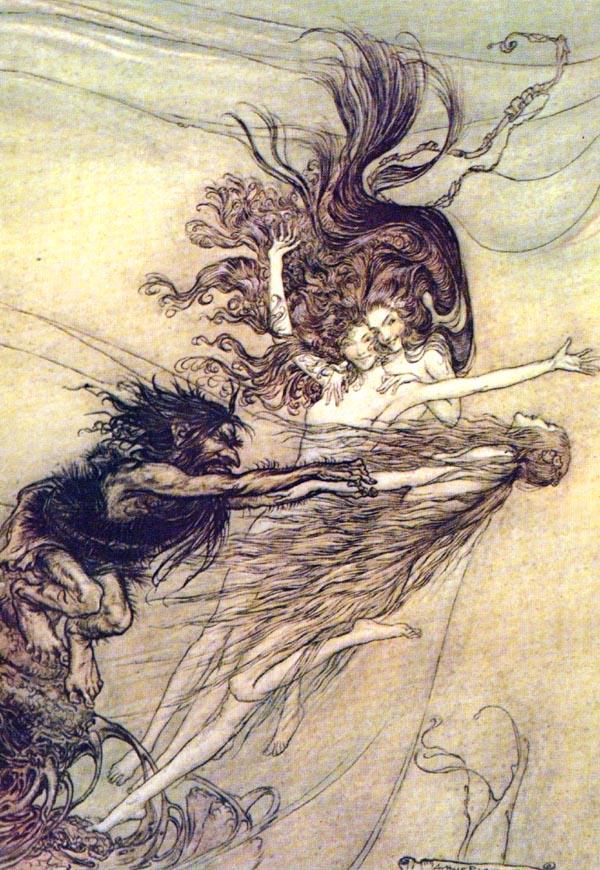 The Rhinemaidens taunt Alberich (from the set of illustrations for the Ring created by Arthur Rackham for a 1910 Edition of the text)
Finally realizing he will never find or have love, Alberich curses and abjures love, and steals the gold. The world has been robbed of its purity and innocence, as the Rhinemaidens sing of their great loss.
Ascending through the earth up to the mountain tops in one of several extraordinary musical transformation scenes, we meet the gods, and in particular their leader, Wotan.
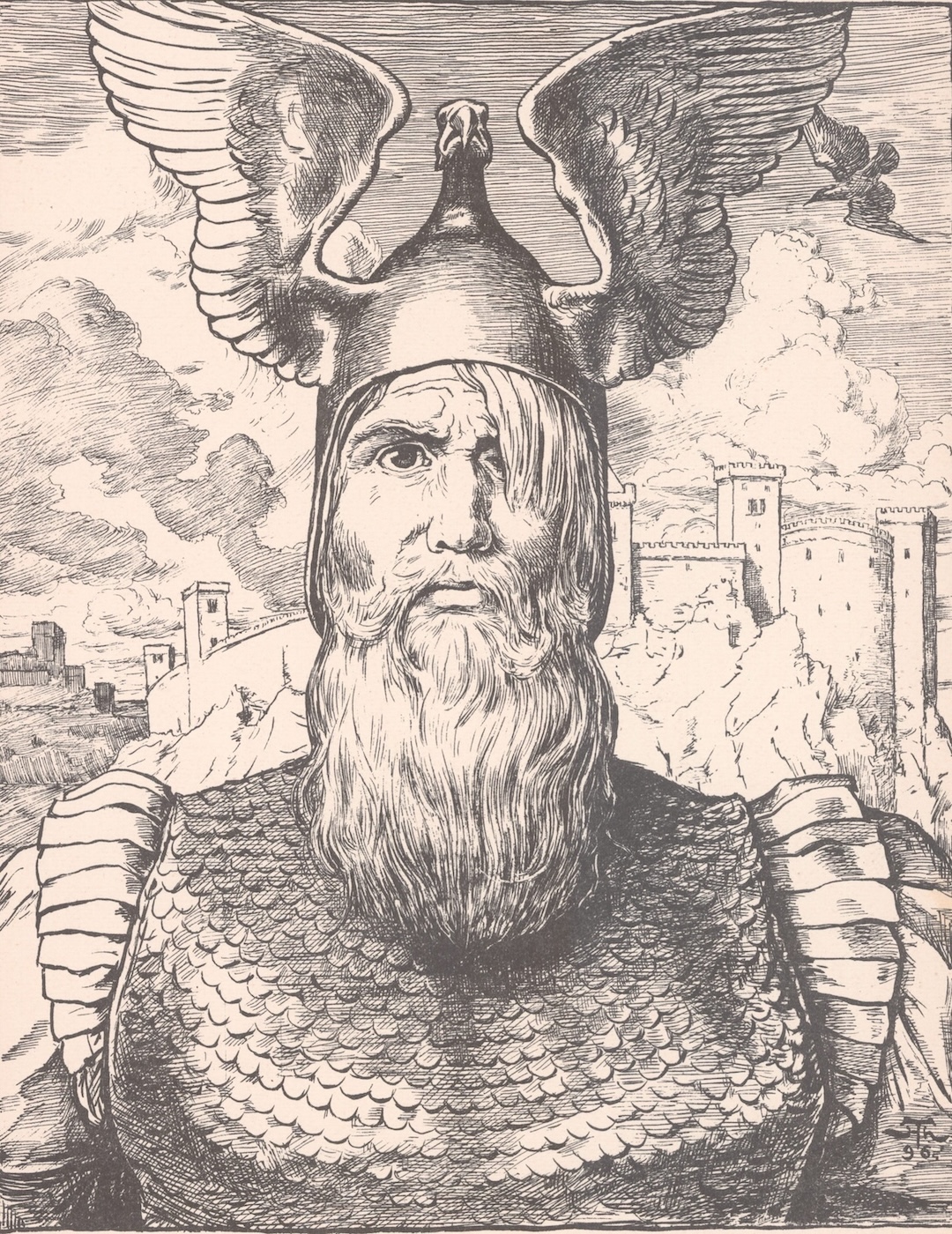 "Wotan's Head" by Hans Thoma (1896)
In the mists above them gleams their newly constructed palace, Valhalla, which has just been completed by two giants, the brothers Fafner and Fasolt. But a ticking time bomb is about to go off, because to pay for the building Wotan has promised the giants they can take Freia, his wife’s sister, as payment - Fasolt in particular is in love with her, mesmerized by her unattainable beauty.
The whole thing is a dirty deal made by a developer who has no intention of paying his contractors. Sound familiar? We also learn from the admonitions of his wife, Fricka, that our man Wotan is prone to wanderlust in every sense - he has real trouble keeping it in his pants as he travels the globe tending to his business and power interests. Sound familiar? (Listening to this opera again, libretto in hand, I was somewhat astonished at just how much it resonated with current events and personalities - more on this later).
But the wily Loge (the God of Fire) tells of the gold of the Rhinemaidens stolen by Alberich, and of the ring of power he has fashioned by renouncing love. While Fasolt dreams of adorning his beloved Freia with the gold, Fafner is more interested in the ring.
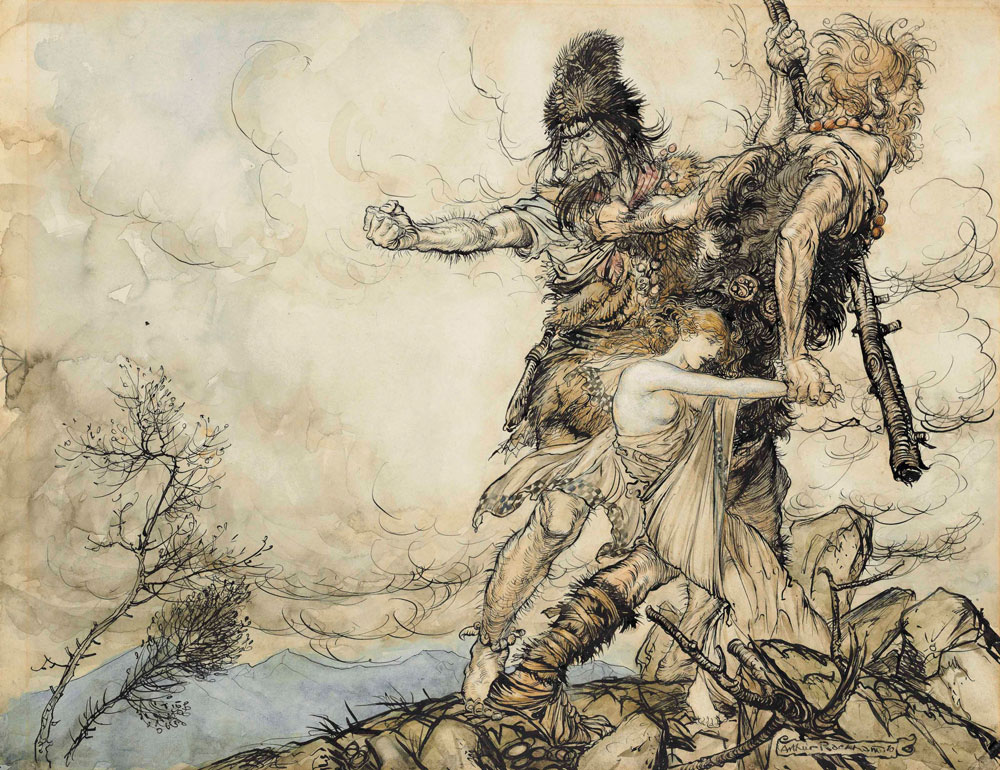 Fasolt and Fafner drag away Freia, by Arthur Rackham
When the giants drag away the protesting Freia, Wotan and the other gods grow weak, because Freia tends the apple trees from which they gain their eternal youth. Without her and her power, the gods will wither and die. Wotan, teaming up with Loge, descends to the caverns of Nibelheim to steal Alberich’s gold. This will enable him to barter with some serious coin to obtain the freedom and return of Freia.
In another superb orchestral transition we descend to the hellish region of Nibelheim, where Alberich has enslaved his fellow dwarves.
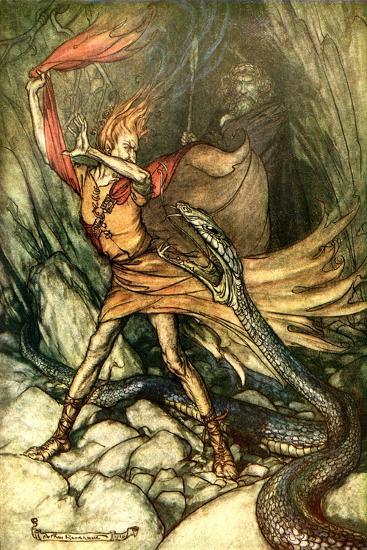 Loge and Wotan watch as Alberich transforms himself into a serpent using the magic Tarnhelm (Rackham)
There Wotan and Loge trick Alberich, capture him, and manage to steal the gold - and the ring. But, before they can leave, Alberich curses all who wear “his” ring.
That curse plays out almost immediately upon Wotan and Loge’s return to the mountain tops. Mesmerized by the gold and the ring in particular, Wotan determines to keep it all.
But with the sudden appearance of Erda, a Mother Earth figure, to warn him of the dangers of seeking the ring, Wotan wavers…
Erda:
“Hear me…
All that is shall come to an end.
A dark day dawns for the gods:
I charge you shun the ring!
Wotan reluctantly surrenders the gold and the ring to the giants in exchange for Freia. But Fasolt is reluctant to give up his beloved. Fafner will have none of his bother’s sentiment. He kills him, and makes off with all of the loot - including the ring.
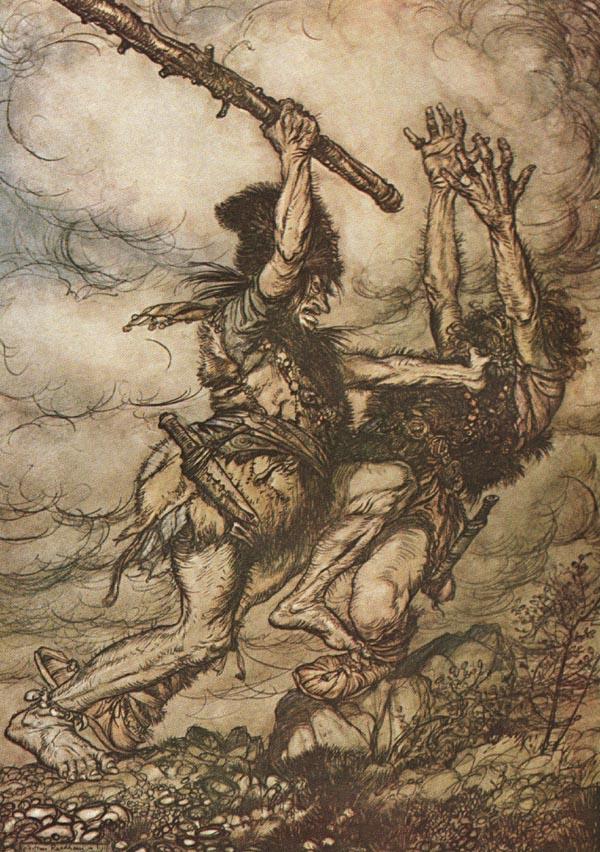
Fafner murdering his brother Fasolt for the ring (Rackham)
Wotan, realizing the peril that the gods now stand in, with the order of the world upended by the creation of the ring of power, determines that he will have to take steps to try and recover it: because surely if anyone is going to wield the ring of power, it should be him. The steps he takes to achieve these aims, and how everything works out in a way different to his plans, culminating in the destruction of the gods and the “old” world order, makes up the action of the rest of the Ring cycle.
But all that lies far in the future. Here and now, on the mountain top, the God of Thunder, Donner, conjures up a mighty thunderstorm to clear the sultry air...
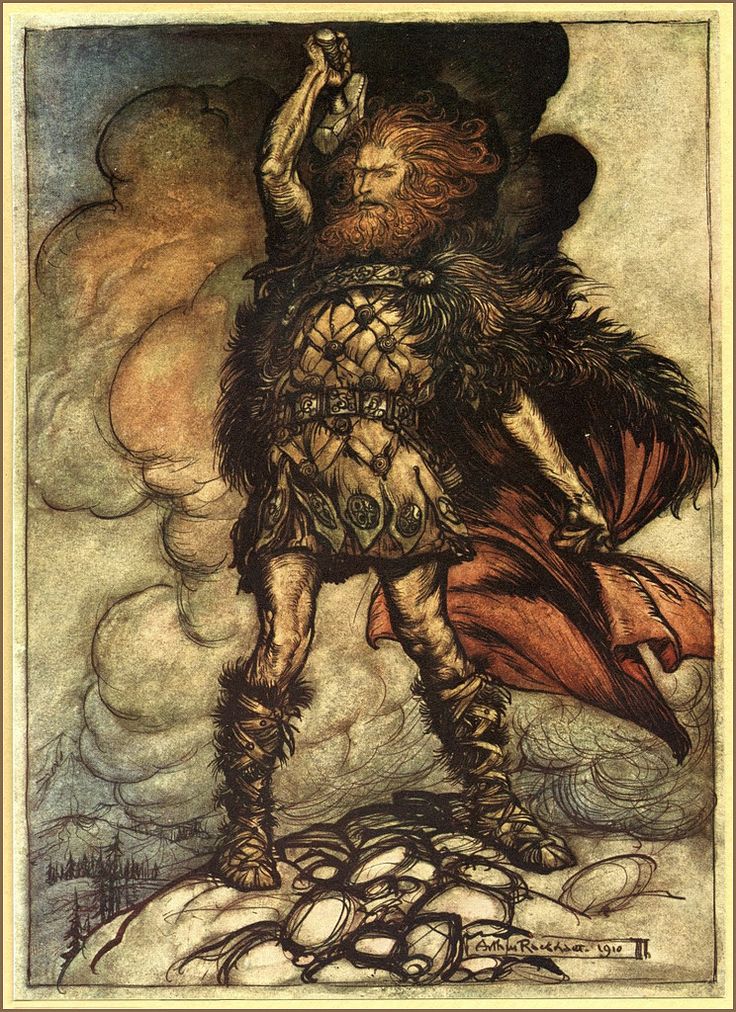 Donner calls forth a storm (Rackham)
Valhalla, finally revealed in all its shining glory, beckons to the gods, who make ready to ascend the rainbow bridge to their new home - built on “murder and theft, organized and legalized through lying, deception, and hypocrisy”.
However, Loge, the one character who sees everything and everyone for what and who they truly are, hesitates, lingering on the sidelines. He shares his misgivings with the audience:
“They hasten to their end,
though they think themselves strong and enduring.
I am almost ashamed to share their doings;
my fancy lures me to transform myself
back into flickering flames.
To burn them who once tamed me,
rather than foolishly end with the blind,
even though they be the most godlike gods,
does not seem stupid to me.
I’ll think it over: who knows what I will do?”
(And burn them he will at the very conclusion of the cycle, his flames helping to bring about the conflagration that ends the final evening of the tetralogy, Götterdämmerung (The Twilight of the Gods).
As Das Rheingold winds to its close, a mighty fanfare of brass accompanies the gods as they finally ascend to the gates of Valhalla, ignoring the distant wails of the Rhinemaidens lamenting the loss of their stolen treasure:
“Rhinegold! Rhinegold! Purest gold!
If but your bright gleam still glittered in the deep!
Now only in the depths is there tenderness and truth:
false and faint-hearted are those who revel above!”
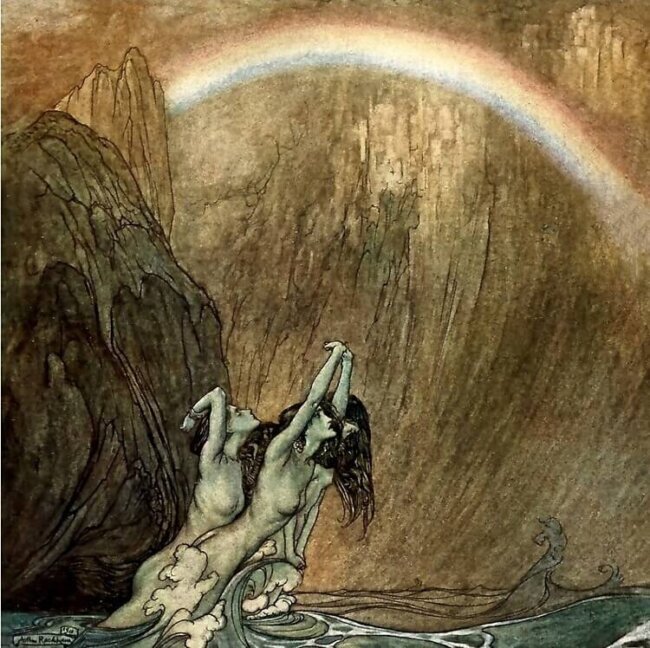 The Rhinemaidens lament the loss of their gold as the gods ascend to Valhalla (Rackham)
In the theater, if the director and his team have done their job right, this is a spellbinding moment. The seemingly invulnerable one-percent ascend to their palace of privilege to the strains of a full orchestra blasting out one of Wagner’s mightiest musical utterances, unaware that - through their self-absorption, isolation, lies, broken promises, desire for power above all else - they have sown the seeds of their own destruction.
No wonder the Ring continues to resonate mightily across the decades, and especially in this political moment.
Composition, Musical Style and Interpretation
In a fine historical essay included in the beautifully reproduced booklet (from the original release) that accompanies this box set, covering the genesis of the Ring, and specifically the themes and concerns of Das Rheingold, Martin Cooper - the distinguished music critic for The Daily Telegraph and author, and father to pianist Imogen Cooper, outlines the genesis of the opera:
“Without subscribing to any theory of the Ring as a conscious political parable, we may still be struck by the fact that Wagner wrote his first sketch of the poem [the appellation Wagner gave to his libretti] in 1848, the year of European revolution, and only a few months before his own implication in the revolutionary movement at Dresden forced him to fly to Switzerland. The chronology of the poems that make up the complete Ring is complex; but Siegfried's Death and The Young Siegfried, which took shape between autumn 1848 and spring 1851, clearly needed preliminary expansion and explanation, and in November 1851 he spoke, in a letter to [his friend] Theodore Uhlig of an opera Die Walküre and a big prelude Das Rheingold. By December 1852 he had printed all four poems in a private edition, and in September he started work on the composition of Das Rheingold, the full orchestral score of which was completed at the end of May 1854. By March 1856 Wagner had completed Die Walküre and the second act of Siegfried; but he then set aside all work on the Ring in order to write Tristan and Die Meistersinger, so that the composition of the complete Ring was not finished until November 1874. Meanwhile, however, Das Rheingold had been given its first performance on September 22, 1869 at Munich. The first performance of a complete tetralogy was not given until August 13, 1876, at Bayreuth.”
From the moment Das Rheingold begins, on that dark low E-flat pedal, we are in a completely different sound world - and musical world - to any other opera. And you can pretty much say that the Ring remains a world unto itself even to this day, 150 years after its first complete performance. It remains a unique artistic and musical utterance, resonating across cultures and decades, always ripe for reinterpretation by directors, performers and commentators. And in many ways, Das Rheingold is the most forward thinking work in the cycle. It is also the most concise: a lean, mean machine of constant action and stunning set pieces.
Gone are the traditional recitatives, arias, duets, ensembles, choruses we associate with “normal” opera. Both on stage and in the music this is a constantly evolving scenario, more akin to film than to regular theater. The work is through composed, with no traditional division into separate scenes. The music never stops, and the curtain never falls, so all the scene changes happen in full view of the audience (which in 1876 required some innovations in stage machinery; the Bayreuth Festival Theater itself was a revolutionary design, still to this day unique).
In order to accommodate the complexities of his concept, Wagner structured his score around leitmotifs - small melodic and chordal fragments associated with specific characters, objects, ideas. These constantly weave in and out of the orchestral and vocal textures: the orchestra is never merely accompanying the singers - it is both telling the story, and commenting on it, without words. The characters as written and sung are flesh and blood in ways that any audience will recognize, embodying a full range of human emotions. But they are also mythic, emblematic figures. The blending of the two is seamless, and it’s the reason why the Ring lends itself so well to different interpretations and production approaches. The characters’ singing is always part of the unfolding drama, never grandstanding for its own sake, and the manner of it is mostly like sung speech, not a separate musical piece during which the dramatic action pauses, like an aria. This is even true in the many monologues.
As alluded to above, Das Rheingold is the leanest incarnation of Wagner’s new approach, moving along at a more rapid clip than subsequent episodes in the cycle. It is the purest expression of Wagner’s ideas about his new type of stage drama that brought together all the arts - what he called the Gesamtkunstwerk (or “total work of art”). It is also especially suited to the gramophone. Here the listener’s visual imagination, prompted by Wagner’s incredibly rich and suggestive music, but unfettered by the realities and limitations of theatrical stagecraft, can run free and wild. Sitting in your listening room your mind can roam where it wills.
You can consider the action through the prism of Freud, of Jung (as in Robert Donington’s illuminating book Wagner’s Ring and its Symbols), or Bernard Shaw - the great Irish poet - who expounded on the world of the Ring in his influential book, The Perfect Wagnerite: A Commentary on the Niblung's Ring.
Shaw offered his book to those enthusiastic admirers of Wagner who "were unable to follow his ideas, and do not in the least understand the dilemma of Wotan." According to Shaw:
“I write this pamphlet for the assistance of those who wish to be introduced to the work on equal terms with that inner circle of adepts...The reason is that its dramatic moments lie quite outside the consciousness of people whose joys and sorrows are all domestic and personal, and whose religions and political ideas are purely conventional and superstitious. To them it is a struggle between half a dozen fairytale personages for a ring, involving hours of scolding and cheating, and one long scene in a dark gruesome mine, with gloomy, ugly music, and not a glimpse of a handsome young man or pretty woman. Only those of wider consciousness can follow it breathlessly, seeing in it the whole tragedy of human history and the whole horror of the dilemmas from which the world is shrinking today.”
Listening to Das Rheingold again in this outstanding recording, newly refurbished, which for me has always stood as an ideal complement to Solti’s more obviously “dramatic” and overtly “colorful” version on Decca, was to be confronted especially vividly in this moment of the world’s political and moral peril by the extraordinarily incisive manner in which Wagner dissects the human and societal condition through music that attains a particular kind of compelling beauty and ardor.
In short, listening to Das Rheingold remains one of the more unique experiences you can have right now in front of your stereo system: an experience that will make your senses hum to the beauty and the power of it all, yet also force your mind to engage with eternal, ugly conflicts and truths our ancestors wrote about in ancient tales; conflicts and truths that yet again threaten to sweep us all away - gods, billionaires ’n all - under the tide of rising rebellious waters.
This is why this reissue is something anyone interested in great art, and specifically great musical art, should consider investigating.
So what does Karajan bring to the Ring table that makes his recording stand out in a crowded field? After all, he is going up against "the greatest recording ever made"...
And does the reissue - sourced from a "mere" 2-track stereo master tape - live up to the high standards of previous Original Source releases? Does it deliver the sonic goods?
All will be answered in Part 2...
While you wait for Part 2, you might enjoy these two videos covering the brand new production by director Kirill Sebrennikov of Das Rheingold, with Kirill Petrenko conducting the Berlin Philharmonic, that just took place at the Salzburg Easter Festival, in the same space where Karajan mounted his production some 60 years ago. (Remember to activate the subtitles). It demonstrates how with every generation the Ring yields new approaches and infinite varieties of interpretation.


















.png)