
Karajan’s "Ring" Cycle Refreshed and Revisited in the Original Source’s First Opera Release - Part 2
"Das Rheingold" - the first opera in the legendary conductor’s recording of Wagner’s mighty "Der Ring des Nibelungen" - gets the Original Source makeover from the 2-track master. Was it worth it?
“Antiheroic Lyricism”: Karajan, Wagner and the Ring
"Music begins to be 'manipulated' the moment it is interpreted by a conductor or a soloist and played by an orchestra in a hall with a specific acoustic. All these factors 'manipulate' music and so does the fact that I ask the oboe please to play more piano. And you are manipulating the orchestra for one reason only: to get the sound you want. In the recording studio you are using the equipment at hand for exactly the same reason.”
"Whenever people say that I am always striving to achieve a beautiful sound, I agree with them, and take it not as a reproach but as a compliment for something I work hard to produce. If people say that I smooth out the corners, my reply is that I believe that in music there is nothing to smooth out. The orchestral sound that people associate with me, or which they describe in apparently critical terms, arises entirely of its own accord. I ask the orchestra to hold on to every note that the composer has written, sustaining it for its full length and not allowing it to grow weaker before the end of note value indicated in the score. The result, of course, is a somewhat different tonal impression from the one you’ll hear in many other recordings. But I stand by this.”
Herbert von Karajan
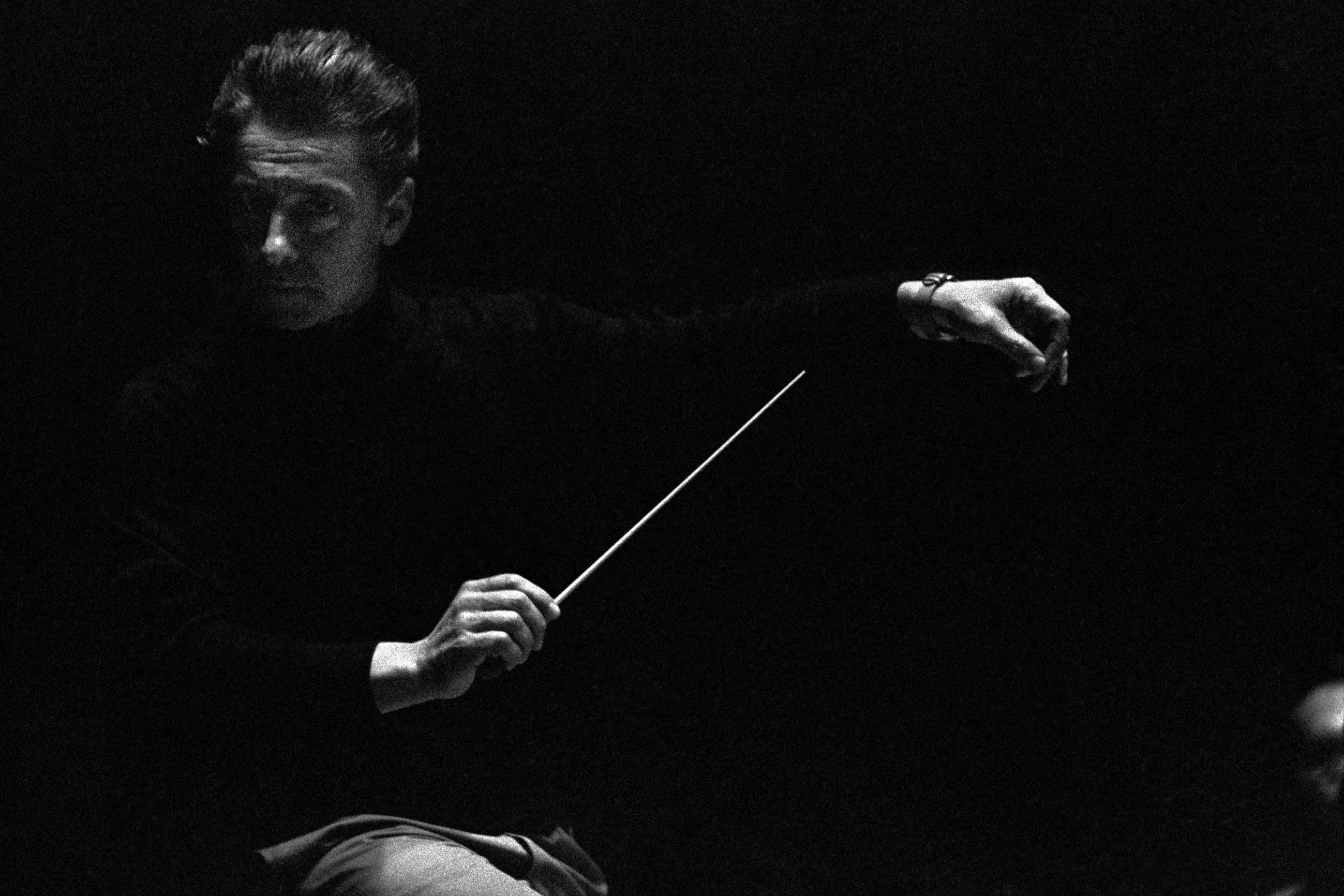
Herbert von Karajan conducted his first Ring cycle in 1937, when he was Music Director in Aachen - at the age of 29! He would return to the cycle several times during his career, but most notably during the 1960s when this series of recordings for Deutsche Grammophon was made in association with Karajan’s own productions at his Salzburg Easter Festival, and associated performances of Das Rheingold and Die Walküre at New York’s Metropolitan Opera.
Richard Osborne, in his definitive biography of the conductor Herbert von Karajan A Life in Music (which I shall be referring to extensively in this section), draws on some revealing contemporary accounts to discuss what made Karajan’s Wagner conducting so inimitable:
In an academic treatise written some years later, the conductor Gianandrea Gavezzini described the revolution Karajan's clear, intimate yet at the same time sensuous and powerfully expressive Wagner style had ushered in. This ‘antiheroic lyricism’ (Peter Conrad's phrase) left its mark, too, on a younger generation of Wagner interpreters. Quite how the ideas were transmitted is difficult to pin down. Though there are recordings to study, Karajan left no annotated scores and much of what he did was, literally, inexplicable: unclear even to the instrumentalists themselves. (‘Free-bowing’, or’ staggered bowing’ as some called it, a technique Karajan adapted from Stokowski, is one element, but that affected only the strings whose playing was also strongly influenced by Karajan’s use of gesture.) Bernard Haitink has recalled discussing the so-called ‘art of Karajan’ with Carlos Kleiber. ‘That is the strange thing,’ replied Kleiber, ‘he does not appear to “interpret” the music. He simply plays the notes. It is a kind of black magic.’
Andrew Porter, author of the widely respected English version of the Ring used by conductor Reginald Goodall in the landmark English National Opera production of the 1970s, would later recall the experience of attending the complete cycle at Salzburg in a 1972 New Yorker article:
The performances had so strong a character that, despite the year that elapsed between installments, and despite changes of cast in the principal roles, one entered the Festspielhaus and was caught up almost at once in the powerful, particular Ring world, unlike any other, Karajan had created…
Above all, it was distinguished by the most beautiful orchestral playing of our day. To the magnificent Berlin orchestra everything else was subordinate. It did not drown the singers, for Karajan held much of its playing to a chamber music finesse. Rather, he accompanied his instrumentalists with voices that were, in the main, far lighter and less imposing than those of the heroic singers traditionally associated with the Ring.
 Sketch by Günther Schneider-Siemssen for Scene 2 of Das Rheingold
The production was marked visually by the striking stage designs by Günther Schneider-Siemssen, very much following on in the vein of abstraction established in post-War Bayreuth by the composer’s grandson, Wieland Wagner.
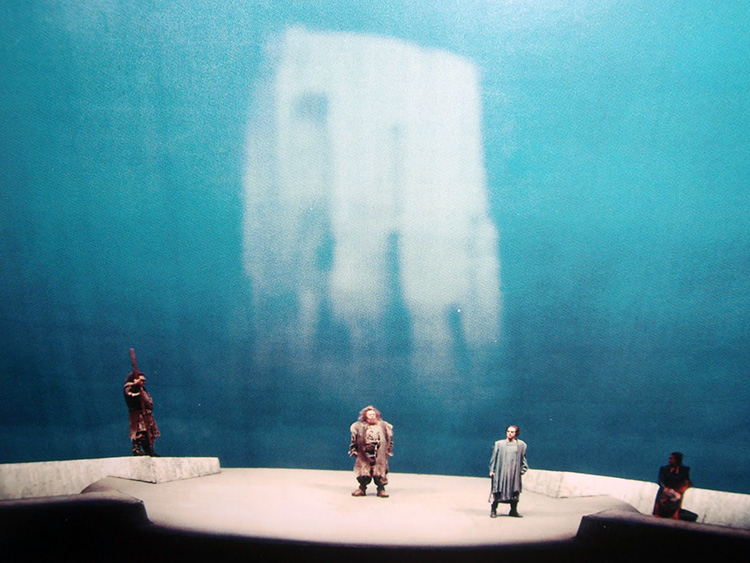 Wieland Wagner's 1951 production of Das Rheingold at Bayreuth - Karajan conducted the second cycle
[Osborne: Karajan A Life in Music, page 551]:
Schneider-Siemssen's sets, based on a huge, cosmic ellipse, growingly lit, remain among the most beautiful and effective of all Ring designs. ‘They seemed to have been planned,’ wrote Porter, ‘solely as illustrations to a drama that was unfolding in the pit.’ Karajan would have approved that last remark. As he explained on German television at around this time:
“Music, in the last resort, is the art which gives expression to our psychic roots. In opera, there is also the visual dimension, which is more than mere illumination. The deeper psychological truth must be there, too. If this is not to the fore, I cannot conduct”.
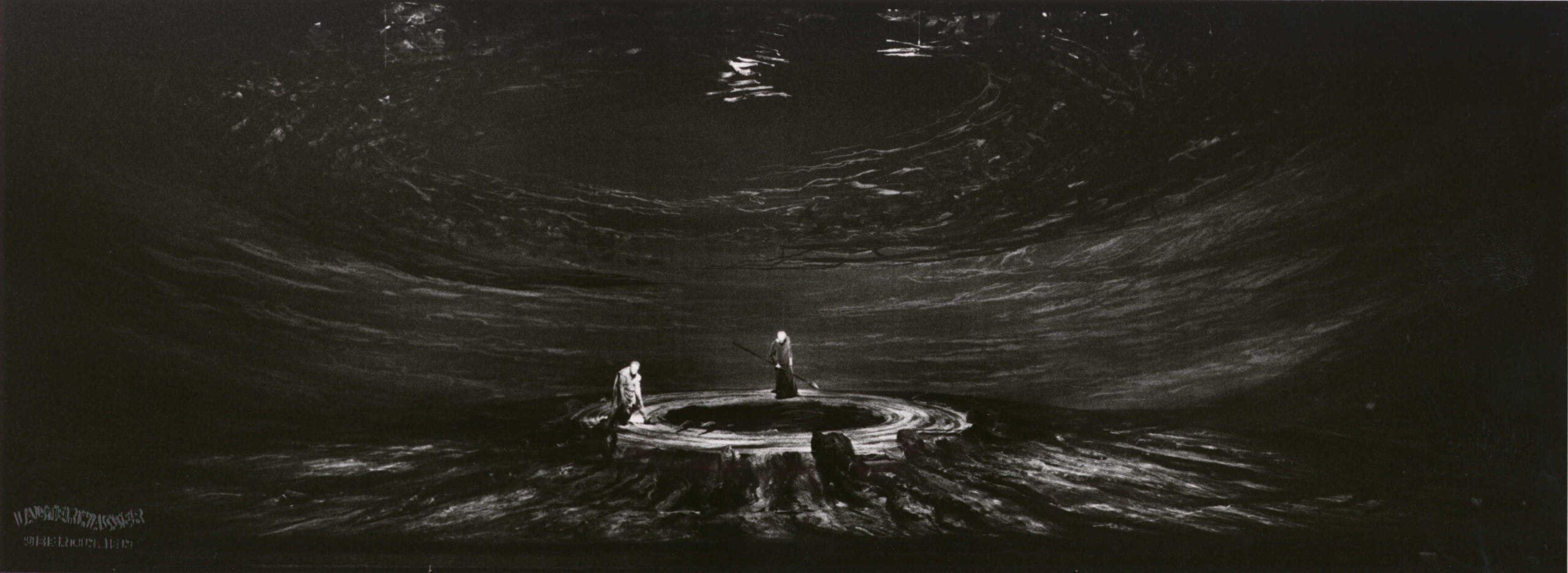 Schneider-Siemssen's set for Siegfried at Salzburg (Photo: Karajan Archive)
A decade-and-a-half before his own Ring production, Karajan’s first and only appearances at Bayreuth were limited to 1951’s inaugural season after the War, where he conducted Die Meistersinger von Nuremberg, and the second of its two Ring cycles, after Hans Knappertsbusch conducted the first. In fact, it was these performances where the first description of Karajan’s approach to Wagner being of turning it into “chamber music” were first heard. A critic wrote:
“‘Applied Bach’ is the best way of summarizing Herbert Karajan's Meistersinger interpretation. He disentangled the textures, makes polyphony transparent in the midst of all the color… At times the effect is that of chamber music. The orchestra follows him in all this as though it had been trained by him for years”.
Karajan resisted this description of what he was doing, stating to a Spanish journalist in 1972:
“I do not make it chamber music; I produce music in which the design is clearly identifiable. The complex structure of the Wagnerian melos, with four or five themes interwoven simultaneously, can only be perceived in that way.”
[Osborne: Karajan A Life in Music, page 302]
Listening to this Rheingold again, in this vastly improved remaster, this is what struck me first and foremost: the clarity of the score’s design. Never clinical, but constantly illuminated from within. That - and the effortless beauty of the orchestral sound which, when it has cause to erupt, erupts with a vengeance. Within this tapestry the singers find their natural place, never stressed, always given the space they need to do their job - magnificently.
Back to the late 1950s and early 60s… Over at Decca, even as John Culshaw was trying to put together his studio recording of the Ring cycle, he was acutely aware of the potential for Deutsche Grammophon to beat him to it. In the end he crossed the finish line first. For DG’s part, the company very much wanted to have its own cycle to compete with Solti and Decca, and Karajan - by the mid 1960s their top recording star - seemed the most likely man to get it done. Therefore when Karajan approached them with his idea that he would record the operas before mounting them with the same casts in the theater, and use the recordings during his rehearsals, DG agreed - even though the company realized that the canny conductor was essentially using DG to fund his musical preparation and rehearsals for the live shows via the recording sessions. Subsequently this became Karajan’s modus operandi for putting together starry opera recordings and allied theatrical performances at his Salzburg Easter Festival for the rest of his career - saving the Festival and himself a ton of money by shifting the financial burden for musical preparation onto his recording companies.
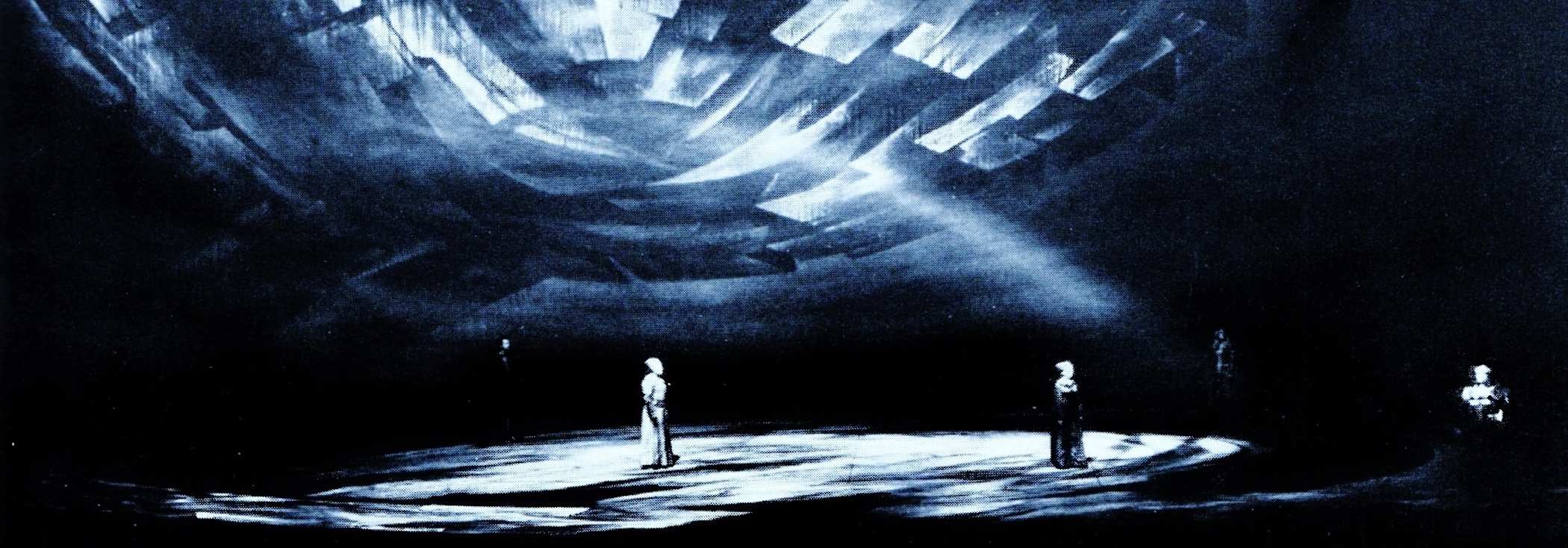 Das Rheingold at Salzburg
No one reading any of the above should for a moment think that Karajan in any way shortchanges the epic sweep and kaleidoscopic sonic grandeur of Wagner’s score in his recording, but this is definitely a somewhat different beast to Solti’s more immediately dramatic, dare I say more overtly “dynamic” approach. Aided by Decca’s incredibly immediate recording, a superb example of the Decca sound retooled for creating a virtual theater experience in the home, Solti crafts an overtly visceral version of Wagner, in which hairpin turns and orchestral bravado marry with what was considered the more traditional Wagnerian, “grand” voices of the period.
Karajan is less of an “in the moment” interpreter. His approach is akin to his approach to Bruckner: the long walk across alpine pastures, then a slow ascent to the craggy peaks, in which every detail of the landscape is taken in on both the micro and macro levels. In Karajan’s Ring one is acutely aware of the environment of the drama. No wonder that the conductor had this to say of the cycle when a reporter in New York said that his recording of Die Walküre was closer in spirit to Weber than to Wagner.
[Osborne (p. 559):]
Karajan looked puzzled at first, then said:
“It is there, of course. Weber was the first composer with a sense of living nature, which goes through all Wagner’s work. If you do not carry this sense of the identity of music and nature, you are not telling the truth to the audience. What is the Ring in the end, but a parable of violated nature? That and the father-and-son complex - the elder who has the knowledge and admires the younger for his greater impact and instinctive force. Wagner identified with both.”
Nature is to the fore in Das Rheingold, and one of the greatest felicities of Karajan’s recording is that at times overwhelming sense of being in nature, from the opening depths of the Rhine itself in that still revolutionary-sounding prelude, to the final orgiastic thunderstorm and ascension of the Gods into Valhalla across a rainbow bridge. In between, the orchestral interludes which lay out the physical world via the ascent from the depths of the Rhine to the heights of the mountaintops, then Wotan and Loge’s descent to Nibelheim, and their ascent again to the domain of the Gods for the opera’s final scenes - all of this Karajan and the Berliners unfurl with a sense of beauty and wonder, but also commensurate detail and sweep, that Solti, for all the immediacy of his account, simply cannot match. (Nor can anyone else). None of this is surprising given Karajan’s love of nature, and his lifelong addiction to sailing, ski-ing and climbing. He knew what it was to not only be in Nature, but to do battle with it. No one captures Nature in the music of Wagner and Bruckner quite like him.
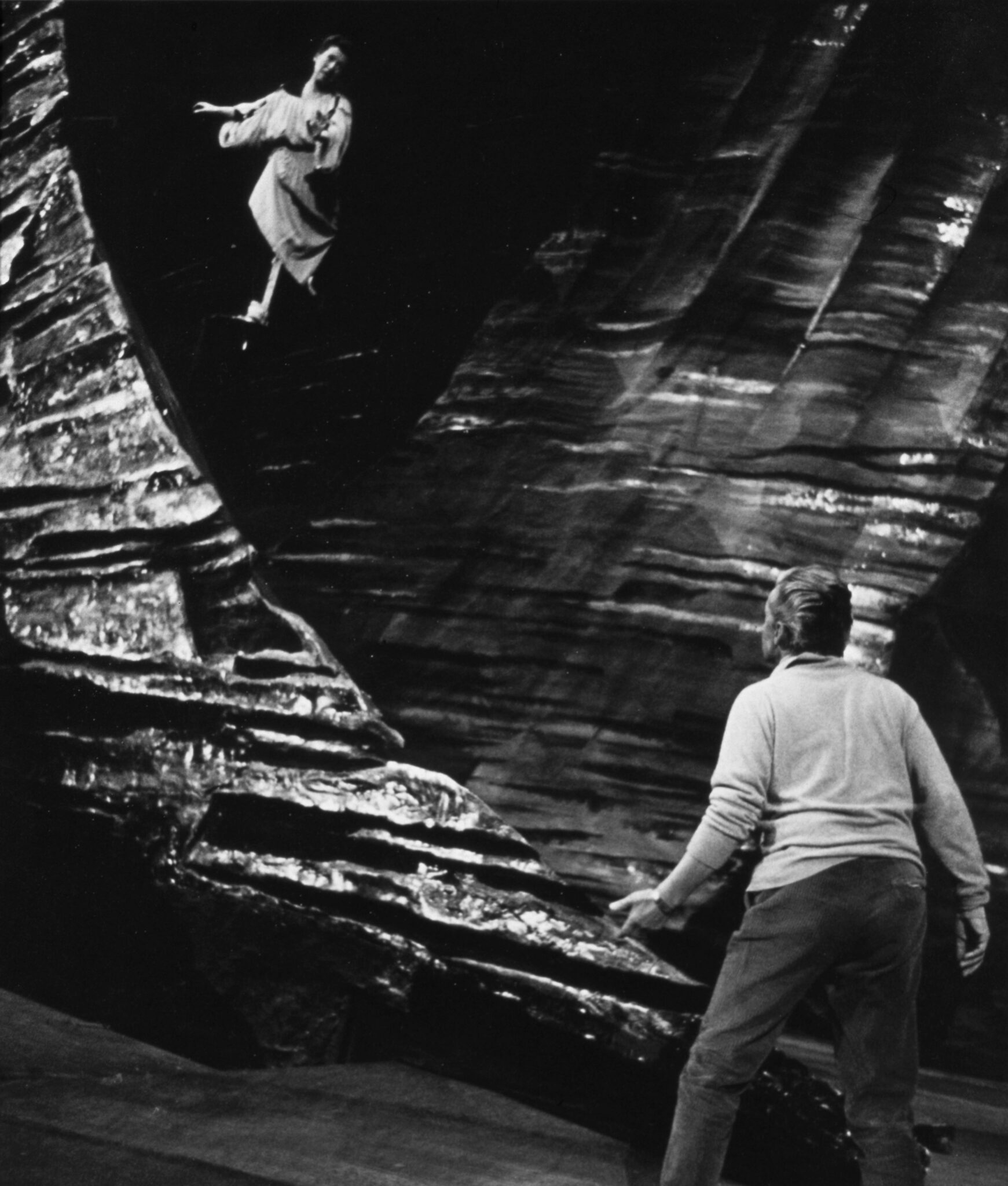 Karajan rehearsing the Rhinemaidens onstage at Salzburg (Photo: Siegfried Lauterwasser/Karajan Archive)
Karajan demonstrating the hydraulic device used to "float" the Rhinemaidens:
Elsewhere, Karajan weaves the orchestra in and out and around his singers like a cat - or a benign Loge (the God of Fire, you may recall) whose flames here caress but do not burn - alert to every minute inflection and deviation from the letter of the written score a singer might make for expressive effect. Karajan was legendary for his ability to match his soloists and singers effortlessly, able to turn his vast orchestra on a dime.
Once, when working with the great Jon Vickers (Vickers is the Siegmund in Karajan’s Die Walküre), the singer brought up a tricky passage in Act 3 of Tristan where Tristan’s music moves forward with the time signatures shifting bar by bar.
‘Forget the bar lines,’ said Karajan. ‘there is a pulse running through that passage. [He sang the words, beating out the underlying pulse.] Once you have that, it doesn't matter what beat I give you.’ In the end it became a bit of a game, Karajan beating the passage differently every time they performed the work together.
[Osborne, page 589].
Given all of the above, one of the things I was definitely listening for in this remastered version of Rheingold was whether Rainer Maillard and Sidney C. Meyer had managed to wring substantial additional sonic magic from the Berliners’ ravishing orchestral palette.
I was also curious to see whether they would be able to approach the quality of earlier Original Source remixes of vocal and choral works, in their ability to grant significantly increased bloom and headroom to voices. Those earlier Original Source releases of works like the Verdi Requiem and Strauss’s Four Last Songs were remixed from master tapes that had surround and room ambient information that turned out to be a real boon to enriching the human voice. With Rheingold the master is merely a stereo 2-track, and in all honesty my original “large tulip” pressing sounded full and sweet (as I remembered it), even if it lacked the immediacy and, yes, vibrancy of Solti’s Decca recording - a remarkable recorded artifact that is now 68 years old, if you can believe it.
So I was thinking - as I am sure many of you reading this will be too - just how much better could these records get?
The answer came the moment I dropped the needle.
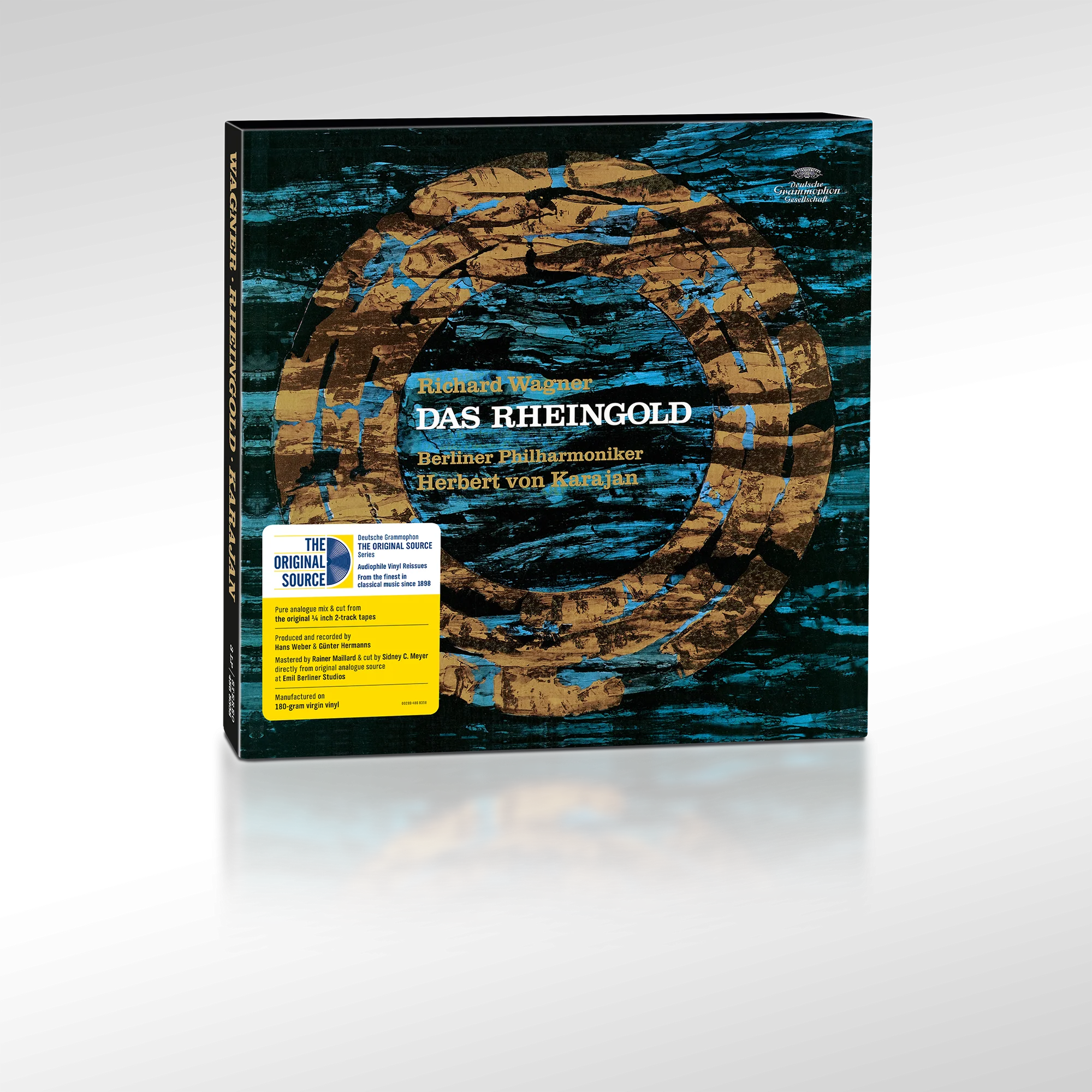
Listening to Das Rheingold
I began my listening with my original “large tulip” pressing - which in all honesty I hadn’t auditioned in a decade or more.
While the opening pedal point registered, it certainly did not have the weight and presence of Solti’s version. As wind and strings entered I was missing the detail of which instrument was doing what - it was more of a wash of sound, with everything blending into everything else. Certainly as the volume and intensity of the music increased those details began to reveal themselves. A final ravishing crescendo - which felt like the waters of the Rhine surging over the river banks - fell back to reveal the Rhinemaidens, their voices floating and dipping and weaving through Karajan’s orchestral ebbs, flows and eddies.
We moved into Alberich’s clumsy attempts to woo each Rhinemaiden in turn, with Zoltan Kelemen’s suitably malevolent dwarf a most odious suitor. Then, as the sunlight hit the gold, Karajan’s mastery of orchestral color came into its own. However, I was finding the Rhinemaidens’ voices a trifle pinched, and lacking in bloom, something which became even more of a problem as they voiced their distress when Alberich abjures love and steals the gold.
That lack of vocal bloom, and a certain constriction in the orchestral sound, persisted through the end of side one, as we moved to the mountain tops and met a daydreaming Wotan and his uneasy wife, Fricka. How much of this was due to those familiar end-of-side constraints and distortions, or simply shortcomings of pressings of the period - who knows!
My verdict on listening to that early pressing thus far? Still completely swayed by the performance - seriously underwhelmed by the sonics.
So I eagerly turned to the new Original Source pressing, noticing that Sidney C. Meyer had given her cut a little extra real estate on the vinyl compared to the original.
The moment that pedal point entered I exhaled in sonic satisfaction. Here was the depth, the sonic richness so lacking on the OG. Sure, it was maybe cut just a little bit hotter, but that wasn’t the whole story by any means. All the detail missing on the OG was now present, and “presence” was the quality that immediately registered on the Original Source remaster. There was more width and depth to the soundstage, instruments and sections were richer of timbre, and the violins in particular were full technicolor whereas on the OG they seemed grey. I relaxed and sank into Wagner’s Creation of the World.
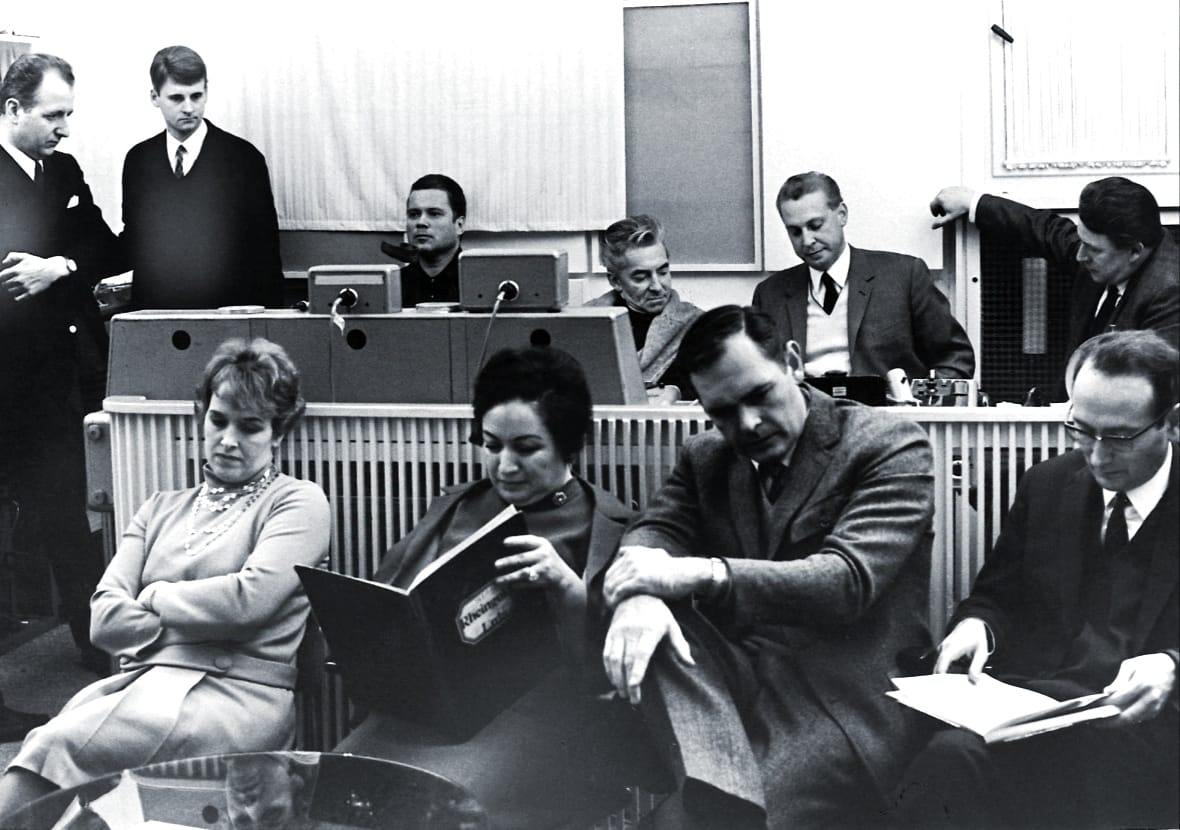 In the control room during sessions for Das Rheingold (Photo: DG)
The moment the Rhinemaidens began singing the improvement in the body, bloom and overtones of their voices was immediately apparent. Likewise the ebb and flow of Karajan’s accompaniment registered with far greater force. Wagner’s revolutionary leitmotif tapestry emerged more fully in all its shifting patterns.
The Rhinemaidens’ ecstatic greeting of their sunlit gold shone like sparkling jewels, and Alberich’s malevolent violation had all the force it needed as the “Fall from Eden” moment that it is.
Finally side one ended as we meet the daydreaming Wotan, all the contours of Dietrich Fisher-Dieskau’s infinitely expressive voice and unmatched interpretation revealed in effortless sonics - with no trace of end of side distortion.
Sidney C. Meyer and Rainer Maillard strike again!
No, we are not getting the vast opening out and seemingly endless horizon of dynamics, headroom and space we get in the Original Source reissues mastered from 4- and 8-track masters that include original room ambience tracks, but somehow or other those two technical wizards at Emil Berliner Studios have been able to capture and communicate so much more of the original 2-track master’s sonic richness in this new cut. Enough to render any other vinyl version utterly redundant (the reissue was always marginally inferior to the “large tulips” pressing; more on the digital options later).
So what exactly have they done? I asked Rainer Maillard to elucidate, and he was characteristically understated about their process:
There are no big stories to tell. The changes are more subtle… All vinyl produces distortions (this is such an interesting issue Sidney and I are researching these days). Distortions (not possible to avoid them) are audible with voices very clearly. The tolerance for accepting them was higher in the old days. Nowadays we are able to cut with a higher level due to a better groove computer to get a better signal to noise ratio, but with voices it’s almost useless. So, getting distortions and level in the best ratio was our goal.
In the old days, the cutting engineer took the tape and never changed anything while cutting. Now, we marked the most problematic bars and did adjust level, frequency, reverb, and whatever was necessary to get the best result in a specific bar.
No big changes, but worth doing.
I’ll say so! Finally I felt like I was hearing Karajan’s Ring in the sound it deserved, and it was thrilling (but in a completely different way to Solti on Decca).
Everything about the orchestral palette and presence was vastly improved: richer, more immediate, more dynamic. Moments where Wagner and Karajan let the orchestra “off the leash” - like the arrival of the giants, the descent into Nibelheim, the transformation of Alberich into a vast serpent, the murder of Fasolt, the storm and ascent into Valhalla - these set my stereo and listening room ablaze.
(Aside: the moment in the descent to Nibelheim, where a vast cavern of clattering anvils filled my room with sound - much better done by Karajan than Solti - caused our adorable young snowshoe cat to sit up alert and stare at the speakers in rapt attention. Actually she stayed through the whole opera, attempting repeatedly to climb into the actual Rheingold box set, rub against the booklet while I tried to follow the libretto, and was for the first time fascinated by my whole process of taking records out of their sleeves, putting them on the turntable, brushing them, dropping the needle etc.).
Likewise all the voices, while not matching the infinite sense of headroom and bloom present on the Original Source remastering of, say, Karajan’s Verdi Requiem, nevertheless had an extra degree of effortlessness and dynamic ease, with that inevitable distortion Rainer refers to seriously minimized. The voices simply sounded more natural, revealing so much more of their distinctive timbres and colors. The uncanny pacing of the work struck anew, with the orchestra and voices feeling completely bound together, part of a larger organic whole.
All of this meant that one could finally fully appreciate the brilliance of the casting, led by Dietrich Fischer-Dieskau’s matchless (in my opinion) Wotan.
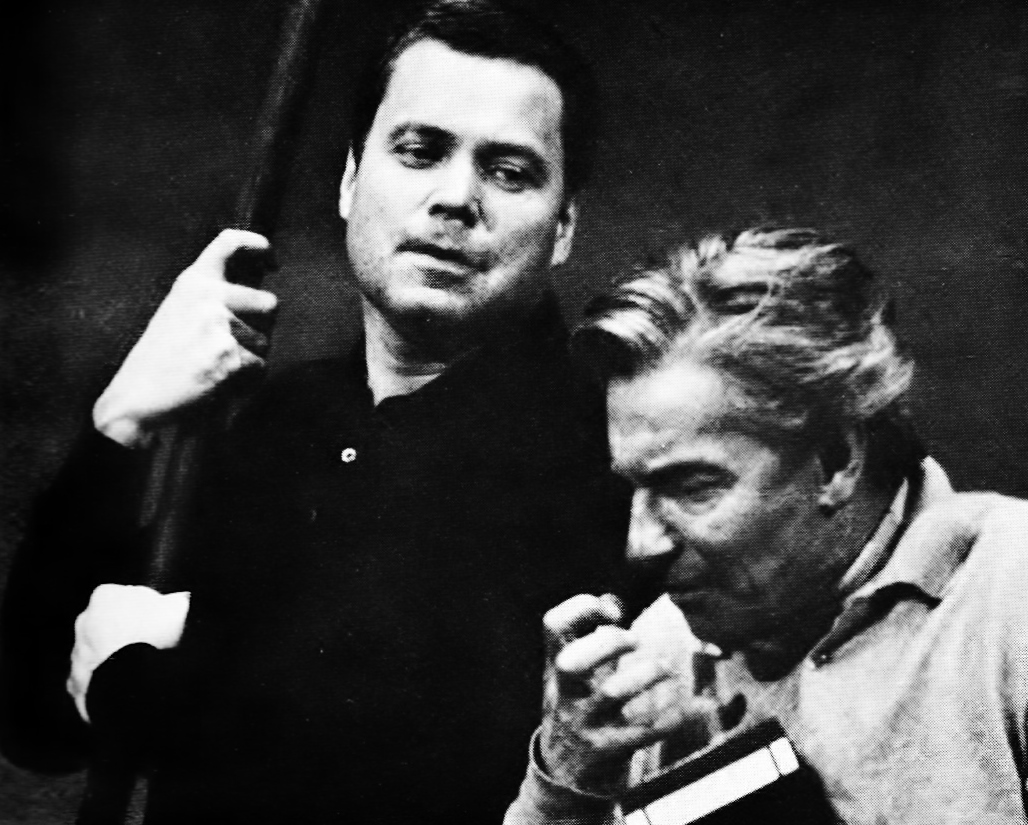 Karajan rehearsing with Dietrich Fischer-Dieskau
Recorded at a time when this singer who was primarily known for performing Lieder was still youthful of voice, Fischer-Dieskau only feels strained in a few moments, and he covers it well. But the benefit of having one of the greatest interpreters of text and music in this role, rather than a more traditional operatic vocalist, is that every shade and nuance of this fascinatingly conceived and rendered character emerges with a clarity and resonance that makes this set of Das Rheingold stand apart from all others.
Firstly, those familiar with Fischer-Dieskau only as a Lieder singer will be surprised by the power and theatrical presence of his voice. There are so many moments where I thought it was someone else singing, so thoroughly had Fischer-Dieskau taken on the mantle of the god of gods. Elsewhere this is balanced by his ability to shade the text and its setting with infinite levels of subtlety and meaning - but never in the somewhat self-conscious manner that began to afflict his later recordings. The character of Wotan, as riddled with human flaws as the rest, drives the engine of the first half of the Ring cycle, and nowhere is he more important to the action than in Das Rheingold. It’s a fascinating study in power, hubris, vanity, self-deception - and the male ego writ large in all its imperfections and transcendent ability to find justifications for bad behaviour (and highly reminiscent of Wagner himself).
Funnily enough, I have just finished watching the first season of Your Friends and Neighbours - the perfect study for our times of the entitled 1% and the rest of us all fighting for survival in a viperous world - and over and over again I was recognizing in Das Rheingold so much of the behaviour that shapes that irresistible new show.
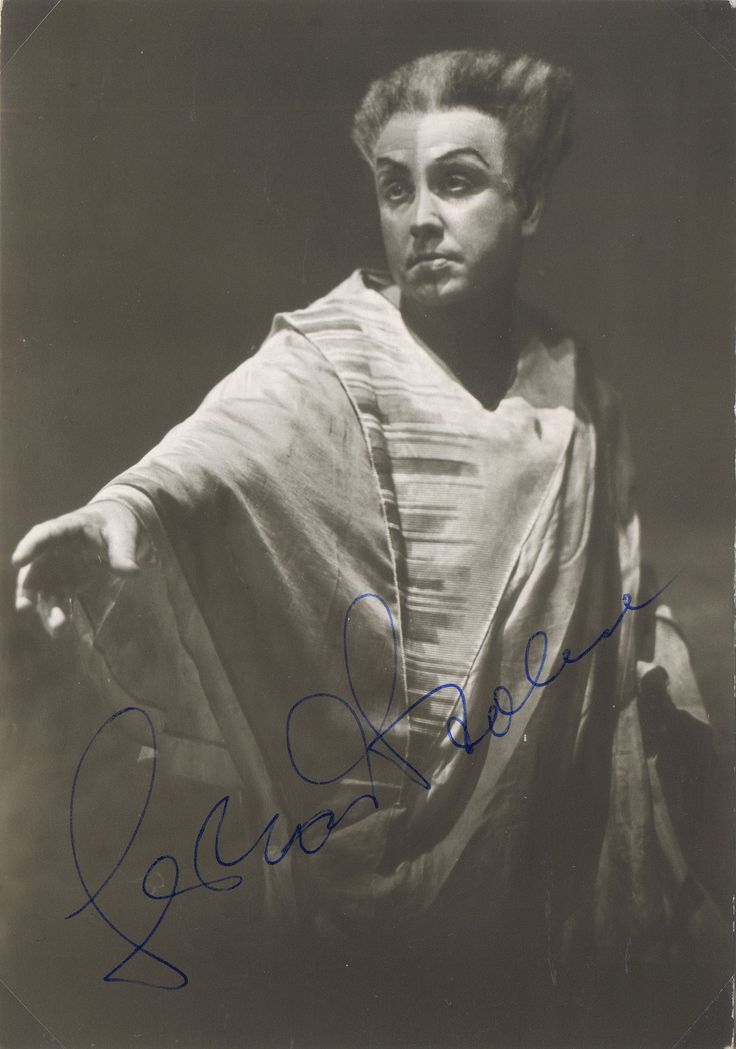 Gerhard Stolze
Of the other roles I must single out Gerhard Stolz’s deliciously sinuous and shifty Loge who would feel right at home as the Machiavellian manipulator in any one of today’s tales of power plays and double dealing; a completely sui generis interpretation fully in line with his classic contributions to Eugen Jochum’s Carmina Burana (also for DG), Solti’s Salome and Elektra, and Siegfried (where he plays the hapless Mime).
Josephine Veasey’s alternately hectoring and baleful Fricka, victim of Wotan’s serial adultery and power obsessions, does not erase memories of Kirsten Flagstad’s memorable swan song in the Solti recording, but taken on her own terms is magnificent.
Martti Talvela’s lovelorn and doomed Fasolt, and Karl Ridderbusch’s dark-hearted Fafner, are luxury casting while, as mentioned before, Zoltan Kelemen’s malevolent Alberich nevertheless finds moments of sympathy. His cursing of the Ring is formidable, working with Karajan to give this moment its full dramatic force. He really gives Solti’s authoritative Gustav Neidlinger a run for his money.
-1777068583.jpeg) Zoltan Kelemen (l.), Thomas Stewart as Wotan (c.) with Karajan rehearsing for his 1978 film of Das Rheingold (Photo: Karajan Archive)
Zoltan Kelemen (l.), Thomas Stewart as Wotan (c.) with Karajan rehearsing for his 1978 film of Das Rheingold (Photo: Karajan Archive)
The other gods fill their roles admirably, with Robert Kerns’s show-stopping summoning up of a thunderstorm every bit as authoritative as Eberhard Wächter for Solti, even if his hammer blow is no match for the mighty, potentially speaker-breaking clunk courtesy of John Culshaw and his Decca team.
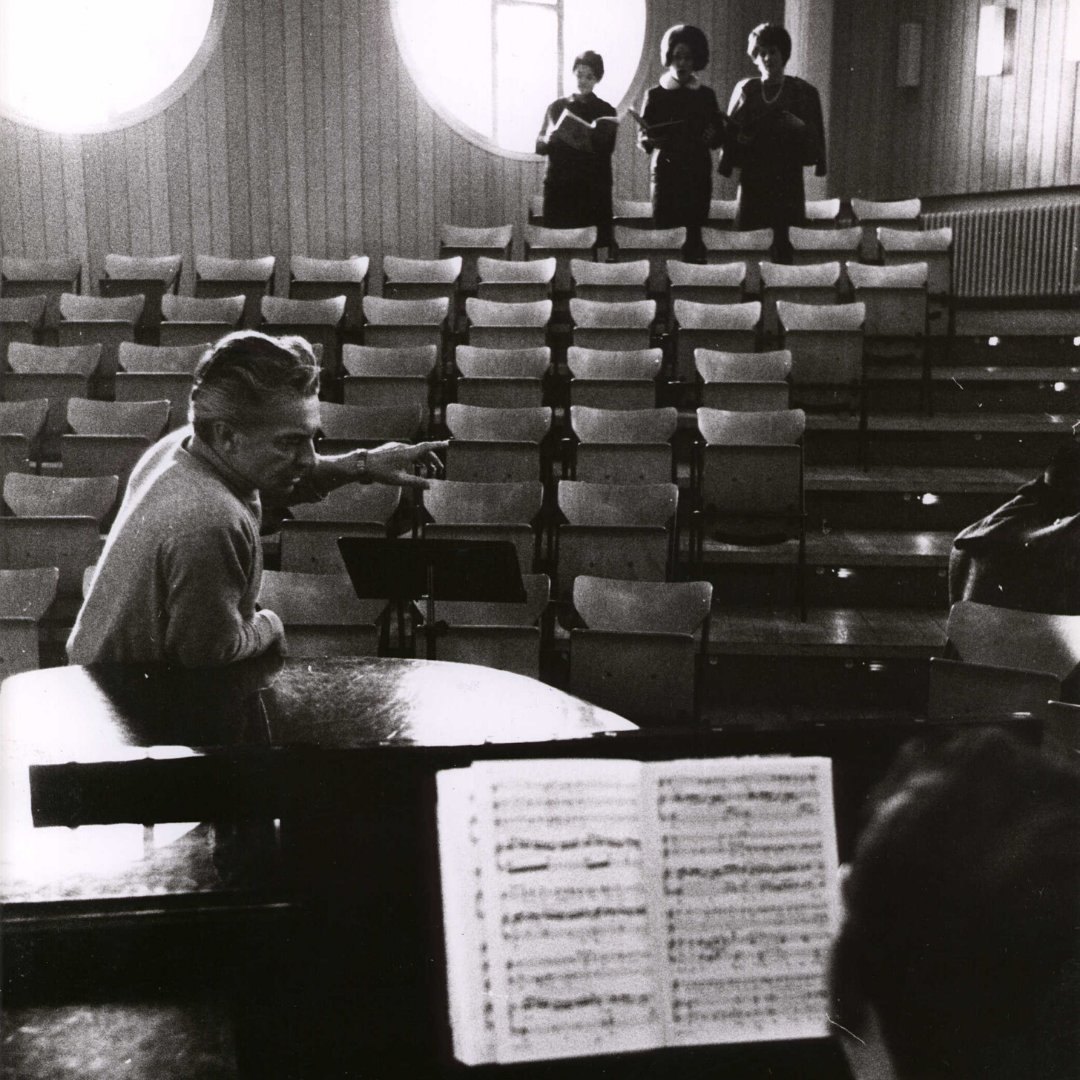 Piano rehearsal for the Rhinemaidens (photo: Karajan Archive)
I find Karajan’s Rhinemaidens better blended than Solti’s. His Erda, Oralia Dominguez, is suitably ominous.
If I have one tiny criticism of the Karajan vs. the Solti it is the occasionally over resonant acoustic of the Jesus-Christus Kirche (plus EBS echo chamber perhaps?) that occasionally makes the voices sound less like they are in a theater, more in a concert hall or church (because they are). The Sofiensaal for Solti lends a more theatrical acoustic to the proceedings, which some may prefer. This is not a problem, simply a matter of preference - and I am really nit-picking here.
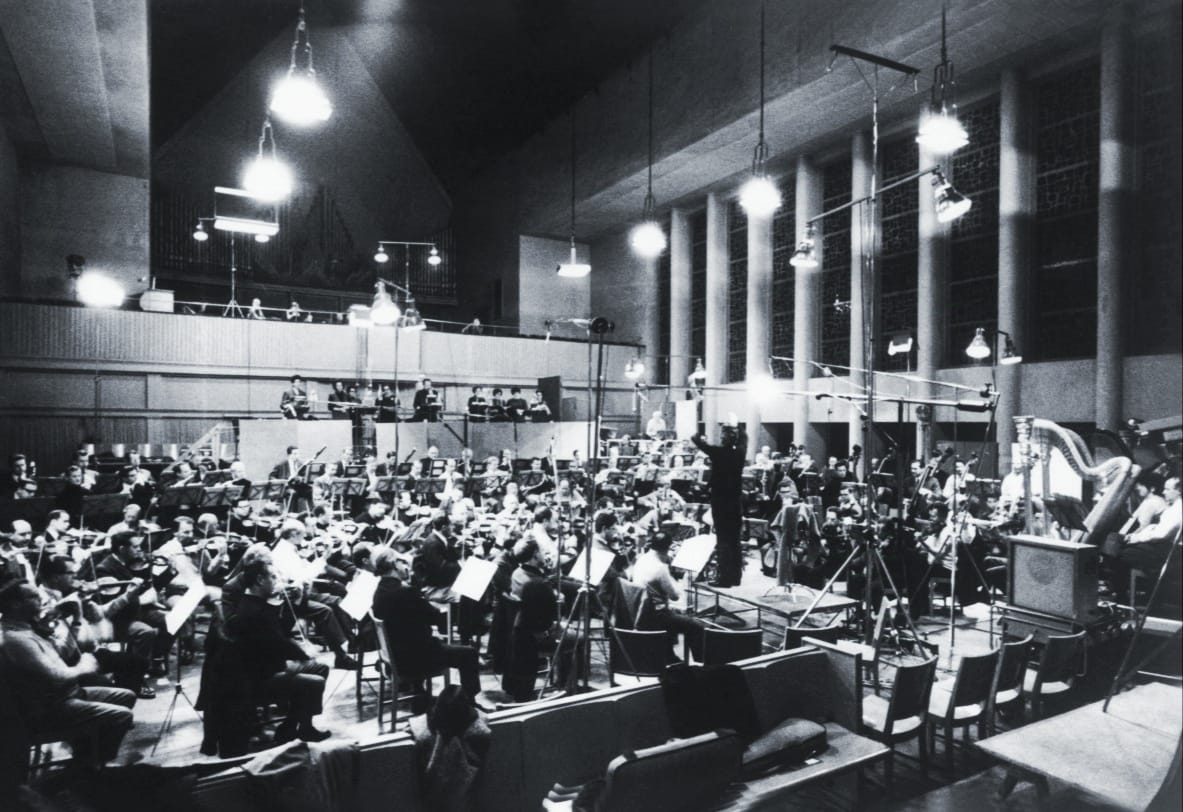 Recording Das Rheingold in the Jesus-Christus Kirche, December 1967 (Photo: DG)
Any lover of the Ring will want both Solti and Karajan (plus several more versions, including at the very least the live Bayreuth Ring under Joseph Keilberth, recorded by Decca and finally released by Testament). There is no doubt that in strictly sonic terms the Solti has the edge: how could it not. This is the classic Decca Sound on steroids, still one of the greatest recordings ever made for all the reasons I outlined in my 3-part review of the recent reissue.
However, especially in its new Original Source incarnation (which bests even the fine 24bit/96kHz stream and the BluRay) Karajan’s Das Rheingold more than holds its own sonically, and as an interpretation is reconfirmed as my go-to for this part of the Ring cycle over all other versions. Fischer-Dieskau’s Wotan - noble and venal in equal measure - is something really special, supported by a flawless cast, and Karajan’s way with the score just brings something to the table that Solti’s more predictably theatrical, more in-the-moment, approach misses.
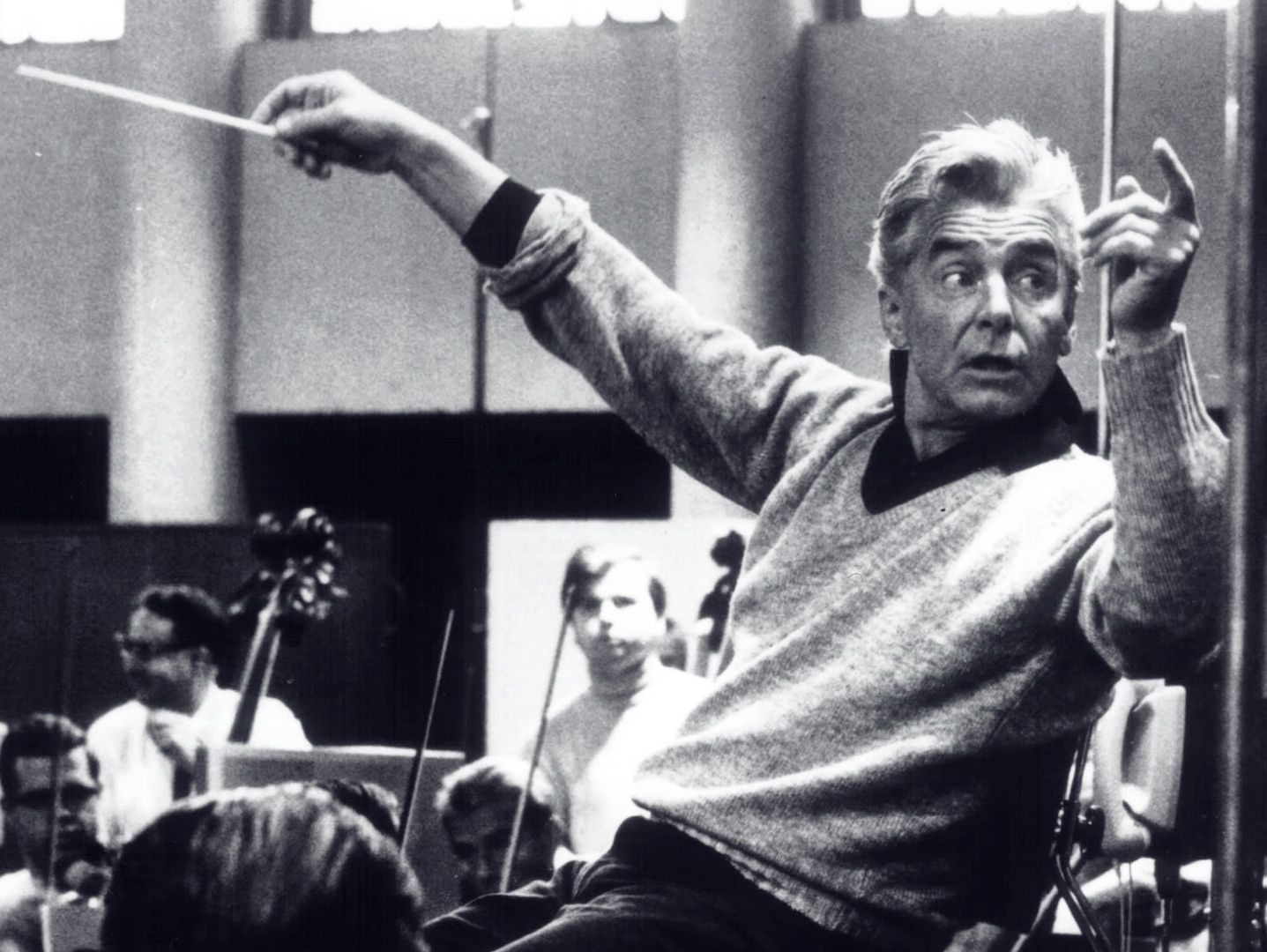 Karajan at the sessions for Das Rheingold (Photo: DG)
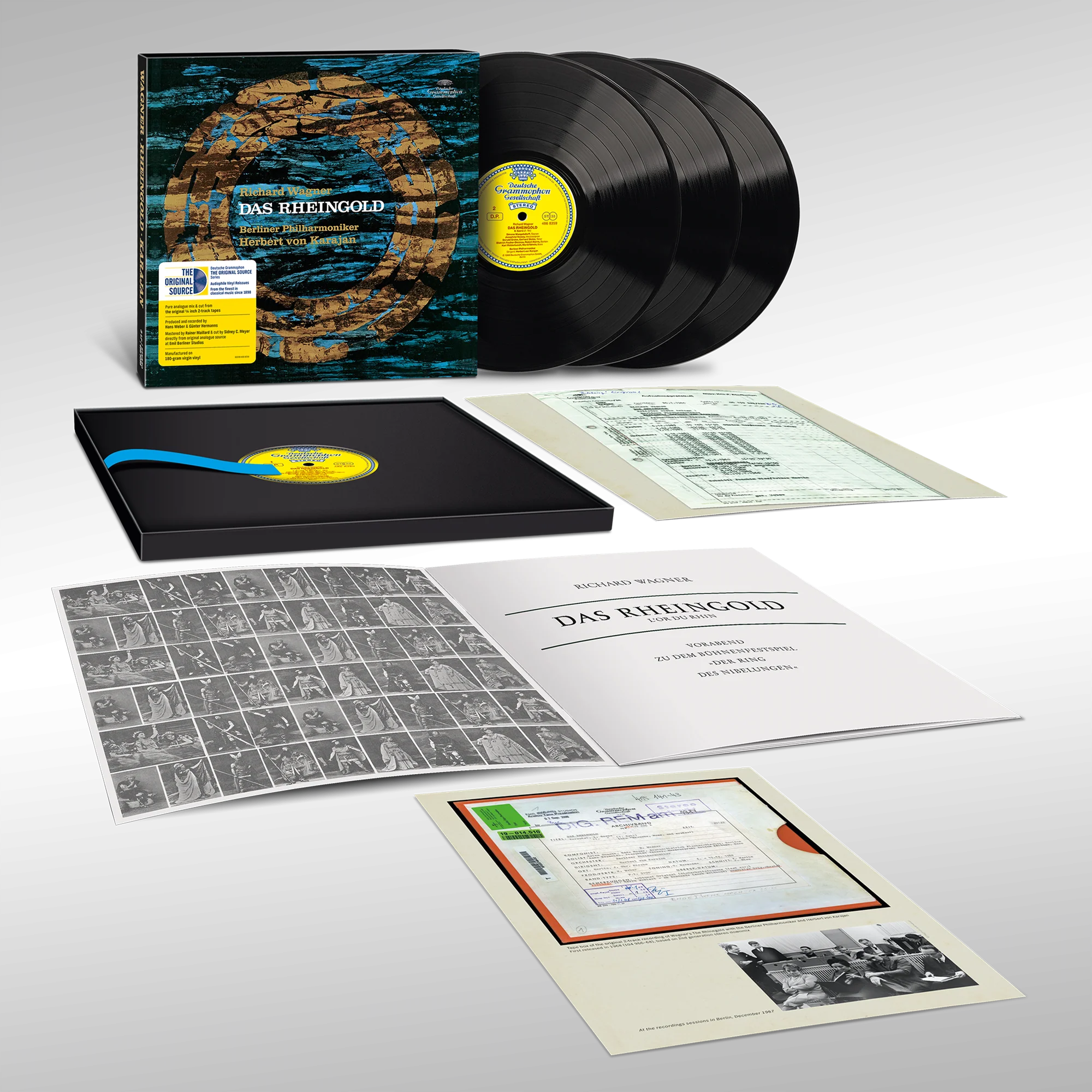
My three 180gram platters, each packed within a separate blank, black heavy-duty cardboard sleeve, were immaculately pressed at Optimal, with one pop across six sides after cleaning - so let’s hope the series’ pressing flaws are well and truly a thing of the past. Records come in an extremely handsome lift-top box, very sturdy, with original full libretto and enlightening essays all reproduced in a handsome glossy booklet that is far more luxurious than the original which, apart from its cover, was printed on regular paper. Inserts with a note on the remastering from EBS, plus photos of tape boxes, session logs and the sessions themselves round out this very handsome reimagining of the original package. That original box came in the cloth-style box used by DG back in the day, which I love, but this more conventional box cast in the dark blue that frames the original’s striking cover design (which clearly references Schneider-Siemssen’s stage designs for the Salzburg and Met productions) actually makes a stronger impression. I found myself preferring it to the original, which surprised me.
DG is taking a big financial risk with this set, and is clearly hoping enough people will take the plunge to justify going ahead with the rest of the cycle and more opera. If these sets sell well there is every chance we will get the complete Karajan Ring.
So Karajan and Wagner fans do not delay! This is a limited edition of 2500 copies.
Yes, Karajan, Wagner and Ring aficionados need not hesitate, but I urge those less familiar with Wagner, the Ring, and opera, to take the plunge too. This is something very different, and an utterly arresting experience in its new incarnation. An utterly arresting experience for your listening room that may well have you questioning your preconceived notions about opera. This is the best sounding version of Karajan’s Das Rheingold by a country mile, and while it may not match the best of the Original Source series so far (hence the 9 rating for sound), it shows just how much EBS can do to breathe new life even into regular 2-track master tapes. It is a powerful counter-argument to collectors who question the merits of even AAA reissues over original pressings. This, and the Decca Pure Analogue 2-track remasters, are rewriting the rules, and I can hardly wait to hear what additional magic Rainer and Sidney can wrest from the many treasures sitting in the DG 2-track catalogue.
I have a list, should anyone in Berlin care to peruse it…
In Conclusion…
I was riveted as I listened to Karajan’s Das Rheingold, marveling again at Wagner’s formidable conception that rewrote the rules of opera, providing a template for epic drama that reached forward to the age of film. I was also struck by just how resonant the work is for what we are going through in the world today - you will be too. The power plays, the interpersonal politics, the abandonment of any moral code in the pursuit of illusory gains, the careless rush to embrace empty power over love and acceptance of others, the destruction of nature to create wealth that is worthless in the end… all resulting in a headlong race to oblivion. It’s uncanny how prescient and relevant to the current moment this work feels. The Ring offers warnings and lessons that we keep on ignoring.
I also marveled at Karajan’s way with the work, his mastery of pace and texture: a lifetime’s experience in the opera house combining with his ability to simply mold and shape the music in a manner so unique to him, and a perfect match for this score. There is a sense of the whole edifice unfolding in a single breath - one long phrase - so unerringly does he pace the work. This ability of Karajan to shape the drama thus brings a commensurate sense of inexorability to the story, with echoes of the fatalism of Greek tragedy. By the end of Rheingold one is already glimpsing the conflagration at the end of Götterdämmerung (The Twilight of the Gods). (In his 1968 film, Karajan makes that explicit by ending on an image of Loge becoming pure flames that engulf the screen). The Berliners are simply sensational throughout. Not better than the VPO for Solti, also suffused with the Wagner tradition, and for many still the definitional Wagner orchestral sound, but different and equally valid (and, I will say, the Berliners are often better in tune, in the brass department in particular).
With the Ring we’re talking about one of the foundational masterpieces of romanticism and the modern age, built upon the universal themes and conflicts of ancient mythology. Love or loathe Wagner, you cannot ignore him - or the Ring.
I would strongly suggest a similar response to this set. Ignoring it would be to miss out on something very special indeed.
You can read Part 1 here.
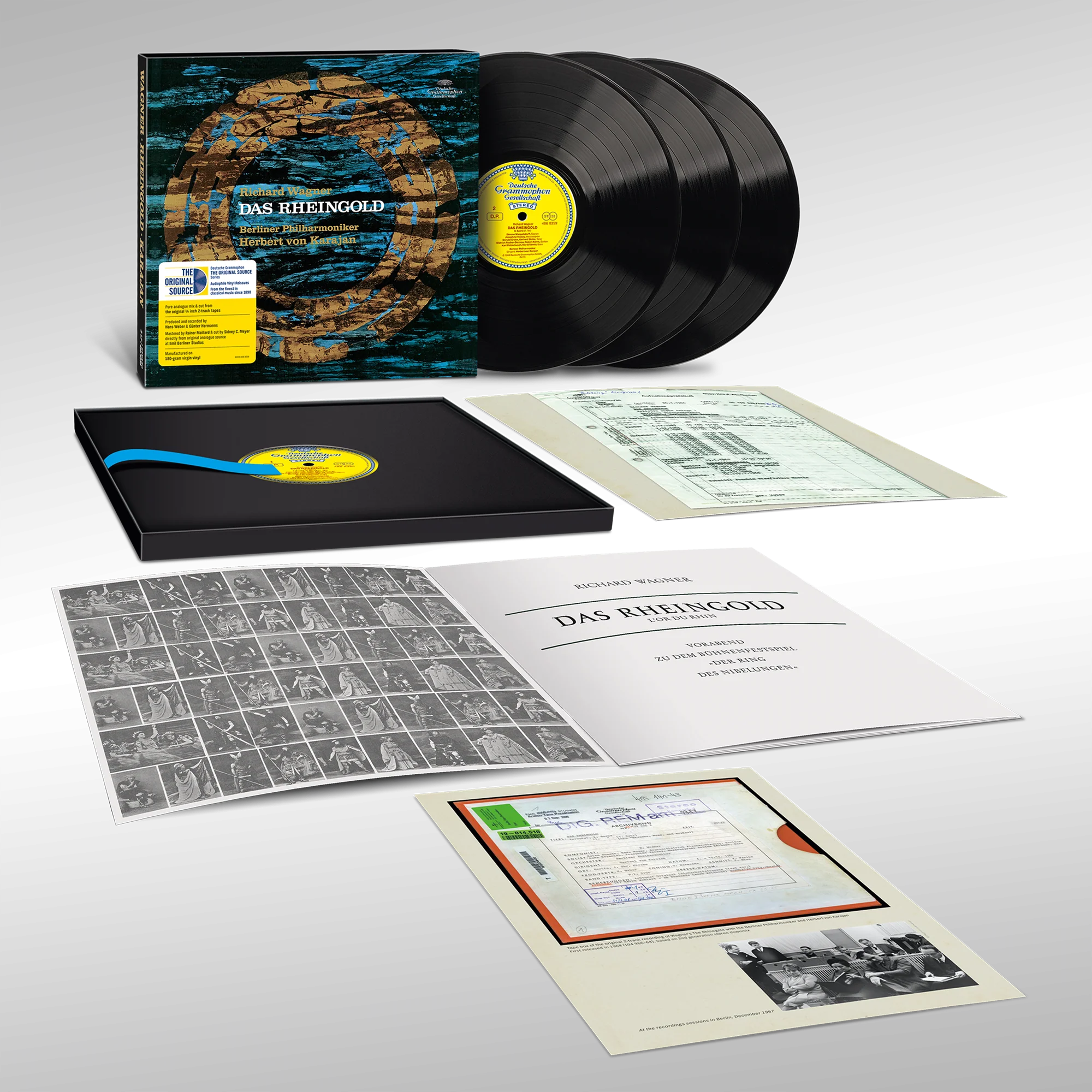
Producer – Otto Gerdes
Recording Supervisor – Hans Weber
Recording Engineer - Günter Hermanns
Recorded in Jesus-Christus Kirche, Berlin - December 1967
CAST:
Flosshilde – Anna Reynolds
Wellgunde – Edda Moser
Woglinde – Helen Donath
Alberich – Zoltan Kelemen
Wotan – Dietrich Fischer-Dieskau
Fricka – Josephine Veasey
Donner – Robert Kerns
Froh – Donald Grobe
Freia – Simone Mangelsdorff
Fafner – Karl Ridderbusch
Fasolt – Martti Talvela
Erda – Oralia Dominguez
Berlin Philharmonic Orchestra conducted by Herbert von Karajan
Reissue Project Managers: Johannes Gleim, Julian Kreuzkam
Reissue Design: Nikolaus Boddin
Cover Illustration: Imre Vincze
Editor: Annette Nubbemeyer, texthouse
Mixed by Rainer Maillard and cut by Sidney C. Meyer at Emil Berliner Studios directly from analogue source (AAA)
Source: 1/4 inch 2-track Stereo master tape
Pressed at Optimal
3LP 180gram box set
Limited Edition of 2500
Catalogue #: 0029 486 8358
Deutsche Grammophon GmbH. Berlin
Music
Sound

Available for purchase at Acoustic Sounds and at the DG Store



































.png)