
Mahler's Fifth Times Two: One Old, One New
Reference Recordings and Decca Pure Analogue Release a Pair of Mahler Fifths Angled Toward Audiophiles
It happens more often than one might think in the market of recorded music: things come in clusters, typically pairs and triplets. Here we have two recordings of Mahler’s Fifth Symphony, both if not aimed, at least oriented toward the audiophile collector. This past March Reference Recordings released a new recording, taken down in concerts in July 2024, by Sir Donald Runnicles conducting the Grand Teton Music Festival Orchestra. Meanwhile, scarcely two months later comes the second batch of four albums in Universal Music’s new Decca Pure Analogue series of vinyl remasterings, one of which is Bernard Haitink’s with the Concertgebouw Orchestra of Amsterdam, a studio recording originally made by Philips in 1970. Separated by fifty-four years, one features an orchestra with a lineage dating back to 1888 and personal ties to Mahler himself, the other a contemporary orchestra that is essentially a pickup group, albeit a very special one.
Like most of Mahler’s music, the Fifth, written at the beginning of the last century, took several decades before it entered the standard symphonic repertoire. In the early seventies it became the composer’s most popular symphony due largely to the prominence the director Luchino Visconti gave its adagietto movement in the score to his 1971 film adaptation of Thomas Mann’s Death in Venice. Though Visconti also used other classical pieces, it was the adagietto that broke out and made the album catch on big with both the classical and the serious-filmgoing public (even today that cut on the soundtrack album continues to generate millions of streams). A byproduct of this popularity is that owing to the substantial demands Mahler’s unusually large orchestra, with its augmented brass and percussion, place upon recording technology, the symphony has become a favorite demonstration piece among audiophiles wishing to show off their sound systems. Together, the two recordings under consideration here offer a fascinating study in comparisons and contrasts, with perhaps unexpected results and conclusions. But first, the music.
In a famous essay, “Mahler: His Time Has Come,” Leonard Bernstein distilled what he termed the “duple vision” of the composer’s music into a striking metaphor: “The first spontaneous image that springs to my mind at the mention of the word ‘Mahler’ is of a colossus straddling the magic dateline ‘1900.’ There he stands, his left foot (closer to the heart!) firmly planted in the rich, beloved nineteenth century, his right, rather less firmly, seeking a solid ground in the twentieth.”[1] As regards the relationship of Mahler’s Fifth Symphony to the four that preceded and the two that followed it, Bernstein’s dateline is right on target: the year demarcates a clear and significant separation between the two sets of symphonies, just as almost a hundred years earlier during another centennial crossing, Beethoven commenced upon what he called his “new path”. And as with Beethoven, so with Mahler: in the century and more after his death, musicologists, music historians, and biographers organized his creative life into a similar tripartite division of Early, Middle, and Late Periods (though in Mahler’s case the divisions are not usually capitalized).
THE “WUNDERHORN” SYMPHONIES
Written between 1888 and 1901, Mahler’s first four symphonies share many similarities, among the most important of which are:
They all have programmatic elements or other extra-music narratives that take up themes such as nature, childhood, young manhood, religion, faith, and philosophy; and they contain passages and even whole movements that are strongly autobiographical. “My first two symphonies represent the contents of my entire life; it is what I have experienced and suffered that I have set down in them, truth and poetry in tones,” he wrote to a friend. “And if someone knew how to read well, my life would indeed appear transparent to him.”
Stylistically, they are filled with characteristic music, e.g., marches, dances, chorales; tone-painting; evocations of the pastoral and the metropolitan, the tragic and the triumphal, the mundane and the transcendental; and are fully late romantic works more or less in line with the standard historical dichotomy in German romantic music in the second half of the nineteenth century: the Wagner-Liszt “party of the future” versus the Brahms-Joachim “party of the past”. Mahler considered himself a modernist and Brahms a traditionalist, though in fact he greatly admired Brahms, who returned the admiration, despite reservations each held about the other’s aesthetics and music.
They are all suffused with song, notably folk and lieder, mostly Mahler’s own, and three of them contain movements with vocal parts requiring soloists and choruses. Because four songs are actually sung, quoted, or adapted from Mahler’s lieder collection Des Knaben Wunderhorn, these first four are often referred to as the “Wunderhorn” symphonies.
The only one of the four with no vocal parts, the First nevertheless has an opening theme that directly quotes "Ging heut' Morgen über's Feld" ("I Went This Morning over the Field"), the second song from the composer’s first song cycle Lieder eines fahrenden Gesellen (Songs of a Wayfarer), while the third movement, a parody funeral march, is based on the French nursery rhyme, "Frère Jacques" ("Brother John" in English). The First began life as a two-part tone poem of five movements for which the composer supplied a title, Titan, and a loose narrative involving a young hero who grows from innocence through trials to triumph. Mahler derived both narrative and title from the German Novelist Jean Paul’s bildungsroman (1800-03), with whose main character he clearly identified (I am certainly not alone in thinking of this symphony as Mahler’s answer to Strauss’s Ein Heldenleben). By the time Mahler revised the work into a “proper” symphony (dropping one movement), he disclaimed any overt program, but to little avail: once let loose, that particular pigeon had spread the message too far and wide to recall it. (Later in his career he tried to suppress titles and descriptions he appended to his other symphonies but to equally little avail: decades upon decades of program and liner notes, music histories, biographies, and critical analyses ensured they stayed attached.)
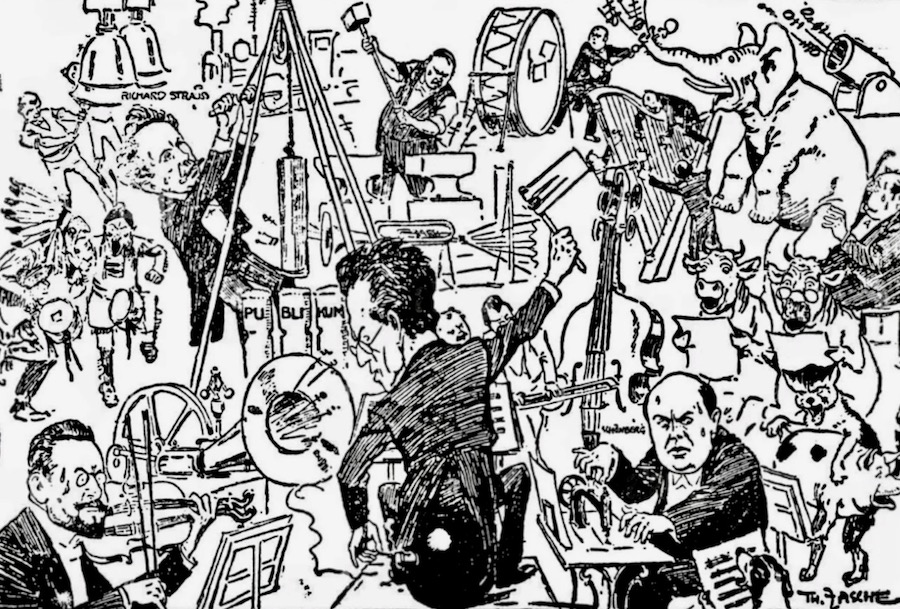
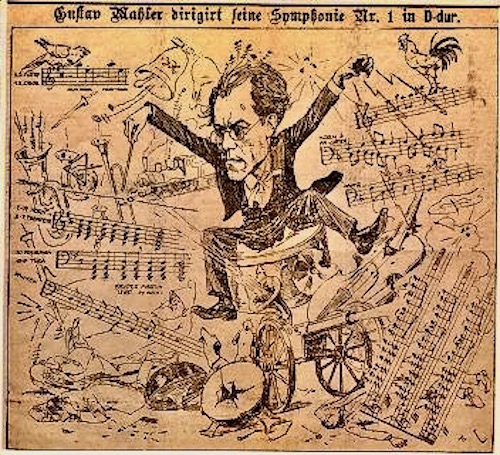 From all reports, as parodied in this caricature from 1900 of him conducting his first symphony, Mahler was as dithyrambically demonstrative on the podium as his greatest acolyte fifty years later, Leonard Bernstein. And both it and the cartoon below poke fun at his famous statement, reportedly said to Sibelius, “A symphony must be like the world. It must contain everything.” In addition to chirping birds, barking dogs, a rooster, a wolf attacking a pig, two singing cows, a musician using an elephant as a trumpet, another playing a sewing machine, still another bringing a sledgehammer down on an anvil, and dancing Indians beating on tom-toms, there are a locomotive, a bellows, a gramophone, and two cannons—everything except the kitchen sink!
The Second symphony also bears a title, Resurrection, and uses two songs from Wunderhorn: an instrumental adaptation of "Des Antonius von Padua Fischpredigt" ("St. Anthony of Padua's Sermon to the Fishes") in the second movement and "Urlicht" (“Primeval Light”), lifted directly with mezzo-soprano soloist for the fourth movement. The final two movements constitute an epic dramatic scena, with two soloists, chorus, and augmented orchestra, fashioned by Mahler from a combination of his own poetry and parts of Friedrich Gottlieb Klopstock’s eighteenth-century hymn, "Auferstehen, ja aufersteh'n wirst du" ("Rise again, yes, you will rise again"), which dramatizes the Christian Apocalypse, the last trumpet awakening the dead, whose graves erupt, freeing the resurrected souls to gather into a triumphal march on their way to heaven.
The third symphony has no overall title, but its six movements bear programmatic ones that are clearly pictorial, e.g., “Pan Awakes, Summer Marches In,” “What the Flowers in the Meadows Tell Me,” “What the Animals in the Forest Tell Me,” etc., and relate to Mahler’s extensive reading in German and romantic literature and philosophy, paramountly Friedrich Nietzsche’s The Happy Science, which tries to answer how one finds joy, meaning, and inspiration in a world where traditional religions were fast losing their authority (the book contains Nietzsche’s celebrated or infamous, depending on your point of view, declaration, “God is dead”). This symphony inscribes a remarkably vivid progression from inanimate matter to transcendent love freed from corporeal constraints. Movements two, three, and five instrumentally quote or otherwise allude to Wunderhorn songs, while the fifth is an arrangement for alto and chorus of "Es sungen drei Engel" (“Three Angels Were Singing”).
Mahler originally had a seventh movement consisting in variations on the Wunderhorn song "Das himmlische Leben" ("The Heavenly Life"), depicting a child’s vision of heaven, sung by a soprano. Evidently realizing that nothing could or should follow the sixth movement’s majestically winding ascent to a pantheistic version of the afterlife, he used this finale to end the Fourth symphony, begun in 1898, completed compositionally over Christmas 1900, but which he continued revising/orchestrating into the summer of 1901 in preparation for the November premier, which he conducted. During that summer, however, and practically back-to-back with finishing the Fourth, he also sketched in three movements of the burgeoning Fifth.
So here is Mahler in the first two years of the new century: four innovative, highly accomplished symphonies, each very different from one another yet sharing an overall conceptual approach, including endings that are affirmative: 1, triumphal; 2, redemptive; 3, transcendent; and 4, blissful. Then he embarks upon the Fifth, which would be premiered in 1904, once again under his baton, and also end affirmatively—but there the similarities end . . .
MAHLER AND HIS FIFTH
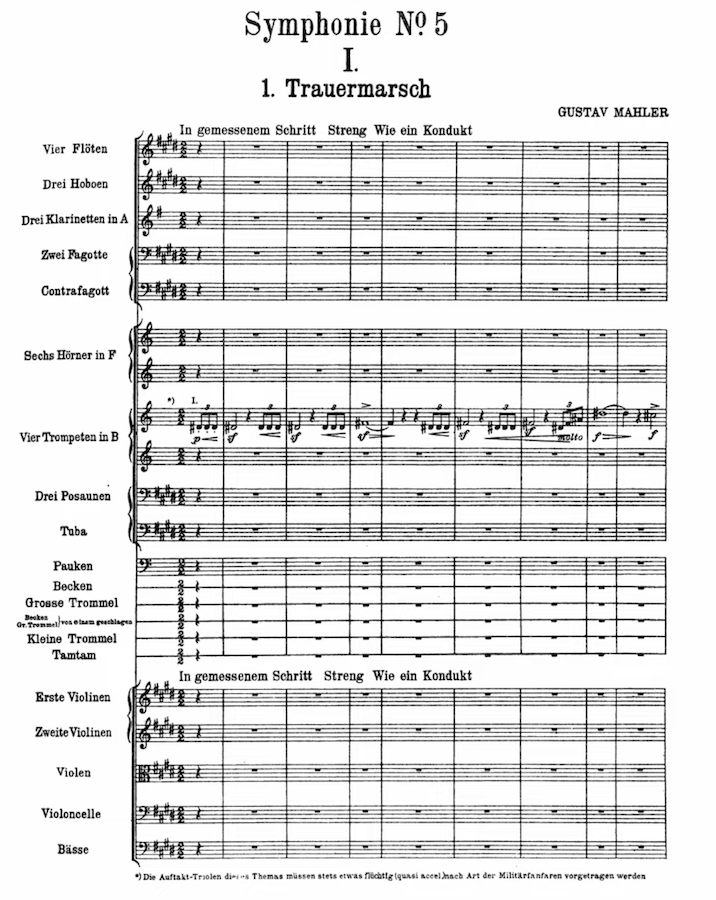 Page one of the full score, first movement "Funeral March"
In the essay cited earlier, Bernstein describes Mahler as “split right down the middle, with the curious result that whatever quality is perceptible and definable in his music, the diametric opposite is equally so.” But if this obtains in all of Mahler’s music, not only from work to work but within each particular work, and not just in terms of antitheses but with innumerable gradations in between, why the division into periods? Because while Mahler the man wrote all seven symphonies plus those and other works that follow, Mahler the composer developed, evolved, and grew throughout the writing the rest of his life, right up to the unfinished Tenth. The Fifth, Sixth, and Seventh together represent a decisive leap into the twentieth century such that, as Bernstein argues, the music that came afterward, notably the Second Viennese School, would be inconceivable without them. Formally, stylistically, thematically, and technically these symphonies find Mahler simultaneously turning his back on the programmatic features of the first four with their songs and lyrics and setting out on a new path toward an aesthetics of absolute or “pure” music.
I put quote marks around “pure” because these three symphonies still contain many passages and even whole movements of characteristic and other kinds of programmatic music, including allusions to some of the songs, but with the crucial difference that they are now subsumed into an overall symphonic structure or musical form that draws all the attention to itself. The programmatic elements of the “Wunderhorn” symphonies are baked-in, so to speak, which means that you cannot listen, say, to the Second as absolute music by trying to shut out the resurrection drama because you will in effect shut out the work itself. Likewise, or rather alternatively, you cannot fully comprehend the Fifth and its two immediate successors by finding a “story” in them: they demand (and reward) appreciation on their own terms as music.
By the time Mahler’s “duple vision” gets to the Fifth, the differences from the earlier symphonies loom so large they are no longer of degree but of kind: we find ourselves in a whole new musical world where conflicts are fiercer, battles thus more frenzied; dichotomies farther apart, clashes thus more brutal; highs and lows in mood and temperament more extreme, thus more manic or grim; transitions of every sort—section to section, key to key, tempo to tempo, soft to loud—more surprising, abrupt, even violent. Sometimes there are no transitions at all: about five minutes into the first movement of the Fifth, the beginning of the development is marked, “Suddenly faster. Passionate. Wild,” and scored for piercing trumpets, shrieking strings, pounding tympani, which smash into the funeral march without warning.
In order to embody or otherwise express this new intensity, Mahler explored denser, more sophisticated and complex contrapuntal techniques, with a correspondingly denser, richer, more chromatic and ambiguous harmonic language. All of Mahler’s symphonies are influenced by the progressive tonality, the increasing chromaticism of the post-Wagner Europe, which undermined the stability of the classical tonal system until Schoenberg shattered it. It can hardly be accidental that the Fifth is Mahler’s first symphony to which he did not assign a key signature, writing his publisher, "From the order of the movements (where the usual first movement now comes second) it is difficult to speak of a key for the 'whole symphony', and to avoid misunderstandings, the key should best be omitted." [2]
As Bernstein points out, Mahler experimented his whole life with different symphonic forms on what I think of as the macro-level, that is, the number and organization of the four-movement classical models of Haydn, Mozart, and (most of) Beethoven. As noted, the First originated as five movements; the third has six,[3] the Eighth two, the unfinished Tenth five again; in fact, only four of Mahler’s ten symphonies have just four movements. The Fifth was also conceived in five moments, but over them Mahler superimposed a three-part division. Part One comprises movements I and II, Part Two movement III, Part Three movements IV and V. Part One, which opens with a funeral march (announced by a motto motif for solo trumpet that so closely echoes the opening of Beethoven’s Fifth as to be quotation), is dark, tragic, brooding, anguished, and violent; the opening of the second movement is even more violent, a maelstrom of stabbing brass, screaming strings, moaning horns, and chords that rend like thunderclaps—“Stormily agitated, with greatest vehemence,” reads Mahler’s instruction. Part Three begins with an exquisitely beautiful adagietto followed by a rondo of unbridled energy and exuberance.
Between them is the scherzo, the longest movement in the work, the longest scherzo Mahler ever wrote, and one of the supreme achievements in symphonic form in the entire history of the genre. Its function is transitional, a series of Ländlers and waltzes by turns rustic and sophisticated, bumptious and elegant, folksy and decadent, pastoral, ghostly, even sinister with more than a hint of madness, i.e., around the nine-minute mark when it reaches that raucous brassy passage, punctuated with woodblocks from the percussion,[4] that threatens to derail the whole structure until the French horn returns with the opening bucolic motif and reins things in—or tries to. But soon enough the riotous energy returns to end the movement in a furious mood of abandon teetering on the edge of mania.
Even by the standards of Mahler’s scherzos this one is a real Mr. Toad’s Wild Ride of irony, parody, burlesque, caricature, and satire, of careening, mercurial, breakneck—I apologize for the mix of metaphors, but is there another composer for whom mixed metaphors are more apposite?—shifts in tone, temper, attitude, mood, emotion, not to mention style, manner, technique, rhythm, harmony, accent, dynamics, and kaleidoscopically changing instrumental colors and combinations. How could it be otherwise?[5] This is the movement that takes us from the bleak landscape of the first two movements to the luminescence and brilliance of the last two. Commentators frequently liken it to a bridge, but a more apt simile seems to me a churning river a boat is trying to get across.
Earlier I pointed out that all of Mahler’s first four symphonies end affirmatively. So does the Fifth, but with a profound difference. The forces of darkness loom so large in Part One and recur threateningly enough in Part Two that they cannot be banished, let alone vanquished easily. Affirmation when it comes must be hard won; as with Mahler’s towering predecessor, his beloved Beethoven, we must get through the storm before we can bask in cloudless blue sunlit skies. Only after the pain and struggle of Part One and the grotesqueries of Part Two is Mahler at last ready to let the clouds lift with the adagietto, a dawn-like interlude of surpassing beauty and tranquility before it is interrupted by a new theme sounded by the horn that recalls the pastoral opening of the scherzo. And so the rondo is off and running in the most uncomplicatedly, irrepressibly joyous music Mahler ever wrote, culminating in the return of the chorale, brutally quashed in Part One, now free at last to burst forth and revel in the glorious key of D-major.
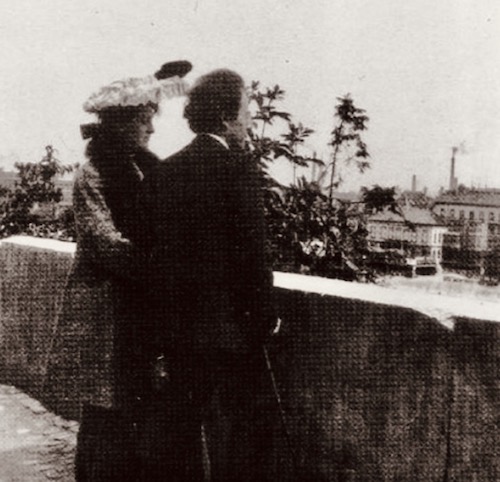
Gustav and Alma, 1903, a year after their whirlwind romance and marriage. By the time of this photograph he was deep into composing his Fifth Symphony, the fourth movement of which he wrote as an adagietto in the form of a love song without words for his new wife. Over half a century later it would be used in the music score of a popular art-house movie, the soundtrack album for which was as close as Mahler ever came to making the Hit Parade.
This symphony represents an unprecedented level of thematic development in Mahler’s work, using the many recurring themes and motifs to serve contradictory ends, at once unifying the potentially sprawling structure yet also preserving the maximum contrast among the three parts. From this perspective, the Fifth is a larger and more complex work than any of those that preceded it. True, the Second and Third are longer in duration, more expansive, and have greater breadth. But their grand finales are fulfillments of all that has gone before, with structures that don’t so much develop as unfold—I think it’s fair to say of them that along the way we can see where they are taking us. I don’t mean this pejoratively: much of their power derives precisely from our being able to apprehend their destinations a long way before we get there, much as mountain climbers, whose journey is also an ascent, have the summit in view a long time before they reach it.
Not so the Fifth. It is a work of high contrasts and stark antimonies often jammed cheek by jowl next to each other, with treacherous swings and hazardous roundabouts, blind curves and dangers around the next bend ready to pounce without warning. Much of the time we don’t know where we’re going until we get there, and even what appear to be respites or breathing spaces along the way are labile, thus in suspense, thus insecure, discomfiting, even scary. It’s not until we get to the rondo that we find ourselves in a brave new world that we can enjoy without the usual reservations of irony and skepticism. After the chorale broadens into a final blazing cadence, the tempo ramps up again up for that thrilling sweep to the final staccato chord that drops out before we can catch our breath. The long-range harmony has been resolved but the tremendous tidal wave of energy that’s been building since the scherzo is by no means dissipated. Instead, we are left still fully charged, suspended in a breathless state of wonder, that D-major triad ringing affirmatively in our ears.
It’s perfect, this ending, isn’t it? A seamless fusion of form and content, of manner and meaning, of style and substance for a symphony that heralds a new beginning with new possibilities in a new world for a great artist who was incapable of standing still.
RUNNICLES AND REFERENCE
 Produced by: Vic Muenzer. Engineered by: Kevin Harbison and Vic Muenzer; Mastering Engineer: Graemme Brown, Zen Mastering (available on SACD, streaming, and stereo-only)
Music

Sound
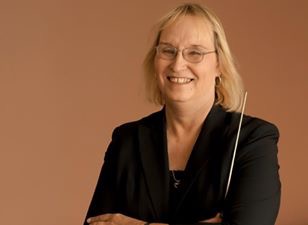
The Scottish conductor Sir Donald Runnicles’s introduction to Mahler began back in the seventies when he heard Leonard Bernstein conduct the Resurrection symphony at the 1973 Edinburgh Festival. It is where his “love affair with Mahler began,” Runnicles recalled in this interview from earlier this year, “where lightning struck: from that moment on I was an obsessive” [6]
A student at the University of Edinburgh already “dabbling in conducting,” he wrote his honor’s thesis on the ways Mahler’s conducting influenced his revisions of his scores. That was over half a century ago. Since then Runnicles has become one of the most active, distinguished, and accomplished conductors in Europe and America, widely acclaimed for his performances of late romantic symphonic and operatic repertoire. At various times he has held leadership positions at the Deutsche Oper Berlin, San Francisco Opera, BBC Scottish Symphony Orchestra, Orchestra of St. Luke’s, Atlanta Symphony Orchestra, Sydney Symphony Orchestra, and since February 2024 Chief Conductor of the Dresden Philharmonic. He has also been a returning guest conductor with the Chicago, Cincinnati, Detroit, Houston, and Pittsburgh symphony orchestras. And since 2005 he has been music director of the Grand Teton Music Festival (GTMF) and the Grand Teton Music Festival Orchestra (GTMFO).
 Sir Donald: High Plains Maestro
Celebrating its 65th anniversary this year, the festival is headquartered Jackson Hole, Wyoming, situated in the scenic Jackson Hole valley surrounded by the mountain range from which it takes its name. Though nominally a year-round festival, its high point and the basis of its reputation is the seven-week festival held every summer with as many as 150 events of world-class solo, chamber, orchestral performances, including educational programs for musicians and audiences alike. It always occupies a high place on any list of the best American music festivals and is equally highly regarded in Europe (BBC Music Magazine designated it their “2020 Festival Choice”). Two years ago Reference Recordings joined the GTMF as its official recording partner, the first release a superb cycle of the Beethoven piano concertos featuring Garrick Ohlsson with Runnicles conducting (see my review here).
Inasmuch as I began this piece by the calling GTMFO “essentially a pickup orchestra, albeit of cream-of-the-crop players,” an explanation may be required. Unlike most orchestras convened for the purposes of one-off recordings, special events, festivals, and so forth, this orchestra is culled from than 250 players representing over eighty-four orchestras and seventy-two institutions of higher learning in North America and Europe. Participation is by invitation only, many occupying principal, assistant principal, or first- and -second chair positions back home, and all of them consummate professionals and virtuosi. While pickup orchestras hired for recording purposes typically fold rehearsals into the recording sessions and many festival orchestras get only one, maybe two run-throughs before the performances, the GTFMO players spend between two and eight weeks at the festival and are accorded a full week of rehearsals before the first concerts (about the same as most guest conductors get during the regular season of most orchestras). Inasmuch as Runnicles assumed the music directorship in 2005 and many players return year after year, this means they have working relationships both with him and with each other that extend over several years, longer still among those he has worked with in his numerous guest appearances before their respective orchestras.
There is thus no mystery how Runnicles gets playing of such unanimity, virtuosity, and tonal beauty from these musicians, though high praise is due both all the same, not least because it’s not just great playing, it’s great Mahler playing, combining idiomatic expressiveness and extraordinary clarity of texture and line no matter how dense the orchestration or elaborate the polyphony. If I were to distill my impressions of this performance down to a single word, it might be “musical,” which is surely appropriate given Mahler’s deliberate move away from programmatic to absolute music. In putting it this way, however, I by no means wish to suggest this is one of those so-called “objective” non-interpretations that allow, as the saying goes, “the music to play itself.” Neither this symphony nor any of Mahler’s others can play themselves. They require conductors of the first skill, intelligence, sensitivity, and imagination. "What is best in music is not to be found in the notes," Mahler once said.
In view of its length; its interlaced three-part, five-movement structure; and its multiple personalities and contrasts, the Fifth may be the most difficult to conduct of all the composer’s symphonies. I’ve listened to this performance all the way through three times now, with increased pleasure and reward, and what strikes me every time is Runnicles’s total command of long-range structure and his always alert responsiveness to shaping the individual movements with their radically shifting moods and emotions.
Take Part One: the motto trumpet motif that announces the funeral march is impersonal, implacable, and without rhetoric as such, death being, as Emerson once put it, the one reality that doesn’t dodge anybody. (A shout-out to Thomas Hooten, principal trumpet of my hometown band the LA Philharmonic, who is perfect here.) The shifts in tempo and dynamics each time the motif returns are grippingly managed. The march itself is mournful and sad, Runnicles scrupulously observing the composer’s injunction, “With measured pace. Strict. Like a cortège,” so that the wild passage which kicks off the development conveys the requisite shock and trauma without exaggerating the effect. After all, we are still at the beginning of a 72-minute performance.
Nothing in this performance is done merely for the sake of effect yet everything registers effectively. Thus the turbulent second movement here opens as vehemently and convulsively as anyone could want, the ensuing chaos of alternating merciless anguish and tenuous reprieve savagely realized. Throughout, however, Runnicles’s ear is clearly on the climactic moment at the end of the development where the clouds briefly open and the D-major chorale sounds out from the orchestra in full throated cry only to be brutally quashed by the violent return of the opening storm. The tragic effect is shattering, the music ending in pieces, quietly.
Parts Two and Three, specifically movements III and V, represent some of the most contrapuntally complex and advanced polyphony Mahler ever wrote. Both movements present the appearance of theme with variations, but the German critic and theorist Thedor Adorno, in his book Mahler: A Musical Physiognomy, calls them examples of “variant technique,” whereby themes and motifs are not repeated exactly but varied in rhythm, harmony, phrasing, and instrumentation each time they return. Both movements also present the same set of interpretive problems: finding a unifying succession of tempos for a constantly shifting set of highly contrasted episodes while at the same time trying to characterize each as vividly as possible. Runnicles is fantastic here, swinging easily—or recklessly, as the music demands—between ingenuousness and irony, not to mention all the shades in between (e.g., the trio begins in Viennese elegance, yet soon enough we become aware of the decadence lurking beneath all that glistening silk and intricate lace). (Another shout-out, this time to Gail Williams for her stellar horn playing.)
Runnicles’s adagietto, ten minutes in duration, ravishingly played at a perfect tempo, is deeply felt yet serene and sun drenched, the brief coda luminously saturated, then disappearing into one of the most exquisitely sustained diminuendos I’ve ever heard. He opts to delay Mahler’s attacca subito instruction—meaning without pause, typically with a sudden change in dynamics—to allow for a couple of seconds of silence before the rondo comes in. (Still another shout-out to the concert master David Choucheron and the whole string complement.) This seems to me entirely in keeping with the character of the music because Mahler marks the rondo giocoso, meaning light-hearted, cheerful, gay (in its original meaning), and he scores it sparingly, the horn recalling but not directly quoting the cheerily bucolic opening of the scherzo, followed by the bassoon, oboe, and clarinet, with the instruction dolce, meaning sweetly. In other words, though he obviously wanted no pause, neither did he seem to want anything startling, rude, or extreme in contrast or disruption, as in the first two parts. Runnicles manages all this splendidly (and I really appreciated the ever so slight additional pause because I wanted to bask a bit longer in the afterglow of the adagietto).
Of course, the tempo soon accelerates. Many conductors, responding to the bracing energy and exuberance of the rondo, set a fast tempo that drives the music relentlessly forward. Performances like that are every exciting, but a potential problem is that when the tempo must broaden for the return of the chorale, it can feel like things have slowed a bit too much, which is then worsened once it has to accelerate back up again, some conductors trying to set an Olympic track-record heat to the end. As I hear the way Runnicles navigates this, having survived the storm and awakened from the dream-like adagietto, perhaps it’s time to relax a bit and enjoy the wonderful sights and sounds of the marvelous new world to which we’ve been delivered. He sets a tempo that allows for some lovely ebbing and flowing, subtly slowing down, then surging forward, with an underlying pulse that continuously urges the entire structure forward until the chorale does at last break forth and broaden with an inevitability that feels completely natural and supremely satisfying. After this, Runnicles’s accelerated sweep through the coda is thrillingly, electrifyingly joyous without being in the least frenetic. A brilliant ending to a fabulous performance.
Even by Reference Recordings’s usual high standards, this is a superlative recording. According to the booklet, a four-mic Decca-Tree was the main setup, two in the center and two outriggers, plus some carefully applied spot miking and a pair of mics aimed toward the back of the hall for the surround mix. The recording is available on hybrid two-channel /multichannel SACD/CD and several two-channel streaming platforms and download options. I listened exclusively to the two-channel SACD layer (using my reference Marantz SA-KI Ruby SACD-CD player), spot checking the CD layer and the Qobuz streaming version (with Bluesound Node Icon and Aurender A10 music servers). All are excellent, and close enough that I soon forgot about the differences in the grip of the performance. The Grand Teton Music Festival’s Walk Festival Hall is said to have a warm, intimate character, which it certainly does as heard here (and in the previously released Beethoven concertos). With a seating capacity of around 750, it is not by modern standards a very large hall, but it’s got a flawless tonal balance top-to-bottom, absolutely echt for Mahler in its combination of warmth and clarity. Owing to the truthfulness of the recording, the soundstage is not super wide, but presentation itself is outstandingly transparent, with great presence and body and prodigious dynamic range and bass response. When the full orchestra is unleashed, it is with real slam, so you don’t feel in the least shortchanged. This is one of those recordings that lets you forget about the sound in favor of the music.
HAITINK AND PHILIPS/DECCA
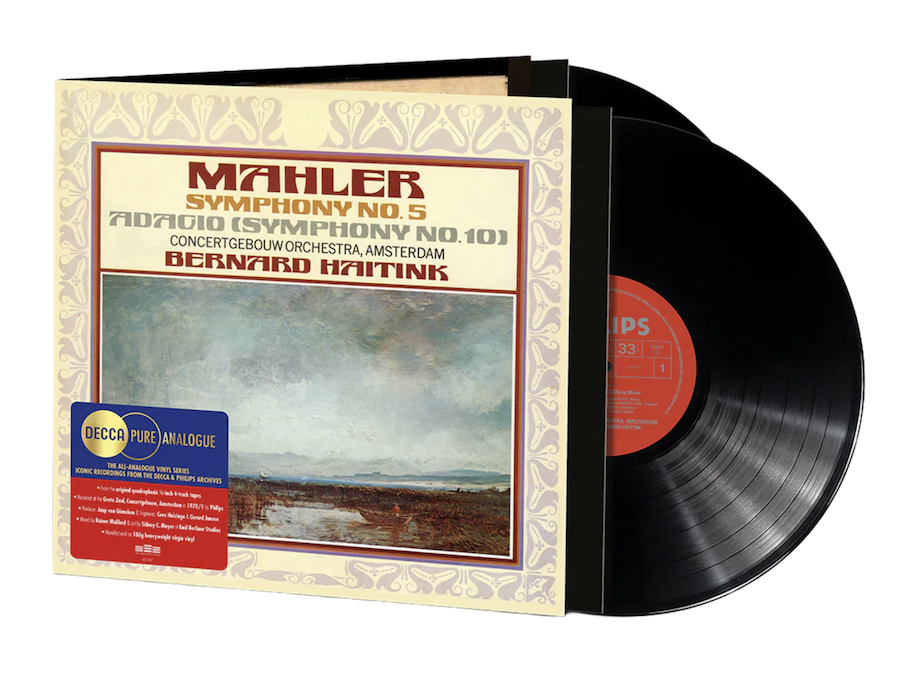 Produced by: Jaap von Ginneken (Philips); Engineered by: Cees Huizinga and Gerard Jansen; Analogue Mastering Engineer: Rainer Maillard (Decca); Lacquers cut by: Sidney C. Meyer at Emil Berliner Studios (Decca) (180g vinyl)
Music

Sound

I am puzzled why Decca choose to include this 1970 studio recording of Bernard Haitink’s Mahler’s Fifth Symphony in the company’s new series of Pure Analogue vinyl remasterings of vintage recordings from what must be well over a hundred in the Philips catalogue. Yes, Haitink was among the first and most committed of the group of conductors who followed Bernstein’s pioneering concerts and recordings of the composer’s music in the sixties And yes, Haitink’s only complete cycle, which includes this Fifth, is still one of the most confidently recommendable. But however one evaluates his obvious stature as a great Mahlerian, the Fifth seems never to have been an especially good fit for his sensibilities and this Fifth in particular was never highly regarded (nor was any of his three subsequent recordings). All the same, I was eager to hear this release, first, because I’d hoped to discover its relatively modest reputation should be much higher; and second, because I had just reviewed the great Colin Davis Sibelius Fifth and Seventh from the same parent label, Philips, superbly remastered by the same redoubtable Emil Berliner Studios team of Rainer Maillard and Sydney C. Meyer.
In any event, I was so disappointed I researched other reviewers just to see if I had missed something. If I did, so evidently did most of them. Reconsidering it in 1987, an unidentified reviewer in Gramophone, which almost always greeted this conductor’s recordings with hats in the air, found it “a rather staid performance—nothing significantly wrong with it, but lacking in blaze and tensions.” Several years later another Gramophone reviewer, again unidentified, judged it “curiously uneven,” conceding that the “first two movements are superbly weighty and assured, but as so often the finale seems far too heavy, without the quicksilver articulation you feel the music demands.” Reviews from other sources scarcely muster any more enthusiasm.
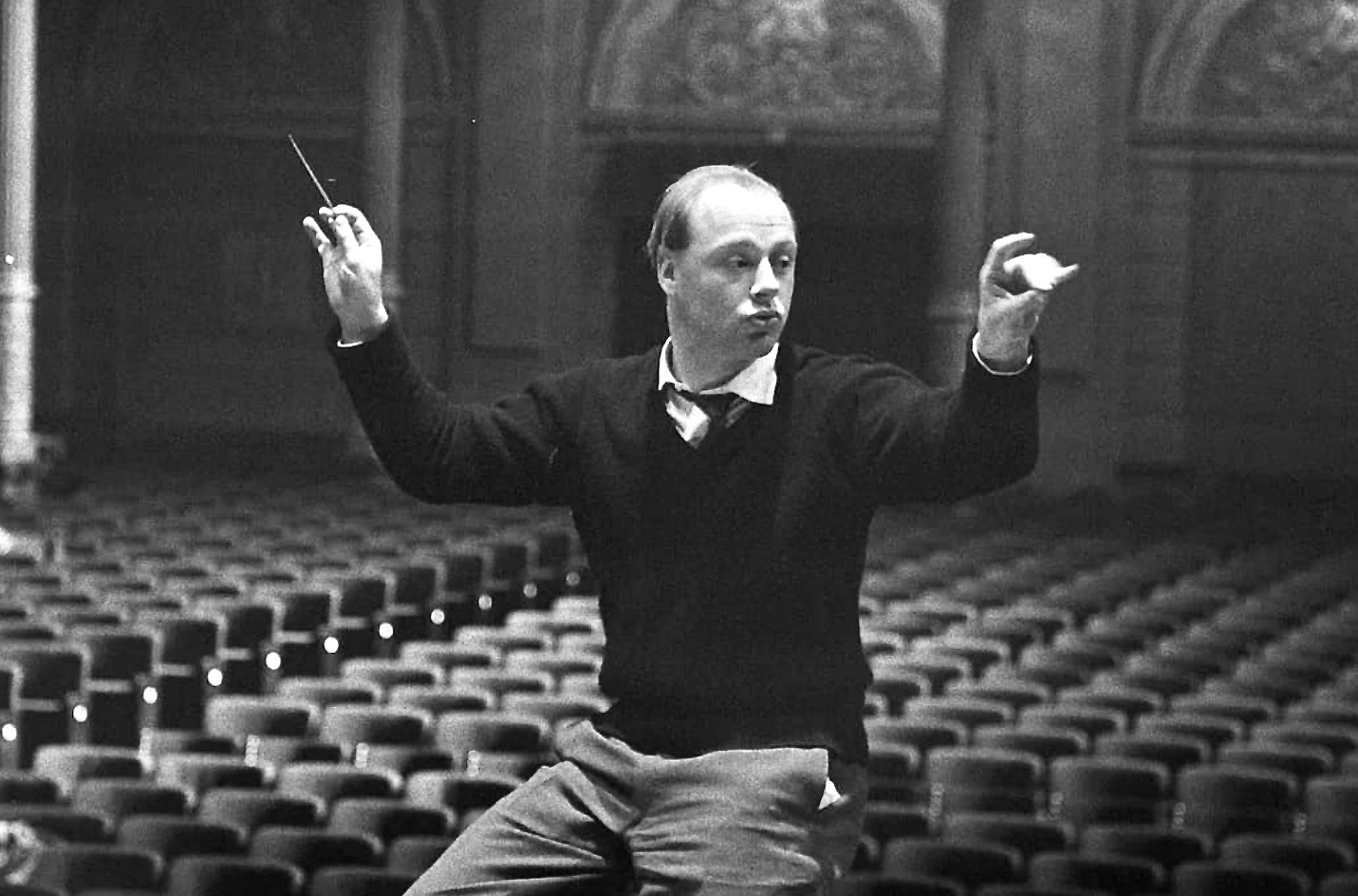 Bernard Haitink in rehearsal, The Royal Concertgebouw concert hall, Amsterdam
It’s not, for example, that Haitink’s opening is too slow (it isn’t, particularly), rather that it lacks a firm rhythmic profile, and from there the movement never catches fire. Ditto the beginning of the second, vehemence present in absentia; as the movement progresses, it gathers some steam, with a pretty powerful chorale, but overall there's still little storm and less stress. The scherzo fares best, Haitink surprisingly responsive to its restless succession of dances, ending with a rousing coda. Alas, the adagietto is bland and pulseless; a tad over eleven minutes, it’s on the long end of the duration spectrum, but at the same length Bernstein in Vienna is impassioned and heart-wrenching. The concluding rondo gets back some of the energy of the scherzo but, unlike Runnicles’s, there are dead spots along the way until the final chorale, which does land with decent impact.
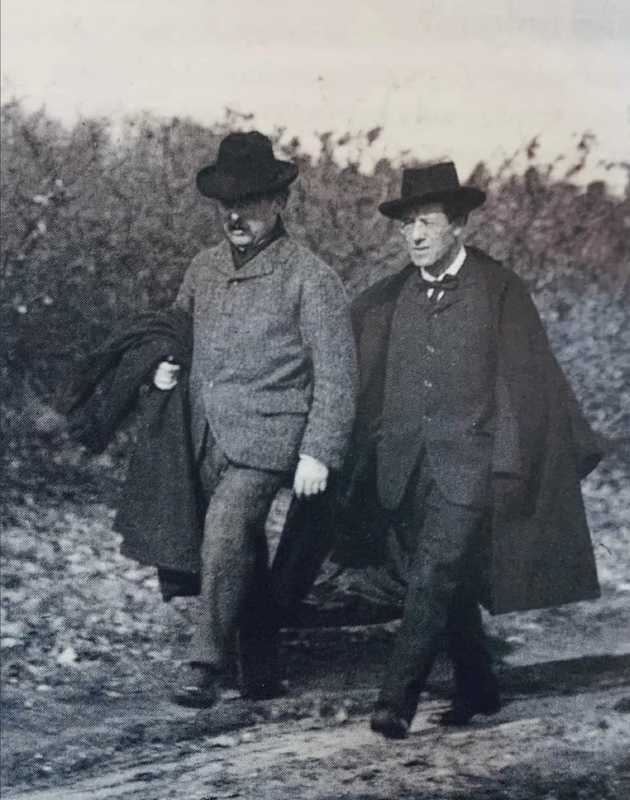 Wilhelm Mengelberg and Gustav Mahler on a stroll, one of the composer's favorite pastimes, c. 1906.
The Concertgebouw Orchestra’s roots go back to Mahler himself and Wilhelm Mengelberg, its principal conductor from 1895 to 1945. They met in 1903 at a performance of the Third symphony led by the composer, whom Mengelberg virtually on the spot pronounced “the Beethoven of our time,” becoming an immediate and fiercely committed champion, conducting some 360 performances of Mahler’s music between 1904 and 1940.[7] He invited the composer to conduct the Concertgebouw several times, as a result of which Mahler rescored parts of his symphonies to take advantage of the orchestra’s special tonal qualities. In other words, this is an orchestra with the Mahler style and idiom practically woven into its DNA. The best thing about this recording (and one of the major attractions of Haitink’s complete set) is getting to hear the Concertgebouw of the mid-twentieth century in its absolute prime—
—or would be if the recorded sound were better. I stand second to none in my admiration for what Maillard and Meyer have achieved with DG’s ongoing Original Source Series and the first batch of Decca Pure Analogue remasterings. But there’s only so much that can be done with the sonics on the original recording, a vintage copy of which in excellent condition was lent me by one of my listening group. There the sound lacks transparency and dynamic range; worse, it is too bright at the top end yet also curiously closed in, and it's anemic in the bass. Presumably because he had access to the four-channel tapes Philips made at the time, Maillard has managed to increase the dynamic range considerably and open out the recording so that there is now a welcomely spacious sense of the Concertgebouw’s famous acoustics.
But along with that comes a brightness that has increased exponentially. I played this on three different setups and on each one the sonics are shrill, grating, almost scorching when cymbals clash and trumpets blare (especially if they happen to be muted, which is a lot more than usual in this work). Meanwhile, the bottom end remains so seriously down in level that the tam-tam is inaudible in its single massive fortissimo at the end of the second movement, while the lustrous gold, warmth, and richness for which this orchestra is fabled is compromised. (You hear far more of these qualities in the Concertgebouw recordings in Bernstein’s DG Mahler cycle released a few years ago as remastered by Maillard and Meyer.
Let me add that none of the three systems over which I listened is intrinsically bright, while my reference Harbeth Monitor 40.3s and Quad ESL 57s have almost textbook concert-hall balance with a gradual slope in the upper octaves and warmth in the lower midrange and bass.
I wish I could report better news about the discmate, the first movement of Mahler’s unfinished Tenth. But nothing ruffles Haitink’s placid demeanor in this soporific run-through, not even that shrieking nine-note chord, accompanied by high-pitched screaming violins and trumpet, maybe the most terrifyingly dissonant passage Mahler ever wrote. (One of the most unforgettable experiences I’ve ever had listening to recorded music occurred sixty years ago when I heard this passage for the first time in the premier Ormandy recording: I could swear my hair stood on end.)
What baffles me most about this release is that in the Decca catalogue there is a recording from the same vintage, indeed, the same year, Solti’s first of the Fifth with the Chicago Symphony, that is far more worthy of the deluxe Pure Analogue treatment. Quibble though some do about aspects of Solti’s interpretation—fiercely driven, powerfully dynamic, breathlessly fast yet incisively shaped and articulated—this is nevertheless a blazing performance in stunning stereophonic sound from the period when this label was justly renowned for its sonics.
Otherwise, Bernard Haitink made around 450 recordings over a long and distinguished career, most of them at a standard of excellence that would be the envy of any conductor. Staying with the Concertgebouw alone, his celebrated Debussy recordings from the seventies of La Mer, Prelude to the Afternoon of a Faun, and Three Nocturnes, sonically superb and musically out of this world, should be at the top of the list, along side a radiant Das Lied von der Erde with Janet Baker and James King and Ninth Symphony, an extraordinary Also Sprach Zarathustra and Ein Heldenleben, some very highly regarded Bruckner and Shostakovich symphonies—well, you get the idea, an embarrassment of riches!
[1] High Fidelity (September 1967), 53. This is essay is reprinted in the various Sony CD boxes of Bernstein’s CBS complete Mahler symphonies and also available here: https://www.google.com/search?client=safari&rls=en&q=bernstein+mahler+his+time+has+come&ie=UTF-8&oe=UTF-8
[2] The parenthetical throw-away in this letter to the effect that the first movement comes second is suggestive. Does Mahler mean that he conceived the “Trauermarsch” principally as a kind of prelude to the symphony proper, which then in effect makes it a four-movement symphony with a separate introduction? As always with Mahler, there are layers beneath layers, boxes within boxes, perspectives plied upon perspectives.
[3] As does also Das Lied von der Erde (The Song of the Earth), which Mahler did not number a symphony—notoriously superstitious, he feared the so-called curse of the Ninth, i.e., Beethoven’s death just three years after completing his, Brucker’s even before completing his—but which many consider a symphony in all but designation (Bernstein regarded it as Mahler’s greatest symphony).
[4] The actual instrument Mahler specifies is a holzklapper, that is, a slapstick or a kind of whip. But most recordings I am familiar with use woodblocks, perhaps because they are a standard part of percussionists’ tool kits. If I am not mistaken the Haitink recording uses a holzklapper. If so, it produces a very light sound that doesn’t sound quite like tapping; frankly, I much prefer the woodblock for the way it forcibly cuts through the texture and drives the rhythm.
[5] If you were to play this symphony without the second part, you’d have a four-movement work of Janus-like black-and-white starkness. I tried this once; the effect was in some strange way weirdly compelling but very disturbing, as if I were in the presence of a seriously dissociative personality.
[6] It was in September following the August Edinburgh performances that the now legendary televised one in Ely Cathedral with the same forces was filmed: Bernstein, the London Symphony Orchestra and the Edinburgh Festival Chorus, Shelia Armstrong and Janet Baker the soloists. It is widely available on DVD and YouTube. It seems to have had a similar effect upon much of the music loving British public; my close friend and Tracking Angle colleague Mark Ward, English born and raised, watched the live broadcast when he was thirteen. “It was the first time I heard the music of Mahler, or saw Bernstein conduct and to say it was a life-changing experience does not come close to conveying how I received it,” Mark told me. “The sense of the music being created ‘in the moment’ was palpable and arresting—as vivid an experience of music fully lived and expressed as it's possible to have.”
[7] The only reason he stopped is that once Nazi Germany occupied the Netherlands, music by Jewish composers was banned.