


"America" Reissued by Analogue Productions at 45rpm
Are you ready for the sandman?
When the acoustic folk-rock band America released their debut album at the end of 1971, I bought it. When they came to my hometown the next month, I saw them play this album. That live set, along with the A-side single “A Horse with No Name” was astonishingly good. I don’t remember if they played the B-side single “Everyone I Know is From California” that night, but it ended up being one of the tightest concerts I’ve ever been to.
“A Horse with No Name” (originally titled “Desert Song”) was already on its way to becoming their biggest hit ever, staying at #1 for three weeks in March 1972. Although this song did not appear on the very first pressings of their S/T LP, it was quickly added to Side A. This addition was initially noted with a sticker on the front cover. Then, for a year or so after that, the song’s name was printed beneath the album title. The album in this form went to #1 and sold over a million copies.
Having collected this record since 1972, I ended up owning four versions of those initial U.S. LPs, including a white label promo of the very first press without “Horse” on side A. Yes, I’m a fan.
They all sounded fantastic, especially those with BH (Bobby Hata) written in the run-out area. Perhaps the WLP with A1/B1 (no RE-1) matrix was just a bit better than the rest, plus it was in great shape since it didn’t have the hit song and consequently was not played much!
There has always been a certain richness and immediacy to the sound on this album that has helped to make it a folk-pop classic. Played on most stereos in 1972, that’s about all you could distinguish as unique. The outstanding soundstage, transparency, and harmonics that were locked in the grooves were routinely masked by poor set ups and/or worn styluses. Only when my playback system improved significantly could I hear and feel the fast attacks and punchy bass that drove this music to another level.
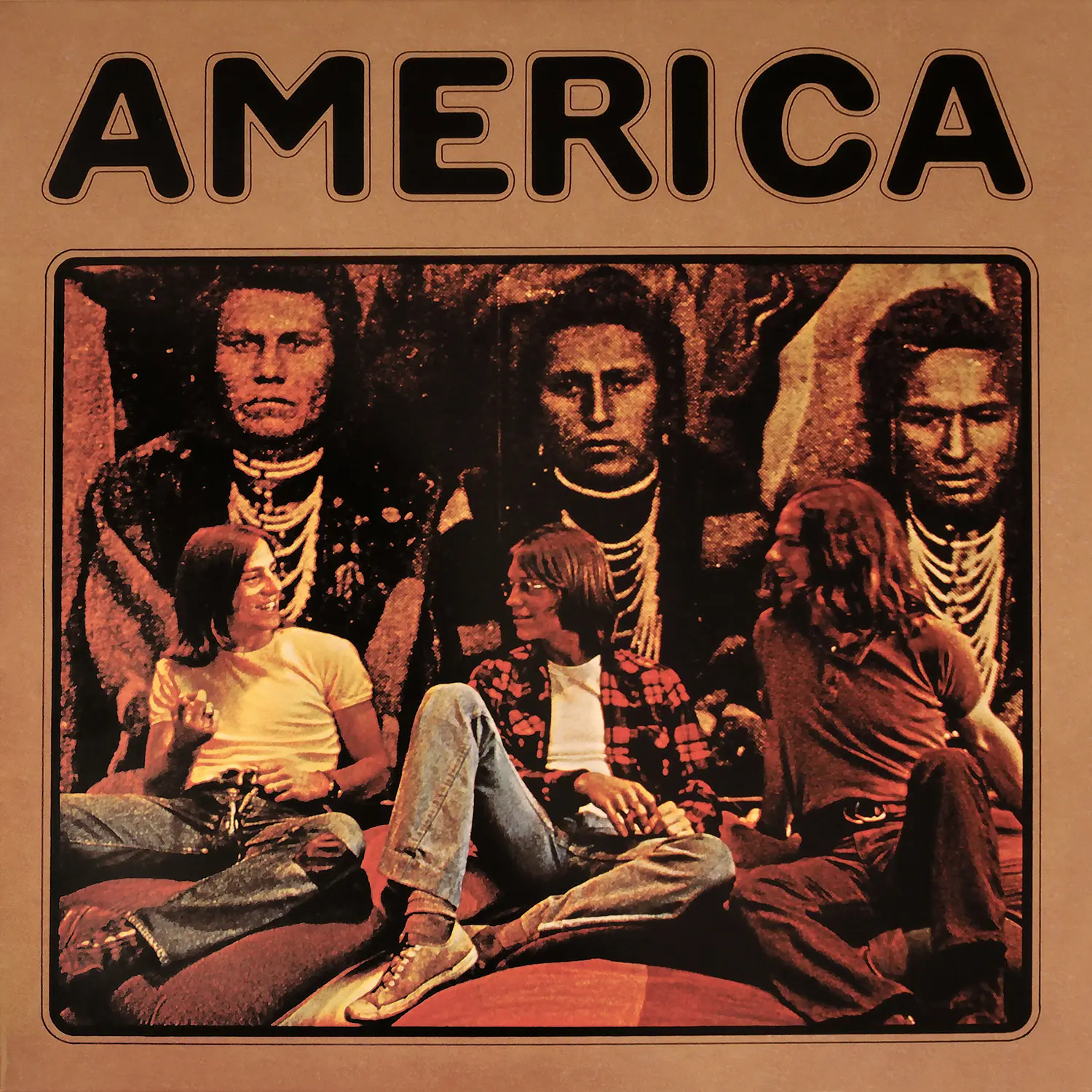
The album’s cover art featured a photo made by Nigel Waymouth of band members Dewey Bunnell, Gerry Beckley, and Dan Peek sitting in front of an 1887 picture of Chief Plenty Coups and other Crow prisoners under U.S. Army guard in Montana. These were some of the men arrested after the Native American tribe won the 1876 Battle of the Little Bighorn, aka Custer's Last Stand. It’s interesting that America chose to use a less than complimentary image portraying their namesake’s history.
Pictured with long hair, worn jeans t-shirts and flannel shirts, the US/UK group looked just like my friends and me, who were soon to be eligible for Vietnam War draft notices. After having just come off year-long Crosby, Stills and Nash (CSN) binge in 1970 listening to their eponymous (couch) album and Déjà Vu, we were ready to gobble up more of those ringing 6 and 12 string acoustic guitars and tightly blended three-part vocal harmonies. Consequently, we played side 1 to death.
Unbeknownst to us at the time, these three singer/songwriter/guitarists were born in the USA and sons of U.S. Air Force enlisted men who were stationed in London, including Gerry’s father, Commander Beckley. While still in high school, they formed the band America in 1969. The three young men worked hard to refine their delivery and before too long were picked up by Kinney Records and assigned to the UK Warner Brothers (WB) label.
Their original song line up for the album was recorded at Trident Studios in London with famed engineer Ken Scott. Realizing they needed a hit, the band quickly recorded “A Horse with No Name” at nearby Morgan Studios and released it as a single a month before the album.
OK, enough about how interesting I think the back story is, let’s dive into the various pressings I had on hand for this review. In addition to the US pressings mentioned earlier, I had the recent Rhino Reserve reissue and the Analogue Productions (AP) 45 double LP on hand.
I did have a German pressing that I thought sounded better at one time, but as my system and room improved, it dropped out of rotation. I also had a Japanese and UK copy but sold them after settling on a clean green label WB copy. There are other more recent reissues that I haven’t heard, including limited runs on colored vinyl from the Music On Vinyl and Friday Music record labels.
The bottom line is that as good as my best original US pressing sounds, the AP 45 double LP is better.
As expected, the basic recording by Scott is remarkable. It might be surprising that not all the individual songs have quite the same level of polish, however. That’s not entirely unexpected when you consider the complex, multi-layered studio production required for their first album together. Note that the 45 rpm sides can make minor flaw like these more apparent, as it takes a modern microscope to the proceedings.
This mastering cut by Matt Lutthans from the original master tape is impeccable, with the listener placed in a front row seat surrounded by an expansive envelope of sound. Macro and micro dynamics are both treated sympathetically. In other words, you don’t have to play this record loud to fully enjoy it.
When played at normal volume, I immediately noticed improved resolution and ambience retrieval compared to my best U.S. WB LP. The acoustic guitars and vocals were rendered just as naturally as on the original US LP, with believable tonality and body, plus the drums and bass were delivered more realistically with improved frequency extension.
Amazingly, the music on this double LP reissue never came off as forward or etched, as it had on some recent reissues that audiophiles rave about. I’m happy to report that while the presentation is not quite as laid back as the original, it’s effortless clarity never overpowers the musical message.
Most importantly, the emotional impact provided by this new reissue is as astonishing as that first show I witnessed. It allowed for a new way to reconnect with a record from my distant past in a more profound way. The result is that I was sucked into the album, rather than simply being an observer.
For example, on the opening track, “Riverside”, the acoustic guitars sound better resolved and chime together more coherently with cleaner tempo and drive. The next song, “Sandman” has always been a key track for comparing pressings. Just listen to how well the vocals and Peek’s electric guitar tone are rendered. That, and the power behind the rhythmic drive of Dave Atwood’s drums, are part of what sets this reissue apart.
The first two tracks and the next three on side 1 were written by the talented song writer and lyricist Bunnell. That’s how important he was and still is to this band. “Three Roses” is another favorite for fans and audiophiles alike with its intricate interplay of two Yamaha FG-180 acoustic guitars played along with the group’s blended vocals. It was a joy to listen to the improved attack and decay of the crisply plucked strings, along with other subtle nuances.
The song “Children” is perhaps the best example of the three men’s appealing vocal harmony together that rivals CSN. Of course, the timeless “A Horse with No Name” is never to be dismissed when doing a shoot-out of this album, if only for gauging how memorable the overall feeling is as created by Bunnell. “Here” was often chosen by the band to close their concerts, and it does the job here at the end of side 1.
“I Need You” also became a hit and leads side 2 with author Beckley playing piano. It’s a very simple tune that’s rendered more intimate on the AP 45. It could be argued that this side of the original record is not as strong musically. Yet even a singalong song like “Never Found the Time” by Peek is rendered more heartfelt on the AP 45. Emotional realism is often what differentiates the best pressings from the rest.
So, here’s a question readers will probably want to ask. Does the AP 45 beat the Rhino Reserves LP, which was also cut by Lutthans but at 33 1/3 rpm? My impression, after listening at matched volume levels, is that they are similar, with the AP 45 presenting a more dynamic and larger soundstage with layers being better separated, resolved and focused. The improved bass delivery is also there on the Rhino Reserves LP, although the 45 does go slightly deeper. Also, unlike some 45 rpm reissues, this one succeeds in breaking up all four sides equally, so that the flow remains satisfying.
Of note, while the overall audio presentation is substantially similar, the Rhino Reserves reissue could be argued to have a more integrated presentation. That’s not uncommon, even accounting for different playback systems and listening rooms, especially if one considers that perhaps the additional resolution provided by a 45-rpm experience means the listener has more information to absorb. The idea that a single 33 1/3 rpm LP has an advantage here, along with album flow and side length, will probably be debated until we get tired of turning over records. Is the 45 worth the extra money? All I can say is that, if you really love this album, I’d buy both.
The 180-gram double LP set pressed at QRP was flat and quiet. Just like with the Rhino Reserves reissue pressed at Fidelity, thoughtful, all-analog mastering paired with a top-quality pressing makes reissues like these easy to recommend. Look for an AP 45 of America’s second album Homecoming to come next.
OK, so how about the album cover? As expected, the AP 45 gives its new owner a more substantial package with better materials for more money, just like the rest of their AP 40 Series celebrating the label’s anniversary. The Stoughton tip-on gatefold jacket is exquisitely crafted. The interior shows a picture on the left that appears to be made in late ‘72 for their second album Homecoming. The right-side photo was previously used on a poster that came inside the 1974 Hatrick LP. As nice as these images are, and I’m being picky here, it’s unfortunate that vintage images from 1971 or early 1972 couldn’t have been used.
Of historical note is the fact that some U.S. radio stations banned "A Horse with No Name" because they thought it contained a hidden references to heroin, which had become known as “horse” on the street. The same song has also been unkindly criticized over the years as “stupid” because of its simplistic lyrics.
Perhaps this can be explained by the song’s author, Bunnell, who said the surreal lyrics are “a metaphor for a vehicle to get away from life's confusion into a quiet, peaceful place", as inspired by his childhood travels through the deserts of the American Southwest with his father, as well as likely inspired by the songs of Neil Young.
I get that. Bunnell was homesick. It was written as seen and felt through the eyes of a child. In that sense, “the heat was hot” is a reasonable description. If you are still reading and want the same nostalgic feeling of a journey with open highways and endless skies with “smarter” lyrics, I’d recommend listening to another Bunnel hit, “Ventura Highway”.
America’s first album was and still is an idyllic SoCal-influenced post ‘69 call to get “your heads back to together”. Although much lighter in fare than CSN for example, America was one of the bands that defined the next era of youthful wonder and provided hope for the hippie dream. Unfortunately, that idea was short lived as late ‘70s and ‘80s music and culture buried it in materialism.
“Horse”, along with “Sister Golden Hair” from the 1975 album Hearts, is pretty much all I hear from the America on playlists nowadays. Peek left in 1977, and the hits stopped coming. The sun simply faded on the band and its namesake, as even a switch toward contemporary yearnings couldn’t seem to alter its inevitable trajectory.
# # #
Article Copyright 2026 Randy Wells. All Rights Reserved.
America - A Horse With No Name (America In Concert, May 24,1973) Video: