
Autechre Re-Imagined For Six Strings
Shane Parish Creates A Stunning Acoustic Guitar Recording Of English Electronic Experimentalists
For any readers who are pressed for time - buy this record. The only category of readers who should think twice are ‘people who do not like Autechre’, and the parallel category of ‘people who do not like acoustic guitar music’, because Autechre Guitar is precisely that, nothing more, nothing less. If you have no money right now, begin saving, otherwise, buy this now. If you have a few moments, and you would like to know why you should own this remarkable LP - read on.
I recently had occasion to encounter some lesser-known aspects (to me) of the universe of guitar. I visited Porto in northern Portugal, where Fado music can readily be experienced, played in duet on nylon strung guitars and bright, metallic Portuguese guitars to accompany impassioned, emotive folk singing in small bars and clubs. On another evening I visited Radioclube Agramonte, a very fine arts hub down a terrifyingly sinister, nocturnal street beside a graveyard. There I heard French guitarist Nina Garcia display a very idiosyncratic method on a Telecaster which involved defying the natural laws of two-handed strumming and fretting, presenting an atonal struggle with the device which was somehow tender and noble. Her foot-stomps and modest approach to volume control were a subversion of the occasionally rather macho sound-world of experimental music, and indeed the shape and modus operandi of the guitar itself.
Before my trip, a liberation from a year spent at home recovering from surgery, I had heard of a forthcoming album which promised “Autechre Guitar” (Palilalia Records, PAL-095, 2026), and was intrigued by a preview track from guitarist Shane Parish which delivered precisely that - a composition by English electronic producers Autechre, played on acoustic guitar. That album has now been released in its entirety by Bill Orcutt’s Palilalia Records from San Francisco. It is no less intriguing and poses many questions about the process of making recorded music, and even more about adapting existing musical forms and interpreting them in an unorthodox manner. The universe of guitar has been kind to me recently.
I wonder if the guitar, in all its forms, is currently the most prevalent personal musical instrument in the western world. This ubiquity certainly requires any guitarist to reach for distinctive methods to stand out in both the compositional and sonic orbits. “Cover versions” are also everywhere - “Classics”, “Songbooks” and “Standards” abound. Re-recorded numbers pop up in recorded musical history with an unfamiliar voice and arrangement precisely because they are popular compositions. Shane Parish has not followed this path. His previous LP “Repertoire” (Palilalia Records, PAL-081, 2024) takes a varied collection of songs which do not seem a natural fit for acoustic guitar and finds captivating solutions to make them conform with his solo six-string performance. Mingus, Cage, Sun Ra, Kraftwerk, Aphex Twin - the ambition in adapting such a diversity of complex (and not necessarily popular) composers to the limitation of solo guitar is admirable.
Taking this approach and multiplying the complexity, Parish has now focused on one artist - Autechre - rendering ten of their deeply elaborate electronic compositions and applying a comparable process in transliterating them for acoustic guitar. Autechre are well-known, possibly successful, certainly worthy of respect - but are they popular? Perhaps not, and their music may not be immediately familiar to a wide audience - I am sure they would not be offended by my assertion. Shane Parish is not, I would suggest, recording ‘cover versions’ of Autechre’s indisputably labyrinthine musical output - the intricacies of Autechre’s rhythmic and harmonic world seem an ill-fit for a showbiz knock-off. Rather it appears that Parish has spent long, introspective hours staring at a woven rug and wondering how to unpick the many strands and myriad colours to discover the structure and artistry of the weaving. Having teased apart and laid out the many strands of the rug, he then patiently set about identifying how to re-make the rug with string and thread of only a single, perfect colour.
Autechre (Rob Brown and Sean Booth) emerged in Oldham, Greater Manchester, England in 1987 and followed an uncompromising pathway around the wilder shores of techno, producing glitchy, experimental works that ignored the straightforward four-four dancefloor formula of the time. Perhaps a clarifying episode in their mission concerns their “Anti” EP (Warp Records, WAP54, 1994) which was a direct response to the UK government’s Criminal Justice and Public Order Act 1994, which prohibited outdoor gatherings of more than nine people listening to music that “includes sounds wholly or predominantly characterised by the emission of a succession of repetitive beats” (what a non-lawyer of the mid-90s might call “a rave”). Therefore Autechre impudently advised that their track “”Flutter” has been programmed in such a way that no bars contain identical beats and can therefore be played at both forty-five and thirty-three revolutions under the proposed new law. However, we advise DJs to have a lawyer and musicologist present at all times to confirm the non-repetitive nature of the music in the event of police harassment.” They continue releasing new music to the present day, rhythmically and melodically as adventurous as ever. The selection of works on “Autechre Guitar” draws mainly from earlier albums in the 1990s such as “Incunabula” (Warp Records, WARP17, 1993), and “Amber” (Warp Records, WARP25, 1994).
As we all know, the map is not the territory. Every sound recording has a relationship with a sonic event which is more or less convincing to the listener. Hi-fi enthusiasts maximise the sonic realism of recordings with a meticulous approach to the machinery of sound reproduction. This recording, made at the home of Shane Parish in Athens, Georgia, is a startling example of sonic faithfulness. It is perhaps a fitting aesthetic philosophy to record this specific set of compositions in this way. This was not recorded in a high end studio and no expensive producer or engineer created the sonic signature of this record. I cannot think of another record that feels so bluntly, indisputably realistic. Nothing is hidden. It feels like everything that occurred around the guitar is captured - tiny ripples of finger pressure, harmonic overtones from the guitar body, microtonal contrasts that speak of the grey zones in a musical scale, minuscule beats that pulse subtly between two vibrating strings. There is a definite “thingness” in this recording. It is not just musical information, but a crystalline moment in four living dimensions. There is an astonishing realism to the recording - the interaction of hands and instrument creating air currents which form an intricate, sculptural “thing”.
This music is pensive, taut - it makes you lean forward - and the sound of this record demands your intimate attention. It is difficult to imagine anything less like background music - this is foreground music. It does not shout at you, it speaks with clarity and subtlety, so that you never wish to turn away or seek a pause. It speaks fluently and sensitively and intelligently, and you never miss a word or an intonation or a sign of emphasis.
This is a dry recording, bone dry - no reverb, no signs of processing. I listened back to another fingerstyle guitar record which I have often found to be a compelling recording - “One Guitar, No Vocals” by Leo Kottke (CD, Private Music, 01005 82171 2, 1999) - by coincidence Kottke was born in Athens, GA. I recalled this record (although quite different in musical style and emotional direction to Parish) having a direct, unmediated feel to the rendering of Kottke’s guitars. However, while I still feel it is a very fine recording of exceptional performances, some harmonic sweetening seems to emerge in tandem with the guitar itself, a subtle enrichment of the tone which lends a faintly illusory, almost luxurious air. I also revisited some favourite instrumental recordings by Bert Jansch, Jessie Buckley and Bernard Butler (yes, the same Jessie Buckley you just saw winning an Oscar - she has a superb singing voice too), Nick Drake, and Yo-Yo Ma’s recording of J.S. Bach’s “Six Unaccompanied Cello Suites”. Perhaps my most treasured recording of all is Glenn Gould’s 1982 "Goldberg Variations" (which I did not revisit for this project, as recording a piano and an acoustic guitar present such distinct challenges), but a close second is “New Ancient Strings” by Toumani Diabate and Ballake Sissoko, the astonishing rendering of two koras recorded in a marble hallway at night in Bamako, Mali. I have to say that, for me, Autechre Guitar has eclipsed the living qualities of all these recordings. To be clear - I am talking about the listening experience and recording quality, not the musical performance, so before anybody sends round the Glenn Gould Police to my house - I did not compare Glenn Gould’s piano playing to a guitarist.
Parish has recorded the pieces on Autechre Guitar with unnerving clarity - the clarity of a razor blade cutting through a wine glass. The dynamics rendered here provide scale and proportion which perfectly reproduce the sensations of sitting six feet away from an acoustic guitarist in a silent room. I cannot detect any trace of the sound of the room itself. The pinpoint precision of the interaction between instrument and microphones feels miraculous, entrancing. There are pulsing bass strings that sizzle, harmonics that ring exquisitely, string squeaks from fingers sliding down the windings. I have only noticed a couple of minuscule moments where there might be a breath taken at the end of a piece, or a tiny brushing of cloth, anything incidental which is not the playing of a Taylor 214E-G guitar. A deliberate inclusion of the outside world appears in “Slip” where the summer optimism of birds singing and a plane flying overhead bookend the performance. The musician seems to lean back from the microphone just as a single-engine aircraft passes to your left; a small plane like that would not take flight on a wet windy day, just as a guitarist might not go outside to record a song during a storm, so the recording delivers not merely an exquisite piece of solo instrumental playing but the sense of a calm, warm day in the countryside too.
Some listeners may say “surely those string squeaks don’t need to be heard on the record?”. For non-guitarists, the sound of the fretting fingers sliding down roundwound strings makes a sound not unlike a DJ scratching a record. I feel the inclusion (or perhaps the non-elimination) of incidental sounds such as this partly define the startling realism of the recording. When listening, you feel physically close to the guitar, and not being able to hear those squeaks could seem unnatural. Very slight movement of the fingers can produce a single click of skin on wire, rather than a glissando-type sound, and these very tiny but authentic sounds of the human-instrument space keep drawing you in closer.
The complex process to translate electronic machine production to acoustic guitar performance is the other compelling factor in this record. The website A Closer Listen published an enlightening interview between Shane Parish and David Murrieta Flores in February 2026, which is an excellent summary of this challenging transcription process - and includes a wonderful image showing Shane’s own handwritten score for “Bike”. This is an inevitably reductive process, subtracting and condensing the original musical elements to enable Parish to render the “six voices” - each individual string of his guitar.
The opening track of Autechre Guitar, “Maetl”, has a mournful quality, a sensitive melodic pattern against a languid bass. The quietly hopeful “Eggshell” requires some intricate rhythmic playing and plucked harmonics, tiny fluttering fingertips on the wood of the guitar top. “Eutow” has a sliding, crosscutting melodic progression which morphs into a second section with enhanced pace and emphasis. “Slip”, recorded outdoors one morning before Parish took his daughter to school, is a delightful piece of gentle fingerpicking which somehow makes Autechre sound pastoral and tender; passages of upper fret phrases tangle around a supple bass pulse. “Bike” is an insistent melodic minor key piece with elongated passages and chiming, rippling tones. “Nine” unravels a terse, cryptic phrase with almost slide-like, starkly-bent phrases in the upper fretboard and potent, elaborate arpeggios. The third side opens with “Yulquen”, a driving, hypnotic standing bass part chugging over an expanding, circling note sequence which is pensive, enigmatic. “Lowride” takes a lithe, stark phrase and surrounds it with clusters of double-stopped, sizzling low-range notes, finding a placid pathway to an ending composed of slowly fading harmonics. “Corc” rings with a tonal honesty, alternately walking and skipping into undulating articulations and fluctuating metrical mechanisms. Closing track “Clipper” revolves around a core rhythm that confounds simple measurement. Plucks and slides interweave, tight sequences flit and quiver, the final statement persistent and austere.
With most modern recordings being multi-tracked in a studio, overdubbed many times by musicians who may double-track their guitars or sing their own backing vocals, we nevertheless settle on a recording as being a true reflection of some musical event (which is often not the case). “Autechre Guitar” seems to really, truly, be that. No overdubs, a few microphones to capture the different sonic aspects of the instrument, no processing to enhance the sound or create illusions of space. Perhaps most importantly, no producer.
I contacted Shane Parish to ask him about his recording process and he was kind enough to respond swiftly to my questions, which I did not expect - I am very grateful to Shane for his openness in replying to my questions and even more grateful for the photos he supplied. He confirmed that there were indeed no overdubs, no additional signal processing nor effects. His signal path included two microphones (an Audio Technica AT4033/SE facing the neck/soundhole of the guitar and a Shure SM57 angled off the bridge) going into an RME Fireface UCX interface with the digital recording made in Logic software. This is stripped back, minimal, no-frills recording, with the emphasis clearly on fidelity and simplicity, with the final decisions about the recording made by the musician himself. The mastering and format preparation for this vinyl release and digital releases was completed by musician and mastering engineer James Plotkin, who was also kind enough to reply to my enquiries. James told me:
"Solo acoustic guitar recordings are always really interesting from a mastering perspective, every nuance of the instrument and accompanying performance is exposed. You can approach the process in any number of ways - but in my experience, the focus is more toward dynamics, detail, and atmosphere than it is about polish, volume, glue/sonic consistency between tracks, etc. No psychoacoustic processing or artificial room sound was used, in order to keep the sound true to the instrument and space of Shane's recording. Typical for a lot of the acoustic guitar recordings I've worked on, some minor work with phase and finely-targeted control over transients in the higher frequency range was essential for the vinyl premastering in order to avoid any cutting issues, while making sure the work being done was as transparent as possible."
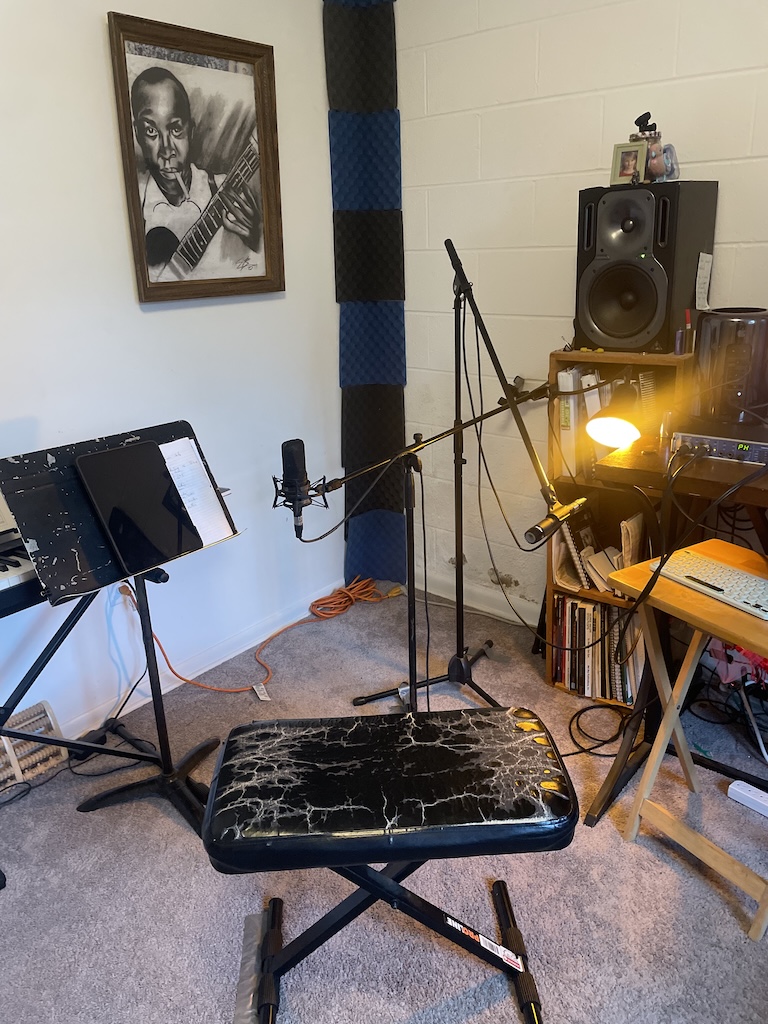 Microphone setup in Shane Parish's studio. Image © Shane Parish
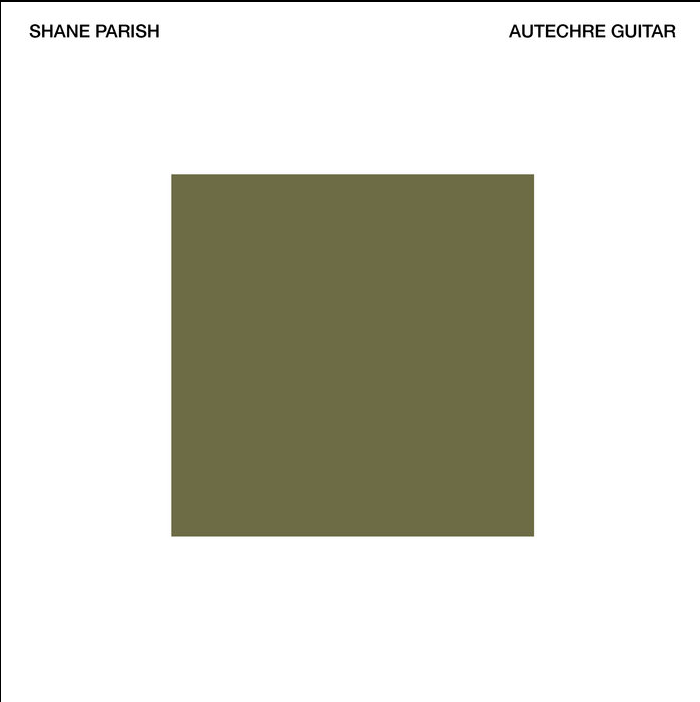
The pressing plant for my (UK/European) double vinyl copy was GZ in the Czech Republic. I see frequent comments expressing concerns about quality in relation to GZ, but this 180g pressing is deep, lively and crisp, with very little surface noise and an uncommon dynamic potency. The ten tracks are spread generously across four sides, allowing the depth and space of these recordings to ring out with zero distortion. The package is just as streamlined as the recording. A heavy gatefold sleeve, olive green and satin white, Helvetica uppercase, and on the interior a widescreen photo of Shane on a gigantic Lisbon stage facing an even bigger audience.
A comparison between audio recording and photographic image-making may be useful here. A landscape looked at with the human eye all appears to be in focus, even the nearby flowers and your dad in the middle and the distant mountains. They are not all ‘in focus’; the human brain can process all these very different perceptions to give us an image we consider ‘real’. The dynamic range of the human eye allows us to ‘see’ areas of darkness and bright illumination in some ‘balanced’ way. Humans did not evolve a visual system that perfectly captures reality, but one which will help us to see prey and evade predators. Cameras are erroneously thought sometimes to ‘capture’ reality. The sensor within a camera (digital or film) has a limited dynamic range and the focusing capacity of a camera lens cannot automatically ‘make everything sharp’. A human operator makes subjective decisions about how the camera should behave, and this is before we consider the variations of tone, colour, cropping, special effects or total fabrication one can achieve in a darkroom or Photoshop.
There are parallels with audio recording. We may imagine the band we are listening to are all standing together, ranged across the soundstage, playing simultaneously, recorded in perfect fidelity, in perfect balance, making no mistakes. (One modern exception may be the Steve Albini engineering method, which only seeks to capture the sound of a band playing live in a room - examined by Michael Fremer in these pages here.) The ‘reality’ is usually quite false - a mix of the best parts, the sound edited and polished by a sound engineer, overdubs melded together by a mixing engineer, creative choices made by a producer, the whole thing ‘glued’ together by compressors and mastering experts to reflect the format, listening environment, fashion and human taste… it’s no more ‘real’ than the processed photograph of our landscape, where everything is in focus, bright and dark areas are equally legible, the wonky horizon is straightened, and the tree that seemed to be growing out of your dad’s head has been edited out. The recording sounds real, the photograph looks real, but neither are real - because the map is not the territory, and the map does not become the territory by fiddling with it to make it seem less map-like and more territory-esque. Shane Parish has therefore achieved something quite special in these recordings. By doing less, by recording with the minimum of required devices, he has presented the singular reality of his instrument and performance with striking immediacy. Perhaps I did not believe that such a pristine, substantial presence could be rendered by any audio format. I have very much enjoyed being proved wrong by Shane Parish on that point.
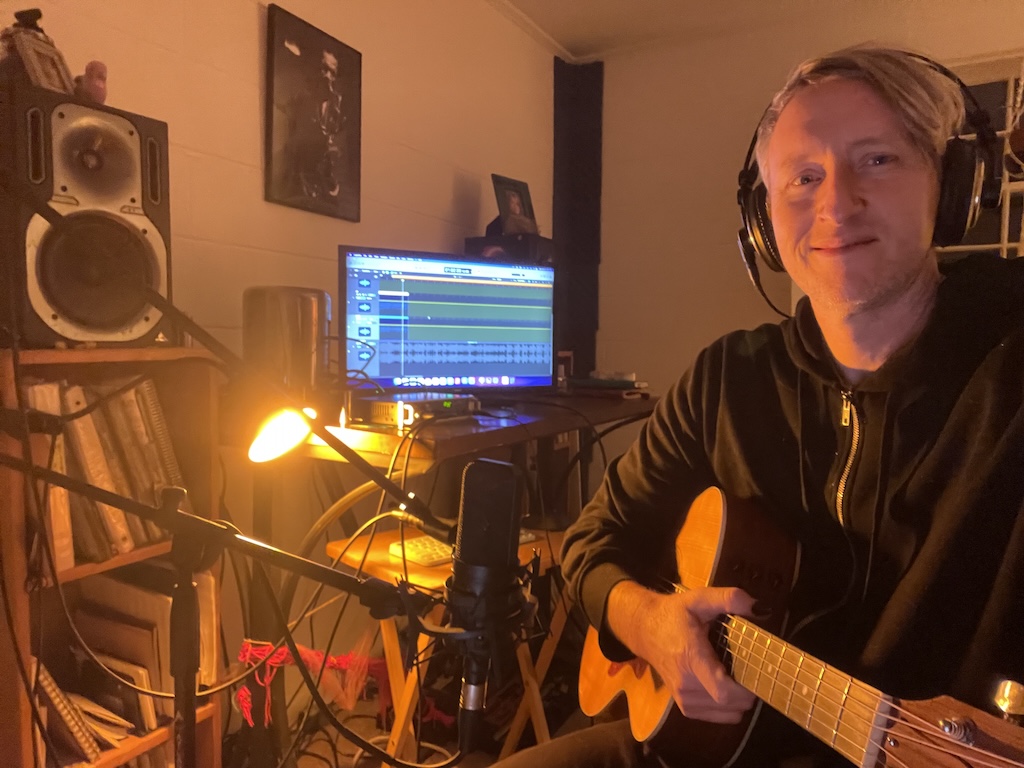 Shane Parish. Image © Shane Parish
For Apple Music Users: The hyperlink playlist provides original Autechre versions of the same songs recorded by Shane Parish for Autechre Guitar.
Autechre Guitar by Shane Parish