
Marta Sanchez's Solo Prepared-Piano Triumph
The Spanish-American pianist breaks into the pantheon
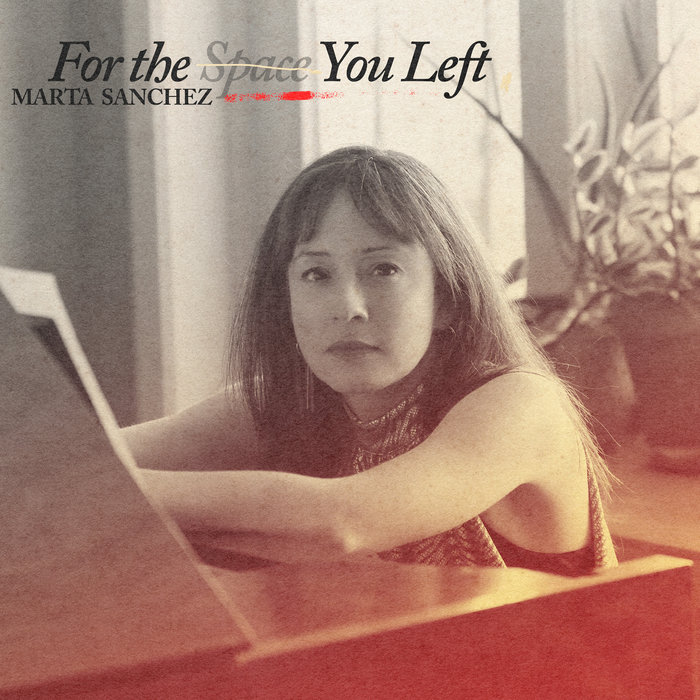
Let’s put the lede where it belongs: This is a terrific, even an exciting album. Marta Sanchez topped last year’s Downbeat critics’ poll in the category of Rising Star Pianist. With this album, she has risen—holding a berth among the top echelon of jazz pianists, period.
Born and schooled in Spain, Sanchez has led bands on six albums since moving to Brooklyn 15 years ago. Her new one, For the Space You Left (on the Out of Your Head Records label), is her first solo recording, and it’s different from anything she’s done—different, for that matter, from anything any jazz musician has done lately.
She composed all nine of its tracks, and on seven of them, she plays prepared piano, a piano with objects inserted between the strings—in Sanchez’s case, tape, tacks, metallic paper, and magnets—to create unusual tones. John Cage came up with the idea in the 1940s; a few musicians, classical and jazz, have followed his lead in the decades since, with mixed outcomes.
Sanchez’s trip down this risky road began in 2017, during a residency at the MacDowell artists’ retreat, where she set out to overcome her fear of composing and playing solo—a task that the COVID lockdown, not long after, made inescapable. By instinct, she kept hearing other instruments, especially percussion, in the background of whatever she was laying down, and so started preparing the piano, so she could create variations on those sounds herself.
The challenge in this trick is to weave these extraneous sounds into the music with a balance of dramatic disruption (they are unexpected) and seamlessness with the rhythm, harmony, and melody—in other words, to deliver a jolt but not for its own sake or in a way that seems gimmicky. Sanchez strikes just this balance.
She studied classical music at Madrid’s Real Conservatorio de Musica, and the roots show, to varying degrees, in all of her albums. In my review of her breakthrough 2022 quintet album, SAAM (Spanish-American Art Museum), I noted “the way she floats a melodic line over a meter and how she transforms the interplay of a few notes into fully woven colors and textures.” You hear that too but with more complex patterns and wide-ranging references. You can hear traces and shards of Debussy, Cecil Taylor, African dance music (a friend had sent her a recording featuring a lot of marimba), to cite a few, but all of it gushes with swing, a strange shade of blues, even romance when the flourish somehow fits—and it’s infused into her own distinctive sound.
She’s also a master of dynamics, pelting the keyboard with ferocity, yet always with precision, and she can pivot to swirls of quiet intensity too.
Adam Muñoz recorded the session at Opus Studios in Berkeley, capturing its 7’10” Steingraeber D-232 grand piano (known for its rich resonances) with a vintage AKG C-24 stereo microphone (placed inside the piano, about 8” above the strings and 10” behind the hammers), plugged into a Millennia HV-3D preamp, then straight to ProTools, with no EQ or compression.
Perhaps to make it sound less closed-in, the mixing engineer, Dave Darlington, added only a touch from a Bricasti reverb unit, which loops in samples of real acoustic spaces. “For this album,” he told me in an email, “we set the piano into Amsterdam’s Concertgebouw.” It’s been a few years since I’ve heard live music in that wondrous concert hall, so I can’t judge its likeness, but I will say the piano sounds as if the piano is in some kind of concert hall, and the effect doesn’t sound ladled on electronically; it’s subtle, wreaks no havoc on the piano’s own tones and overtones or those of all the doo-wads that Sanchez has stuck inside. Anyway, the combination of close, purist miking and a slight knob-twirl of sonic trickery hits just the right chord, so to speak.
I listened to the CD a couple times before receiving the LP and thought it sounded very good, but the vinyl pressing—cut at Well Made Music—is extraordinary, revealing way more detail. On the CD, when the hammers strike the prepared elements, you hear some metallic color; on the LP, you hear the full transients of the objects struck and their resonances with the keys around them. It’s more 3D, and the piano itself is richer too. The vinyl is a limited run, but try to find it. As far as I can tell, it’s offered in the US only on Bandcamp and the label’s own website. Adam Hopkins of Out of Your Head Records tells me it’s also for sale at HHV in Germany and Sound Ohm in Italy, and soon throughout Europe via Orchard.
Heard on a good system, it’s a great and great-sounding album.















.png)