
Miles Davis ’56
The First Great Quintet Recordings Mastered a New Way
When I first began to seriously collect records in the mid ‘80s, anytime I came across vintage jazz LPs by artists I liked I would buy them. That’s if I could afford them. You see, nice condition first pressings from the greats were expensive even back then, unless you got lucky. I got lucky regularly for a while. Not so much in the past fifteen years.
Miles Davis was one of the jazz artists I focused on. He fundamentally reshaped modern music across fifty years, constantly reinventing himself. Whether it was in his role as a jazz trumpeter, bandleader, or composer, his ability to continually grow as an innovator and influencer in directing the evolution of jazz made him someone I wanted to collect.
After spending time developing his bebop style, most notably with Charlie Parker, Davis released a compilation album called Birth of the Cool that heralded a shift to more considered interpretation. Next came his involvement in hard bop. This era was known for fiery, blues-soaked swinging jazz with melodic harmonies.
As part of this jazz icon’s centennial celebration, Craft Recordings has been busy preparing for the Davis 100th anniversary and their own Prestige label’s 70 year of existence. Recently, Craft has released two individual anniversary box sets that cover his early hard bop period: Miles ’54 and Miles ‘55: The Prestige Recordings. See Fred Kaplan’s in-depth Tracking Angle’s review .
This review focuses on the next brief but very important period where he was moving from hard bop to a more introspective styler. As important as his ‘54 and ’55 recordings were, it was his first quintet from 1956 that propelled Davis to fame as a band leader. Comprised of an all-star line-up of talent including John Coltrane, Red Garland, Paul Chambers and Philly Joe Jones, this small group redefined “modern” jazz with their live performances in the villages of New York City. The recordings they made together remain highly influential today.
This happened in the time right before Davis recorded the landmark modal jazz title Kind of Blue for Columbia in 1959. He had signed with the famous label in late 1955 after his first appearance at the Newport Jazz Festival.
To fulfill his contractual obligations with Prestige, in 1956 Davis and his first great quintet recorded tracks in 1956, many of which would be released as four landmark albums: Cookin’, Relaxin’, Workin’ and Steamin’. These records were released between 1957 and 1961.
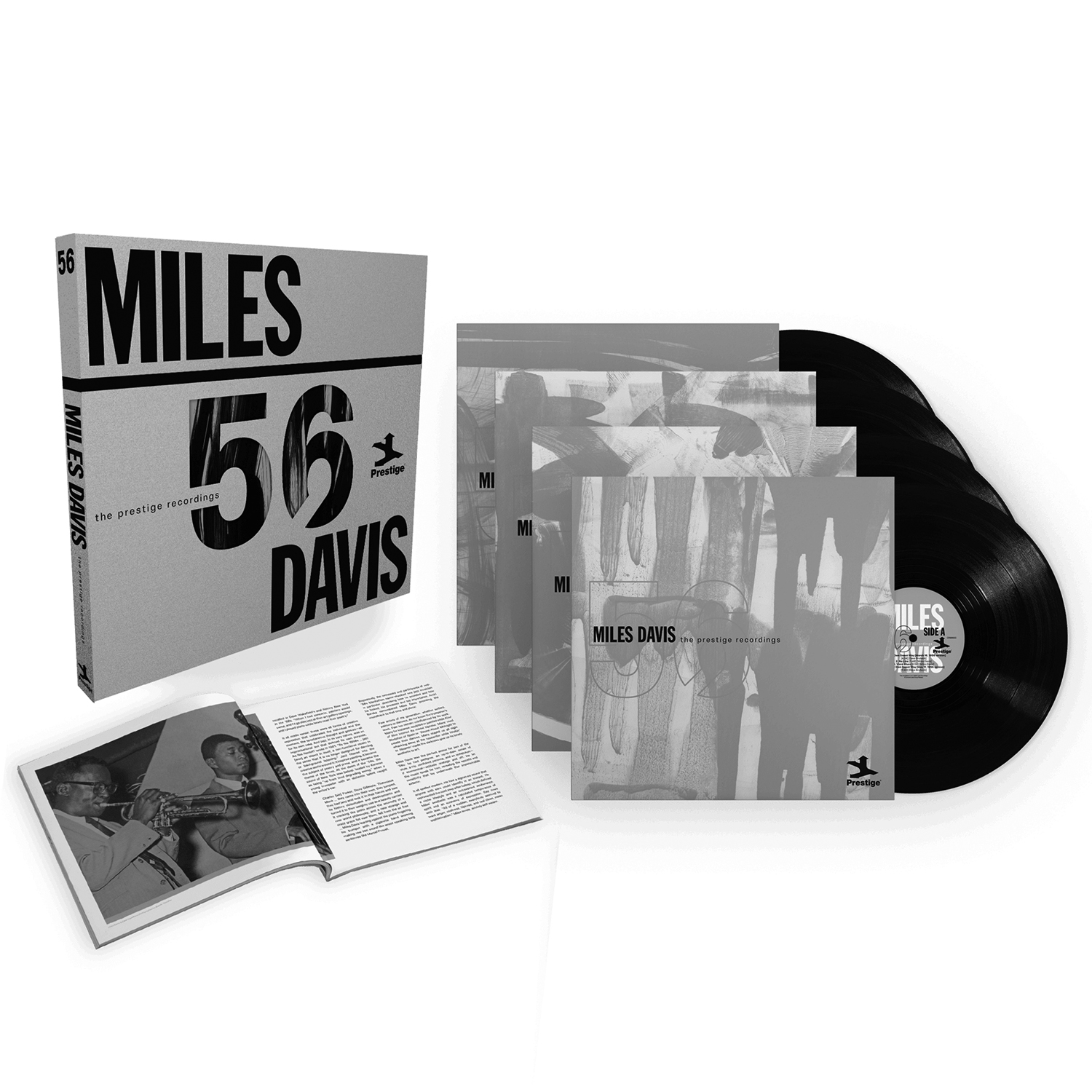
The just-released box set from Craft is unsurprisingly titled Miles ’56. It gathers these recordings together in a limited-edition vinyl collection of four 180-gram discs. A 3 CD set is also available.
The tracks, mastered from the original master tapes, include a couple of alternative versions. In this box they appear in the order in which they were recorded. Also included is a set from another Davis session featuring Sonny Rollins, Tommy Flanagan and Art Taylor. Captured on March 16th, 1956, this music appeared as part of the Prestige record titled Collectors’ Items.
One additional tune was also inserted into the chronological track list, the Monk-penned “’Round Midnight”. This famous jazz composition was recorded by Davis on October 26, 1956 and appeared on the Prestige album Miles Davis and the Modern Jazz Giants.
This Craft box also includes a pamphlet with a new essay by music historian Ashley Kahn and the well-known track notes of the late Dan Morgenstern. The LPs, placed in custom sleeves inside a modern box, were flat and quiet.
There were two older vinyl box sets covering this phase of Davis’s output that I had on hand for this review, the 1980 Chronicle: The Complete Prestige Recordings (12 LPs, tracks presented in the order they were recorded) and the well-regarded 1996 Analogue Productions (AP) The Great Prestige Recordings comprising 5 LPs, including the four albums featured here, plus the ‘56 album Miles: The New Miles Davis Quintet.
I also had some stand-alone 1984 OJC LPs and two vintage records, a deep groove 1958 Rudy Van Gelder (RVG) second pressing of Relaxin’ with yellow Prestige labels and a 1964 Cookin’reissue with blue Prestige labels and RVG stamp in the run-out area.
For this release, Plangent Processes was enlisted to help ready the tape for remastering. As many readers know, the Plangent Processes playback system, used for this tape transfer and audio restoration by founder Jamie Howarth and John Chester, is a hybrid state of the art unit that couples contemporary analog electronics with unique proprietary digital signal processing.
The advantages to using the Plangent process include advanced wow and flutter correction and speed stabilization. The company states these and other applications provide improved imaging, clarity, and pitch without audio degradation or loss of traditional analog warmth. Audio engineer Paul Blakemore handled the final mastering of the stabilized digital files, and Kevin Gray at Cohearent Audio cut the LPs.
For this review, I listened to this new remastering and my other Davis LPs that were recorded in 1956, focusing on the poignant interpretation of Rogers and Hart’s “My Funny Valentine” for comparison purposes. This song was included on Side 2 of the original album Cookin’, my personal favorite from this period. It is also among the last songs Davis recorded on Prestige and would go on to become a staple in his live repertoire.
The 1964 Prestige pressing I own, mastered from original RVG metalworks, presents Davis’s trumpet and Harmon mute with immediacy and convincing bite. Even though it is a mono recording, there is air around the piano and drum kit, and the notes on the acoustic bass have great presence and depth.
On the same track from Chronicle: The Complete Prestige Recordings, as well as the later 1984 OJC Cookin’ reissue, the bass is rendered tightly, but there is a less breathy atmosphere around the trumpet’s burnished tone and a slight veil over the piano notes. The resulting loss of believability prevented me from feeling as completely engaged in the music compared to the 1964 pressing.
In contrast, when listening to the 1996 AP 180-gram LP from that box set, which was mastered from the original master tape by Kevin Gray, the tune returned to its former glory, while at the same time providing additional crispness, fullness and resolution. Note: The 2003 Steve Hoffman and Kevin Gray mastered AP 45 is still what I will pull out for the ultimate all analog experience when listening to this record, as warm and euphonic as it might be.
When I played the new Craft box, “My Funny Valentine” felt and sounded very similar to the presentation offered by the AP box pressing, but with even more believability. That might seem like an odd thing to say about a vinyl record made with a digital step. However, in this case I think Plangent is on to something. The attack and decay from Davis’s horn, the brushstrokes from Philly Joe Jones, and the harmonic tonality of Red Garlands’ piano playing were a bit less euphonic, although cleaner and more convincingly portrayed with greater resolution. Everything was just more “there”.
It’s important to understand that these mid-50s mono recordings were made with the microphones Van Gelder had at the time, as good as some of them were (Neuman U47), a modified tape deck (Ampex 300-C), and a console (Altec 230B) fed by questionable A/C with equalization curves that needed to be adhered to at the time.
So, as good an audio engineer as Van Gelder was, Howarth at Plangent Processes had the opportunity to improve on what he describes as “an authority and authenticity that further honors the performance”. In our conversation, he mentioned that along with the speed stabilization, he corrected for artifacts like phase shifts, intermodulation distortion and mitigation of the microphones' resonances. This was suitably achieved with the latest version of his hardware and software while transferring the 30 ips Scotch 111 tape, which is reportedly in great shape.
I am not a digital vinyl snob, nor do I assume anything before I have a chance to experience it myself. So, I listened objectively on a system I am very familiar with in a listening room that has not changed in decades.
I can say, that after careful comparisons, there was a notable improvement in emotional connection and authority with this new reissue. The result is that Kevin Gray, Paul Blakemore and Craft, with their implementation of Plangent Processes in transferring the master tape, have provided the modern-day record collector, and seasoned enthusiasts alike, with a reasonably priced option for gathering this important era in jazz history together on brand-new high-quality audio media. Recommended.
Davis always brought his best and played according to his own way of doing things. His hard bop style in 1956 was no different. His treatment of warhorse standards could always be identified by his poetic and lyrical phrasing punctuated by the improvisations his band members became famous for.
Kind of Blue, the best-selling jazz album of all time, would follow closely on the heels of these recordings, creating a whole new genre of modal jazz that is still being made today. Coltrane and Chambers stuck around for that record, but Davis never stood still, he was always looking for the next big thing, which he had a part in pioneering until his death in 1991. One hundred years after his birth, we are still listening to his music for more.
# # #
Note: All of the tracks included in Miles '56 were originally recorded in mono, so mono is this box set's presentation.
Article Copyright 2026 Randy Wells. All Rights Reserved.





















.png)