
“Queen II” Goes From Sounding Dense to Breathing Freely
The Plangent Process is the secret ingredient!
From the moment Queen broke onto the music scene in the early 1970s, they were almost light-years ahead of their contemporaries. Their own brand of ‘regal rock’ was fearless, testing the boundaries of recording technology by layering harmonies and instrumentation. As if their self-titled debut from 1973 was a raucous slab that honed in on Queen’s initial hard rock foundation, the follow-up would become a major sonic leap.
Queen II, released in March 1974, was as far removed from the typical ‘sophomore slump’ stigma that plagued many rock discographies. Some of the material dated back to the pre-Queen band Smile (“White Queen (As It Began)”) and was purposely set aside so the group had the proper time & freedom to execute them properly in the studio. The album’s thematic material was consciously divided into Brian May’s emotive compositions (Side White/1) and Freddie Mercury’s darker, fantasy-driven excursions (Side Black/2).
Queen raised the ante of their original harder-edged sound on “Father to Son” and “Ogre Battle,” pointing the way towards heavy metal. Brian May and Roger Taylor came more into their own, singing lead on their own compositions, “Some Day One Day” and “The Loser in the End,” respectively. “The Fairy Feller’s Master Stroke,” inspired by Richard Dadd’s painting of the same name, is technically imposing, which Taylor calls ‘Queen’s biggest stereo experiment.’ The album’s shining moment is “The March of the Black Queen.” Its quasi-operatic approach would lay the blueprint for what became “Bohemian Rhapsody” on A Night at the Opera.
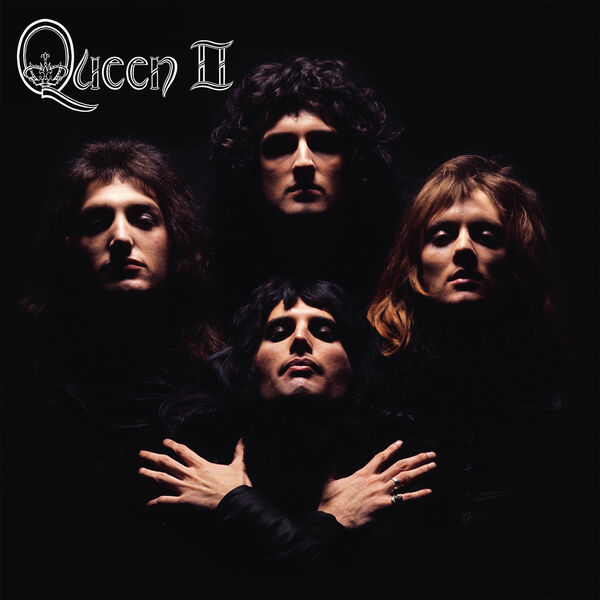
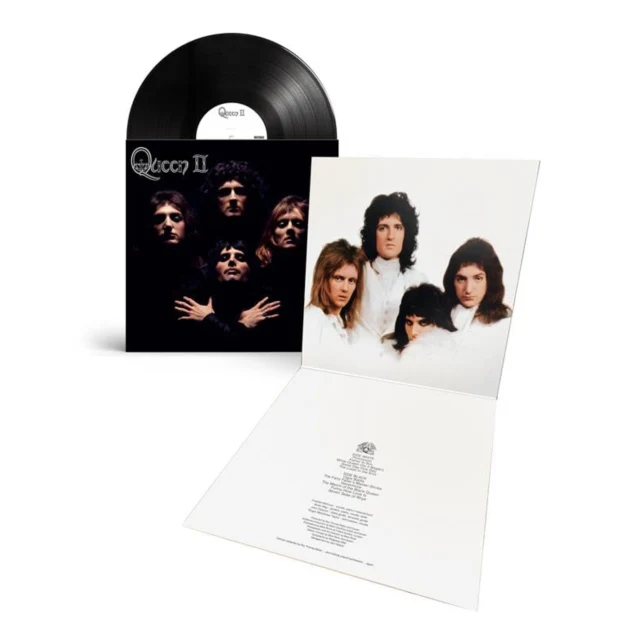
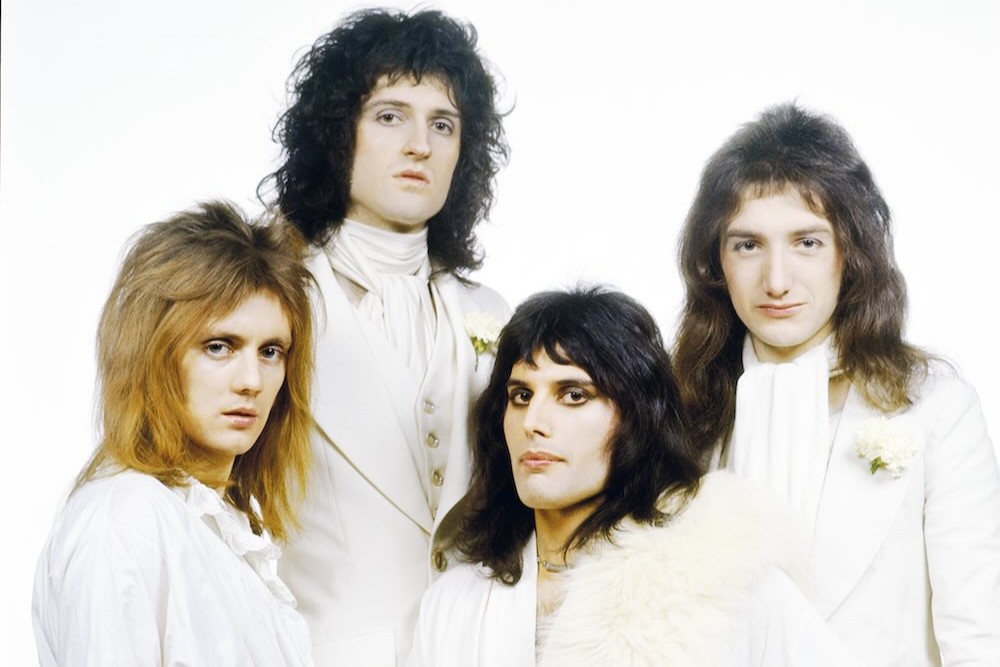
Critics were never favorable disposed towards Queen in the early days, so reviews for Queen II were perplexed at best. Nonetheless, it was the group’s first Top 5 album in the UK and “Seven Seas of Rhye” became the group’s first UK hit. It’s an album that band members look back on with fondness and admiration, and makes for an obvious successor within the current series of Queen remixes that launched in 2024 with Queen I (which you can read about here). Mick Rock’s iconic album cover, inspired by Marlene Dietrich and brought to life in the “Bohemian Rhapsody” music video, looks darker but more effectively captures the chiaroscuro effect. Whereas the cover is striking for its use of darkness and light, the gatefold spread of the members draped in white is a softer-looking contrast. The white/black schtick also integrates itself within the printed inner sleeve and center labels.
One of Queen II’s production trademarks is its use of numerous overdubs to the point that the tape oxide had worn off completely, almost making the album too ahead of its time. The ability to spread each element across a depth-enhanced stereo spectrum is this remix’s ultimate advantage. “The Fairy Feller’s Master Stroke” brings out more harpsichord and reveals guitar licks that were once obscured in the original mix. The acapella falsetto/harmony section of “The March of the Black Queen” never sounded so full and spacious as it does now; arguably one of the finest moments Queen ever laid to tape. These tracks are smoother-sounding and finally have space to breathe.
What sounded like a dense wall of instrumentation on “Father to Son” now comes across as a Brian May guitar orchestra, revealing underlying rhythmic acoustics and harmonized parts that are both singled out and mesh majestically together. Some of May’s guitars provide more crunch, enhancing the metallic element on the grotesque “Ogre Battle.” Roger Taylor’s snare drum sounds slightly tweaked, but the rest of his kit sounds authentic to the original. His fills are more dynamically boisterous, and his kick-drum/crash-cymbal accents are sharp enough to snap the listener’s attention consistently. John Deacon’s bass runs, particularly the ones on “Some Day One Day,” sound more punctual than rounded. The power and gusto in Freddie Mercury’s vocals are magnified to a high degree and draw more focus than before.
The secret sauce that makes this remix of Queen II shine is the Plangent Process. Before Queen’s long-standing audio team of Justin Shirley-Smith, Joshua J. Macrae, and Kris Fredriksson rebuilt this album from scratch, each of the multitracks–including the ones bounced from one reel to another–was fed through Jamie Howarth’s restoration method that fixes flaws that are seeped and locked into analog recordings. The playback results in hearing a given voice/instrument with the clarity akin to hearing it straight off the microphones, which helps magnify many of Queen II’s intricacies. As much as analog purists worship the idea of working via analog materials, this DIGITAL step provides a much clearer representation of what the band and producers/engineers heard in the studio as it was being captured to tape.
The 2024 Queen I remix was an attempt to bring its flawed production value to May and Taylor’s liking. Digitally retouching drums and pitch correcting vocals made it more of an artificial rendering than a fresh approach to a period piece. Although intentions were in good faith, it was a questionable precedent if future releases were approached in the same fashion. Now, this new mix of Queen II proves that a rocky start doesn’t set the tone in perpetuity. If the Plangent Process can be utilized for re-representing Queen’s classic catalog, the effect of hearing these albums for the first time all over again would ultimately be achieved.
Special thanks to Jamie Howarth for his insights while this article was being written, and nobody played synthesizer… again.
BONUS: Back in the 1970's TA editor Michael Fremer cut the national radio spots for Queen's first 3 albums. He also cut a pair for Jackson Browne's 2nd album and others. The 3 Queen spots and 2 Browne spots are in the Soundcloud player below. His British accent was horrible.