


"Spilt Milk" Vinylphyle" Jellyfish Reissue Doesn't Spill Some Mysterious Beans
mysteries abound but the new sound delivers the album on 2.5 sonically crushed sides
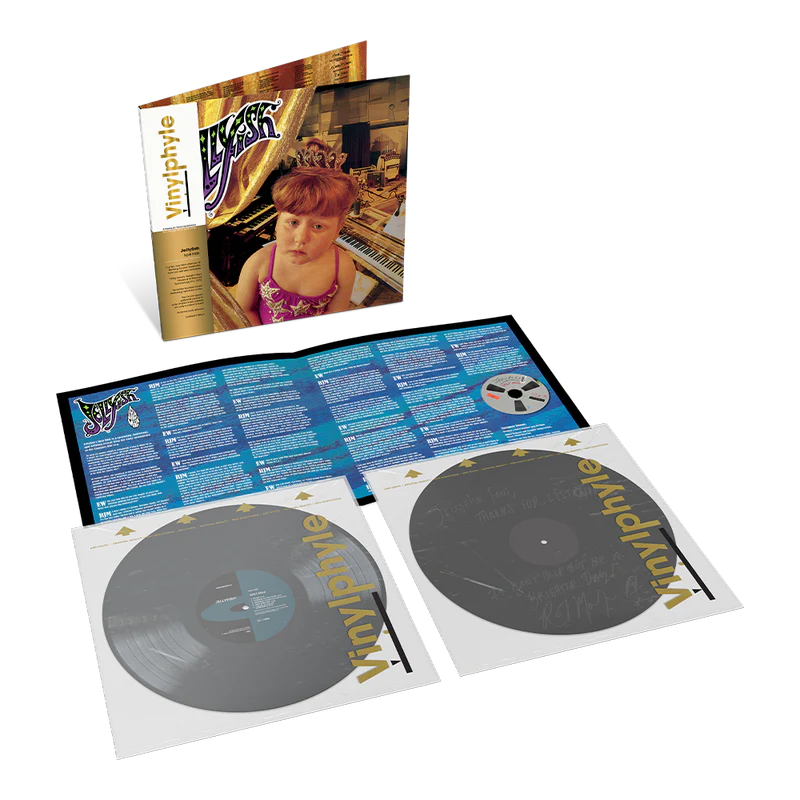
Before getting to the music, here are the mysteries: the first is that though the insert shows the Ampex 499 master tape box in full sized glory with an orange sticker indicating it was baked on July 24th 2017 (as best as I can make the date out) and the 30IPS tapes are fully assembled side A and B reels, this reissue was cut from a high resolution digital file. Why?
The Capitol "UDiscovermusic" website says that all records in the Vinylphyle series are cut from analog tape "unless sequenced analog masters don’t exist". The insert shows that these tapes do exist. I don't have time to go back to the Iron Mountain tour video that I produced and posted but somewhere in that video are Jellyfish master tapes, though as I recall they said the artist was "Beatnik Beatch" changed to "Jellyfish". That would make sense for the first Jellyfish album Bellybutton, because the late Andy Sturmer and Roger Manning had left that band to form Jellyfish. Speaking of Bellybutton, the album was only on vinyl in the U.K. on Charisma (CUSLX3) and cut at Townhouse. It includes two live Wings songs, "Jet" and "Let 'Em In" and I am happy I am to have it!
I have a single disc Omnivore Records Split Milk reissue from 2012 cut at GOLDEN, so I went to Discogs and the listing says John Golden "confirmed" it was cut from that tape marked "Beatnik Beatch" (as "confirmed on the Steve Hoffman Forum" as if that means anything), but it also says on Discogs that "The tape legend says Ocean Way Recording, dated 4-7-1990". Well, that's wrong! The album was recorded in 1992 and mostly at Bill Schnee's studio and some at Ocean Way. But let's assume everything but the date was correct. Perhaps someone confused this album with Bellybutton!
On Discogs and on AcousticSounds I found an earlier Capitol Records single LP Spilt Milk reissue from 2023 claimed to be cut from the "analog master tapes" by Kevin Reeves and pressed at GZ Media. Many complaints there about the cut and pressing. I'd bet it was one of KR's low level fixed pitch cuts, which are another mystery! Why would anyone do that ever?
So here we are with a new Vinyphyle reissue cut from a digital file for undisclosed reasons. If you're going to include full sized tape box images in a reissue like this, you really ought to 'splain why you're showing the tape and then cutting from digital files.
A few interesting funny facts: the tape box is dated October 3, 1992 (which for boomers, for instance is the equivalent timespan to now of 1935 to 1970!). So consider for youngsters today 1992 was in ancient times!
Second funny fact: the tape box misspells the client Charisma Records as "Chrismas Records" and the engineer Jack Joseph Puig as "Jack Joseph Plug" on both tapes! With white out applied both times to "fix" what might have been the correct spelling!
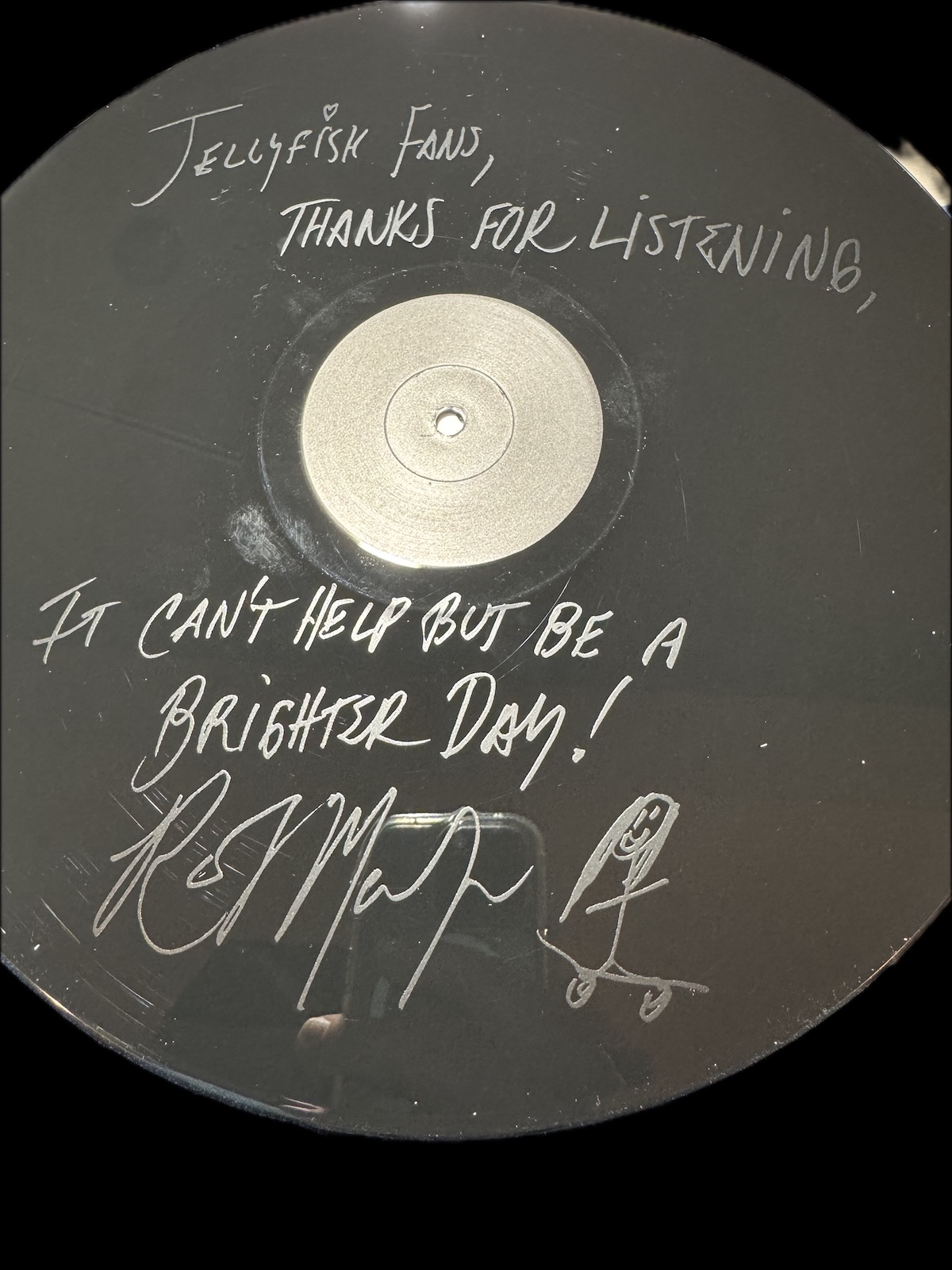
Though it was mastered by the late, great Doug Sax, Spilt Milk also was never released in America on vinyl. So here we have another pass, this time expanded to three sides to give the tracks some breathing room with side 4 being a Roger Joseph Manning, Jr.'s autograph (speaking of time he'll be 60 in a few weeks!).
For those unfamiliar with Spilt Milk, note the cover girl, a sad, little ballerina. Art director Mick Haggerty (Grammy Award for co-creating cover of Supertramp's Breakfast In America) said he was looking for "saddest and most pathetic" looking child they could find to fit the album's theme. Probably the most abusive (though thankfully less revealing) cover since Nirvana's Nevermind.
However, despite Haggerty's identification of a theme here, the subject matter is varied with the songwriting and wordplay on a very high level as you'd expect from musicians steeped in the music of Queen, The Beatles (more to the point, Wings), The Beach Boys (and especially Pet Sounds) and perhaps XTC and some others, and the lyrics of Elvis Costello. Queen will immediately come to mind as you'll hear that group's old timey nostalgic musical character ("Killer Queen" in particular), exploding tight harmonies giving way to near silence—the production genius of the late Roy Thomas Baker—and glints of other artists that Manning and Sturmer admired. But these guys moved all of their influences into new and exciting territory.
Unfortunately, when Spilt Milk was released, rock music had turned hard and grungy and as much as older music critics and label execs championed, and despite the label's best efforts the album flopped on the charts "peaking" at #164. Here's a page from the original press release I kept (in the original Charisma U.K. pressing of Bellybutton since there was no other place to keep it until the Omnivore release):
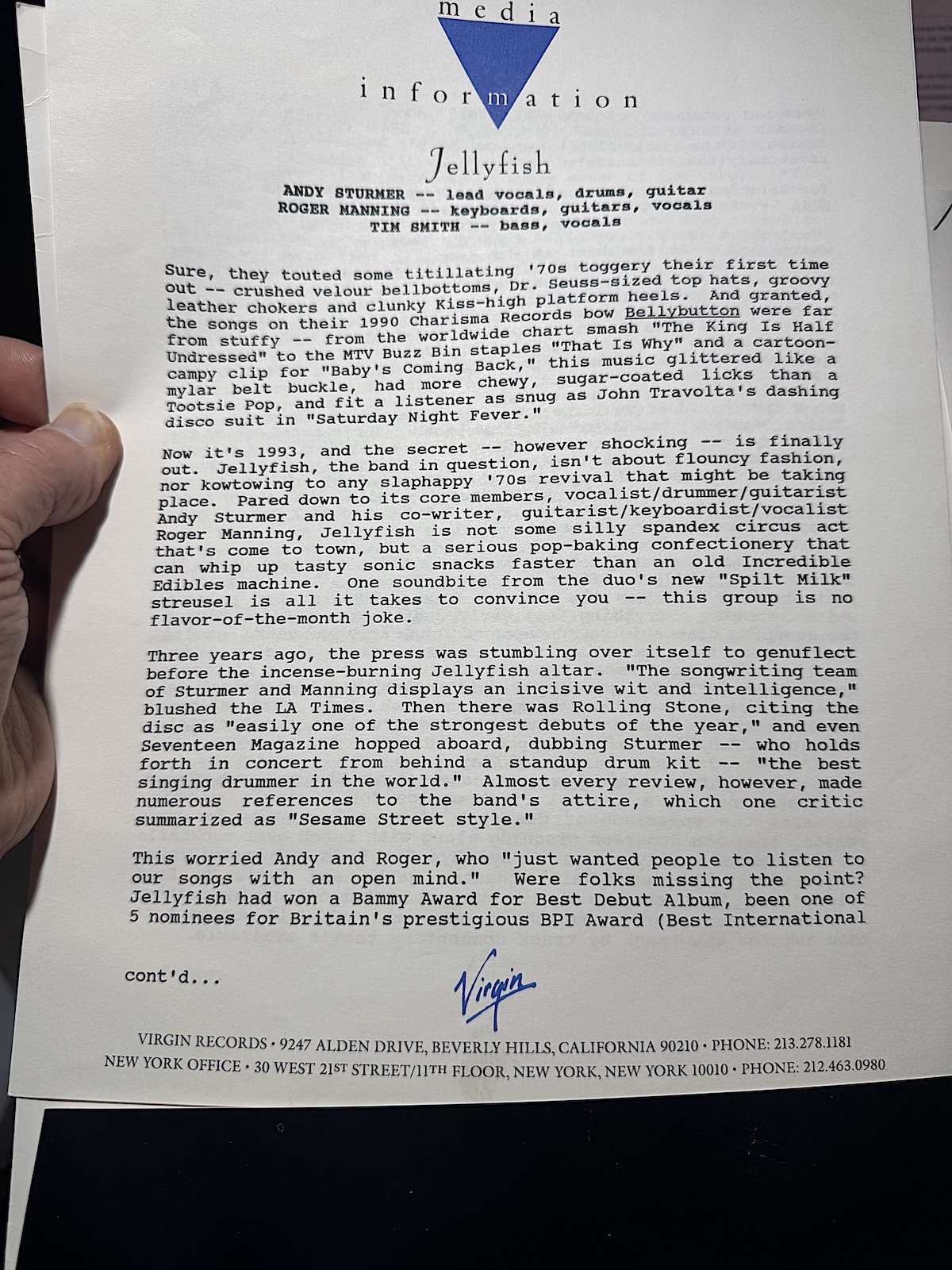
This was back when records came with often well-written and entertaining press releases. That's just the first page. Despite the flop and break up, Jellyfish still has its old fans and new ones come onboard all the time, attracted by the great songwriting and production.
It's too bad the lyrics often get caught up in the sonic bombast, attractive as it is, and unfortunately though the lyrics are included, they are hidden over very busy artwork that looks like either record grooves or french bread. They are worth pursuing as they cover marriage breakup, the ills of stardom and how death sometimes brings previously unobtainable chart success, TV evangelists (very big back then, now we've got mostly Joel Osteen), mistakes (in life), one about the late Sturmer's San Francisco apartment that was too pricey to maintain given how often he was on the road. There's even a song, "Best Friend", written about the songwriting duo's "little buddies", who in my world today is my gay Irish friend Lefty O'Hand if you get the picture. It's the lead off to side 3.
It's really too bad someone didn't unearth this Virgin Records press release and include it here because the dense production sometimes makes picking out individual instruments difficult. In the press release you learn that they took the time to record a real flute, a piccolo and French horn and that on "Bye Bye Bye" Roger says "That's a real accordion, played by this total Italian mafioso bar mitzvah guy named Frankie who played on Pet Sounds and we went for the full ethnic setting...." Andy adds "We definitely wanted to get a polka on the record, get some balalaikas going...."
Perhaps these instruments are difficult to hear because there's a large amount of dynamic compression applied to the mix here that's not on the Omnivore single record, which is far more dynamic, listenable, timbrally colorful and texturally varied. And the bass is so much deeper!
I can only assume Joe Nino-Hernes for some reason chose to crush this in post or someone did in the mystery that is the source of this release. Why didn't they use the tape John Golden used? If you try to crank this VinylPhyle version it gets very unpleasant despite the carefully laid out mix. If you can get past the "wall of compressed sound", what lurks below this version is a musical wonderland that's clearly audible on the Omnivore, which you can crank the crap out of and it only gets better because it's probably a bit too warm and played loudly it perfectly balances out.
The best way to listen here is at low SPLs. The soundstage is still flat, two-dimensional and hangs like a curtain between the speakers but at least that way it's not overly aggressive. There's so much going on, you can listen for years and not hear everything because the blend is so flat. It sounds as if every element was well-recorded, especially drums and vocals and the mix is generally "in the pocket" but the compressional squeeze sabotages it. The Omnivore kills this.
As for the lyrics, they are worth following but that's not easily done over French bread. Now the Internet offers various sites where the lyrics are over solid colors. They are worth reading. The word play is often as ingenious as the music.
As the 35 year old press release says for those who didn't get the band's first release (and it applies equally well to those who haven't gotten it for 35 additional years), ,"Jellyfish is willing to forgive you. Just listen to Spilt Milk with an open mind (i.e., your cerebrum) and a faithful song-sensible heart, and prepare yourself for a breathtaking rollercoaster ride into everything contemporary rock and roll should be".
At the same time you'll probably figure out why the record didn't work first time around for many: the group loads up the songs with so much "stuff" so densely packed, you have to expend a great deal of effort to get through to it and enjoy. For fans it's well worth the effort. So you might want to give it a try. Adding to the pleasures are guitarists Jon Brion and Lyle Workman.
If you love "power pop" or any of the groups references herein, you'll enjoy the music on this record but the sound far less. I'd still like to know why the tape wasn't or couldn't be used and why this "Vinylphyle" edition sounds so flat, hard and unlistenable compared to the Omnivore from tape. This is the first serious miss in this series mastered by Joe Nino-Hernes.