


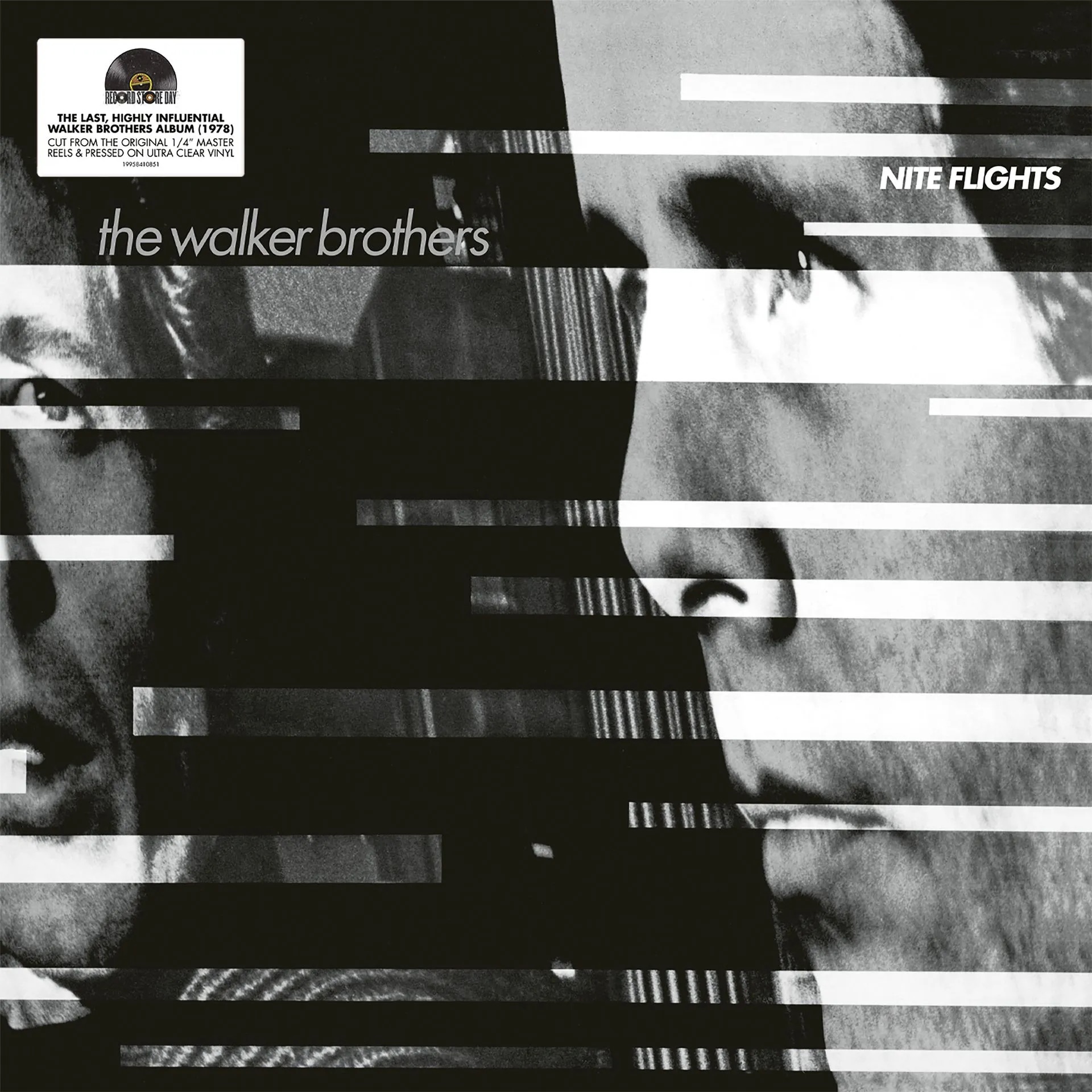
The Walker Brothers’ ‘Nite Flights’ Gets Definitive Reissue For RSD 2026
Four essential Scott Walker tracks outweigh the other guys’ slop
Scott Walker’s career can be divided into two parts: before 1978’s Nite Flights, and after it.
Before Nite Flights, Scott Walker was the Walker Brothers crooner who, after the group’s dissolution, moved onto solo material where he extensively covered Jacques Brel then started writing more of his own songs, as each solo record from 1967’s Scott through 1969’s Scott 4 became more musically sophisticated and lyrically complex. The entirely original Scott 4 is now regarded as one of the greatest records of all time (even if Scott 3 is my favorite), yet it hardly sold upon release and Phillips quickly deleted it from their catalog.
Scott’s label and management figured that his darker and more intellectual original material led to declining sales, so they struck a compromise for 1970’s ’Til The Band Comes In. Scott could include his excellent 10-song suite, as long as he tacked on five MOR covers at the end. And so the downfall began, with Phillips forcing him to churn out more of the MOR slop that made the Walker Brothers famous in the previous decade, all as Scott heavily drank through this artistic and personal crisis. He then moved over to CBS, thinking that they’d let him write his own songs again, but that wasn’t the case. The Walker Brothers (none of them brothers, none of them actually named Walker) reunited in 1975, signed to GTO, released an album and had a UK hit by covering Tom Rush’s “No Regrets,” and followed it with another album that did nothing. By 1978, GTO was about to get absorbed into CBS, so no one paid any attention to what a bygone act like the Walker Brothers would record.
And with that, Scott Walker wrote four songs, his first in eight years, for the Walker Brothers’ final album Nite Flights. In some ways, it represents an art rock-funk path he didn’t end up taking. Yet it also stands as the point where Scott 2.0—the man who made challenging, unconventional, startlingly modern masterpieces like Tilt, The Drift, and Bish Bosch—first emerged. And unfortunately, Nite Flights only has four Scott tracks, and the other guys’ contributions (two from Gary Walker, four by John Walker) absolutely suck. Nite Flights as an album is the musical equivalent to those European anthology films, where a few directors each contribute a short film lasting a reel; one or two contribute something great, another one or two throw in something decent enough, and at least one turns in a shockingly terrible flop. This album is basically a story of three EPs, only one of which is actually worth listening to (and in fact, Scott’s tracks did get a separate EP release once), but the Scott material is some of the greatest music ever recorded. Of course, hardly anyone noticed at the time, and upon its original release, Nite Flights only sold around 3000 copies.
Thankfully, the Scott contributions are concentrated in Nite Flights’ opening stretch. “Shutout” envisions a dystopia over processed guitar wails and a funky bass line placed in a proto-post-punk atmosphere, while “Fat Mama Kick” opens with menacing dissonant sax and a beat driven by metallic ride cymbals and hi-hats, as Scott conjures another dark image: “The gods are gone, the air is thick, you cannot risk the fat fat mama kick/Armed angels walk the city lites, wait inside their master corpses peeled raw, betrayed and fade and fade as the noise goes over and over.” What exactly does it mean? Well, as David Bowie said in the 2006 documentary Scott Walker: 30 Century Man, “I have no idea what he’s singing about, and I never bother to find out, and I’m not really interested.” It sounds lazy, but it’s a fair point, as more than any other writer in “pop” music history, Scott Walker was a writer of images, his lyrics the final form of “show don’t tell,” relying on flashes of details and actions in lieu of much establishing context.
Scott cited Joni Mitchell as an influence around this time, but was clearly also listening to Bowie’s Low and “Heroes”, while Nite Flights then influenced Bowie and Brian Eno making Lodger in Montreux. Bowie also covered the title track from Nite Flights on his 1992 album Black Tie, White Noise, but Scott’s original is so much better, with slide-descending bass and guitar parts and a thin background synth creating an ever-present, tangible anxiety against his ghostly voice and oblique lyrics.
The centerpiece of Nite Flights, and maybe the defining composition of Scott Walker’s entire career, is “The Electrician,” where brutality and eroticism meet in a six-minute song that sounds like the conclusion to pop music (as a formal definition) at large. A slow, discordant spiral into darkness, Scott described it in 1984 as a “political song… having to do with the Americans sending in these people to train torturers in South America, ‘the electrician’ is what it was all about… I imagine these lovers in a conversation.” It starts with dissonant orchestral drones, ominous electric bass plucks, and reverberant feedback. Then Scott sings, then drums come in. The first section of the song tapers off, then the instrumental break brings the most tragically ecstatic string arrangement of all time. No description can do “The Electrician” any sort of justice, so I’ll quote what Eno said in that 2006 Scott Walker documentary: “It’s humiliating to hear this. You just think, ‘Christ, we haven’t gotten any further.’ I just keep hearing all these bands that sound like bloody Roxy Music and Talking Heads. They haven’t got any further than this. It’s a disgrace, really.” It’s true: “The Electrician” is unquestionably one of the greatest musical compositions in human history, and after nearly 50 years, still sounds like it comes from 50 years ahead of now.
If Nite Flights was only the four Scott Walker tracks, it’d be one of the most perfect records ever made, but there are six more songs from the other two Walker Brothers. After “The Electrician” leaves you stunned, you’re blasted with the cheesy 70s TV sax of Gary’s “Death Of Romance,” where he sings like he’s nodding off on benzos at 3am. It’s probably the worst song transition of any album ever, totally laughable in how emotionally jarring it is. The other Gary contribution, “Den Haague,” is slightly less sleepy and has a more coherent vibe, but is about equally dull. The concluding four John Walker tracks are total soft rock slop, and do not even belong in the same galaxy as the Scott compositions. Gary and John’s work significantly weighs down this album’s overall rating, but I cannot stress enough how essential it is to buy Nite Flights, listen to the four Scott tracks, lift the needle before “Death Of Romance” starts, and listen to the Scott tracks again and again. Don’t even bother with side two.
After Nite Flights, the Walker Brothers went on a small UK cabaret tour, ignoring the new material, until it ended one night during a Birmingham residency. Mythology states that an out-of-tune trumpet enraged perfectionist Scott, to where he stormed off and it was all over. Scott Walker never performed live in front of an audience again, instead returning once a decade with increasingly complicated albums that probably never turned a profit, but still sound like nothing else. He died in 2019, his final work being some unrecorded lyrics published in his 2018 anthology book Sundog.
Nite Flights was never originally released in the US, and reissues have been scant over the years. Tizona Records licensed a reissue in 2013 and had it cut by Kevin Gray and pressed at RTI, though that one is long out of print. In 2016, Music On Vinyl reissued it, cut from digital files in-house at Record Industry as usual from them, though that also recently went out of print, and now for Record Store Day 2026, Sony finally reissued it themselves, cut from the original 1/4” master tapes by Henry Rudkins at Pitchcraft in London, and pressed on clear vinyl at Record Industry. Hopefully this means that Sony will start reissuing more LPs cut from tape.
I have the UK original cut at Strawberry, which always sounded tolerable but underwhelming. When I first played this new reissue, my first thought was “wow, the hi-hat sounds 6dB louder than it does on the original.” Indeed, this reissue is much brighter and sharper than the original, and it also has more bass, but instead of sounding like a revisionist modernization, it shows how badly compressed and rolled off the original was. The reissue finally opens up the recording in three dimensions, with deep cavernous space, startling physicality, and precise textural delineation. You can finally hear all of what’s going on in those four Scott tracks. Bass is muscular, vocals are right there, strings actually sound like strings and envelop you rather than overcrowding the other sounds, and the drums no longer sound like cardboard. Yes, it’s bright, but you can turn it up and the huge image remains intact with all the additional detail. This is surely closer to what Scott put on the tape than what the original presents.
The US allocation for this RSD reissue was 1800 copies, but they’re already heavily discounted from many record shops online. Right now it costs only a third as much as the UK original (all of which are in great condition since no one bought or played it back in 1978) which now only holds value as a historical relic. The medium-weight (approximately 150g) ultra clear vinyl Record Industry pressing is flat and quiet, and comes in a polylined sleeve inside a replica of the original gatefold, now printed on thicker stock (still direct-to-board). Overall, this is a definitive pressing of an album with four of the most essential art rock recordings ever, and it belongs in any well-curated collection.




































.png)