
Pink Floyd's 'Wish You Were Here 50' Deluxe Box Set Isn't Perfect
Mostly good, with a few curatorial oversights
Over the last 50 years, enough has been written about Pink Floyd’s Wish You Were Here that I have nothing to add about the original album other than that it’s easily my favorite Pink Floyd album and was the first vinyl LP I ever bought. It’s carefully textured but not too indulgent and meandering, and the lyrics hit the sweet spot between universality and specificity. Never before or after would the band so perfectly achieve this balance, as the earlier stuff can be too ambiguous and indulgent while the later gets too blatantly sophomoric and theatrical.
Crucially, Wish You Were Here 50 is the first Pink Floyd release since Sony fully acquired the band’s recorded catalog. Therefore, reissues can actually come out in a timely manner, rather than getting delayed for three years as David Gilmour and Roger Waters argue over liner notes. While Wish You Were Here already got the super deluxe treatment with the 2011 Immersion box set, the new 50th anniversary goes further to include five previously unreleased studio outtakes (I don’t count the newly-uninterrupted “Shine On You Crazy Diamond” stereo remix as “new”) as well as James Guthrie and Joel Plante’s new Dolby Atmos mix.
After the Atmos listening premiere, I asked if Sony could send me a review copy of the super deluxe box set, which they kindly did. It arrived as standard, sealed North American distribution stock, so no special reviewer treatment.
The Package
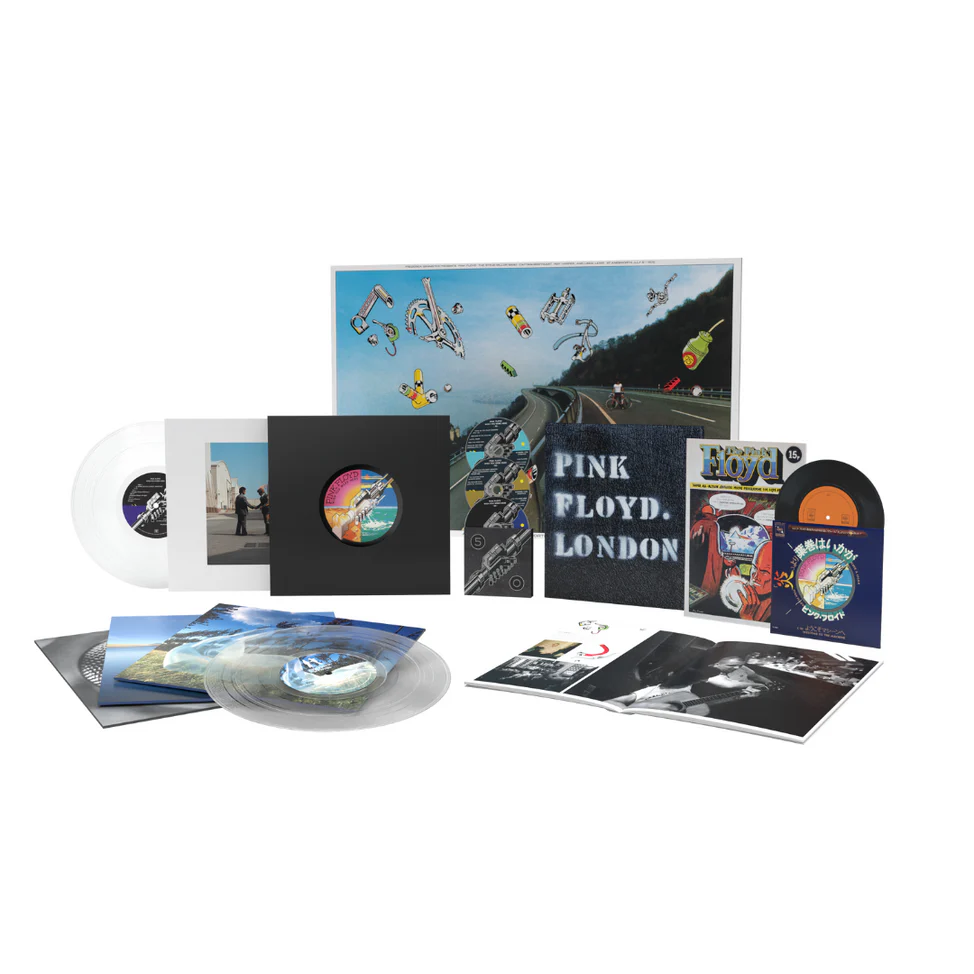
The 50th anniversary Wish You Were Here comes in multiple packages spanning the cost spectrum: remastered 1LP album, expanded 3LP with two LPs of bonus studio material, a 2CD set mirroring the 3LP; a standalone Blu-ray with the aforementioned extras plus Mike Millard’s Los Angeles Sports Arena bootleg recording and three surround mixes (Atmos, 5.1, original quadraphonic) of the core album; and the $250 super deluxe 4LP/2CD/Blu-ray/7” set with all of that and more. There’s also a 2CD/Blu-ray Japanese edition in a 7” mini-LP jacket with a replica Knebworth 1975 poster. Even further beyond that, Blood Records and their filled-records subsidiary Bad World released limited variants pressed from a DMM cut by Hendrik Pauler in Germany.
Unlike the 50th anniversary super deluxe Dark Side Of The Moon, which had more elaborate packaging fluff than actual content, the multi-format Wish You Were Here box set is simpler and more utilitarian. It comes in a die-cut glossy black slipcase with the 64-page hardcover book in front (CDs and Blu-ray in the back of the book) followed by foldover jackets for the four LPs (with printed inner sleeves) and a unipak jacket housing replicas of the “Have A Cigar”/“Welcome To The Machine” Japanese 7”, Knebworth 1975 poster, and comic book tour program. The slipcase design is a neat tribute to the original LP’s black shrink wrap, but it’s extremely susceptible to basic handling scuffs and I question its durability. The book seems too heavy for the slipcase to properly support it, as the box is already creaking under the weight and won’t even independently stand up straight on my shelf. The slipcase size and construction would be fine if it was only holding records, but the book will make it fall apart over time with regular handling. Perhaps the front die-cut weakens the box construction too much.
The 64-page book has plenty of nice photos, though for a significant album in a package costing this much, there should’ve been at least one scholarly essay to contextualize why this album remains so important. Of course we all already know the history, but c’mon, it’s not like there’s any mystery to still maintain. The only real text contributions are a borderline unreadable tribute poem by Simon Armitage and Hipgnosis designer Aubrey Powell’s recounting of the album cover photo shoots, extracted from Through The Prism: Untold Rock Stories from the Hipgnosis Archive. Still, it’s really annoying that there isn’t annotation at least explaining what the bonus material actually is and where those recordings fit into the album’s evolution. Now that Sony owns the catalogue outright and no one has to fight over liner notes, would it really have hurt them to commission a decent historical piece?
The design work throughout the set—all done by Aubrey Powell and StormStudios co-founder Peter Curzon, sometimes building from the late Storm Thorgerson’s unused original concepts—is aesthetically thoughtful, even if it doesn’t all match the original album’s uniquely striking imagery. The original postcard is nowhere to be found (though the image is in the book) and the main album inner sleeve doesn’t have the original die-cuts, though the Knebworth 1975 poster and the comic book tour program are well replicated, wise inclusions. Certainly more appropriate than the marbles and coasters from the 2011 box.
Pressing Quality
There are several manufacturing variations across the multiple configurations. All North American vinyl packages were pressed at GZ Media subsidiary Memphis Record Pressing, while Record Industry pressed European stock of the single LP and 3LP sets. Optimal pressed European copies of the big box set. Meanwhile, the CDs and Blu-ray were glass mastered at Sonopress for all packages around the world (except Japan). Why are there so many different pressings? It’s not like tariffs are supposed to affect records and printed materials. Anyway, my copy is the Memphis Record Pressing variant, which is a total crackle-fest with tons of surface noise and patches of audible non-fill that overpower the music. The box set clear vinyl is a nice reference to the album’s back cover, but it’s very difficult to see defects and there are no poly-lined inner sleeves, which for a $250 box set is unacceptable. If you’re in North America and you want the album remaster and/or bonus material on vinyl, import a European copy. Surely the Optimal and Record Industry pressings are significantly quieter.
The Album Remaster
For the main album, I compared the new 50th anniversary cut to the 2011 Doug Sax cut (also from a hi-res file mastered by James Guthrie and Joel Plante) as well as an early A-1/B-7 Portuguese pressing from UK metal parts cut by Harry Moss (“HTM”) at Abbey Road. I also trekked out to Michael Fremer’s listening cave where we compared those with the 2016 Guthrie/Plante/Grundman remaster and an early 80s Columbia US pressing.
Let’s get this out of the way first: despite being cut by Bernie Grundman from the exact same file (the 2016 192kHz/24bit release and the album files in new digital release measure identically on the Dynamic Range Database), the 50th anniversary vinyl is different from the 2016 vinyl. The new cut is cleaner, more open and transparent, while the 2016 cut tries to add lower midrange richness that isn’t and shouldn’t be there. It’s appealing but the highs sound slightly more veiled on the 2016. I wonder if Grundman either EQ’d the file differently for each cut, or if he significantly upgraded something in his mastering system. Similarly, the 2011 Doug Sax cut has that tube-y, distorted sound—again, appealing but not accurate to the mastered file or the tape. Sax’s 2011 cut makes Wish You Were Here almost sound like a folk rock record in how softened and dried out it is. On ‘Shine On You Crazy Diamond,” the 2011 cut makes David Gilmour’s Stratocaster sound more like a Telecaster, as that lean Strat sound gets clouded up with harmonic distortion. So of the past 15 years of digitally remastered vinyl cuts, the 50th anniversary pressing is the best recent Wish You Were Here. (I fully agree with Malachi's sonic assessments_ed.)
That said, the new pressing doesn’t come close to the fully analog cuts. The 50th anniversary remaster/recut is clean and polite and “not bad” and certainly won’t offend anyone. If you’ve only heard the other digitally remastered pressings, this will be an improvement and you won’t know what you’re missing. Yet of the five copies we compared, the UK-cut Portuguese pressing blows the others out of the water. It has a certain delicacy, spatial expansion, and sonic realism that the digital remasters can’t replicate. Synths are enveloping, cymbals have natural decay and don’t sound brittle, vocals sound like a person singing in the room, dynamic shifts are starker… on the title track’s intro guitar solo, you hear a hand moving on an acoustic guitar, while the new reissue sounds thin, processed, and mechanical, like an approximation of a guitar instead of a real guitar. The 80s US pressing doesn’t have the same image heft and definition as the UK-mastered Portuguese pressing, but it’s more expressive and three-dimensional than the reissue, which sounds antiseptic and scrubbed of character compared to the older analog cuts.
Is it a digital problem? Maybe, but plenty of recent digitally-sourced vinyl has equaled or bested older all-analog pressings. I think it’s more likely that the master tape has lost its sparkle. Tape formulations in the 70s degraded a lot faster than earlier tape stocks, and for an album as popular as Wish You Were Here, the tape has been used a lot. Even a new cut from tape might not be as good as the early UK cuts from a fresh tape.
The Bonus Discs
Some artists’ studio outtakes are endlessly fascinating, whether documenting a song’s many stages of evolution (Bob Dylan, The Beatles, many jazz musicians), or being entirely finished, previously unreleased compositions (Prince). Pink Floyd, however, is not one of those bands; with them, it’s kind of “all or nothing” in that there’s either a finished piece of music (or an alternate version very close to the finished product), or a scrap that barely even resembles a song. They also hardly threw anything away, so whatever they wrote and recorded would eventually be used at some point. As such, Pink Floyd have always been pretty selective about what unreleased studio material left the vault, and the bonus studio recordings on Wish You Were Here 50 are interesting but not revelatory.
The Rarities set starts on side 3 (or tracks 6-8 on the first CD) with three tracks already released on the 2011 Experience and Immersion editions: the alternate “Have A Cigar” with Roger Waters singing, a version of “Wish You Were Here” with French jazz violinist Stéphane Grappelli, and “Wine Glasses,” a piece from the abandoned Household Objects project that was used in “Shine On You Crazy Diamond”’s intro. These tracks are decent, but there’s a clear reason why they’re alternates/outtakes.
Hopefully, anyone who buys one of the Wish You Were Here 50 deluxe editions considers “Shine On You Crazy Diamond” to be Pink Floyd’s crowning achievement (it is), because it makes up about half of the bonus material. First is the 19-minute “early instrumental version rough mix,” which lacks the finished recording’s ambient intro and ending, but is otherwise very similar to the album version. There’s also a new uninterrupted stereo mix of the album version, done as usual by James Guthrie and Joel Plante. It has a richer midrange and is admirably tidy, though sounds a little more compressed and less transparent than the original (the channels are also inexplicably switched on a lot of elements).
Beyond that are two versions of “Welcome To The Machine,” titled “The Machine Song,” and two more versions of the title track. At its core, Roger Waters’ initial demo of “The Machine Song” is an acoustic folk song with electronics on it. His vocal performance is loose, a bit rushed, and too emotionally detached. “The Machine Song (Demo #2, Revisited)” sounds a lot more like the finished song, with more synths and vocal delivery similar to how Gilmour would sing on the album recording. “Wish You Were Here (Take 1)” is, again, very similar to the album take. The arrangement is fundamentally identical though some instrumental sections are stretched out and the guitar solos are different. I love the “Pedal Steel Instrumental Mix” of the song, though it’s merely the album take with the pedal steel finally mixed prominently. Overall, the studio extras reveal how simple these songs really are, and how the album is a product of careful arrangements and studio layering. It also probably doesn’t help that there are only four songs on the original album, so there really isn’t much extra to mine.
The two Rarities LPs sound pretty good, a little better than the main album because most of these mixes are less polished and the tapes haven’t been worn out so much. Still, not exactly demonstration quality recordings.
The Live Recordings
“Exclusive” to the super deluxe box set is the Live At Wembley 1974 LP with live versions of “Shine On You Crazy Diamond” (yes, again) and “You’ve Got To Be Crazy,” which became “Dogs” on Animals. I say “exclusive” in quotation marks because these recordings were already released in the 2011 Experience and Immersion CD sets, along with the Wembley performance of “Raving And Drooling” (later “Sheep”), which is completely absent here. Why? Well including it would’ve made one of the live LP sides half an hour long, but it’s a glaring omission no matter what excuse you make. This is supposed to be a definitive deluxe package—it shouldn’t be missing material that’s already been released on other editions. Anyway, these November 1974 performances find Pink Floyd in absolute top form, even if most fans despise the piecemeal release strategy (The Dark Side Of The Moon from this performance was already released on vinyl for that album’s box set, and the “Echoes” encore is locked in The Early Years CD/DVD/Blu-ray mega box set). The 2011 mix by Andy Jackson and Damon Iddins is serviceable, though it’s not quite as clear as other soundboard/mobile recordings from this era (in general, not specifically Pink Floyd).
No multitrack soundboard recordings exist of the 1975 tour, so on the Blu-ray and streaming/download editions, Sony includes bootlegger Mike Millard’s cassette recording from the Los Angeles Sports Arena on April 26. Millard, equipped with a Nakamichi 500 cassette deck and a pair of AKG 451E condensers, would hide his gear in a wheelchair, pretending to be disabled so he could also get a perfect spot for recording. Steven Wilson edited the dead space between songs and restored/mastered the audio from two different transfers of Millard’s original cassette. While you can find these recordings (and probably those exact flat transfers) on peer-to-peer networks, Wilson did a good job making this sound almost like a professional live album. The performances of the Wish You Were Here and eventually Animals stuff are great, though this Dark Side Of The Moon bores me to tears (sorry, I can’t stand these songs being longer than they already are on the LP) and this “Echoes” meanders too much. I do think that Sony should’ve included the Millard recordings on a couple CDs at least in the super deluxe box, but I suppose it’s nice that they officially released them at all.
The Blu-ray
In the box set and available separately for $27 is a Blu-ray with all the audio content except the Wembley recordings. The original album is presented in 48kHz Dolby Atmos TrueHD 7.1, 96kHz/24bit uncompressed LPCM 5.1, 192kHz/24bit LPCM stereo, and 96kHz/24bit LPCM quadrophonic 4.0. The studio outtakes and Los Angeles bootleg audio are also presented in uncompressed 96/24 LPCM. I don’t have a surround setup so I can’t comment on the surround mixes aside from the Atmos mix I heard at the press event. That said, they should’ve actually released the visualizer that they exclusively showed us, as it’s much better than the basic screensaver slideshow that plays over the Blu-ray audio.
The Blu-ray also has video content: three concert screen films by Gerald Scarfe and a 2000 animated short directed by Storm Thorgerson. Two of the concert screen films are for the early section of “Shine On You Crazy Diamond”—one is a sort of stop-motion piece with a reflecting crystal superimposed over cross-dissolving still photographs, while the other is animated, as is the “Welcome To The Machine” video. The audio on these is 48kHz/24bit 5.1 or 2.0 LPCM.
The full-frame 1.33:1 concert screen films are encoded in 1080i AVC with a bitrate hovering between 20-25Mbps (lower than ideal). Compression and (to a lesser extent) interlacing artifacts are noticeable, and film grain is excessively soft and clumpy. It’s the same master used for the 2011 Immersion box set, and the transfer itself is probably older than that. It certainly looks like a very outdated early/mid-2000s telecine scan. This video content isn’t that important and Sony/Pink Floyd management probably thinks that having it preserved at all is “enough,” but c’mon, no one really wants to watch mediocre scans from 20 years ago. They should’ve done a fresh 2K scan and cleanup. Who knows what surviving elements they have for this stuff, but a new scan would have sharper grain, better frame stability, and it’d be easier to remove the remaining scratches and tram lines. That said, the colors on the existing transfers are pretty good, and blacks are deep and inky on my LG OLED. Despite these being old scans, there’s thankfully no magenta push.
The 6-minute Storm Thorgerson animated short film from 2000 looks like it was made in MS Paint. Charming, with some good visual ideas, though obviously clunky. Some pixelation and scan lines, but that’s what you get from basic computer animation in 2000. The audio (a “megamix” edit of various song snippets) for this one is 48kHz/24bit stereo LPCM.
CD Sound Quality
Did I listen to the CDs all the way through? No, but I put them on for a bit, and they hold up well for CDs. Enough that, despite having the equivalent vinyl and 24bit stream just as accessible, I didn’t rush to turn off the CDs. They’re not as good as the LPs and hi-res files but if you settle for the 2CD WYWH 50, you’ll be satisfied enough.
The 7”
Included in the multi-format box set is a replica of the Japanese “Have A Cigar”/“Welcome To The Machine” 7”. Unlike the LPs all cut by Bernie Grundman, the 7” was cut in-house at whichever plant handled the deluxe box sets, so GZ for my North American copy and Optimal for EU stock. It sounds fine for what it is, better than I expected especially for “Welcome To The Machine” being the full seven minutes. “Have A Cigar” is an edit that simply fades early. The artwork scans aren’t very good but the sleeve is printed on thick stock.
Conclusion
Overall, Wish You Were Here 50 is a super deluxe box set that looks nice on paper/online/in theory, but the more you dive into it, the more the oversights become glaring. The MRP clear vinyl pressing is way too noisy for a $250 premium product, the LP jackets should’ve been thicker (my set arrived with seam splits), and the book should’ve had substantive historical analysis. The general issue is that this set doesn’t communicate a clear curatorial intent; great box sets of classic albums and/or archival material can feel almost monumental, while Wish You Were Here 50 just… exists. Without any annotation, the new studio outtakes/alternates feel rather unceremoniously dumped out there, and I can’t tell if the Millard bootleg was included for its contextual value or merely because Rolling Stone published an article in 2021 saying that Pink Floyd should officially release Millard’s recording of this particular show. Really, it’s hard to know if the contents here were carefully selected and assembled from a wealth of material, or if Sony is scraping the bottom of the barrel.
If you primarily want a great sounding copy of Wish You Were Here, skip this reissue campaign and find a vintage pressing cut in the UK. They’re not terribly expensive as long as you’re not hung up on getting an absolute first pressing with all the packaging extras intact. If you want the bonus material, either get the European pressing of the 3LP set or buy the standalone Blu-ray if you have a Blu-ray player integrated into your hi-fi setup. The vinyl sounds a little bit better than the hi-res files, though the Blu-ray is certainly the best value for money (or you could spend a bit more and get nicer packaging with the Japanese 2CD/Blu-ray edition). As for the exhaustive $250 multi-format deluxe box, it’s overpriced for what it is; if you want it, wait a few months and hopefully the price drops below $200. Having the album in three formats is definitely redundant, though I understand the appeal of wanting a hefty box with a nice photo book sitting on your shelf. At least Wish You Were Here 50 is one of the more substantive imperial-era Pink Floyd reissues, which at this point counts for something.